Treatment of LEA Disease
 Call Kai
 Learn
Learn Practice Test
 Spaced Repetition
 Match
Match Flashcards
 Knowt Play
1/52

There's no tags or description
Looks like no tags are added yet.
Name | Mastery | Learn | Test | Matching | Spaced | Call with Kai | Chat |
|---|
No analytics yet
Send a link to your students to track their progress
53 Terms
Thrombolytic therapy is used to treat…
Extensive acute DVT and acute arterial obstruction by thrombus
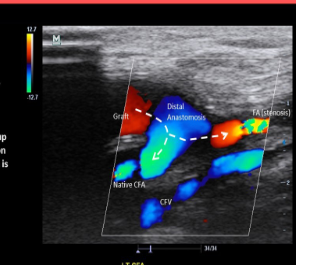
BPG
Provides alternate pathway for blood
Require good inflow, adequate conduit, good outflow
Most common BPGs
Aorto-bifem: used to correct distal aortic stenosis and bilateral iliac stenosis
Fem-Fem: used to correct unilateral iliac stenosis
Fem-pop: used to correct unilateral femoral stenosis
Fem-tib: used to correct distal femoral or pop stenosis
Ax-fem: Least common; used to bypass multiple sites of stenosis, diseased aorta or those who cannot undergo aorto-bifem or fem-fem procedures
Synthetic grafts
Dacron - synthetic polyester; walls of graft demonstrate SAWTOOTH pattern (not smooth)
Gore-Tex - PTFE; also known as Teflon; demonstrate a double layer wall
All synthetic grafts should demonstrate uniform diameter
Abnormal BGP velocity criteria
<40cm/s at ANY segment in graft
2:1 increase in PSV between two segments or at anastomosis indicates 50% diameter erduction
4:1 increase in PSV between two segments or at an anastomosis indicates >75% diameter reduction (>400cm/s = >75% stenosis)
Abnormal ABI indicated by a DECREASE of >0.15 from last exam
Change from triphasic to biphasic
Complications of BPG
Early graft failure in the first month is due to ERRORS in placement/attachment or graft material malfunction
Reperfusion of the leg via BPG can lead to the acute onset of anterior compartment syndrome
Re-stenosis caused by MYOINTIMAL HYPERPLASIA usually occurs in the first 2 years after placement
Re-stenosis caused by ATHEROSCLEROSIS occurs in grafts that are more than 2 years old
Leakage and rupture
Thrombosis
Aneurysm - seen in mature grafts
Vein grafts
Native vein >3mm is preferred, but 2mm and up can be used
Used for extremity, coronary or dialysis graft
GSV, Cephalic, Basilic and SSV commonly used for a vein graft
Pre-Op evaluation:
Pt in reverse trendelenburg
R/o the presence of thrombus
Measure the diameter of vein in multiple locations from upper thigh to lower calf
Reversed saphenous graft
Vein removed and placed in new position in leg
Branches must be ligated
Valves remain and stay OPEN due to gravity
Vein is rotated so the SMALLER more distal end of the native vein is attached above the stenosis and the LARGER more proximal end of the native vein is attached below the stenosis
Smaller diameters end located proximally, larger diameter end located distally
Flow velocities are usually elevated in the now smaller proximal portion and stenosis of the proximal anastomosis is the MOST COMMON complication of…
Reversed saphenous graft
In-Situ vein graft
GSV NOT harvest prior to use
It is detached from the venous system and connected to the diseased artery adjacent to it
Prox GSV connected to the artery proximal to stenosis and distal GSV is connected to the artery distal to stenosis
VALVES MUST BE DESTROYED (can cause stenosis if they remain)
Branches and perforators must be ligated
Most common complication of In-Situ vein graft
AV fistula (b/c branches were not ligated)
Abnormal vein graft criteria
Vein grafts will demonstrate mild thickening of the intima and a nonuniform diameter
In-situ grafts should be evaluated for valve remnants that can cause stenosis and patent branches that can cause AV fistula formation
Reversed vein grafts should be evaluated for patent branches that can cause AV fistula formation
Velocity ratio is the best indicator of graft stenosis; PSV at stenosis divided by the PSV just proximal to stenosis
Abnormal venous graft flow
Decrease in PSV >30cm/s from last exam
Decrease in ABI by more than 0.15 from last exam
Normal venous graft velocity
60-70cm/s
Radial artery
Used as coronary graft instead of saphenous veins b/c it has thicker walls and is similar to coronary artery in caliber
Must test for ulnar artery patency prior to removal (Allen test)
Internal mammary artery
AKA internal thoracic artery
Originates from subclavian artery
Used in TRAM flap breast reconstruction and as coronary graft for left anterior descending artery
Epigastric artery
Superior EA originates from the internal mammary artery and shares anastomosis with the inferior EA
Inferior EA originates from the external iliac artery
Both vessels supply the rectus abdominis muscle that is used in TRAP flap procedure for breast reconstruction
Evaluated to locate the section of muscle with the best perfusion for surgery
PVR amplitude should increase by 50% or more after…
Revascularization
Dampened PVR or PPG waveforms and reduced ankle/foot pressures indicates…
Failure of the BPG
Transducers should be sterilized by soaking them in alcohol for ___________ prior to procedure
30 mins
If an ABI is performed too soon after a procedure for a graft, what can be seen
Artifacts produced by air in the patch or graft
Can inhibit exam
Monophasic flow with increased diastolic flow may still be identified in the first two months after the graft procedure due to …
Reactive hyperemia
Causes of graft failure <30 days post-op
Technical issues cause failure; improper suture placement, stricture or kinking
Thrombosis is the MOST COMMON cause of acute arterial BPG stenosis/occlusion
1-24 months post op causes of graft failure
Valve stenosis or partial valve remnant in venous graft
Myointimal hyperplasia; MOST COMMON cause of chronic BPG stenosis/occlusion; anastomosis sites are #1 SITE OF GRAFT STENOSIS, related to “over healing” of anast
>24 month causes of graft failure
Usually caused by progression of atherosclerotic disease; less common cause of failure than myointimal hyperplasia
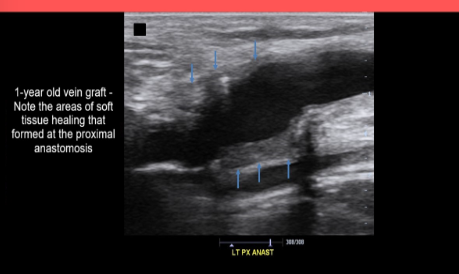
Myointimal hyperplasia of graft
Lower extremity arterial stent eval: <50% stenosis
PSV <180cm/s
Velocity ratio <2.5
Tibial artery velocity >50cm/s
Lower extremity arterial stent eval: 50-70% stenosis
PSV >180cm/s
Velocity ratio >2.5
Tibial artery velocity: <30cm/s
Lower extremity arterial stent eval: >70% stenosis
PSV >300cm/s
Velocity ratio >3.5
Tibial artery velocity <30cm/s
Criteria for synthetic grafts: Normal
PSV <150cm/s
Distal PSV/Prox PSV <1.5
Criteria for synthetic grafts: <49%
PSV: 150-200cm/s
Distal PSV/Prox PSV 1.5-2.0
Criteria for synthetic grafts: 50-75%
PSV 200-400cm/s
Distal PSV/Prox PSV 2.0-4.0
Criteria for synthetic grafts: >75%
PSV >400cm/s
Distal PSV/Prox PSV >4.0
Criteria for vein graft: Normal
PSV <125cm/s
Distal PSV/Prox PSV <1.4
Criteria for vein graft: <49%
PSV 125-180cm/s
Distal PSV/Prox PSV 1.5-2.4
Criteria for vein graft: 50-75%
PSV 180-300cm/s
Distal PSV/Prox PSV 2.5-4.0
Criteria for vein graft: >75%
PSV >300cm/s
Distal PSV/Prox PSV >4.0
Percutaneous transluminal angioplasty (PTLA)/Balloon angio
Balloon tipped catheter inserted into a stenosed artery
Balloon expanded to compress the atherosclerosis and increase the lumen size
Can also be used to deploy a stent
Anticoagulant therapy should be discontinued prior to procedure
Stents are made of Nitinol and are very ECHOGENIC
During procedure, Doppler PTA, DPA or Pero arteries
Use Doppler US to assess stent patency and stenosis
Post PTFE/Angioplasty procedure ultrasound
ABI greater than 0.9 and/or increase of at least 0.25 in the ABI from pre-procedure levels
Eval artery from a few centimeters above the treated area to a few centimeters below treated area
Eval inflow → AT <180cm/s
Eval PTLA site for thombus
PSV <180cm/s and >40 PI
Less than 2.0 velocity ratio
Decrease in PI from treated segments indicated distal disease
Angioplasty failure
Dampened, low-velocity waveforms in the distal arterial tree, no change in post-procedure ABI
Most common cause of restenosis within 1 year of an angioplasty or atherectomy
Myointimal hyperplasia
Intravascular ultrasound
Catheter contains transducer array with multiple elements to provide a circumferential view
Average frequency → 20-40MHz
Can be used to guide procedure or eval stent position after placement
Allows for contrast eval of lumen characteristics as the angio is performed
US guided thrombin injection
Used to treat pseudos
CANNOT be performed on pts on anticoagulant therapy or an associated AVF
Document baseline pedal pulses with Doppler and/or baseline ABIs
Color should not be performed during the procedure
US beam should be PERPENDICULAR to the needle
Thrombin injection should be FAR from NECK
Thrombosis should begin immediately
Re-evaluate pseudo 20-30mins after procedure to confirm pseudo is closed
No change in ABI pre and post procedure
Eval native artery to confirm thrombin did not enter the artery
US guided compression of pseudo
Compression techniques applied to close the stalk and stop the flow
Compression performed io 10 one-min intervals with a re-evaluation of flow with color Doppler after each compression interval
For arterial disease intervention, what pts prep instructions must be provided to the pt?
Requires cessation of anticoagulant therapies
A fem-pop bypass graft is used to treat:
Unilateral distal femoral artery disease
A kissing stent would be used to correct:
Bilateral iliac stenosis
How is the stenosis estimated in a synthetic bypass graft?
Compare the velocities obtained as you move the Doppler cursor through the graft
What is the most common complication of a reversed vein graft?
Stenosis at the proximal anastomosis
What are complications seen in an in-situ vein graft that are not commonly seen with reversed vein grafts?
AV fistula in retained tributaries
Thrombus formation around retained valve cusps
Stenosis formation around retained valve cusps
How is the velocity ratio calculated to evaluate graft patency?
Divide the velocity at the stenosis by the velocity proximal to the stenosis
Whish of the following is a sign of a successful angioplasty procedure on the femoral artery?
A drop in ABI value >0.15
An acceleration time greater than 200ms in the common femoral artery
A velocity ratio <2.0
All of the above
A velocity ratio <2.0
A post-procedure exam following thrombin injection is performed to:
Confirm the thrombus formation within the body of the pseudo, the absence of thrombus formation in the feeding artery, and normal flow pattern and velocity in the feeding artery