NR 416 Midterm
 Call Kai
 Learn
Learn Practice Test
 Spaced Repetition
 Match
Match Flashcards
 Knowt Play
1/69

There's no tags or description
Looks like no tags are added yet.
Name | Mastery | Learn | Test | Matching | Spaced | Call with Kai | Chat |
|---|
No analytics yet
Send a link to your students to track their progress
70 Terms
What is planning
process of identifying, predicting, evaluating, and mitigating the effects of proposed development before any actions
Why is planning important
it improves economic development while safeguarding the public and ecological health/saftey
Key Planning Tools (3)
General Plans
Zoning
Permits
3 Main Components of EIA
Description of the affected environment (existing/baseline conditions)
Prediction of impacts (how will environmental resources be impacted)
Impact Mitigation (actions for mitigating impacts of proposed project)
“The Environment”
made up of:
the natural environment
the built environment
the health environment
Main parts of natural environment
water(hydrology, water supply)
biological(wildlife, plants, habitats)
geology(soils, hazards)
Main parts of built environment
traffic/transportation
noise
land use conflict
utilities/public services
main parts of health environment
damage from natural disasters
risk of exposure to hazardous materials
risk of contracting diseases
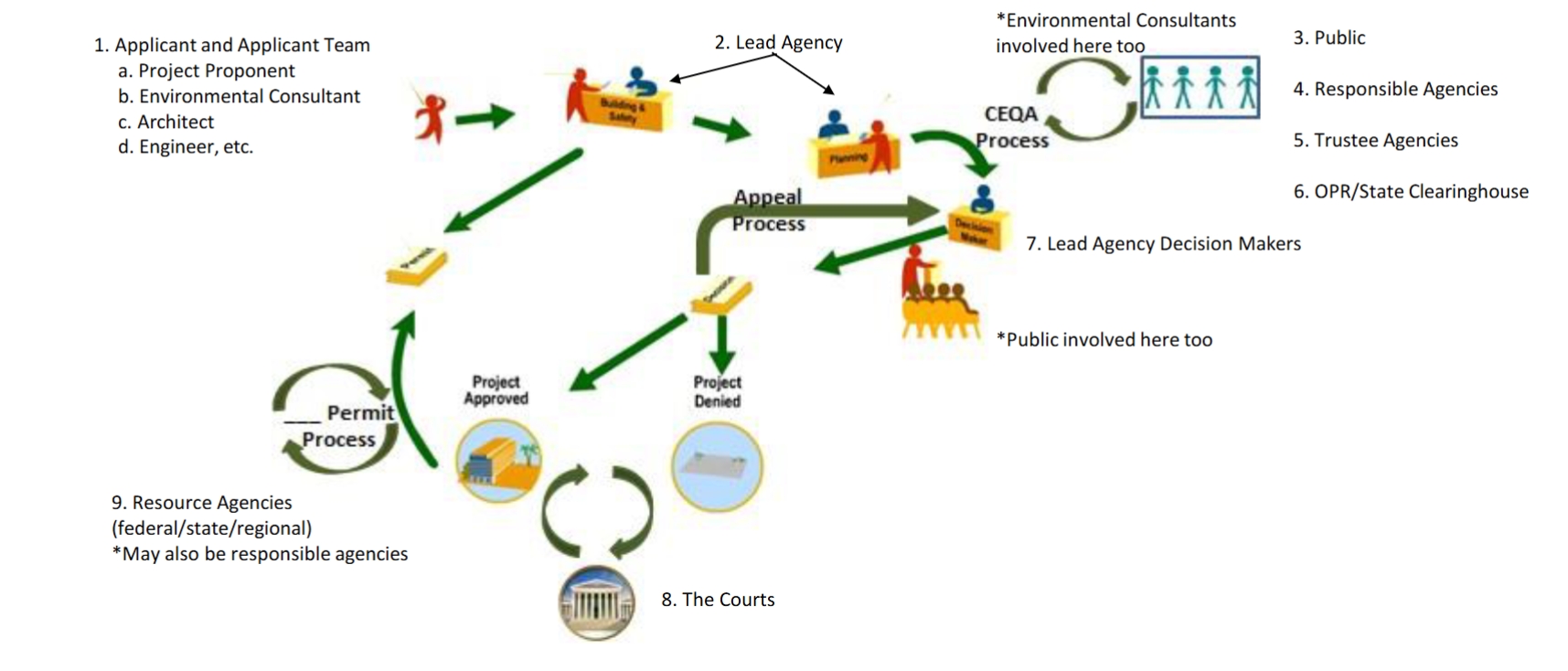
Land-use Permitting Process
project proposal
agency review
environmental review
public review/input
lead agency decision
permit/approvals
Key Participants in Process
Applicant, lead agency, trustee agency, responsible agency, public, courts, environmental consultants, other resource agencies
CEQA Objectives
disclose agency decision-making
disclose environmental impacts
avoid/reduce environmental impacts
enhance public participation
foster intergovernmental coordination
Public vs Private projects
Public: CEQA applies to all public projects and is often funded through taxes. ex) highway construction
Private: only applies if it requires governmental approval, self-funded
Discretionary vs Ministerial Permits
Discretionary: Agency has judgment/decision-making authority. ex)rezoning
Ministerial: Agency follows fixed rules with NO judgment. ex) standard building permit
Define Project
whole of an action” that has potential for a direct physical change or foreseeable indirect physical change in the environment
CEQA Phases 1-4
Preliminary Review
Initial Study
ND/MND or EIR
Decision Document
CEQA Directives allow agencies to:
require project changes
disapprove projects
approve projects
impose fees
Phase 1: Preliminary Review
is the activity under definition of a project?
general rule exemption?
statutory exemption?
categorical exemption?
exception to exemption?
Notice of exemption
Tiering? → substantial conformity or MND
General Rule Exemption
certainty that there is no possibility of significant impacts → rare
Statutory Exemption
Exempt by the legislature, it could have significant impacts but the benefits outweigh the necessity of going through CEQA
Categorical Exemption
Broad categories (classes) that have minimal environmental impacts
if house burned down and want to rebuild in the same exact place and exact same size
Categorical exemption Exceptions
possibility of impacts due to unusual circumstances
Cumulative impacts would be significant
affects sensitive ecosystems and scenic resources
Notice of exemption
brief project description, evidence and reasoning, limits legal challenges
Phase 2: Initial Study Contents
project description
defining environmental setting & baseline
potential impacts and their significance
Recommended mitigation efforts
names of preparers
What does the initial study do
asks if impacts occur, are they significant, and can mitigation reduce impacts
Initial Study Outcomes
ND: no significant impacts
MND: significant impacts can be mitigated below a significant threshold
EIR: evidence that significant unavoidable impacts may occur
Initial Study Format
no specific process requires by CEQA
no naked checklists → need substantial evidence to support impact reasoning
based on appendix G w/ lead agency modifications
Aesthetics Sub-issues
visual character impacts
light/glare
Air quality sub-issues
emissions/pollution
odor impacts
Biological Resources sub-impacts
listed species
wetland/habitat loss
Transportation sub-issues
traffic congestion
emergency access
2 types of initial studies
significant impacts known
significant impacts unknown
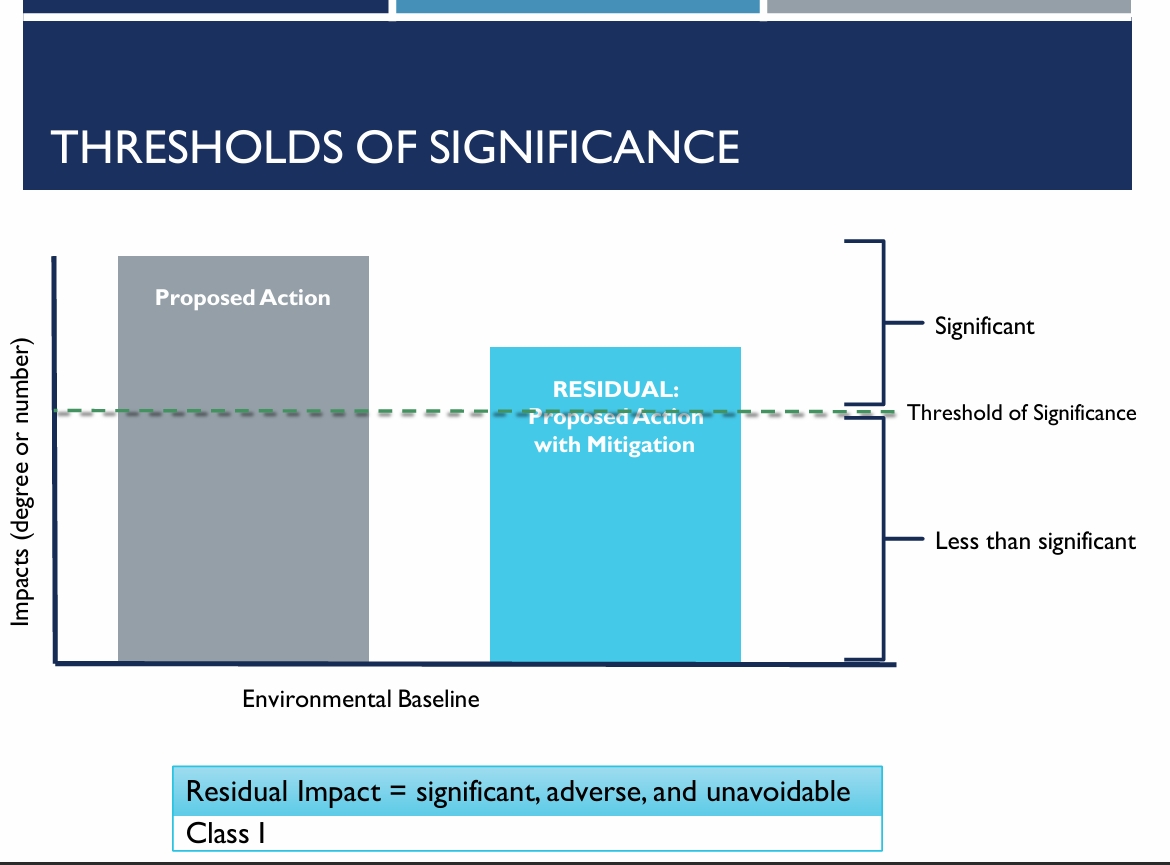
Environmental Baseline
Temporal, functional, and spatial dimension
Threshold of Significance Class 1
Types of Environmental Impacts (4)
direct - from a project same place and time
indirect - from a project at a different place and time
growth inducing - removes obstacles for economic/population growth
cummulative - 2 or more effects when put together are significant
Short-term - Construction impacts.
Long-term - operational impacts; traffic
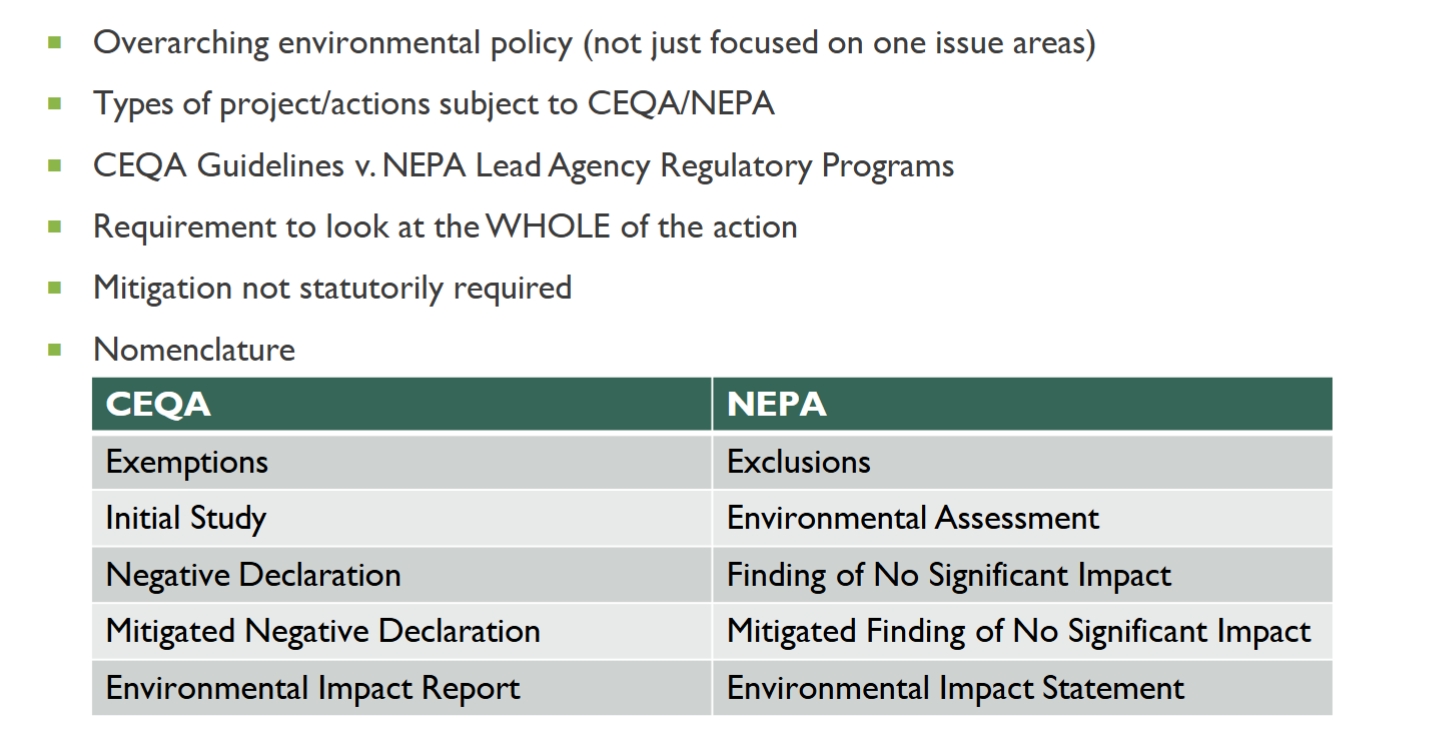
CEQA vs NEPA
1972 Friends of Mammoth v Board of Supervisors of Mono County
extended CEQA’s reach beyond just public projects to also include private projects requiring government permit
2015 Keep Our Mountains Quiet v County of Santa Clara
The court held that relevant personal observations can qualify as substantial evidence under CEQA.
Pure speculation or unsupported opinions are not substantial evidence.
Lead Agency vs Trusty Agency vs Responsible Agency
Lead agency: carry out/approve project
Trusty Agency: protect natural resources held in trust, can become a responsible agency if needed(CDFW, CA State Parks, CA State Lands Commission, U.C. System)
Responsible Agency: has approval power over some of the project, issues their own permits, relies on lead agency document
CEQA achieves its objectives through
Environmental review
Public disclosure
Mitigation
Alternatives
5 potential outcomes of tiering
No Review
Addendum
ND
MND
Supplemental EIR
EIR Process
Initiation → NOP, preliminary PD, initial study, scoping
Preparation → Draft EIR, public review, NOC/NOA, public hearings
Finalization → Final EIR, changes to documents, response to comments, NOD (decision making document)
What does an EIR do
Informs decision makers and public about: Significant impacts, Mitigation/Alternatives
Demonstrates to the public the enviornment is being protected
Ensure political accountability by disclosing to public
Recirculation
Only if new significant information is added after draft EIR is available for public review
new significant impact
increase in severity of an impact unless mitigation is adopted
different mitigation/alternative was declined
inadequate draft EIR
Differences between MND/EIR
ND/MND
No significant impacts after mitigation
Simpler process
No alternatives analysis
No response to comments required
EIR
Significant impacts possible
More detailed
Alternatives required
response to comments required
Required Contents for ND/MND
Project description
Initial Study
Mitigation measures
Findings of no significant impact
Tiering
Using a broader environmental document to support later, more specific reviews.
Required Contents of an EIR
Executive Summary
Project Description
Environmental Baseline
Environmental Impact Analysis
Cumulative and Growth Inducing Impacts
Alternatives Analysis
Different notices
NOP → Notice of Preparation: Starts EIR process.
NOA → Notice of Availability: Draft EIR available for review.
NOC → Notice of Completion: Sent to State Clearinghouse.
NOD → Notice of Determination: Filed after project approval.
Summary importance, purpose, key contents
Most important, often the most people read. Has to be thorough and it summarized the project, impacts, mitigation, alternatives.
Project Objectives importance/purpose
Define project purpose and guide alternatives analysis
must be accurate, stable, and complete
Can environmental baseline be Historical or Future?
Yes, in unusual circumstances but existing conditions are generally preferred.
Examples:
Temporary conditions
Ongoing environmental trends
Threshold of Significance class 2
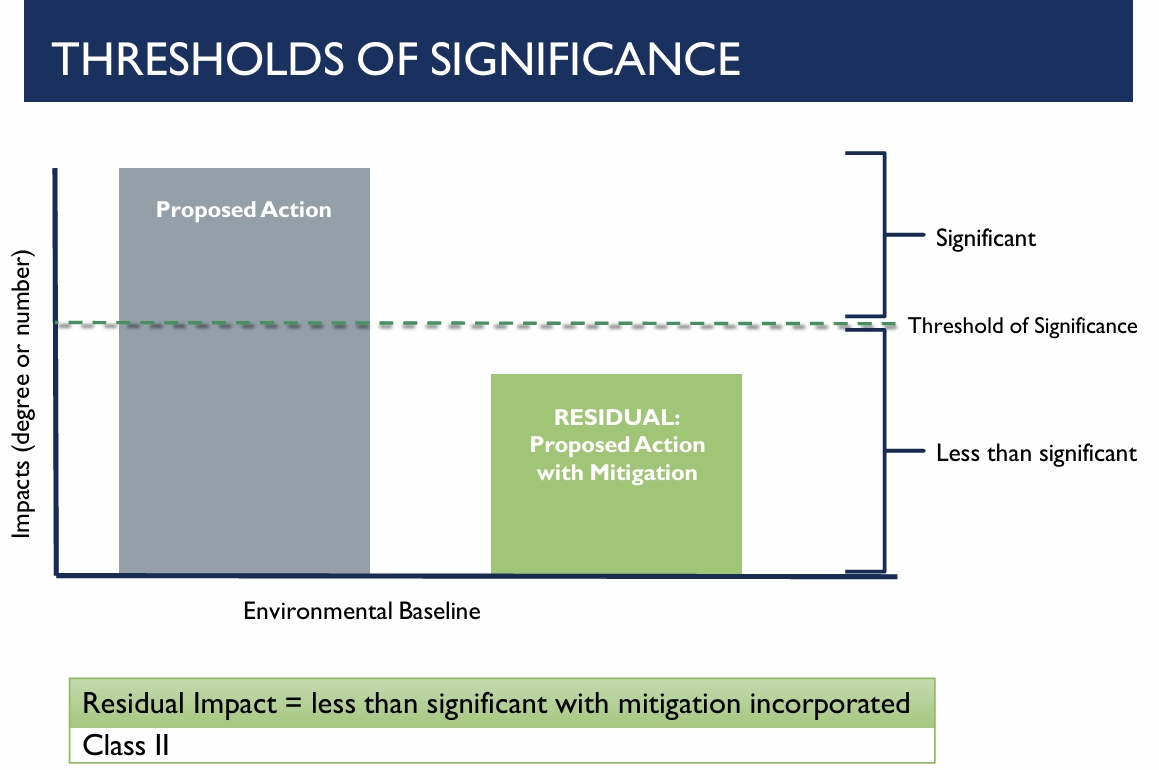
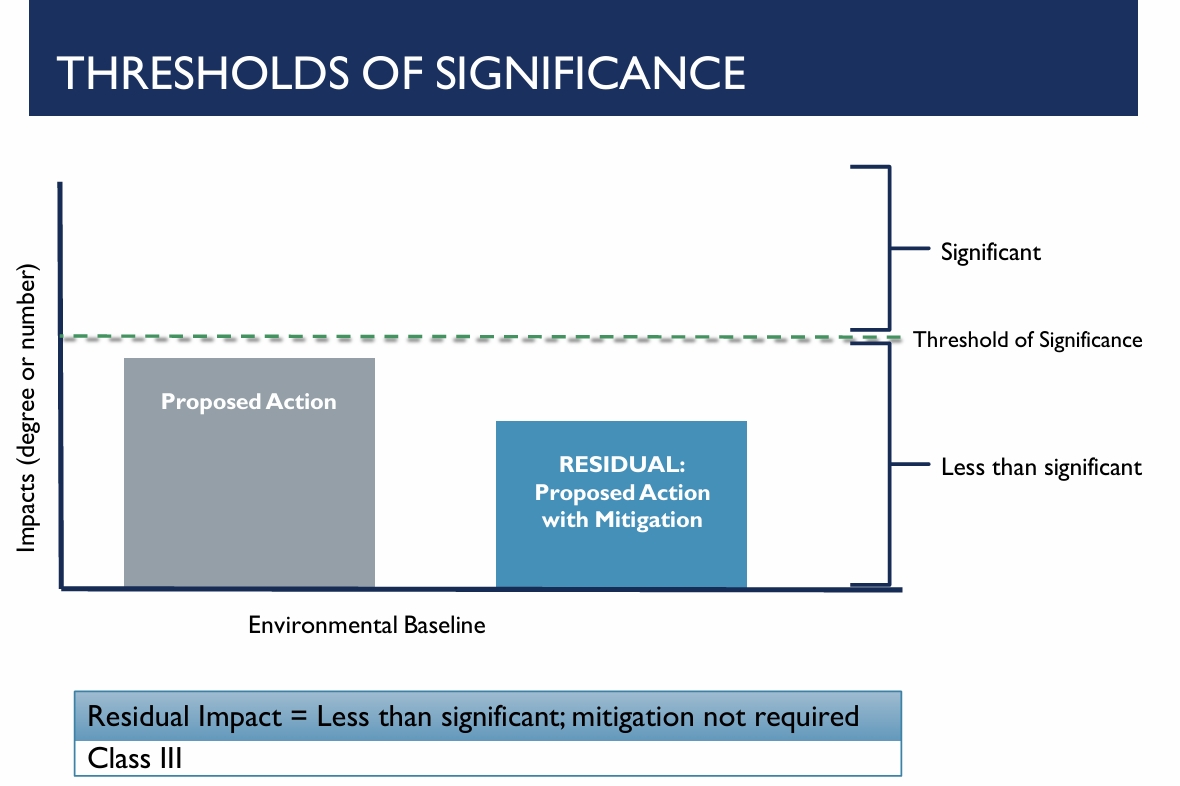
Threshold of Significance class 3
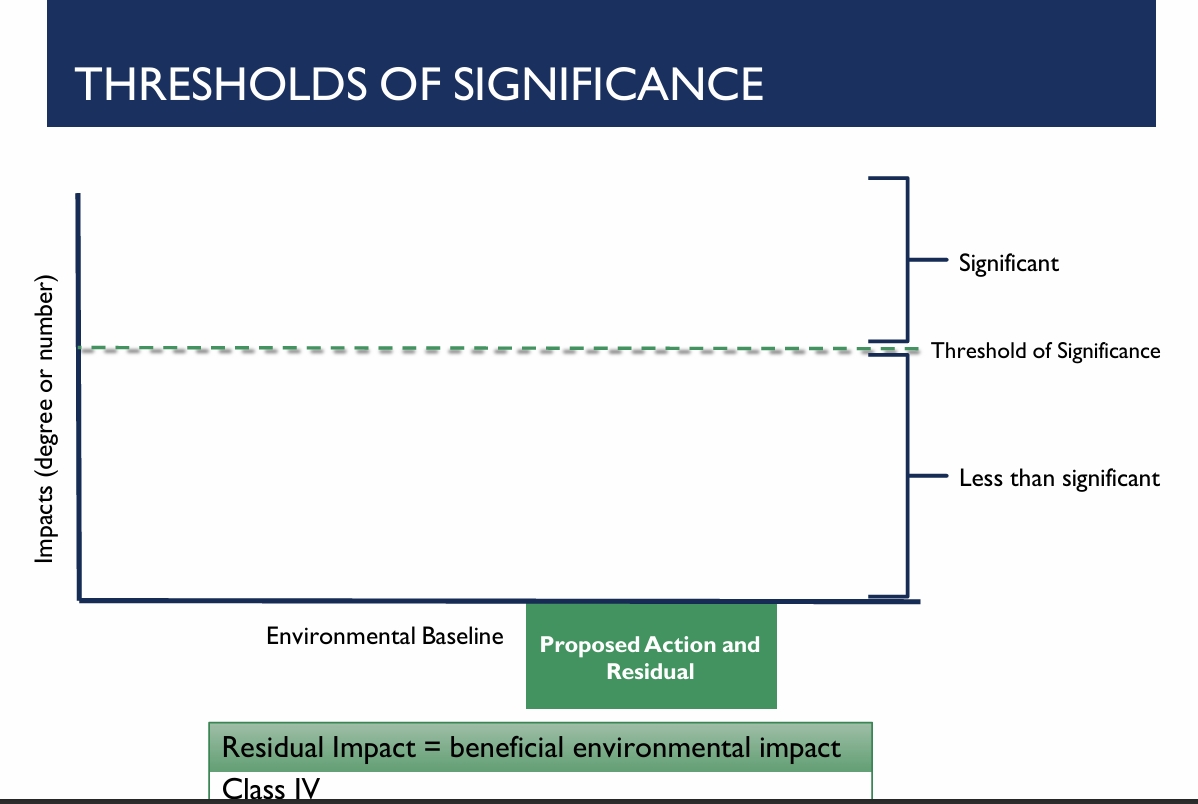
Threshold of Significance class 4
beneficial
List v. projection approach for cummulative impacts
List Approach: Known projects→ past, present, and future, how they contribute to same cumulative impact
Projection Approach: Regional predictions/trends
alternatives analysis
Find ways to reduce impacts while meeting project objectives. must be effective, feasible, and enforceable (for mitigations too)
No Project Alternative =
Assumes project not built.
Required in every EIR.
Is the No Project Alternative always the same as the environmental baseline?
no because no project alternative is done after the environmental baseline which means they could be different conditions
Mitigation Hierarchy
avoidance → most efficient, least costly by avoiding impact all together
minimization → minimize impacts by limiting the degree of its implementation
Rectify → Repair, restore, or rehabilitate the affected environment after an impact has occurred as close to its original condition
Reduce or Eliminate → reduce the severity of an impact through ongoing maintenance, management, monitoring, lessening impacts over time
compensation → most costly; compensating for impact by replacing or providing substitute resources or environments (in-ind & in-lieu)
5 Considerations for effective mitigation measures
Specific
Feasible
Effective
Enforceable
Measurable
Nollon v CCC
Essential nexus between impact and mitigation
Mitigation must address project impact.
Dolan v City of Tigrad
Mitigation must be proportional to impact.
Mitigation Deferral: Proper v Improper
Proper: Performance standard identified. Future details can be developed.
Improper: Promise to create mitigation later without standards.
Mitigation monitoring
ensure proper implementation
provide feedback on mitigation effectiveness
allow for adaptive management
provide learning opportunities for future projects
identify need for enforcement action to prevent environmental damage
MMRP
Mitigation Monitoring and Reporting Program:
to report or monitor any changes to project or conditions of approval in order to avoid significant effects. Designed to ensure compliance during project implementation and usually adopted at the time of certification of final EIR
Environmentally superior alternative to no project
comparative matrix to support conclusions in another ESA
Adaptive Management
Monitoring results are used to modify management actions if needed.
Statement of Overriding Considerations (SOC)
Required when significant unavoidable impacts remain.
Agency explains why benefits outweigh impacts.
CDFW CEQA Fee
Paid when project approved and CEQA review completed.
How many days is each EIR phase
Initiation: 30 days after NOP to review and comment on it
Preparation: 45 days draft EIR review
Finalization: written response to commenting agencies 10 days before certification.
NOD: filed 5 days from approval