Diseases of Peripheral Nerve & NMJ
 Call Kai
 Learn
Learn Practice Test
 Spaced Repetition
 Match
Match Flashcards
 Knowt Play
1/24

There's no tags or description
Looks like no tags are added yet.
Name | Mastery | Learn | Test | Matching | Spaced | Call with Kai | Chat |
|---|
No analytics yet
Send a link to your students to track their progress
25 Terms
List the different types of Peripheral Nerve Injury

List the:
Demyelinating neuropathies
Axonal neuropathies
Neuronopathies
Demyelinating Neuropathies
Guillain-Barré syndrome
CIDP
CMTI
Dejerine-Sottas disease (CMT3)
Axonal Neuropathies
Diabetic neuropathy
Toxic neuropathies
Alcoholic neuropathy
Nutritional neuropathies
Metabolic neuropathies
Paraneoplastic neuropathies
CMT2
Neuronopathies
Herpes zoster
Paraneoplastic Sensory Neuronopathy
Toxic Neuronopathy
Amyotrophic Lateral Sclerosis
Describe Acute Inflammatory Demyelinating Polyradiculoneuropathy
AKA
Clinical Characteristics
Predisposing conditions
MOA
Treatment
Prognosis
AKA:
(Guillain- Barré Syndrome)
Clinical Characteristics:
ascending paralysis -> respiratory muscles
Sensory & autonomic involvement
peripheral nerves + spinal nerve roots inflammation w/ mononuclear cells infiltration
foci of segmental demyelination
Predisposing conditions:
acute flu-like illness
2/3rds of cases
(esp. CMV & EBV)
infection with certain bacterial organisms
Campylobacter jejuni
Mycoplasma pneumoniae
Vaccinations
MOA:
Infections & vaccinations -> immune response cross reacts w/ Ags in peripheral nerve myelin
(esp. gangliosides)
Treatment:
Plasmapheresis
Prognosis:
Mortality rate is 2 - 5%
Up to 20% of hospitalized survivors suffer long- term disability
Describe CIDP
STATs
Clinical Characteristics
Histo. Changes
Remission Induction
Chronic Inflammatory Demyelinating Polyradiculoneuropathy (CIDP)
STATs
MC chronic acquired inflammatory neuropathy
Clinical Characteristics:
Polyradiculoneuropathy -> chronic course w/ relapses and remissions
mixed sensorimotor polyneuropathy
Histo. Changes:
similar to those of Guillain-Barré syndrome;
“onion bulbs”
Evidence of recurrent demyelination & remyelination
Remission Induction:
w/ immunosuppressive Rx
EX: steroids, & plasmapheresis
NOTE:
To be considered CIDP, patient has to have symptoms for at least 2 months
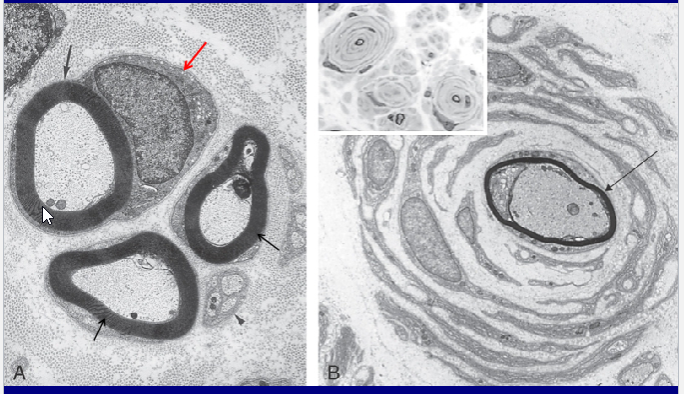
CIDP with Onion Bulb
Describe Diphtheria
What is it?
MOA
Symptoms?
What is it?
Acute necrotizing infection of URT
By C. diphtheriae
MOA:
C. Dip -> exotoxin -> inhibits protein synthesis -> demyelinating sensorimotor neuropathy
Symptoms:
paresthesias,
weakness,
early loss of proprioception & vibratory sensation
Associated w/
prominent bulbar Dysfunction
respiratory muscle dysfunction
Describe Herpes zoster (Shingles)
Pathogenesis
Histological Findings
Herpes zoster (Shingles)
Pathogenesis:
Varicella -> VZV hides in dorsal root/Trigem ganglia -> React. (higher age, lower immunity) -> virus spreads along sensory nerves -> painful vesicular skin eruption in the distribution of sensory dermatomes
Histologic findings:
Mononuclear infiltrates + focal necrosis of Dorsal root ganglion cells
2 degree degeneration of axons in peripheral nerves

Herpes Zoster (Shingles)
Describe Charcot-Marie-Tooth Disease, Type 1 (CMT1)
STATs
Genetics
Clinical presentation
Histo
Describe CMT2
Genetics
Symptoms
Dif vrom CMT1
STATs
MC hereditary peripheral neuropathy
Genetics:
Autosomal Dominant (AD)
Duplication of (17p11.2-p12) (CMT1a)
“segmental trisomy”
Involves gene for PMP22 (peripheral myelin protein 22)
Could also involve MPZ Gene on Chromosome 1 (CMT1b)
Clinical Presentation:
Presents in childhood or adolescence
Slowly progressive w/ distal muscle weakness
Atrophy of calf muscles & “steppage” gait
Pes cavus & hammertoes
Stocking-glove sensory loss
Weakness of hand & forearm muscles
later
Histo:
Demyelinating neuropathy with onion bulbs
Numerous onion bulbs = “hypertrophic” neuropathy
NOTE:
Sensorimotor deficits and secondary orthopedic problems are usually limited in severity
Charcot-Marie-Tooth Disease, Type 2 (CMT2)
Genetics:
AD
genetically heterogeneous disorder
Mutation in MFN2 -> makes mitofusin-2
(CMT2A) -> early onset
Symptoms:
Clinical manifestations are similar to CMTI
Axonal neuropathy
Difference from CMT1
No onion bulbs = no hypertrophicneuropathy
NOTE:
CMTI & CMT2 are the MC cause of chronic peripheral neuropathy in children
Describe Dejerine-Sottas Neuropathy (CMT3)
Genetics
Histo
Clinical Presentation
Dejerine-Sottas Neuropathy (CMT3)
Genetics:
AD or AR; begins in early infancy
Genetically heterogeneous
mutations in PMP22, MPZ, et al
Histo:
Demyelinating neuropath -> onion bulbs -> hypertrophic neuropathy
Clinical Presentation:
Resembles CMT1, but more severe
Both trunk and limb muscles are involved
Describe X-linked CMT disease (CMTX)
Stats
Pathophysiology
Clinical presentation
STATs
CMT1X is the most common x-linked form
15% of genetically defined cases of CMT
Females are less severely affected than males
Pathophysiology
Mutation in GJB1 gene -> encodes Connexin 32
Gap junction protein in schwann cells
Clinical Presentation
Have features of both axonal + demyelinating neuropathy
Progressive
Describe PERIPHERAL NEUROPATHY IN DIABETES MELLITUS
STATs
Types of neuropathy/MOA
Pathophysiology
STATS
Most common cause of peripheral neuropathy
Types of neuropathy/MOA:
Distal symmetric sensorimotor neuropathy
Ischemia or metabolic derangements
Autonomic Neuropathy
Ischemia or metabolic derangements
Mononeuropathy or Mononeuropathy multiplex
Ischemia
Pathophysiology
Axonal degeneration = predominant finding
Endoneurial arterioles -> hyaline arteriolosclerosis
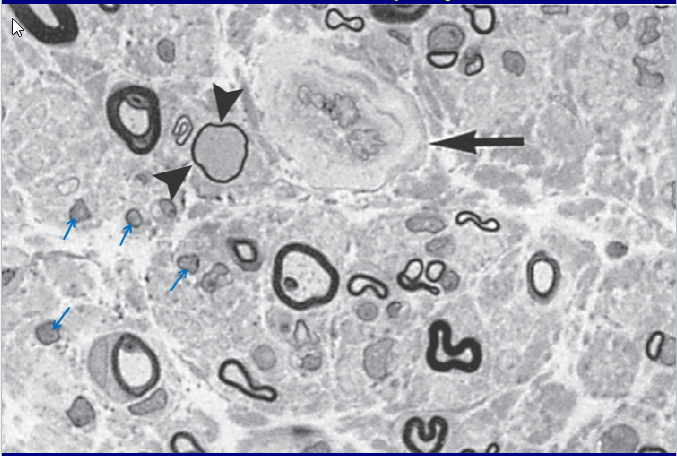
Diabetic Neuropathy
Describe Toxic Neuropathies
Causes
Common Symptoms
Toxic Neuropathies
Causes
industrial/environmental chemicals
biological toxins
therapeutic drugs
Most toxic
Common Symptom:
distal symmetric sensorimotor neuropathy
axonal neuropathies


Describe Alcoholic Neuropathy
Symptoms
Clinical Presentation
Causes
MOA
Symptoms:
Distal symmetric sensorimotor axonal neuropathy
May also have an autonomic neuropathy
Clinical presentation
Symptoms begin in distal aspect of the lower extremities
Sensory symptoms occur before motor symptoms
Causes:
Direct toxic effects of alcohol and its metabolites
(esp. acetaldehyde)
Vitamin deficiencies
(esp. thiamine)
MOA:
loss of nerve fibers due to axonal degeneration of the dying-back type
Describe Thiamine (vit. B1) deficiency
Symptoms
Clinical Presentation
Associated w/?
Thiamine (vit. B1) deficiency
Symptoms:
Distal symmetric sensorimotor axonal neuropathy
Clinical Presentation:
Initially involves the lower extremities
Toe drop -> foot drop -> wrist drop
Associated w/ other manifestations of thiamine deficiency
Beriberi heart disease
Wernicke-Korsakoff syndrome
NOTE: In the US, most commonly seen in alcoholics
What are the Other vitamin deficiencies associated with axonal neuropathies
Other vitamin deficiencies associated with axonal neuropathies
α-tocopherol (vit. E)
Cobalamin (vit. B12)
Folate (vit. B9)
Pyridoxine (vit. B6)
Isoniazid inhibits conversion of pyridoxine to pyridoxal 5’ phosphate -> functional pyridoxine deficiency
Describe COMPRESSION NEUROPATHY (ENTRAPMENT NEUROPATHY)
What is Entrapment neuropathy
What is Carpal tunnel syndrome:
Predisposing factors
COMPRESSION NEUROPATHY (ENTRAPMENT NEUROPATHY)
Entrapment neuropathy
nerve is compressed w/in anatomic compartment
Carpal tunnel syndrome:
compression of median nerve w/in compartment delimited by the transverse carpal ligament
numbness & paresthesias of the thumb & first two fingers, pain, difficulty gripping objects
Predisposing factors:
Pregnancy, hypothyroidism
Amyloidosis, arthritis, acromegaly
Excessive repetitive motion of the wrist
Describe Uremic neuropathy
STATs
Symptoms
Treatment
Uremic neuropathy
STATs
≈ 60–70% of patients with ESRD develop clinically significant peripheral neuropathy
Symptoms:
Distal symmetric sensorimotor axonal neuropathy
Cramps,
dysesthesias,
restless legs syndrome
Decreased DTRs,
sensory loss
Treatment:
Hemodialysis
Renal transplantation
NOTE:
Precise cause of uremic neuropathy is not known
List the Other metabolic disorders associated with neuropathy:
Other disorders associated with neuropathy:
Chronic liver disease
Polycythemia
COPD
Acromegaly
Hypothyroidism
List some malignancy → neuropathies due to Direct infiltration or compression of nerves
Direct infiltration or compression of nerves, e.g.
Brachial plexopathy
Obturator palsy
Describe these Paraneoplastic neuropathies
Paraneoplastic sensorimotor polyneuropathy
STATS
types
Cause
Paraneoplastic sensory neuronopathy
Preceding conditions
MOA
Monoclonal gammopathies
Types
MOA
Paraneoplastic sensorimotor polyneuropathy
STATS
Most common paraneoplastic neuropathy
Type:
axonal neuropathy
Cause:
unknown
Paraneoplastic sensory neuronopathy
Preceding Conditions:
precedes Dx of malignancy by 6 - 15 mo’s
small cell carcinoma of lung
MOA:
anti-Hu antibodies
Inflammatory infiltrates w/in dorsal root ganglia
-> Inflammatory demyelinating polyradiculo- neuropathy
Monoclonal gammopathies
Types:
MGUS
MM & B cell lymphoproliferative disorders
MOA:
Deposition of light-chain amyloid (AL type) in peripheral nerves
Production of monoclonal antibody (usually IgM) against myelin-associated glycoprotein
(MAG) [anti-MAG neuropathy]
Describe MYASTHENIA GRAVIS
STATs
Pathogenesis
Strong association w/? STATs? Why?
Clinical Features
Treatment
Prognosis
STATs
Bimodal age distribution
F/M ratio is 2:1 in young adults
Male predominance in older adults
Pathogenesis
85%: autoabs against postsynaptic AChRs
15%: autoabs against muscle specific receptor tyrosine kinase
(anti-MuSK antibodies)
Strong association btw anti-AChR antibodies and thymic abnormalities
10% of patients have a thymoma
30% of patients have thymic hyperplasia
WHY?
Thymus normally contains small numbers of myoid cells that express AChRs
Clinical Features
Ptosis
Diplopia
Generalized weakness -> fluctuates
easy fatigability
muscle response decreases w/ repeated stimulation
Treatment
Acetylcholinesterase inhibitors
Immunosuppressive drugs
Plasmapheresis
Thymectomy
Pts w/ thymoma
Patients w/o thymoma who
Have generalized MG
Positive for anti-AChR antibodies
≤ 50 years of age
Prognosis:
Overall mortality < 5%
Describe LEMS
Preceding conditions
Symptoms
In contrast to MG?
Patho?
Treatment
LAMBERT-EATON MYASTHENIC SYNDROME (LEMS)
Preceding conditions:
Underlying malignancy in ≈ 50% of cases
Symptoms may precede the Dx of cancer, sometimes by years
Patients w/o often have other autoimmune diseases
Symptoms:
weakness + wasting of proximal limb & trunk muscles
In contrast to Myasthenia Gravis:
No anti-AChR antibodies
Muscle strength ↑ after few seconds of muscle activity
Repetitive stimulation on EMG ↑ muscle response
Patho:
Autoabs against Ca++ channels -> less AcH release from pre synaptic
Treatment
Drugs that ↑ acetylcholine release
Immunosuppressive agents