Photoreceptors
 Studied by 0 people
 Call Kai
 Learn
Learn Practice Test
 Spaced Repetition
 Match
Match Flashcards
 Knowt Play
1/229

There's no tags or description
Looks like no tags are added yet.
Name | Mastery | Learn | Test | Matching | Spaced | Call with Kai |
|---|
No analytics yet
Send a link to your students to track their progress
230 Terms
variable pupil diameter, different photoreceptors
(photoreceptors are the MAIN reasons though)
We can see a huge range of light, from 10^-6 (threshold) to 10^10 (sun). Why? (2 main reasons)
photopic vision
refers to our ability to perceive visual stimuli under bright light conditions due to the activity of cones; roughly 10⁴ to 10⁸ luminance
**bright lighting conditions mediated by cones
scotopic vision
refers to our ability to perceive visual stimuli in near darkness due to the activity of rods; roughly 10⁻⁵ to 10⁻³ luminance (includes threshold)
**dim lighting conditions mediated by rods
mesopic vision
refers to our ability to perceive visual stimuli at dawn or dusk levels, which involves both rods and cones
**twilight conditions mediated by rods & cones
cones
Which photoreceptors mediate photopic vision?
rods
Which photoreceptors mediate scotopic vision?
rods and cones
Which photoreceptors mediate mesopic vision?
cones
(lowest threshold light is scotopic vision, mediated by rods, so cones have the highest threshold)
Which type of photoreceptors have the higher threshold of detecting light: rods or cones?
rods
(lowest threshold light is scotopic vision, mediated by rods, and lowest threshold = highest sensitivity)
Which type of photoreceptors have the higher sensitivity of detecting light: rods or cones?
ganglion cells
Which cells in the retina encounter light first?
bipolar, horizontal, amacrine
What 3 kinds of cells in the retina are found in the more middle layers as light passes through?
photoreceptors
Which cells in the retina encounter light last?
photoreceptors are in the back but initiate the phototransduction signal
Why is the retina considered to be "inverted"?
retinal pigmented epithelium (RPE)
outermost layer of the retina that provides metabolic support for the retina and absorbs light photos that are not absorbed by photoreceptors
ganglion cell axons
(leave the retina to carry signals from retina to cortex)
What makes up the optic nerve?
photoreceptors, bipolar cells, ganglion cells
What is the order of the 3 main cells in the phototransduction process? (feedforward connection)
horizontal cells
Which cells mediate interactions between photoreceptors and bipolar cells?
amacrine cells
Which cells mediate interactions between bipolar cells and ganglion cells?
ganglion cells to photoreceptors
What is the order of the 2 main cells in the feedback phototransduction process? (i.e. NOT going toward the optic nerve)
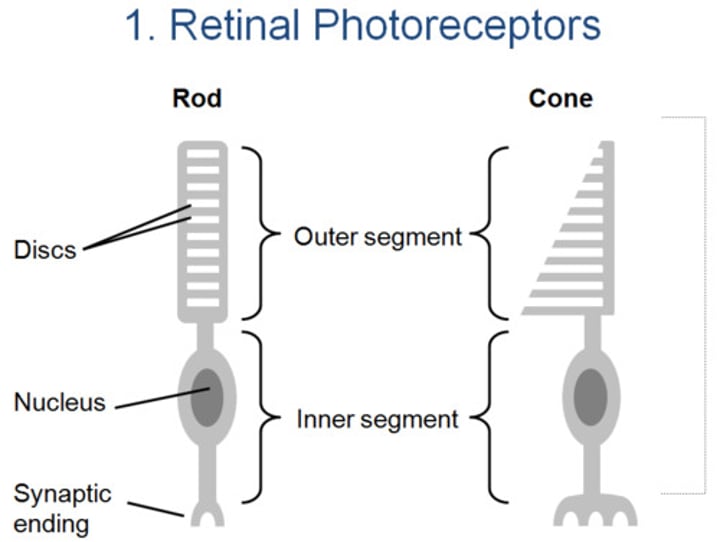
discs containing photopigments
What is included in the outer segment of photoreceptors?
photopigments
What do discs in rods and cones contain?
daytime
The outer segment discs in photoreceptors are continuously shed. When do rods mostly shed their outer segment discs?
nighttime
The outer segment discs in photoreceptors are continuously shed. When do cones mostly shed their outer segment discs?
organelles (including nuclei)
What is included in the inner segment of photoreceptors?
spherule
refers to a rod synaptic ending
pedicle
refers to a cone synaptic ending
inner segment
Which part of a photoreceptor does light encounter first: inner or outer segment?
true
(this is why light encounters the inner segment first)
True or false: The retinal layers, including the photoreceptors themselves, are inverted to the direction of incoming light.
inner segment
(since the intended target is the photopigments in discs of the outer segment)
What part of a photoreceptor acts as a "light guide" to direct photons of light towards their intended target, acting like fiber optics?
RPE
(prevents light from bouncing back onto photoreceptor outer segments, which would degrade the retinal image)
Photons that are not absorbed by the outer segments of photoreceptors are mostly absorbed by which retinal layer?
6 million
How many cones are in the human retina?
120 million
How many rods are in the human retina?
rods
Are there more rods or cones in the retina?
1 million
About how many ganglion cell axons leave the retina to comprise the optic nerve?
true
(since there are 6 million cones and 120 million rods, but only 1 million ganglion cells)
True or false: Each retinal ganglion cell receives signals from several photoreceptors.
spatial summation
refers to each retinal ganglion cell receiving signals from multiple photoreceptors
false
True or false: Rods and cones are distributed equally throughout the retina.
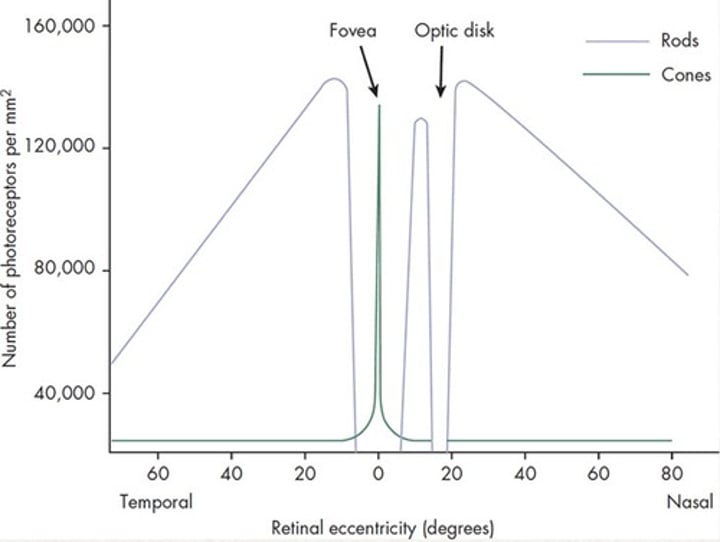
peripheral
Are rods more numerous in the central or peripheral retina?
fovea
Where are the most cones found in the retina?
**at 0 degrees eccentricity in the retina
5
What is the width of the fovea in degrees?
foveola
very center of the fovea that has NO rods; peak density of cones here is about 200,000 cones/mm^2
**Note: rest of the fovea outside of this very specific region does still have some rods
1.2
What is the width of the foveola in degrees?
optic disc
region where ganglion cell axons leave the eye as the optic nerve
**at about 15 degrees eccentricity in the nasal retina
5
What is the width of the optic disc in degrees?
20 degrees
Rods are the most densely packed at about how many degrees from the fovea?
**peak density is about 150,000 rods/mm^2
decrease
As we age, does our amount of rods increase, decrease, or remain the same?
decrease
(actually it decreases significantly, even if you just go 0.2 degrees out)
Cones are the mostly highly concentrated in the foveola, with a density of about 200,000 cones/mm^2. As you move out, does the concentration increase or decrease?
1/10
Just 1 degree away from the fovea, what is the cone density relative to its maximum at the foveola?
neither
Does the optic disc contain rods, cones, both, or neither?
wavelength they respond to
There are 3 types of cones, which vary based on what?
red
What color of light do LONG wavelength cones respond to?
green
What color of light do MEDIUM wavelength cones respond to?
blue
What color of light do SHORT wavelength cones respond to?
short
Which wavelength of cones responds to BLUE light: short, medium, or long?
medium
Which wavelength of cones responds to GREEN light: short, medium, or long?
long
Which wavelength of cones responds to RED light: short, medium, or long?
long, red
Typically, which cones are most numerous: long, medium, or short wavelength? Which color do they respond to?
short, blue
Typically, which cones are least numerous: long, medium, or short wavelength? Which color do they respond to?
0.5 degrees from the fovea
Where does S cone density peak?
false
(NO S-cones at the central 0.3-0.4 degrees of the fovea)
True or false: S cones can be found highly packed from 0-0.5 degrees of the fovea.
increases
What happens to the size of the cones with increasing retinal eccentricity? (moving away from the fovea)
increases
(S cones are very widely spaced, about 6 arc min between each)
What happens to the spacing of the cones with increasing retinal eccentricity? (moving away from the fovea)
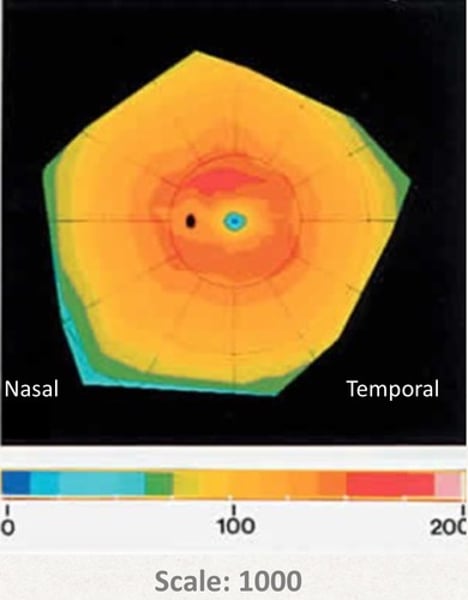
radial symmetry
pattern of rod and cone distribution around the fovea, showing that the greatest concentration of both is surrounding the optic disc (except for the optic disc itself) and the distribution decreases moving toward the periphery
15 degrees nasal
Where is the blind spot on the retina? (i.e. how many degrees, nasal or temporal)
20 degrees
According to a topographic map, the highest rod density is a ring encircling the fovea at what eccentricity?
Note: there is a little bit of asymmetry
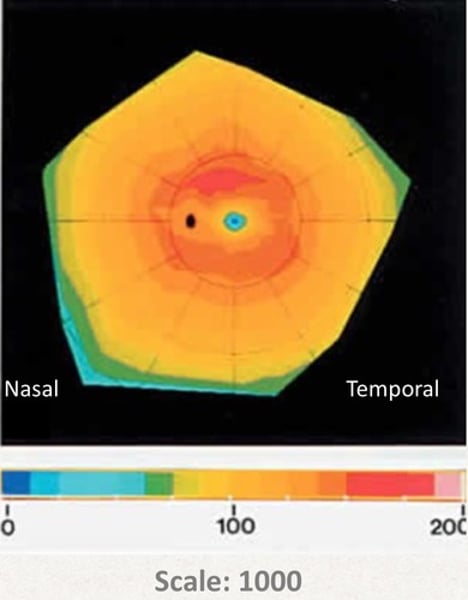
decrease
(more or less radially symmetric)
As eccentricity increases, does cone density increase or decrease?
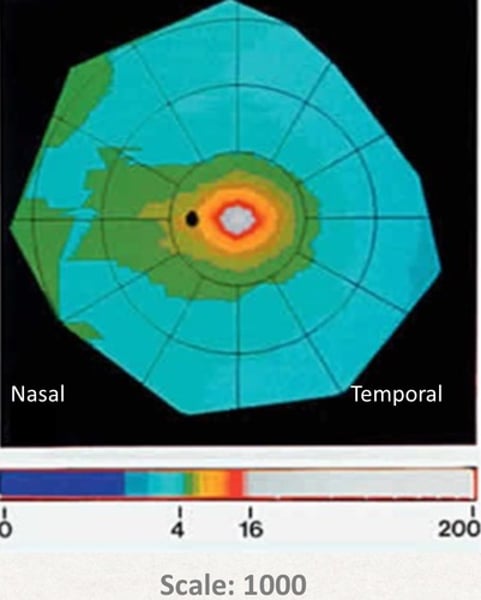
nasal
(25% more cones in nasal retina)
Are there more cones in the nasal or temporal retina?
**on a topography map, results in a cone ____ streak
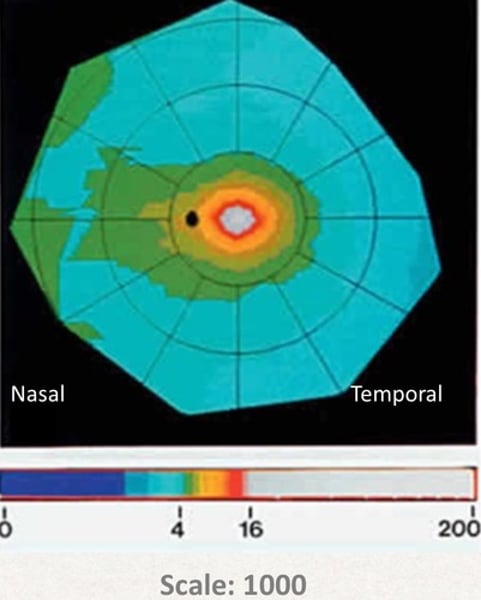
rhodopsin
What photopigment(s) are in rods?
cyanolabe, chlorolabe, erythrolabe
What photopigment(s) are in cones?
cyanolabe
photopigment found in S-cones
chlorolabe
photopigment found in M-cones
erythrolabe
photopigment found in L-cones
507 nm
What is the maximal absorption wavelength of rhodopsin?
426 nm
What is the maximal absorption wavelength of cyanolabe? (found in S-cones)
530 nm
What is the maximal absorption wavelength of chlorolabe? (found in M-cones)
557 nm
What is the maximal absorption wavelength of erythrolabe? (found in L-cones)
each cone contains only one photopigment
Why are cones not as sensitive to light as rods?
each rod disc contains about 10,000 molecules of rhodopsin
Why are rods more sensitive to light than cones?
-50 mV
What is the resting membrane potential of rods?
rhodopsin
When light hits a rod, what substance absorbs the photons?
closing of sodium channels
(specifically cGMP-gated Na channels, since this process results in decreased cGMP)
When light hits a rod, rhodopsin absorbs the photons. Photon absorption triggers the process of phototransduction, which leads to the opening or closing of what kind of channels?
hyperpolarization
(between -50 and -70 mV)
In phototransduction, does the closing of sodium channels lead to depolarization or hyperpolarization of the rod?
glutamate
Hyperpolarization of a rod leads to a decrease in its release of what neurotransmitter?
true
True or false: The amount of sodium channels closed in the initiation of phototransduction is directly proportional with how much the membrane potential changes.
rods, neurotransmitter, membrane potential, neurotransmitter
Phototransduction summary:
1. A photon initiates the transduction process...
2. Change in voltage in ____
3. Change in concentration of ____ in the synapse
4. Change in the ____ ____ of the post-synaptic cells
5. Change in the release of ____ at the next synaptic terminal
saturation
process in which all sodium channels are closed when just 10% of a rod's rhodopsin molecules are bleached with light
**further bleaching of rhodopsin does not result in further hyperpolarization, since the number of Na+ channels located in the outer segment is limited
-70 mV
At what membrane potential have we reached saturation of sodium channels?
shine monochromatic light through box with rhodopsin, measure amount of light transmitted through the box with a radiometer
Photopigments absorb photons of a specific wavelength range, but different wavelengths of light have a different probability of being absorbed. How can we measure the absorption probability of different wavelengths?
rhodopsin
In the transmission experiment, what molecule is put in a box for monochromatic light to shine through?
radiometer
In the transmission experiment, what can we use to measure the amount of monochromatic light that is transmitted through a box of rhodopsin?
**this is how we know that wavelengths in the region of 507 nm are most likely to be absorbed by rhodopsin
20 quanta
Transmission experiment example: 100 quanta of a 400 nm light is incident upon a box containing rhodopsin. 80 quanta are transmitted. How much did rhodopsin absorb?
relative absorption vs. wavelength
How do we plot a graph for the transmission experiment? (y vs. x)
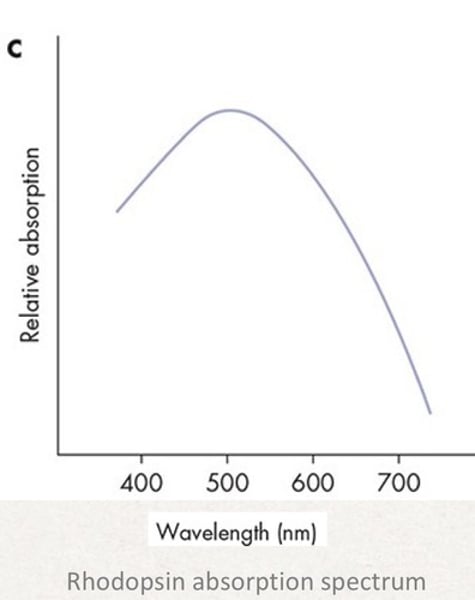
lesser
(since rods are MOST sensitive to this wavelength)
If light of wavelength 507 nm hits the retina, is this a greater or lesser threshold for rods to respond?
1
(which is why rhodopsin bleaches faster than cones)
Absorption of how many photons does it take to bleach rhodopsin?
true
True or false: Absorption of one photon is enough to activate rhodopsin.
5 minutes
(means that when a certain number of rhodopsins is bleached, 50% of them will recover in 5 minutes)
What is the half life for rhodopsin regeneration?
50
100 rhodopsins are bleached with photons of light. After 5 minutes, how many have recovered and are now unbleached?
75
100 rhodopsins are bleached with photons of light. After 10 minutes, how many have recovered and are now unbleached?
507 nm
(since this is mediated by rods)
At what wavelength is the scotopic visual system most sensitive?
cones
(but rods bleach faster since they only require 1 photon)
Which photoreceptors recover faster: rods or cones?
 Note
Note  Flashcards (127)