lab practical 1
 Call Kai
 Learn
Learn Practice Test
 Spaced Repetition
 Match
Match Flashcards
 Knowt Play
1/284

There's no tags or description
Looks like no tags are added yet.
Name | Mastery | Learn | Test | Matching | Spaced | Call with Kai | Chat |
|---|
No analytics yet
Send a link to your students to track their progress
285 Terms
anatomical position
to stand erect facing forward, with arms at the sides, palms of the hands turned upward, feet shoulder width apart
abdominal
abdomen
acrominal
point/joint of shoulder
antebrachial
forearm (elbow to wrist)
arm
brachial
axillary
armpit
brachial
upper arm
buccal
cheek
calcaneal
heel of foot
carpal
wrist
cephalic
head
cervical
neck
crural
lower leg (shin)
digital
fingers or toes
leg
crus or crural
femoral
thigh
frontal
forehead
gluteal
buttocks
inguinal
groin
mammary
breast
nasal
nose
occipital
back of head
oral
mouth
otic
ear
palmar
palm
patellar
knee
pelvic
pelvis
plantar
bottom of foot
popliteal
back of knee
pubic
pubis/genital
scapular
shoulder blades
sternal
breastbone/sternum
sural
calf
tarsal
ankle
thoracic
chest
umbilical
navel/belly button
vertebral
backbone/spine
lumbar
lower back
mental
chin
anterior (ventral)
front of the body/toward the front
posterior (dorsal)
back of the body/toward the back
superior
higher or located above on the body, nearer to the head
inferior
lower or located below on the body, farther to the head
medial
toward the midline
lateral
away from the midline, towards the sides
contralateral
on the opposite side of the body from another structure
ipsilateral
on the same side of the body as another structure
proximal
closer to the point of attachment/origin
distal
farther from the point of attachment/origin
superficial
near the surface
deep
away from the body surface, more internal
sagittal plane
vertical division of the body into right and left portions
midsagittal plane
divides the body into equal right and left sides
parasigittal plane
divides the body unequally into right and left parts
frontal/coronal plane
divides the body into anterior (front) and posterior (back) portions
transverse ("cross-section") plane
divides the body into superior (upper) and inferior (lower) parts
oblique plane
divides the body at an angle (any angle)
dorsal cavity
contains the brain and spinal cord
ventral cavity
- thoracic cavity: divides into pleural cavities and pericardial cavity
- pleural cavities: lungs
- pericardial cavity: heart
- abdominopelvic: divides into abdominal cavity and pelvic cavity
- abdominal cavity: digestive organs, liver, kidneys, spleen
- pelvic cavity: urinary bladder, rectum, and reproductive organs
the parts of the cell
- cytoplasm and plasma membrane
- nucleus and nucleolus
- membranous structures - smooth and rough endoplasmic reticulum, golgi apparatus, lysosomes
- ribosomes
- mitochondria
- centrioles

smooth endoplasmic reticulum
where lipids are synthesized, calcium levels are regulated, and toxic substances are broken down
golgi apparatus
stack of membranes in the cell that modifies, sorts, and packages proteins from the endoplasmic reticulum
lysosome
cell organelle filled with enzymes needed to break down certain materials in the cell
ribosome
site of protein synthesis
cillia
tiny hairlike extension that move together in a sweeping motion
microvillia
really tiny hairlike extensions that increase surface area (smaller than cillia)

stages of the cell cycle (mitosis)
interphase, prophase, metaphase, anaphase, telophase, cytokinesis

interphase
cell grows, performs its normal functions, and prepares for division; consists of G1, S, and G2 phases

prophase
first and longest phase of mitosis, during which the chromosomes become visible and the centrioles separate and take up positions on the opposite sides of the nucleus

metaphase
second phase of mitosis, during which the chromosomes line up across the center of the cell

anaphase
the third phase of mitosis, during which the chromosome pairs separate and move toward opposite poles

telophase
the final phase of cell division in which the chromatids or chromosomes move to opposite ends of the cell and two nuclei are formed

cytokenis
the division of the cytoplasm to form two separate daughter cells after mitosis

epithelial tissue
refers to the sheets of cells that cover exterior and interior surfaces of the body, line internal cavities and passageways, and form certain glands, supports gas exchange, surface movement of substances, and absorption; appears like thousands of cells squished into layers
- skin
- lining of organs
- sweat glands

apical surface
an upper free surface exposed to the body exterior or the cavity of an internal organ
basement membrane/basal surface
layer between epithelium and underlying connective tissue; where epithelial cells are attached
simple squamous epithelium
single layer of flattened cells
- allows easy passage of materials by diffusion and filtration; secretes lubricating substances
- located in kidney glomeruli, air sacs of lungs, lining of heart and capillaries, and lymphatic vessels

simple cuboidal epithelium
single layer of cube shaped cells
- secretion and absorption
- located in ducts and secretory portions of small glands, kidney tubules, ovary surface

simple columnar epithelium
single layer of tall column shaped cells
- absorption, secretion of mucus, enzymes, and other substances
- nonciliated type lines most of the digestive tract (stomach to anal canal), gallbladder and excretory ducts of some glands
- ciliated variety lines small bronchi, uterine tubes, and some regions of the uterus

stratified squamous epithelium
multiple layers of flat cells
- protects underlying tissues in areas subject to abrasion
- nonkeratinized type forms the moist lining of the esophagus, mouth, and vagina
- keratinized type forms the epidermis of the skin, a dry membrane

stratified cuboidal epithelium
two or more layers of cube shaped cells
- protection
- located largest ducts of sweat glands, mammary glands, and salivary glands

stratified columnar epithelium
two or more layers of column like cells
- protection and secretion
- rare in the body; small amounts in male urethra and in large ducts of some glands

psuedostratified columnar epithelium
single layer of cells that appears to be made up of multiple layers of cells; each cell may have different heights/nucleus positions
- secretes substances, particularly mucus; propulsion of mucus by ciliary action
- ciliated variety lines the trachea, most of the upper respiratory tract; male's sperm carrying duct

transitional epithelium
- stretches readily and permits distension of urinary organ by contained urine
- only in the urinary system: lines the ureters, urinary bladder, and part of the urethra

connective tissue
binds the cells and organs of the body together and functions in the protection, support, and integration of all parts of the body
- made up of fibroblasts (connective tissue cells)
- bone
- fat
- cartilage
- blood
- padding tissue

areolar connective tissue (loose)
gell-like matrix with web like fibers
- fills the spaces between muscle fibers, surrounds blood and lymph vessels, and supports organs in the abdominal cavity
- underlies most epithelium

adipose connective tissue (loose)
closely packed adipocytes; acts as storage depots for fat with little cellular matrix
- rapid storage and mobilization of lipid molecules
- cushion and protection
- found cushioning around the kidneys and cushioning the back of the eye
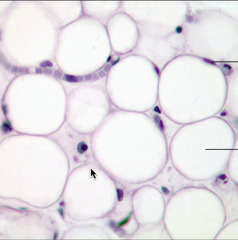
reticular connective tissue (loose)
network of reticular fibers in a typical loose ground substance; mesh-like, supportive framework
- form a framework for soft internal structures; creates network that supports attachment of other cell types like white blood cells, mast cells, & macrophages
- located in lymphoid organs, lymph nodes, bone marrow, and spleen

dense regular connective tissue (dense)
fibers are parallel to each other, enhancing tensile strength and resistance to stretching in the direction of the fiber orientations
- attaches muscle to bones or to muscles; attaches bones to bones, withstands great tensile strength when pulling force is applied in ONE direction
- makes up/located in tendons, ligaments, and layer under the epidermis

dense irregular connective tissue (dense)
fibers are in randomized directions; increases strength when pulled in multiple directions, less in one direction
- able to withstand tension exerted in MANY directions; provides structural strength.
- dermis of the skin, submucosa of digestive tract; fibrous capsules of organs and of joints
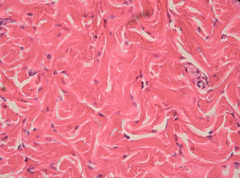
elastic connective tissue (dense)
stretchy and squiggly appearance; densely packed fibers
- allows recoil of tissue following stretching; maintains pulsatile flow of blood through arteries; aids passive recoil of lungs
- located in walls of large arteries; within certain ligaments associated with vertebral column, within the walls of the bronchial tubes

cartilage
connective tissue made up of chondrocytes and empty spaces called lacuna
hyaline cartilage
most abundant type of cartilage; short and dispersed collagen fibers
- forms moveable joints and embryonic skeleton
- found on the ends of long bones, ribs, and nose
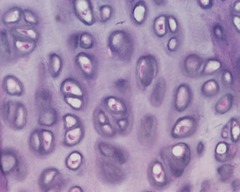
elastic cartilage
cartilage with abundant elastic fibers
- gives rigid support as well as flexibility
- found in external construction of the ear

fibrocartilage
tough due to its thick bundles of collagen fibers dispersed through its matrix
- found in menisci in the knee joint and the intervertebral discs
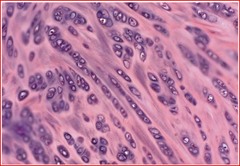
bone
dense, mineralized, hard connective tissue composing the skeleton

blood connective tissue
fluid extracellular matrix used to transport substances throughout the body filled with blood cells

muscle tissue
excitable, responding to stimulation and contracting/lengthening to provide movement
- skeletal
- smooth
- cardiac

skeletal muscle
a muscle that is attached to the bones of the skeleton and provides the force that moves the bones; each cell
- voluntary
- striated

smooth muscle
muscle found inside many internal organs of the body that causes their movement (ex: stomach muscle)
- involuntary
- smooth
