C6: chemical changes
 Call Kai
 Learn
Learn Practice Test
 Spaced Repetition
 Match
Match Flashcards
 Knowt Play
1/18

There's no tags or description
Looks like no tags are added yet.
Name | Mastery | Learn | Test | Matching | Spaced | Call with Kai | Chat |
|---|
No analytics yet
Send a link to your students to track their progress
19 Terms
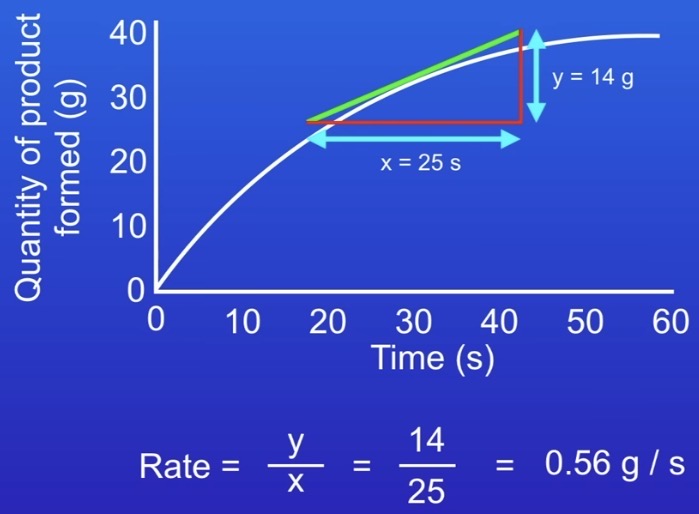
What is the formula for mean rate of reaction (g/s or cm³/s)
Quantity of reactants used OR quantity of product formed (g or cm³) / time taken
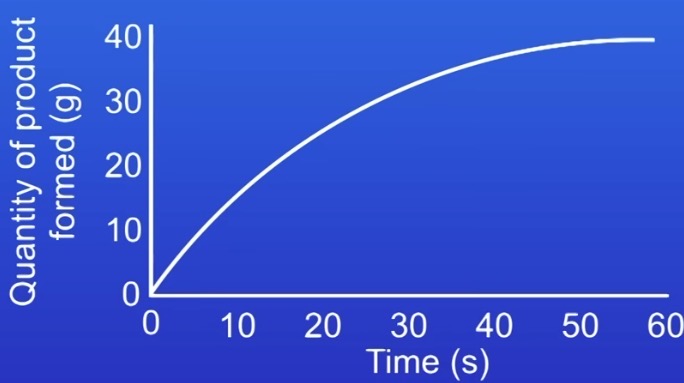
REMINDER: practice how to draw tangents on graphs
What is collision theory?
Chemical reaction can only occur when reacting particles collide with eachother and with sufficient energy (activation energy). The rate of reaction is determined By frequency of collisions.
What factors affect rate of chemical reaction?
Concentrations of reactants in solution
Pressure of reacting gases
Surface area of solid reactant
Temperature
Catalysts
How does increasing the concentration of reactants or pressure affect rate of reaction?
Increases frequency of collisions and therefore increases rate of reaction
How does increasing the surface area affect rate of reaction?
Particles can only react with particles on the surface of the solid, so increases frequency of collisions and therefore increases rate of reaction.
Smaller sized solid reactants have a greater surface area to volume ration than larger blocks, so they have a greater number of particles on the surface, meaning more collisions per second. This increases rate of reaction.
How does increasing the temperature affect rate of reaction?
Increases energy of the particles, so they move faster and therefore collide more often. More particles have enough energy to overcome the activation energy barrier and collide successfully.
Required Practical: rate of reaction involving a change in colour
Use a measuring cylinder to put 10cm³ sodium thiosulfate solution into a conical flask.
Place the conical flask onto a printed black cross.
Add 10cm³ hydrochloric acid into the conical flask.
Swirl the solution and start a stopwatch. Look down through the top of the flask.
Stop the stopwatch when the liquid becomes too cloudy to see the cross.
Repeat steps 1-5 using lower concentrations of sodium thiosulfate solution. Calculate means for each.
Why is the disappearing cross experiment not reproducible?
Different people have different eyesight
Some people may see the cross longer than others so may not get the same results, however using the same size printed cross can help reduce this error
Required Practical: rate of reaction involving measuring volume of gas produced
Use a measuring cylinder to put 50cm³ hydrochloric acid into a conical flask.
Attach the conical flask to a bung and delivery tube.
Place the delivery tube into a container filled with water.
Place an upturned measuring cylinder also filled with water over the delivery tube.
Add a 3cm strip of magnesium to the hydrochloric acid and start a stopwatch.
Every 10 seconds, measure the volume of hydrogen gas produced in the measuring cylinder. Continue until no more hydrogen is given off.
Repeat steps 1-6 using different concentrations of hydrochloric acid.
What is a catalyst?
They increase rate of reaction without being used up in the reaction. They’re not therefore shown in the chemical equation for a reaction.
How does a catalyst increase rate of reaction?
They provide a different pathway for the reaction that has a lower activation energy. This means that more particles can successfully collide per second.
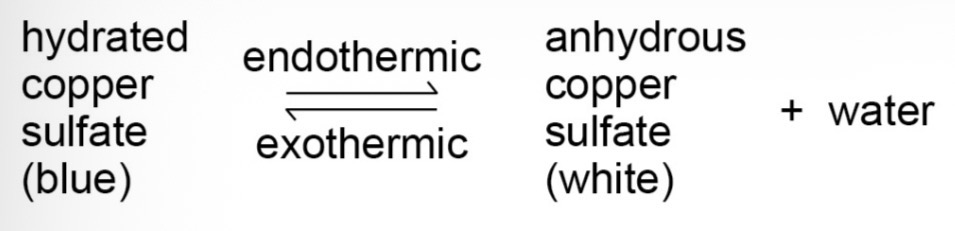
What is a reversible reaction? How are they represented?
A reaction where, depending on the conditions (e.g. heat or cool), the products can react to produce the original reactants. If a reversible reaction is exothermic in one direction, it’s endothermic in the opposite direction. The same amount of energy is transferred in each case.

What is the hydrated copper sulfate (blue) reversible reaction?
What is equilibrium?
When a reversible reaction occurs in a sealed container, at the point where both forward and reverse reactions occur at exactly the same rate.
What happens when a reaction is at equilibrium and a change is made to the conditions?
The reaction responds to counteract the change. This is called Le Chatelier’s Principle.
What happens if the concentration of one of the reactants / products is changed in a reaction at equilibrium?
It is no longer at equilibrium and the concentrations of all the substances will change until equilibrium is reached again. If concentration of a reactant is increased, more products will be formed until equilibrium. If concentration of a product is decreased, more reactants will react until equilibrium.
What happens if the temperature is changed in a reaction at equilibrium?
If increased:
Equilibrium shifts in the endothermic direction to reduce the temperature - so whatever the product is would increase, and the reactants decrease
If decreased:
Equilibrium shifts in the exothermic direction to increase the temperature - so whatever the product is would increase, and the reactants decrease
What happens if the pressure is changed in a gaseous reaction at equilibrium?
If increased:
Equilibrium shifts towards the side with the smaller number of molecules (big numbers in reaction symbol equation)
If decreased:
Equilibrium shifts towards the side with the larger number of molecules
If there is the same number of molecules on both sides, changing pressure has no effect on the equilibrium.