Liz Anatomy chapter 1 combined set
 Call Kai
 Learn
Learn Practice Test
 Spaced Repetition
 Match
Match Flashcards
 Knowt Play
1/125

There's no tags or description
Looks like no tags are added yet.
Name | Mastery | Learn | Test | Matching | Spaced | Call with Kai | Chat |
|---|
No analytics yet
Send a link to your students to track their progress
126 Terms
Macroscopic anatomy
The study of large, visible body structures without the use of magnification.
Histology
The microscopic study of tissues.
Cell physiology
The study of the functions of living cells.
Systemic physiology
The study of the functions of specific organ systems.
Cytology
The study of cells.
Renal physiology
The study of kidney function.
Cells
The basic unit of life.
Metabolism
Chemical reactions in cells, including respiration, digestion, circulation, and excretion.
Homeostasis
The process of maintaining a stable internal environment despite external changes.
Receptors
Components of a homeostatic mechanism that sense change.
Negative feedback
The most common homeostatic mechanism that counteracts changes to restore stability (e.g., thermostat analogy).
Positive feedback
A homeostatic mechanism that amplifies changes temporarily (e.g., blood clotting, childbirth).
Axial portion
The anatomical division of the body comprising the head, neck, and trunk.
Appendicular portion
The anatomical division of the body comprising the limbs.
Diaphragm
The muscular structure that separates the thoracic and abdominopelvic cavities.
Parietal membrane
A double-layered membrane that lines the wall of a body cavity.
Visceral membrane
A double-layered membrane that directly covers internal organs.
Serous membrane
Membranes that function to reduce friction between organs and cavity walls.
Integumentary system
Organ system composed of skin, hair, and nails that provides protection and temperature regulation.
Skeletal system
Organ system composed of bones and ligaments that offers support, protection, and blood cell production.
Nervous system
Organ system composed of the brain, spinal cord, and nerves that regulates sensory reception, integration, and muscle/gland control.
Endocrine system
Organ system composed of glands producing hormones for slower but longer-lasting body regulation.
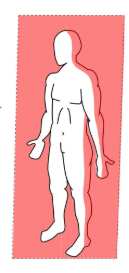
Anatomical position
Standard body reference posture where the subject is standing erect, facing forward, with arms at the sides and palms facing out.
Prone position
Position of a person lying face down on their stomach.

Supine position
Position of a person lying face up.
Sagittal plane
A section that divides the body or organ into right and left portions (midsagittal divides into equal halves).
Frontal (coronal) plane
A section that divides the body or organ into front and back portions.
Transverse (horizontal) plane
A section that divides the body or organ into upper and lower portions.
Right upper quadrant
Abdominal quadrant containing the gallbladder and liver.
Right lower quadrant
Abdominal quadrant containing the appendix.
Pes region
Anatomical region referring to the foot.
Anatomy
Study of the structures of the body.
Physiology
Study of how the body and its parts function.
Cytology
Study of cells.
Histology
Study of tissues.
Pathophysiology
Study of how disease changes normal body function.
Atom
Smallest unit of an element.
Molecule
Two or more atoms chemically joined together.
Macromolecule
Large biological molecule made from smaller molecules, such as proteins or DNA.
Organelle
Specialized structure inside a cell that performs a specific job.
Cell
Smallest living unit of the body.
Tissue
Group of similar cells working together.
Organ
Structure made of multiple tissues working together for a specific function.
Organ system
Group of organs working together.
Organism
An entire living thing.
Growth
Increase in body size or number of cells.
Reproduction
Production of new cells or a new organism.
Responsiveness
Ability to detect and respond to changes.
Movement
Change in position of the body or substances within the body.
Metabolism
Sum of all chemical reactions occurring in the body.
Digestion
Breaking food into forms that can be absorbed and used.
Circulation
Movement of blood, nutrients, gases, and other substances throughout the body.
Excretion
Removal of metabolic wastes.
Homeostasis
Maintenance of a relatively stable internal environment.
Receptor
Detects a change or stimulus in the body.
Set point
Normal value or range the body tries to maintain.
Effector
Muscle, gland, or organ that responds to a change and helps restore homeostasis.
Feedback mechanism
Process that regulates a body condition by responding to changes.
Negative feedback
Response reverses the original change and brings the body back toward its set point.

Positive feedback
Response intensifies the original change until an event is completed.

Anatomical position
Standing upright, facing forward, arms at sides, with palms facing forward.
Bilateral
Present on both sides of the body.
Ipsilateral
On the same side of the body.
Contralateral
On opposite sides of the body.
Superior / Cranial
Toward the head or upper part of the body.
Inferior / Caudal
Toward the feet or lower part of the body.
Anterior / Ventral
Toward the front of the body.
Posterior / Dorsal
Toward the back of the body.
Medial
Toward the body’s midline.
Lateral
Away from the midline; toward the side.
Intermediate
Located between two structures.
Proximal
Closer to the point where a limb attaches to the trunk.
Distal
Farther from the point where a limb attaches to the trunk.
Superficial
Toward or near the body’s surface.
Deep
Farther from the body surface; more internal.
External
Toward or on the outside.
Axial region
Head, neck, and trunk.
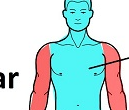
Appendicular region
Arms and legs, including the appendages attached to the axial body.

Body cavity
Internal space containing and protecting organs.
Dorsal body cavity
Posterior cavity containing the brain and spinal cord.
Cranial cavity
Space inside the skull containing the brain.
Vertebral / Spinal cavity
Space inside the vertebral column containing the spinal cord.
Ventral body cavity
Anterior cavity containing most internal organs.
Thoracic cavity
Chest cavity containing the lungs, heart, and related structures.
Abdominopelvic cavity
Large cavity below the diaphragm containing the abdominal and pelvic cavities.
Abdominal cavity
Contains many digestive organs, including the stomach, liver, intestines, and spleen.
Pelvic cavity
Contains the urinary bladder, internal reproductive organs, and rectum.
Oral cavity
Mouth.
Nasal cavity
Space within and behind the nose.
Orbital cavities
Cavities containing the eyes.
Middle ear cavities
Small spaces within the temporal bones containing the middle-ear structures.
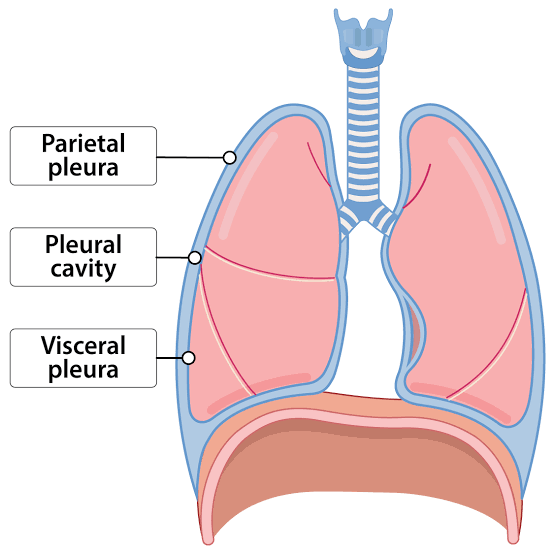
Serous membrane
Thin membrane that lines a body cavity and covers organs within it.
Parietal layer
Serous membrane layer that lines the wall of a body cavity.
Visceral layer
Serous membrane layer that covers the surface of an organ.
Pleura
Serous membrane surrounding the lungs and lining the thoracic cavity around them.
Pericardium
Membrane surrounding the heart.
Peritoneum
Serous membrane lining the abdominopelvic cavity and covering many abdominal organs.
Midsagittal plane
Vertical plane dividing the body into equal left and right halves.
Sagittal plane
Vertical plane dividing the body into left and right portions.
Frontal / Coronal plane
Vertical plane dividing the body into front and back portions.