anatomy of permanent teeth
 Call Kai
 Learn
Learn Practice Test
 Spaced Repetition
 Match
Match Flashcards
 Knowt Play
1/78

There's no tags or description
Looks like no tags are added yet.
Name | Mastery | Learn | Test | Matching | Spaced | Call with Kai | Chat |
|---|
No analytics yet
Send a link to your students to track their progress
79 Terms
systematic identification of teeth

human permanent dentition

incisors
4 maxillary (upper) and 4 mandibular (lower)
no cusps

permanent maxillary central incisor
distal outline > convex
> rounded distoincisal angle (vs sharp mesioincisal)
incisal ridge straight

lingual aspect of maxillary central incisor
crown has smooth convex proximal surfaces
cervical line curved incisally
> curved on mesial side
maxillary lateral incisor compared with central (labially)
smaller
central > squarish
crown > rounded outline
mesioincisal + distoincisal angles and mesial + distal crown margins > rounded
root curved distally

permanent maxillary lateral incisor palatal aspect
elevations
marginal ridges (mesial + distal)
cingulum (> cervically)
incisal ridge
depressions
palatal fossa: > concave and circumscribed (> clearly bounded)
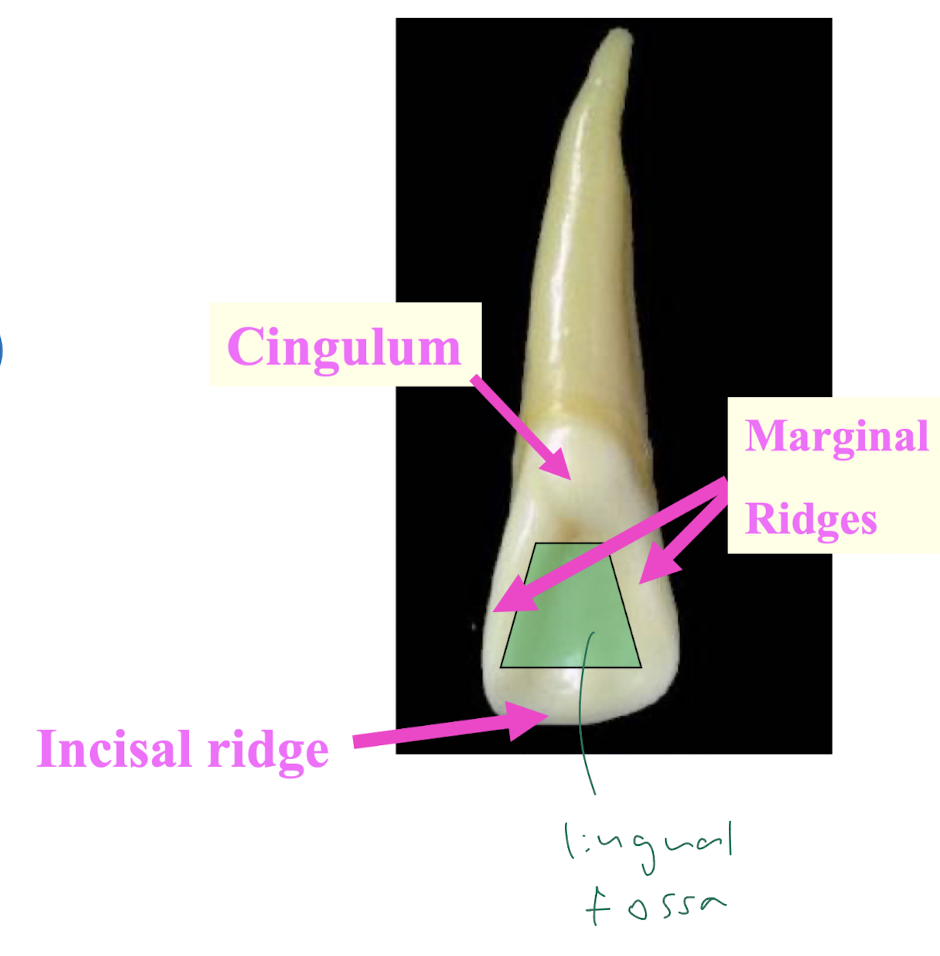
maxillary central vs lateral incisors (palatally)
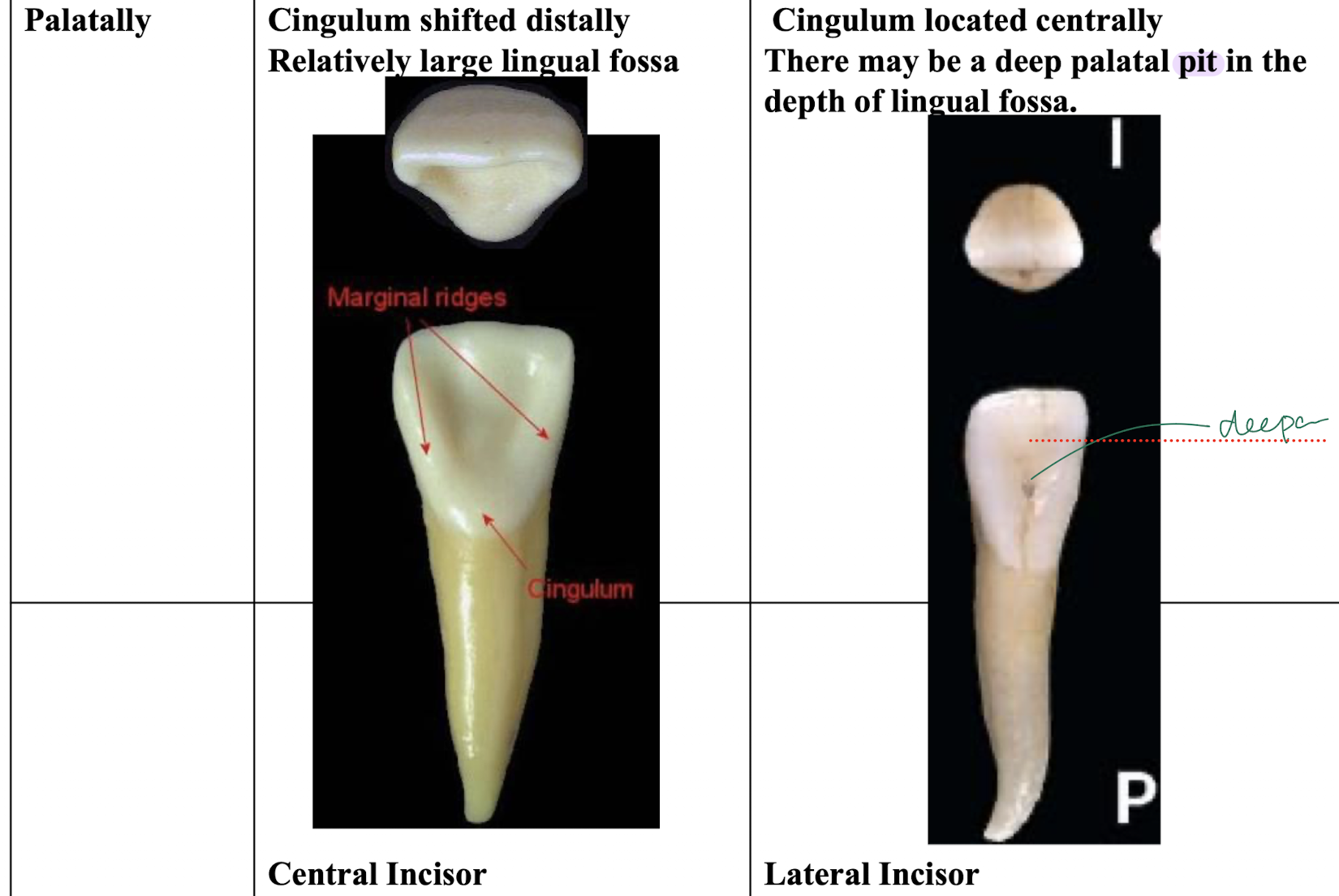
maxillary central vs lateral incisors

maxillary vs mandibular incisors
root flat along m-d direction

mandibular central incisor labial
trapezoid
symmetrical mesio-distally
disto-incisal margin rounded

mandibular central incisor lingual
cingulum: centered, < developed vs maxillary incisor

mandibular central incisor mesial vs distal
mesial
triangular
distal
cervical line < curved
developmental groove on root

mandibular lateral incisor labial
slightly larger than central
M side longer than D as incisal edge inclined
D angle < rounded
D contact point located closer to cervical (neck)

mandibular lateral incisor lingual
mesial marginal ridge longer than distal
cingulum deviated distally

mandibular lateral incisor M+D vs central
distal surface shorter
both cervical line curvatures < pronounced
distal contact point > cervical
root depressions on both surface

mandibular lateral incisor incisal/ lingual aspect
incisal ridge tilted distally and lingually (+ whole tooth)
cingulum shifted ditally
allows tooth to follow dental arch curvature

mandibular central vs lateral incisors

maxillary canine
longest root
labial-palatal crown dimension greatest of anterior teeth
distal bulge (side trait)
pinched/ stretched distally
cusp tip located toward front side
cingulum/ palatal ridge size largest

mandibular canine
smaller, > slender
> symmetrical (vs maxillary)
longest crown dimension

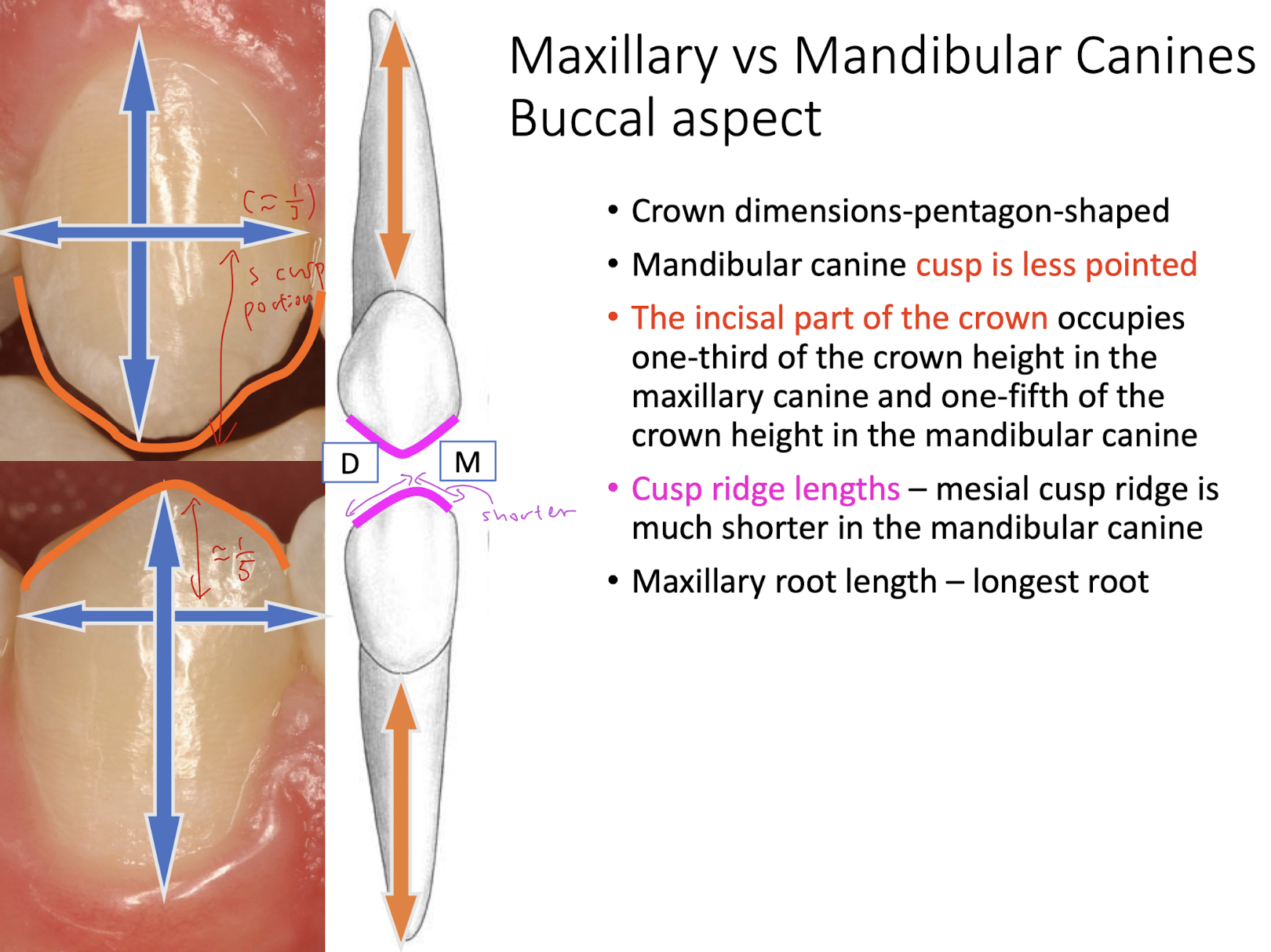
maxillary vs mandibular canines (buccal)
crown dimensions both pentagon-shaped
mandibular cusp < pointed
incisal part of crown occupies 1/3 of crown height in maxillary canine
1/5 of crown heights in mandibular
cusp ridge lengths
mesial cusp ridge shorter in mandibular
maxillary longest root length
maxillary vs mandibular canines (lingual)
cingulum
> well defined and central in maxillary
marginal ridge prominance
significant in maxillary
lingual ridge
prominent in maxillary, insignificant in mandibular
lingual fossae depth prominent in maxillary

maxillary vs mandibular canines (incisal)
crown symmetry
maxillary - asymmetrical
mandibular - > symmetrical
distal bulge
maxillary - well prominent
mandibular - insignificant
incisal edge
maxillary - thicker than in mandibular
facial/ labial ridge
prominent in maxillary

right vs left canines
distal cusp ridge
longer and > sweeping/ oblique
mesial shorter, steeper/ vertical
distal labial outline
S-curve (convex middle third, slight cervical concavity)
vs mesial: straighter line
distal root depression
deeper developmental groove
general features of premolars
at least 2 cusps
1 large bucal
smaller lingual
= bicuspid
lower 2nd premolar may have 3 cusps (1 buccal + 2 lingual)
maxillary 1st premolar

maxillary 1st premolar (buccal)
elevations
convex surface (max at cervical ridge
prominent ‘buccal ridge’
depressions
shallow depressions - mesial and distal to buccal ridge

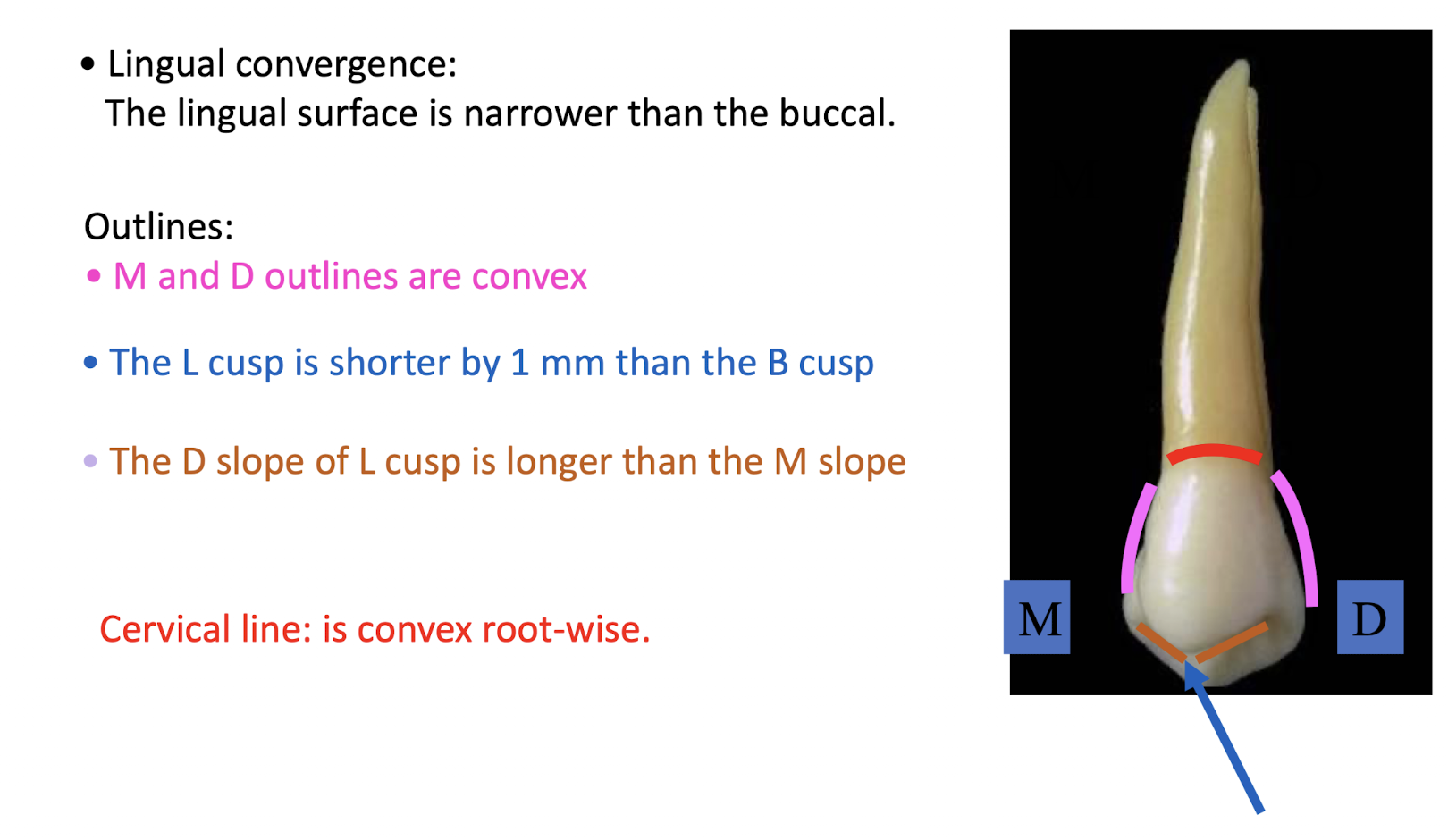
maxillary 1st premolar (lingual)
lingual convergence
lingual surface narrower than buccal
M and D outlines convex
L cusp shorter by 1mm than B
D slope of L cusp longer than m
cervical line: convex root-wise (towards root)
maxillary 1st premolar (occlusal - geometric outline)
polygonal/ hexagonal
2 equal buccal sides (MB, DB)
M side shorter than D
ML side shorter than DL side
B-L dimension > M-D
crown wider bucally than lingually (lingual convergence)
maxillary 1st premolar (occlusal - surface anatomy)
2 cusps
elevations
1 buccal triangular ridge
1 palatal triangular ridge
mesial and distal marginal ridges
depressions
central developmental groove
mesial and distal triangular fossae
mesial marginal developmental groove (side trait)

most characteristic feature of maxillary 1st premolar (side and type trait)
mesial cusp ridge longer than distal
mesial marginal developmental groove

maxillary 2nd premolar
1 root
thicker marginal ridges

maxillary 1st vs 2nd premolar (buccal)

maxillary 1st vs 2nd premolar (lingual)

maxillary 1st vs 2nd premolar (mesial)

maxillary 1st vs 2nd premolar (occlusal)


maxillary 1st vs 2nd premolars: overall

mandibular 1st premolar

mandibular 1st premolar (buccal)
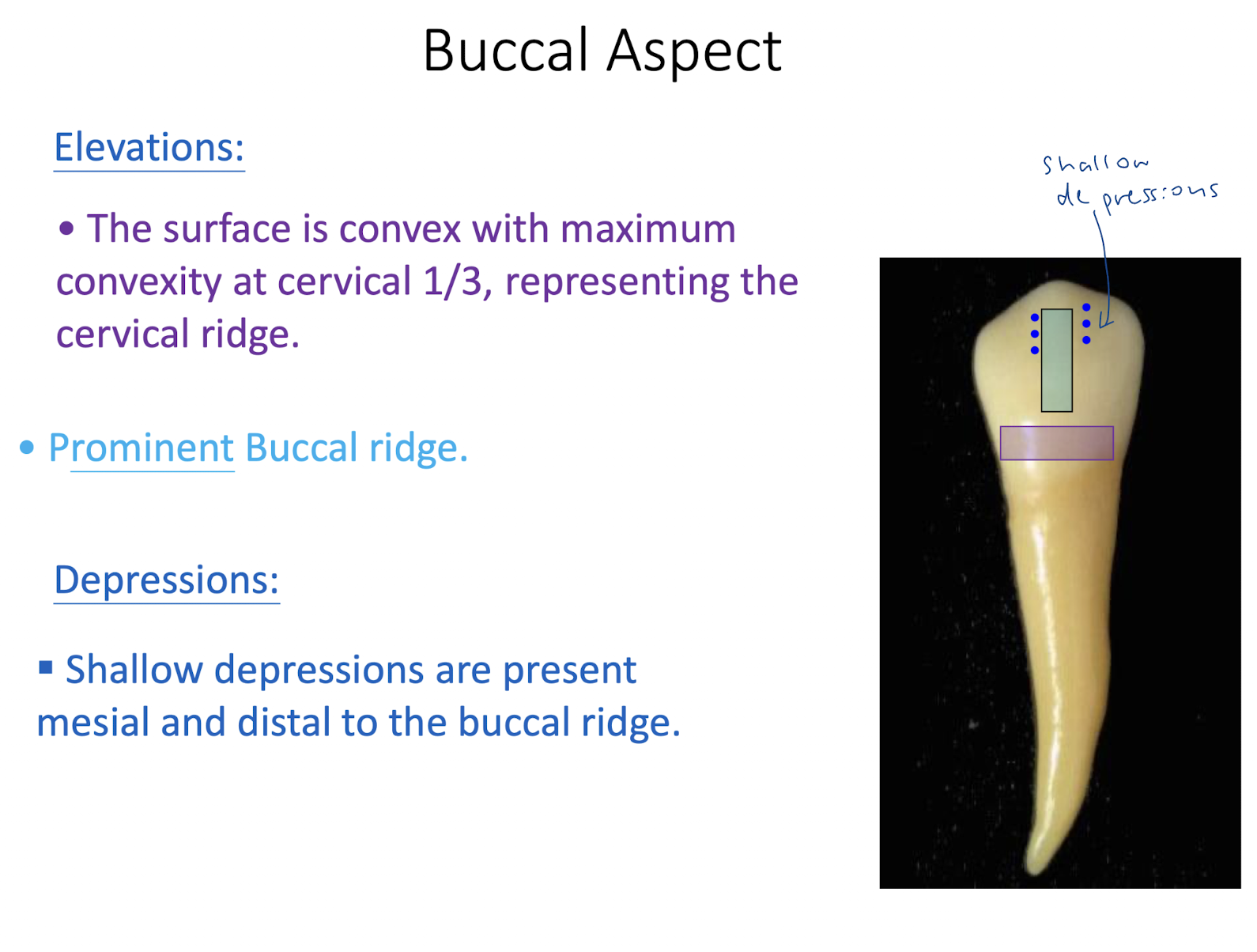
mandibular 1st premolar (lingual)
lingual convergence
lingual side narrower than buccal
outlines
M and D outlines convex
cervical line: convert root-wise
depressions
mesiolingual developmental groove at ML line angle (side trait)

mandibular 1st premolar (m+d)

mandibular 1st premolar (occlusal)

mandibular 2nd premolar (2 cusp type)
bulbous/ round
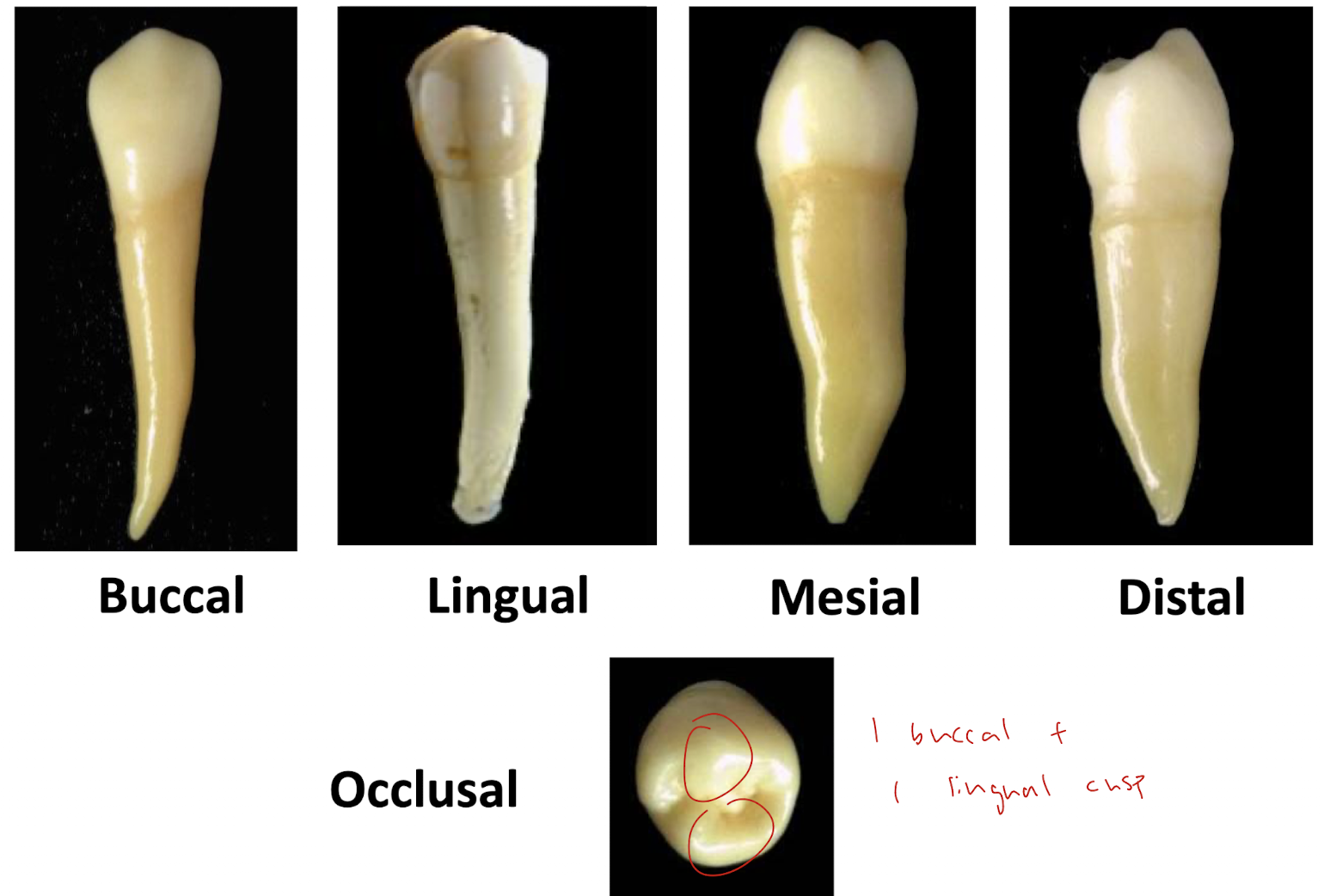
mandibular 2nd premolar vs 1st (buccal)

mandibular 2nd premolar vs 1st (m+d)

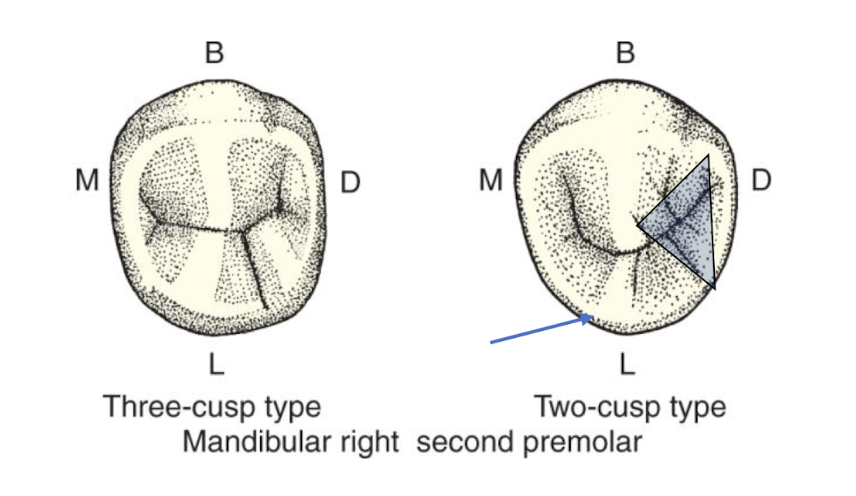
mandibular 2nd premolar vs 1st (occlusal) 2 cusp

mandibular 2nd premolar vs 1st (occlusal) 3 cusp type

side traits of mandibular 2nd premolar
2 cusp type
distal fossa generally larger than mesial
lingual cusp tip shifted mesially
3 cusp type
lingual cusp usually subdivided into mesiolingual and distolingual cusps
mesiolingual cusp wider and higher distolingual

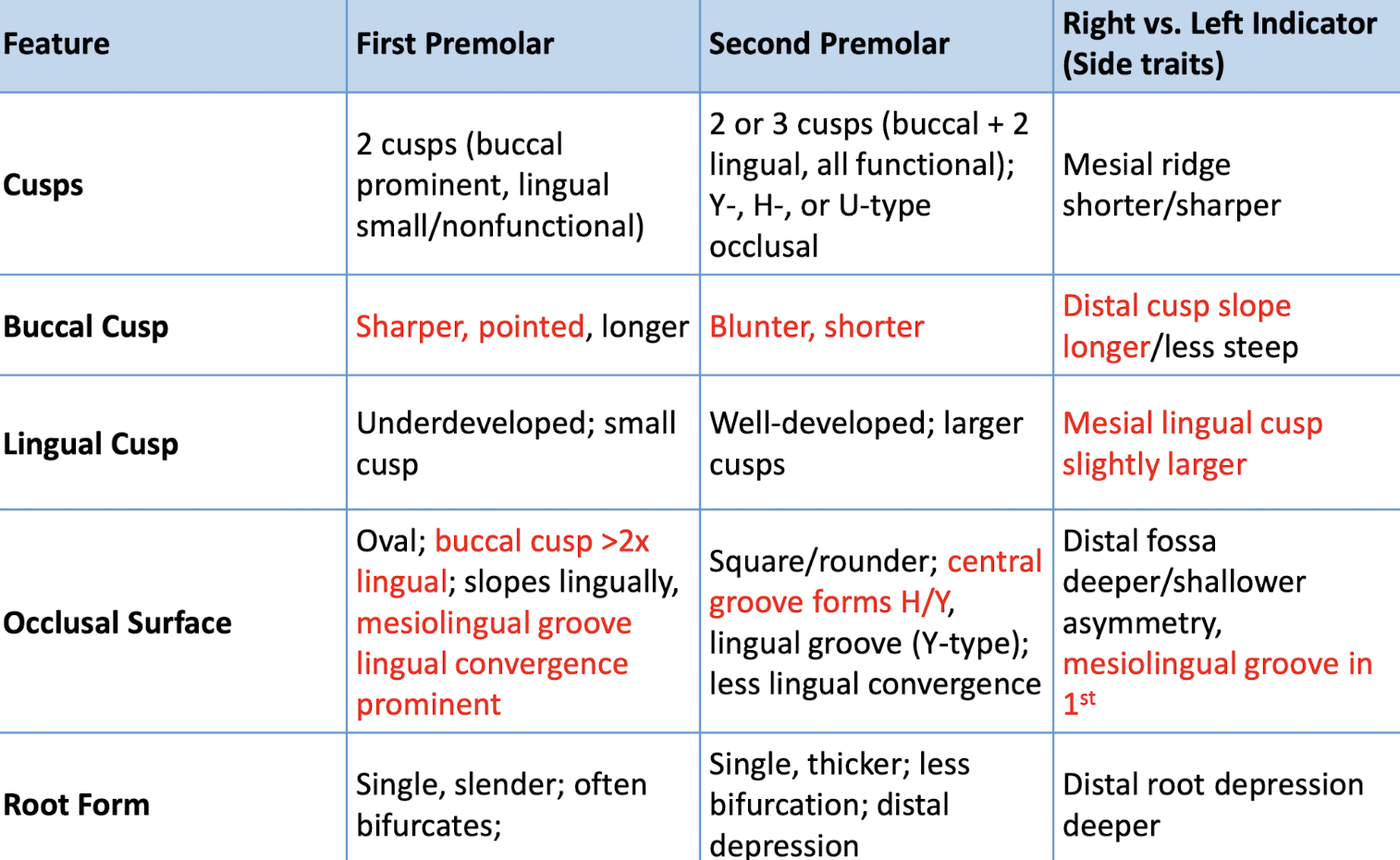
mandibular 1st vs 2nd premolars

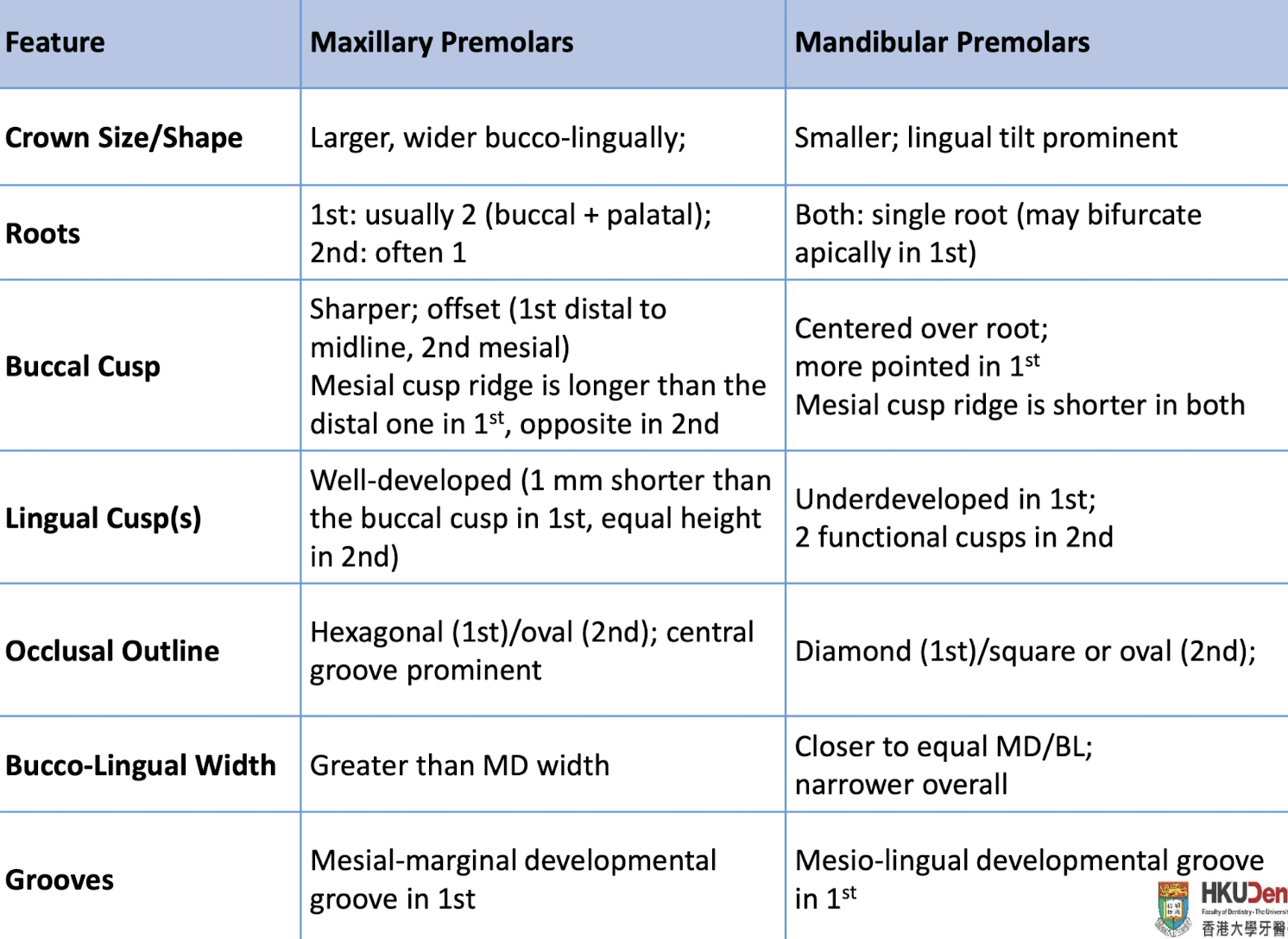
maxillary vs mandibular premolars
maxillary 1st molar
3 roots
4 cusps

maxillary 1st molar (buccal)
mesio-buccal cusp broader, shorter, < sharp than disto-buccal
cervical outline
irregular and slightly convex towards root

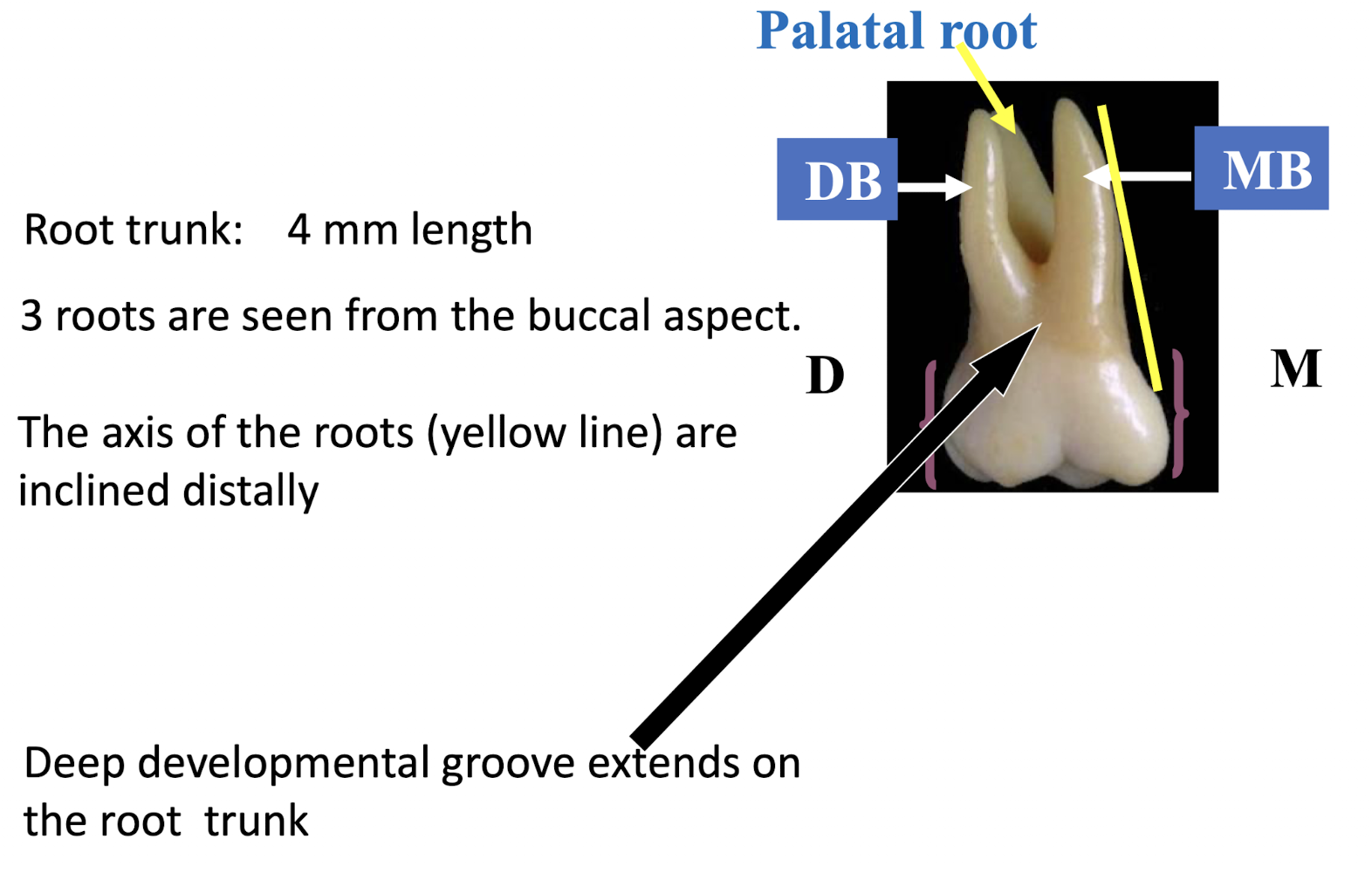
maxillary 1st molar (buccal - root)
root trunk: 4mm length
3 roots seen from buccal aspect
axis of roots inclined distally
deep developmental groove extends on root trunk
maxillary 1st molar (palatal)
ML cusp = largest
DL cusp = spheroidal
cusp of carabelli in 60% of lingual cusp surface of ML cusp (5th cusp/ tubercle)
lingual developmental groove
cervical outline: irregular and slightly convex towards root

maxillary 1st molar (occlusal)
geometric outline: rhomboidal, reduces in MD width from 1st to 3rd molar
cusp size largest → smallest
ML cusp
rounded MB
sharp DB
small distolingual
tubercle of Carabelli
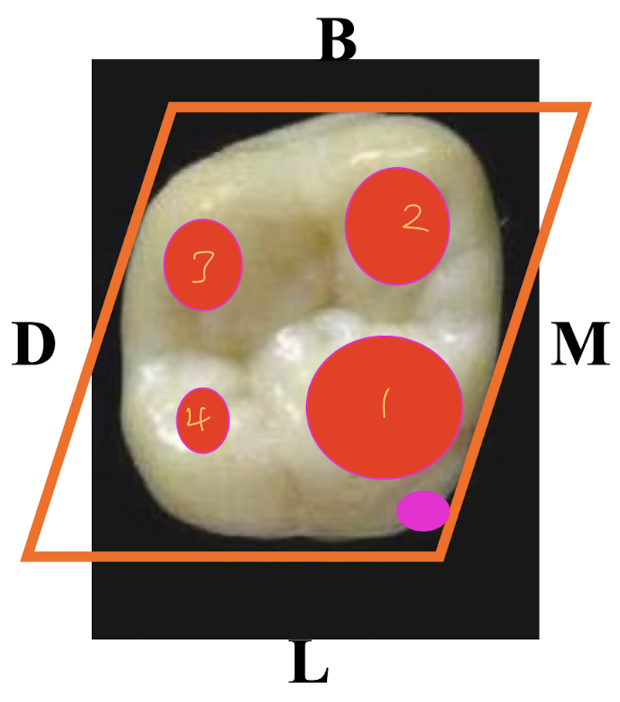
maxillary 1st molar (occlusal - elevations)
4 cusps with 4 triangular ridges and tubercle
oblique ridge
between ML, DB cusps
distal cusp ridge of ML cup and triangular ridge of DB cusp
mesial marginal and distal marginal ridges

maxillary 1st molar (occlusal - depressions)
2 major fossae (central and distal)
2 minor fossae (M + D triangular fossae)
developmental grooves (central)
maxillary 2nd molar
3 roots

maxillary 2nd molar (buccal)

maxillary 2nd molar (buccal)
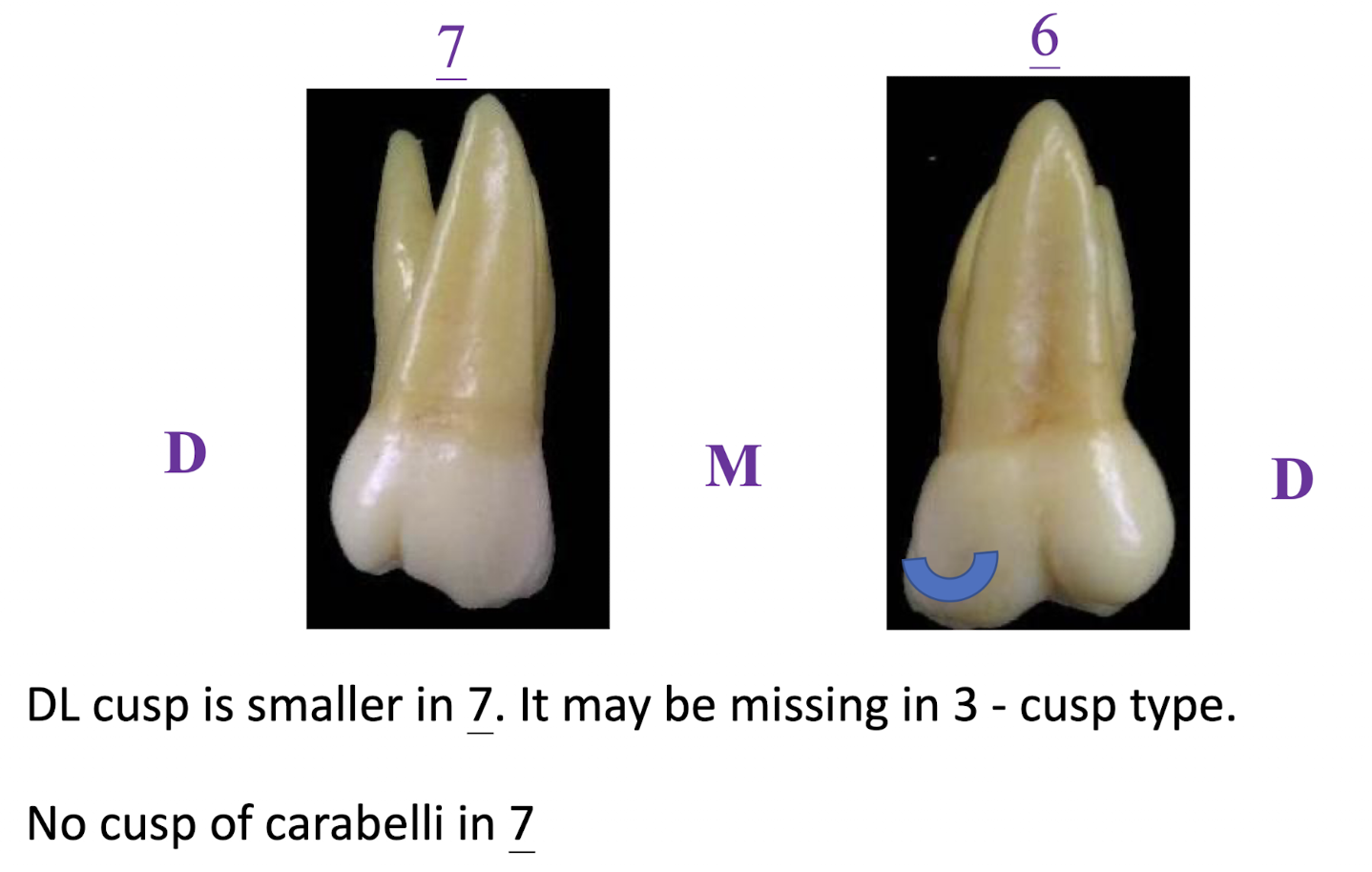
maxillary 2nd molar (mesial)

maxillary 2nd molar (occlusal)


maxillary 1st vs 2nd molars key diff

mandibular 1st molar
5 cusps
2 roots

mandibular 1st molar (buccal)
trapezoidal with small, uneven side present cervically
M outline: concave till contact area at junction of occlusal and middle 1/3
D outline: straight till contact area with distal cusp ridge

mandibular 1st molar (buccal) occlusal + cervical outline
occlusal outline
2 cusps: MB, DB, **D
cervical outline
straight with dipping into root bifurcation

mandibular 1st molar (buccal) anatomical landmarks
2 developmental grooves (MB, DB)
(in Chinese pop, may be 2 mesial roots)
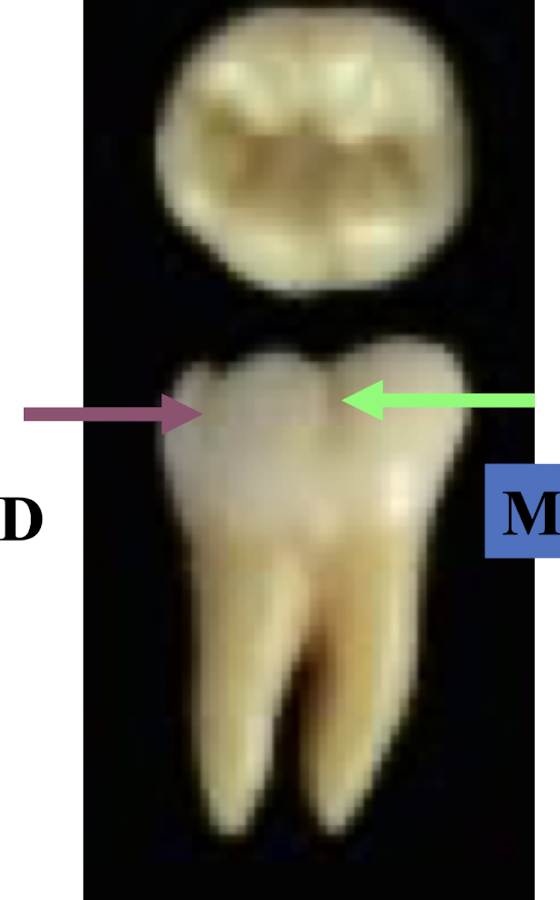
mandibular 1st molar roots
roots ~ x2 length of crown
axis of roots inclined distally
root trunks 3mm
deep developmental groove extends on root trunk

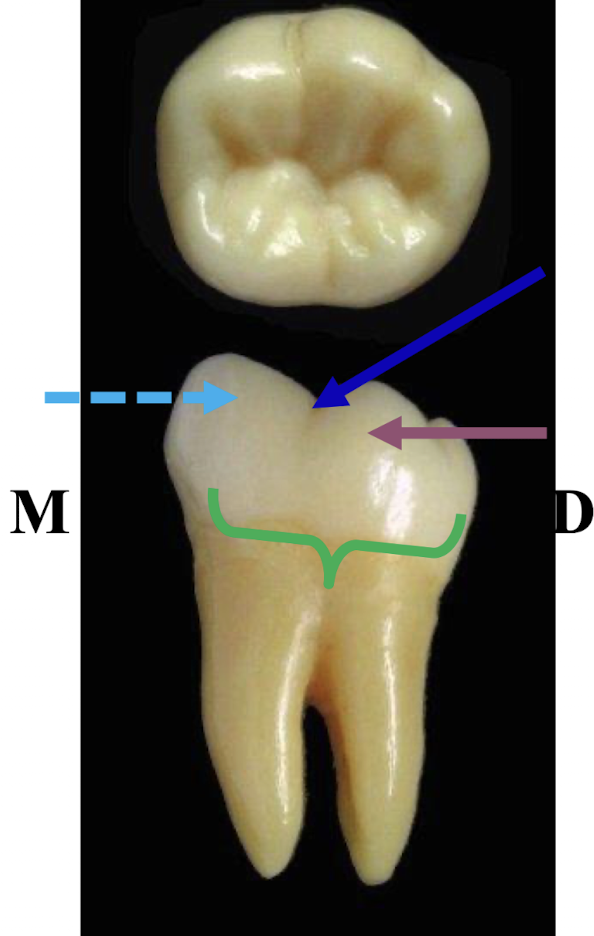
mandibular 1st molars lingual
occlusal outline
formed by 2 lingual cusps
ML, DL of nearly equal length
cervical outline
irregular with dipping into root bifurcation
anatomical landmarks
lingual developmental groove
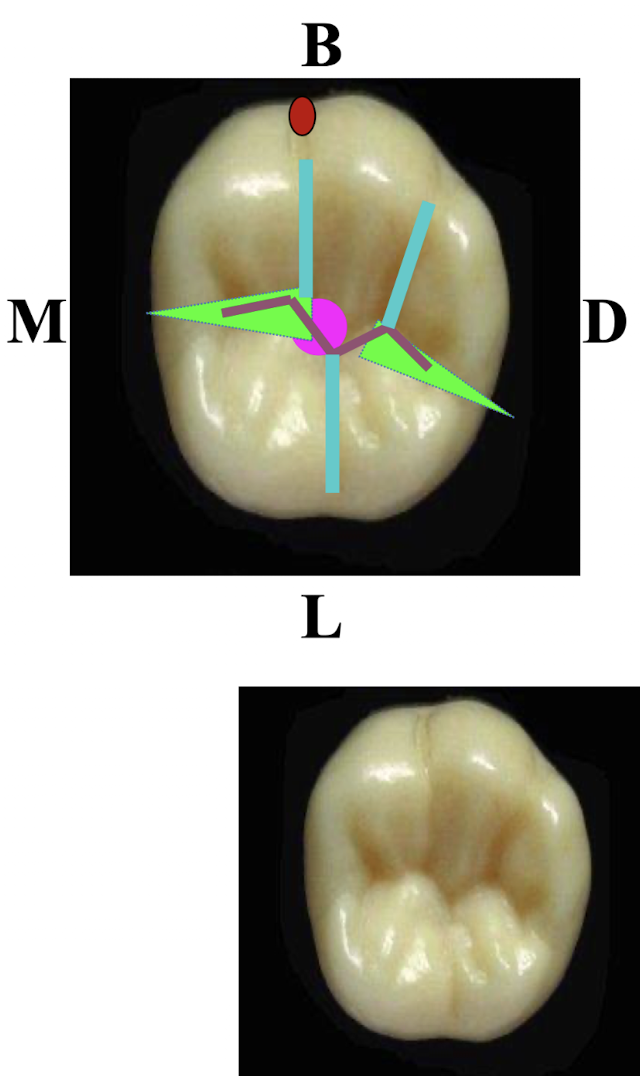
mandibular 1st molars occlusal - elevations
anatomical landmarks
zigzag groove pattern
elevations
5 cusps with 5 triangular ridges
M marginal ridge and D marginal ridge

mandibular 1st molars occlusal - depressions
1 major central fossa + pit
2 minor fossae (M + D triangular fossae)
developmental grooves
central groove = zigzag in its MD course
MB groove, DB and L groove
**MB groove may end in buccal pit (prone to caries)
mandibular 2nd molar
2 roots
4 cusps

mandibular 2nd molar - buccal
geometric outline
trapezoid with small, uneven side located cervically
anatomical landmarks
buccal developmental groove may end up in buccal pit
MB cusp longer than DB cusp
root closer and nearly parallel with > pointed apex than 6
convergence

mandibular 2nd molar - lingual
crown
lingual cusps > pointed than buccal
anatomical landmark
lingual developmental groove never pitted
root
short root trunk with developmental depression

mandibular 2nd molar mesial
geometric outline
rhomboidal with lingual inclination
M marginal ridge concave
only M root visible (M root much longer)
longitudinal depression on M surface M root

mandibular 2nd molar occlusal

mandibular molars 1st vs 2nd (occlusal)


mandibular molars 1st vs 2nd

(third molars)
