Exam 1 Cell Structure and Function- Proteins
 Call Kai
 Learn
Learn Practice Test
 Spaced Repetition
 Match
Match Flashcards
 Knowt Play
1/90

There's no tags or description
Looks like no tags are added yet.
Name | Mastery | Learn | Test | Matching | Spaced | Call with Kai | Chat |
|---|
No analytics yet
Send a link to your students to track their progress
91 Terms
Macromolecules
A very large organic molecule composed of many smaller molecules
Enzymes
biological catalysts that increase the rates of chemical reactions
Structural Proteins
physical support and shape
motility proteins
contraction and movement
regulatory proteins
control and coordinate cell function
Transport Proteins
move substances in and out of cells
signaling proteins
communication between cells
receptor proteins
enable cells to respond to chemical stimuli from the environment
defensive proteins
protect against disease
storage proteins
store amino acids
How many kinds of amino acids are used in protein synthesis?
20
How many possibilities of proteins are there?
practically infinite
True or False: Two different proteins can have the same amino acid sequence
False
True or false: every amino acid has the same basic structure
true
Carboxyl group
COOH
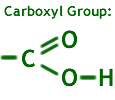
Amino group
NH2

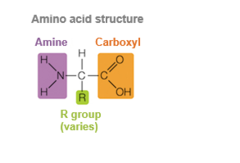
R group
defines a particular amino acid
alpha carbon
Central carbon atom in amino acids.

Each amino acid consists of
central carbon atom, hydrogen atom, amino group (-NH2), carboxyl group (-COOH), R group
All amino acids in the human body are
L- amino acids
L- amino acid
amino group on the left

D-amino acid
amino group on the right
Polar, charged (Acidic) Amino Acids
R-group side chain has a negative charge

Polar, charged (Basic) Amino Acids
R-group side chain has a positive charge

Polar, uncharged (Hydrophilic) Amino Acids
R-group has no charge, but has Oxygen (O), Nitrogen (N), or Sulfur (S) atoms

Nonpolar (Hydrophobic) amino acid
R-group made almost entirely of Carbon (C) and Hydrogen (H) atoms with no charges and no (-OH) groups.
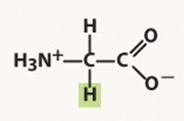
What nonpolar amino acid is the only amino acid to not have separate L and D isomers?
Glycine
dehydration (condensation) reaction
A chemical reaction in which molecules combine by removing water
peptide bond
The chemical bond that forms between the carboxyl group of one amino acid and the amino group of another amino acid
Which two functional groups must react with each other to link two amino acids together
carboxyl group of the first amino acid and the amino group of the second amino acid.
two distinct ends of any growing polypeptide chain
The N-terminus (free amino group at the start) and the C-terminus (free carboxyl group at the end).
Product of dehydration
Water
Monomeric proteins
consist of a single polypeptide
multimeric proteins
consist of two or more polypeptides
Dimers
proteins with two polypeptide subunits
Trimers
proteins consisting of three polypeptides
Hemoglobin structure
two alpha subunits and two beta subunits
Distinction between polypeptide and protein
Proteins may be made up of multiple polypeptides
Protein conformation
proper three-dimensional shape of a protein.
True or False: Proteins rely only on noncovalent interactions to fold properly and maintain stability.
False
Which three parts of an amino acid residue can actively participate in the bonds and interactions that stabilize a protein?
The carboxyl group, the amino group, and the R group (side chain)
Amino acid residues
amino acids which have been incorporated into the peptide chain
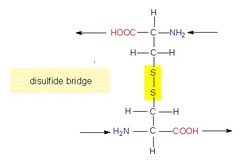
disulfide bond
the covalent bond formed between the sulfur atoms of two cysteines in a protein; typically causes the protein to fold by bringing otherwise distant parts of the protein close together
Cysteine Residues
Amino acids forming disulfide bonds in proteins.
Covalent bonds in protein folding and stability
peptide bonds, disulfide bonds
Non-covalent bonds in protein folding and stability
hydrogen bonds, ionic bonds, van der waals and hydrophobic interactions
type of weak forces make up the absolute majority of interactions responsible for holding a folded protein together
Van der Waals and hydrophobic interactions.
disulfide bonds are most commonly found stabilizing what specific category of proteins?
extracellular proteins
True of False: Hydrogen bonds are less polar than ionic bonds
true
ionic bond
charged interaction between fully positive and fully negative functional groups

primary structure of a protein
amino acid sequence

Which type of chemical bond holds the primary structure together?
Covalent peptide bonds.
True or False: R-group side chains are actively involved in stabilizing secondary protein structures.
False
secondary structure of protein
Local structure of a protein structure formed by folding and twisting of amino acid chain into alpha helices or beta pleated sheets
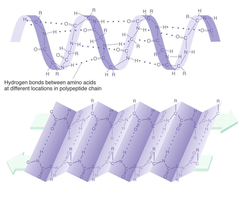
Which specific groups form the hydrogen bonds that stabilize secondary structure?
The amino (NH) and carboxyl (CO) groups of the peptide bonds in the backbone.
protein conformation
the specific, proper way a protein is folded based on both covalent bonds, and noncovalent interactions
tertiary structure of protein
3D folding of. single polypeptide chain via interactions of disulfide bonds, hydrogen bonds, van der waals forces, and hydrophobic interactions
Amino Acid sequences are written
N-terminus to C-terminus
Direction in which polypeptides are synthesized
N to C terminus
First protein to have its amino acid sequence determined
hormone insulin
Insulin is made up of what?
2 polypeptide chains linked by disulfide bond(1 alpha and 1 beta subunit)
Importance of primary structure
affects the secondary, tertiary, and quaternary structure and overall shape and function of the protein
Alpha Helix
Secondary structure- Spiral shape, peptide backbone, R groups facing outwards from spiral, H-bond forms between CO group of one a.a and NH group of another a.a

Beta Sheet
Secondary Structure- Extended Sheet-like conformation, atoms of polypeptide chains located at peaks and troughs, R groups on alternating sides of sheet
In a standard beta-sheet secondary structure, how are the side chains (R groups) of adjacent amino acids along a single beta-strand spatially oriented relative to the plane of the sheet?
side chains project outward in opposite directions
Why is a beta sheet structurally referred to as a beta -pleated sheet?
Because its successive backbone atoms are located at alternating "peaks" and "troughs", giving it a folded, accordion-like conformation.
Where are the amino acid R groups (side chains) located relative to the \(\beta \) sheet plane?
They jut out on alternating sides of the sheet (one pointing up from a peak, the next pointing down from a trough)
What is the general shape of an alpha helix
spiral
In alpha helix, where are the R groups (side chains) located?
R groups jut outward away from the spiral backbone.
How many turns away is the matching NH group from its corresponding CO partner in the helix?
1
What is the specific hydrogen bonding pattern that stabilizes an alpha helix?
A hydrogen bond forms between the CO group of amino acid \(n\) and the NH group of amino acid n+4
what structural component forms the inner spiral core of the alpha helix?
Peptide backbone
While some beta sheets form between completely separate, different polypeptide chains, they can also frequently form between different regions within a
single polypeptide chain
parallel beta sheet configuration
The interacting strands run with the same polarity relative to their N- and C-termini.
Antiparallel beta sheet configuration
The interacting strands run with opposite polarity relative to their N- and C-termini.

What type of bonding saturation characterizes a finished beta sheet secondary structure?
maximum of hydrogen bonding between the involved strands.
What is a motif (or supersecondary structure) in protein anatomy?
A supersecondary structure composed of a few secondary structure elements.

hairpin loop motif
Two adjacent, antiparallel beta strands connected by a loop

Proline is referred to as the "helix breaker" because
It lacks the hydrogen atom needed for hydrogen bonding.
What specific part of the amino acid sequence determines a protein's tertiary structure?
The interactions of the R groups (side chains).
What physical behavior do hydrophobic residues exhibit that helps drive tertiary folding?
fold inward to avoid interacting with water.
Fibrous proteins have a highly ordered, repetitive structure because they contain extensive regions of ____________ structure.
secondary
Fibroin produces silk and is made predominantly of \(\beta \) sheets, whereas keratin is the primary component of hair and is composed of many ____________.
alpha helices
Globular proteins
Compact, ball-shaped proteins that include most enzymes.
Protein domains
Individual, functional units within a protein that each do a specific job.
Proteins with multiple
functions usually have
a separate domain for
each function
AlphaFold
An AI system used to predict the 3D shapes of proteins.
Quaternary structure
multiple separate subunits interact and assemble
True or False: Secondary, tertiary, and quaternary structures are maintained solely by non-covalent bonds.
False, while they mostly use non-covalent interactions, tertiary and quaternary structures can also contain strong, covalent disulfide bonds.
What type of strong covalent bond can be found stabilizing both tertiary and quaternary protein structures?
Disulfide bonds
Which of the following is a classic example of a multimeric protein because it contains two or more different types of interacting polypeptide chains?
Hemoglobin