ECON 2020 Quiz 1
 Call Kai
 Learn
Learn Practice Test
 Spaced Repetition
 Match
Match Flashcards
 Knowt Play
1/33

There's no tags or description
Looks like no tags are added yet.
Name | Mastery | Learn | Test | Matching | Spaced | Call with Kai | Chat |
|---|
No analytics yet
Send a link to your students to track their progress
34 Terms
Economics
the study of how people make choices when resources are limited
opportunity cost=
true cost
Why do opportunity costs arise?
scarce resources
Marginal
additional or one more unit
Marginal decision
compares the additional benefit of doing something with the additional cost
Microeconomics
studies individual decision-making
Macroeconomics
studies the economy as a whole
(micro/macroeconomics) households
micro
(micro/macroeconomics) Firms
micro
(micro/macroeconomics) Industries
micro
(micro/macroeconomics) Individual markets
mico
(micro/macroeconomics) National Income
macro
(micro/macroeconomics) Employment
macro
(micro/macroeconomics) Output
macro
(micro/macroeconomics) Overall prices
macro
Positive economics
describes the world using facts and evidence
can be evaluated using data
Normative economics
describes using opinions, values, or judgements about what is good or desirable
cannot be settled by facts alone
Production Possibilities Frontier (PPF)
Shows the max combinations of 2 goods or services that can be produced with available resources and technology
Points on the PPF are
efficient
Points inside the PPF are
inefficient
Points outside the PPF are
unattainable
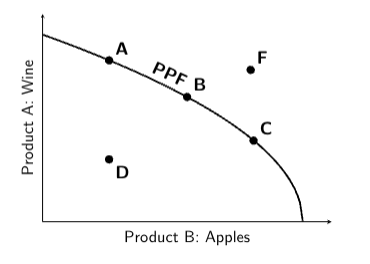
Describe: A, B, C
efficient
Describe: D
inefficient
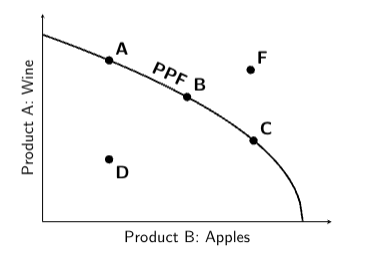

Describe: F
unattainable
Linear PPF means
constant opportunity cost
Bowed-out PPF means
increasing opportunity cost
What does movement along the PPF show?
trade-off
outward PPF shift
Economic growth, better technology, more resources
inward PPF shift
Natural disasters, war, loss of resources
Absolute advantage
ability to produce more of a good using the same amount of resources
Comparative advantage
the ability to produce a good at a lower opportunity cost
what is trade based on? (absolute/comparative advantage)
comparative advantage
Opportunity cost formula
(what is given up)/(What is gained)
For a trade to benefit both parties
trade price must fall between opportunity costs