Software Engineering Module 3: Software Automation
 Call Kai
 Learn
Learn Practice Test
 Spaced Repetition
 Match
Match Flashcards
 Knowt Play
1/31

There's no tags or description
Looks like no tags are added yet.
Name | Mastery | Learn | Test | Matching | Spaced | Call with Kai | Chat |
|---|
No analytics yet
Send a link to your students to track their progress
32 Terms
Key Characteristics of Machine Learning (ML)
Learning from data, Prediction and decision-making, Automation
DevOps
Set of practices that combines software development (Dev) and IT operations (Ops)
Functions of DevOps
Predictive Analytics in CI/CD Pipelines, Intelligent Resource Management, Automated Incident Management
MLOps
Automated process of designing, training and deploying machine learning models
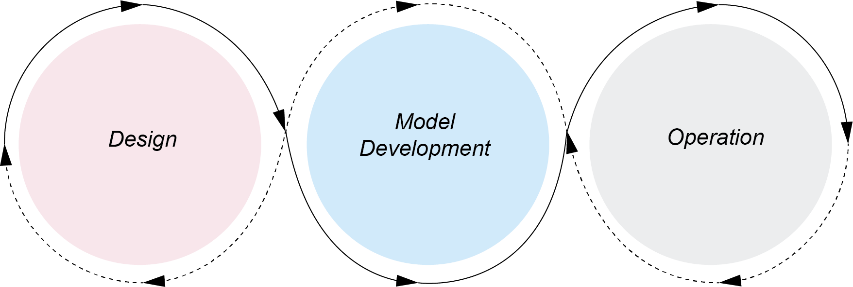
MLOps Design Stage
Defining business problem, refactoring business problem into machine learning problem, defining success metrics, researching available data
MLOps Model Development Stage
Data wrangling, feature engineering, model training, model testing and validation
MLOps Operations Stage
Model deployment, supporting operations/use, monitoring model performance
Robotic Process Automation (RPA)
Uses software robots or “bots” to automate repetitive, rule-based tasks traditionally performed by humans
ML in RPA
Handling Unstructured Data, Intelligent Decision-Making
Business Process Automation (BPA)
Use of technology to automate complex business processes, aiming to increase efficiency, reduce human error, and improve overall productivity
ML in BPA
Automating Decision-Making, Handling Unstructured Data in Business Workflows
Artificial Intelligence (AI) vs. Machine Learning (ML)
AI: making decisions, understanding languages, recognising objects, playing games
ML: (specific method within AI) learn from data, identify patterns, make decisions with minimal human intervention
ML Training Models
Supervised, Unsupervised, Semi-Supervised, Reinforcement
Supervised Learning Use Case
Predictive or Classification
Unsupervised Learning Use Case
Pattern Finding, Clustering
Semi-Supervised Learning Use Case
Combination of Supervised and Unsupervised
Reinforcement Learning Use Case
Decision-Making Over Time
Convolutional Neural Networks (CNNs)
Used to identify patterns within images
Neural Networks
Inspired by the biological neural networks in the human brain
Neural Network Structure
Input Layer, Hidden Layers (activation functions), Output Layer
Feedforward Neural Networks (FNN)
Data moves in one direction, from input to output, without cycles or feedback loops
Recurrent Neural Networks (RNN)
Designed for sequence data, have feedback connections that allow information to be passed from one time step to the next
Deep Neural Networks (DNN)
Multiple hidden layers to learn more abstract and complex features from the data
Generative Adversarial Networks (GANs)
Generator (creates fake data) and discriminator (evaluates whether data is real or fake) are trained together
Types of Machine Learning Algorithms
Linear Regression, Logistic Regression, K-Nearest Neighbour (KNN)
Key Concepts of Neural Networks
Neurons and Layers, Feedforward Process, Activation Function, Backpropagation and Gradient Descent
Impact of Automation
Safety of Workers, People with Disability, Skills Required for Development, Efficiency Waste and Environment, Economy and Wealth
Human Behaviour Influences
Psychological Responses, Acute Stress Response, Cultural Protocols, Belief Systems
AI Bias Types
Human Bias, Dataset Source Bias