Exoplanets
 Call Kai
 Learn
Learn Practice Test
 Spaced Repetition
 Match
Match Flashcards
 Knowt Play
1/18

Earn XP
Description and Tags
Name | Mastery | Learn | Test | Matching | Spaced | Call with Kai | Chat |
|---|
No analytics yet
Send a link to your students to track their progress
19 Terms
state kepler’s laws and any associated formulas
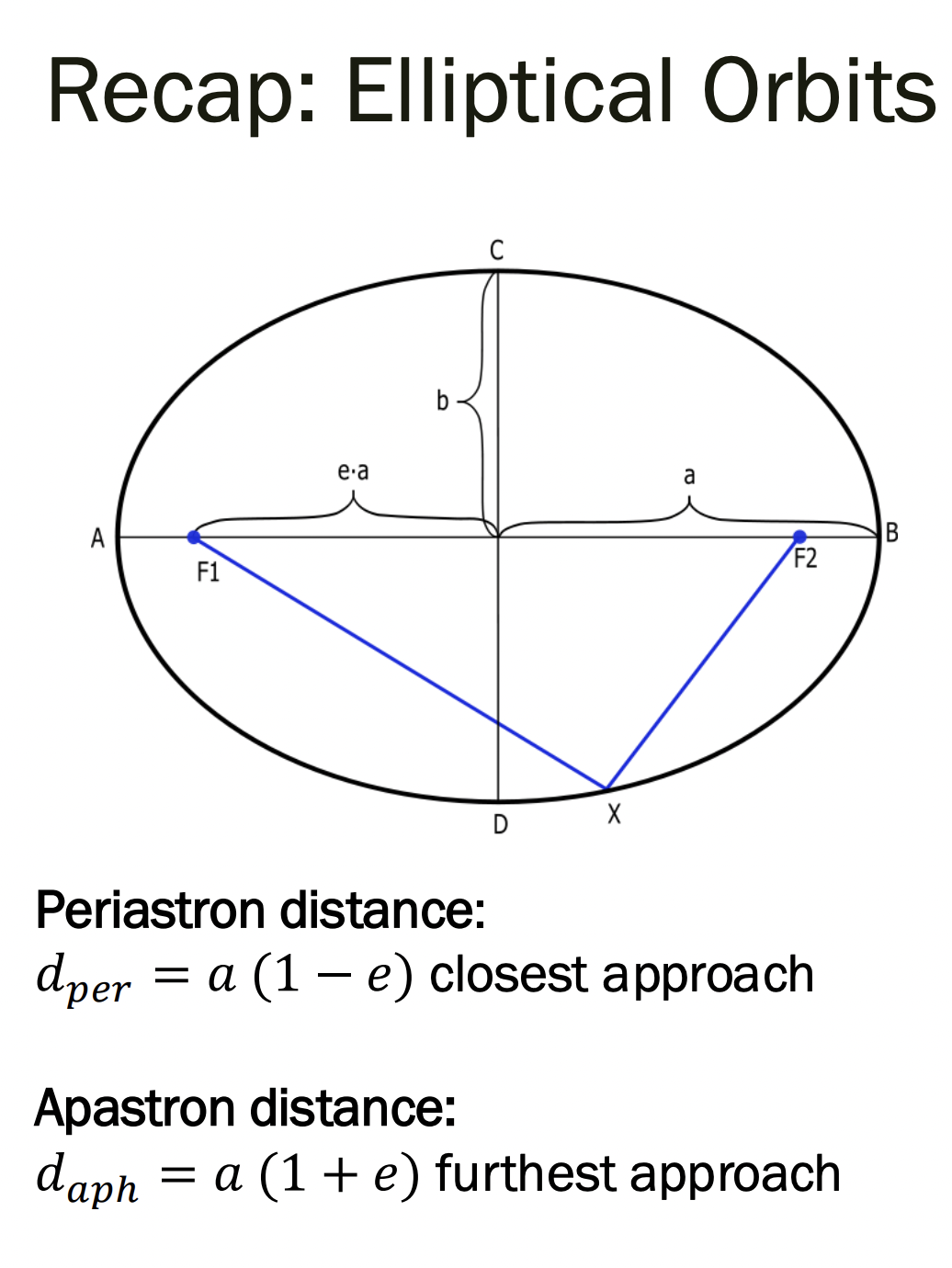
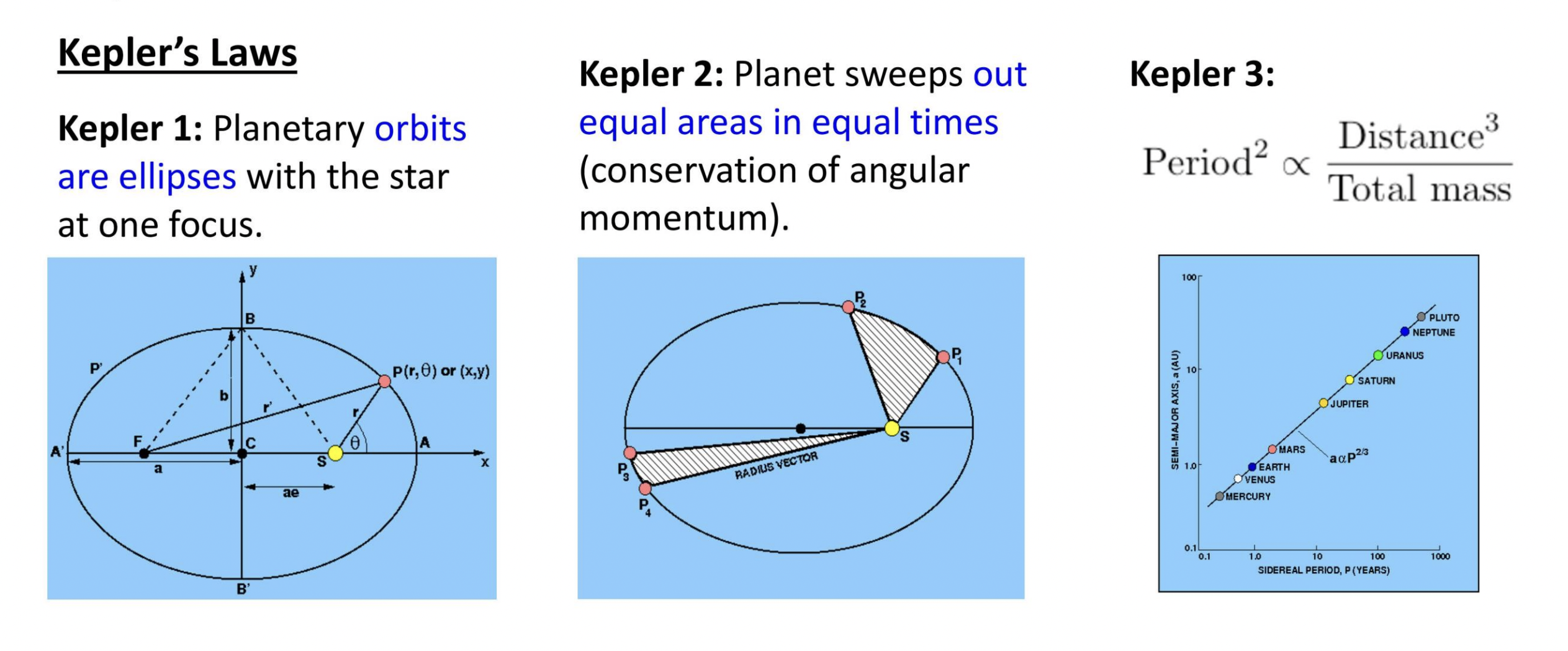
I - planetary orbits are elliptical with the star at the focus (elliptic orbits formulas)
II - the planet sweeps out equal areas in equal stretches of time
III - p2/a3 = 4𝜋2/GM⦿
what is the energy condition for the collapse of gas in initial planetary formation?
Egravity ≥ Ethermal
what is the jeans mass?
the mass at which gravitational energy exceeds thermal energy - at which collapse of gas is initiated!
what is the general reason behind the formation of protoplanetary discs?
during the formation of a star, some rotation is already present. as the gas surrounding the star begins to collapse onto itself (reaching the jeans mass!), the rotation of the gas must increase in order to conserve angular momentum (think a figure skater, as r decreases, v increases) - the gas and dust is then forced into a thinner, disc shaped structure around the star
what is meant by the centrifugal barrier? what are the associated formulas?
at some point, velocity increases enough during collapse that it halts the collapse entirely
we know that: J = vrot r = specific angular momentum
so:
rcent = J2 / GM*
direct detection method flux ratio equation?
𝜖 = 𝑓𝑝 / 𝑓* = 𝑝(𝜆) Rp2 / a2
what would the flux ratio look like for general wavelengths?
𝜖 = Rp2Tp / R*2T*
T dependance comes from B𝜐=2kBT / 𝜆2
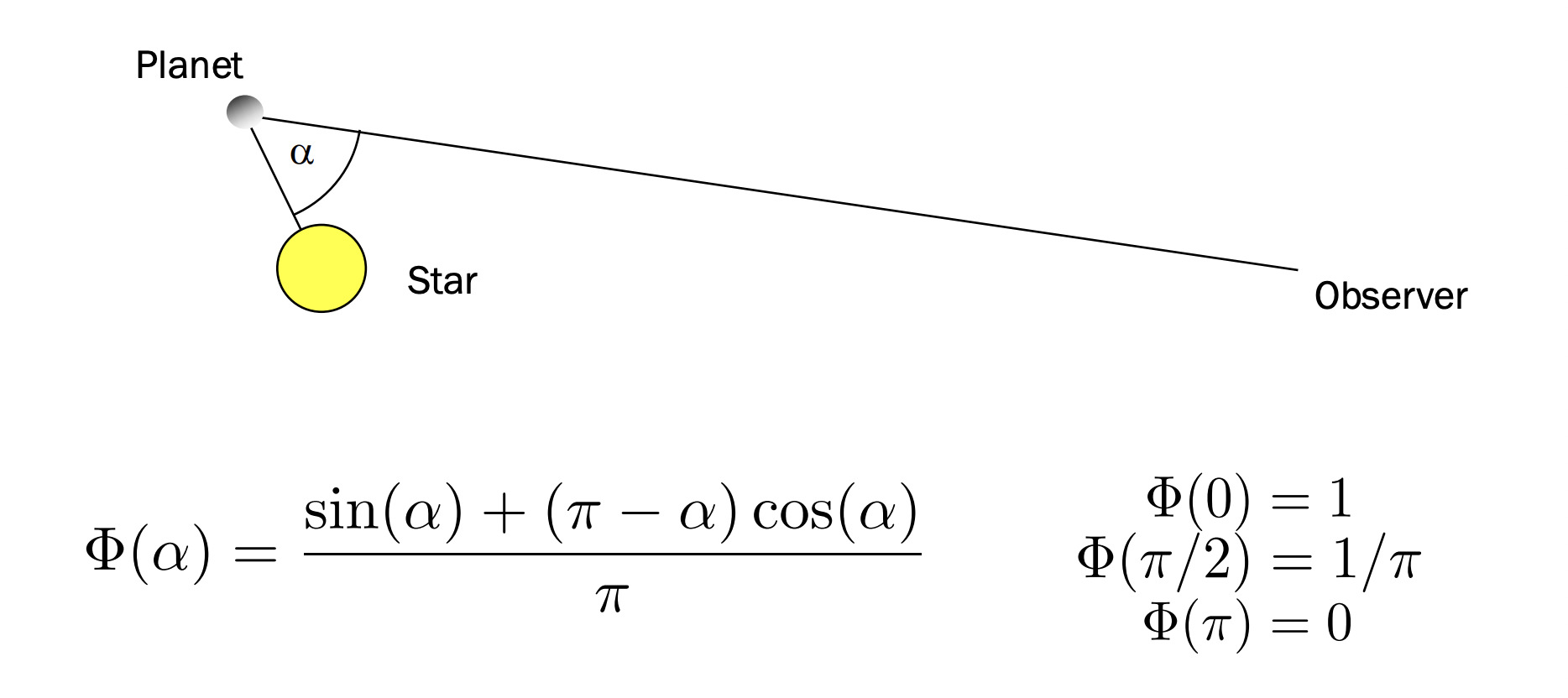
what is the phase function 𝛷 and what does it do for direct detection method?
corrects for partial illumination as a function of 𝛼 phase angle
what is the advantage of using infrared in direct detection/observation?
planets are heated from the star - often this emission is greater than the radiance of optical reflected light, so better for detection.
equilibrium temperature formula
Teq = T* (R*/2a)1/2 (1 - A)1/4
where A is the albedo
briefly describe the radial velocity method of detection
detecting the ‘wobble’ (doppler shifts) in a star caused by the gravitational pull of an orbiting planet. obviously easier to detect larger, closer in planets.
inclination does affect how well we see this wobble!
allows for the measurement of a planet’s mass with an estimate of the star’s mass.
reflex velocity formulas/ratios
V*/Vp = Mp/M*
Vp = 2𝜋a / p (from kepler’s III)
what are the 4 stages of star formation (and points at which certain planets can begin forming)
class 0 - gas and dust falling/accreting onto protostar
class I - dense core forming, protoplanetary disc begins forming around protostar
class II - protostar still contracting, now surrounded by a complete protoplanetary disc of gas and dust. this is the last point at which gas giants are able to form as the star quickly accretes the gas around it
class III - gas no longer remains, dust remains within the protoplanetary disc. star is now pre-main sequence.
explain in words the origin of the gravitational lensing effect.
a massive object in space’s gravity affects the spacetime around it, essentially ‘curving it’. light coming from behind or in an area around this massive object will ‘curve’ around it, which distorts the light and can even show light coming from directly behind the massive object.
Light from behind a massive source is seen at a different point than if the source were not present.
derive an expression for the einstein angular radius in terms of DLand DS
derivation
what is the vertical gravitational acceleration of a dust grain in an accretion disc around a protostar? derive.
derivation
what are the four main stages of planet formation, and describe what happens/ formulas you’d need to know if asked about any of these stages?
1) Dust settling and growth - accretion disc around protostar
vertical gravitational acceleration
gas density
time it takes a dust grain to settle
2) Pebbles and boulders begin to form into planetissimals
meter sized drift barrier!
3) planetissimals grow into planet sized bodies or large cores of gas giants
Hill Sphere/Radius is important here, as larger bodies absorb smaller planetissimals within its feeding zone
Isolation Mass
4) Gas accretion onto giant planet cores - accretion supplies internal energy and heats this gas up. (Reminder that this needs to happen very early on into a star’s formation)
what is the meter sized drift barrier?
Dust typically orbits a star slower than the gas, so while smaller dust grains are able to stick together easily, and larger (km sized) objects don’t feel that much of a drag force, objects around meter size feel a significant ‘headwind’ from the orbiting gas, and begin to spiral into the protostar due to this drag force. This presents a barrier to the growth of rocks and boulders that could eventually become planetissimals.