PSYCH 515 - Lectures 4 & 5 + Harlow and Tolman
 Call Kai
 Learn
Learn Practice Test
 Spaced Repetition
 Match
Match Flashcards
 Knowt Play
1/71

There's no tags or description
Looks like no tags are added yet.
Name | Mastery | Learn | Test | Matching | Spaced | Call with Kai | Chat |
|---|
No analytics yet
Send a link to your students to track their progress
72 Terms

Ocellus
Found in many insects
Not good at detecting shape, distance, or resolution
Main task is to detect light/darkness changes (supplementary)

Pigment cup
Curvature allowing different areas to detect light
Still not able to pin point direction of light, slightly better resolution

Pinhole Eye
Full curvature, allowing for detection of directionality of light
Still open, allowing water to freely flow in and out

Primitive Lens
A sheet of cells covering lens
Introduction of lens, only lets in light, even better at directionality
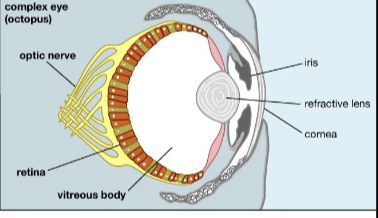
Complex Eye
Introduction of muscles that help focus lens

Octopus vs Human Eye
These are both compound eyes, but have two different evolutionary histories = Analogous Structures
Mammals have a blind spot where the optic nerve leaves the eye, octopus do not have this blind spot
Compound Eye
Evolved independent of other known eye structures, very low in resolution
Eye Placement
Eyes on sides - Prey
Have greater coverage - need to keep an out for prey
Less detail - don’t have a large binocular vision overlap
Eyes in Front - Predator/Fruit eater
Greater detail - larger binocular vision overlap, better at depth perception
Less coverage - they need to lock on prey/fruit
Color Vision
Depends on number of different color receptor types
Ultraviolet Light
Less than 400 nm
Bees and Pigeons
Some flowers under this light look like a bulls eye
Infrared Light
More than 780 nm
Vipers - Pit Organs, kinda like '“thermal vision”
Plane of Polarization
Used to tell the sun’s position from dominant band of light
Improves contrast under water
Cuttlefish uses it to define objects (prey)
Sand fleas
Sand fleas actually use camouflage, but to use they are very visible, for birds they are hard to see
Sound
Frequency - changes in pressure over time
Waves travel better in water than in air
Echolocation (Sonar)
Bats click faster (=higher frequency) creating echoes that are able to detect size, shape, and texture
Dolphins do the same to produce echoes in water
Ultrasonic Sound
Higher frequency, shorter distances, over 20,000 Hz
Infrasonic Sound
Lower frequency, longer distances, under 20 Hz
Elephants and Whales
Sound Localization
Owls have disk shaped faces that help funnel sound in
They also have asymmetrical ears, allowing to locate sound better
Lateral Line Organ
Able to detect the rate of vibrations in water - “water ears”
Somatosensory Homunculus
Representation of how much brain an animal dedicates to a touch-sensitive area of the body
Star-nosed Mole
Have most nerve ending in nose
Nose able to be used for touch, smell, and taste
Taste
water-borne chemicals
Types of receptors to alert animals to avoid poison and seek nutrients
Garter Snake
They use their tongue as a way to taste air and move air particles into nose
Males are able to sniff out the directionality of females
Silk Moth
Male silk moths are able to detect the faintest traces of female pheromones
This is done using their antennae, which are covered in scent receptors
Bloodhounds
Have six times the amount the scent receptors as humans do - their olfactory epithelium is larger
Electrical Sense
Platypus have electroreceptors that help them detect prey
Electrical current is released from prey’s muscles -n great for muddy conditions
Electrical Fields
Some fish are able to generate an electrical field allowing them to detect if fish are swimming near them
Mormyromasts
Electroreceptor that detects object echoes
Knollenorgans
Electroreceptor that detects other electric fish
Ampullary Receptors
Electroreceptor that detects muscle activity of prey
Magnetic Fields
There is not great evidence on if animals use magnetic fields
Bacteria contain particles of magnetite which would make them sensitive to magnetic fields
Innate Behavior
Fixed and genetic that are triggered or enhanced by learning
Fixed action patterns, releaser stimuli, supernormal stimuli
Learned Behavior
Acquired and modifies over development that can be affected by innate biases
Classical Conditioning, Operant Conditioning, Latent Learning
Fixed Action Pattern
A behavior that once triggered must be completed, not modifiable
Ex: once a frog sticks out its tongue it cant stop
Graylag Goose
Once the goose sees anything egg shape, it will use its beak to roll it back to the nest, even if you remove the egg
Stickleback Mating
Female follows red bellied male into the nest, where it lays its eggs, then leaves following the male
This is an example of a releaser stimulus
Releaser Stimulus
Stimuli that trigger innate behaviors
Ex: the red belly of a male stickleback for a female
Supernormal Stimuli
Objects with extreme and unnatural features that release an innate behavior
Ex: Herring Gull Egg Rolling Preference

Herring Gull Egg Rolling Preference
This is an example of a supernormal stimulus, herring gulls would roll bigger normal looking eggs more preferentially than smaller ones.

Australian Digger Wasp
The wasp does not know what the tunnel should look like, rather it shows us how behavior can be coded by genetics
If there is a hole it will create new tunnel from that hole, if neck is buried in will make the funnel in the ground
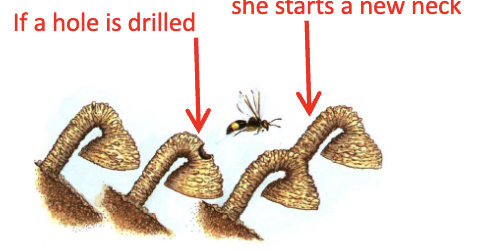
Innate Behaviors in Humans?
There are some during infancy, but they go away
There is not a clear innate human behavior
Conditioning
Associative learning
Unconditioned stimuli
Any event or thing that naturally and automatically triggers a reaction without any prior learning or training
Unconditioned Response
an automatic, natural reaction to something that happens without any prior training or learning
Learning in Classical Conditioning
US → UR
US + NS → UR
CS → CR
Blocking
When the addition of a second cue has little to no effect, the first cue is already effective
Contiguity
Occurring together (1 then 2, 2 then 1)
Contingency
Occur together in a predictive order (1 then 2, always)

Contiguity vs Contingency
Contingency forms the basis of learning
Shaping
Animal discovers the response that leads to reinforcement through trial and error
Postive
The addition of a stimulus
Negative
The removal of a stimulus
Reinforcement
Continue the behavior
Punishment
Stop the behavior
Appetitive
When an animal shows preference for a stimulus
Aversive
When an animal avoids a stimulus
Reflex Chain
Behaviorist say that animals learn a motor program
Mental Map
Cognitive People will say animals create a image of the space that they can use flexibly

Rats were able to create a mental map telling them where food was, therefore they woudl often pic the fastest path to the food
Latent Learning
Animals spontaneously combine information to produce behavior that is not explicitly trained or conditioned

On Day 1 rats freely move from room to room
On Day 2 rats receive a shock once they enter the black room
On Day 3 rats do not enter the black room at all rather just go to the white room
Innately Biased Learning
Animals are born with genetic predispositions that bias learning
The timing that is needed for learning depends on the stimulus
There are fixed modalities for the cues that can be associated with certain outcomes
Ex: Rats can learn to jump to avoid shock but not to get food
Mobbing
This is an innate behavior, but the bird still has to learn which predators to mob
Experiments show that you can teach a bird to mob to non predators
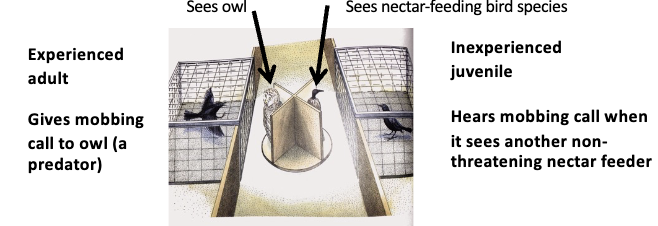
Imprinting
Chicks have this innate behavior, but they have to learn who to imprint on

Pigeons might be able to detect the polarization of light
will peak in the direction of polarization
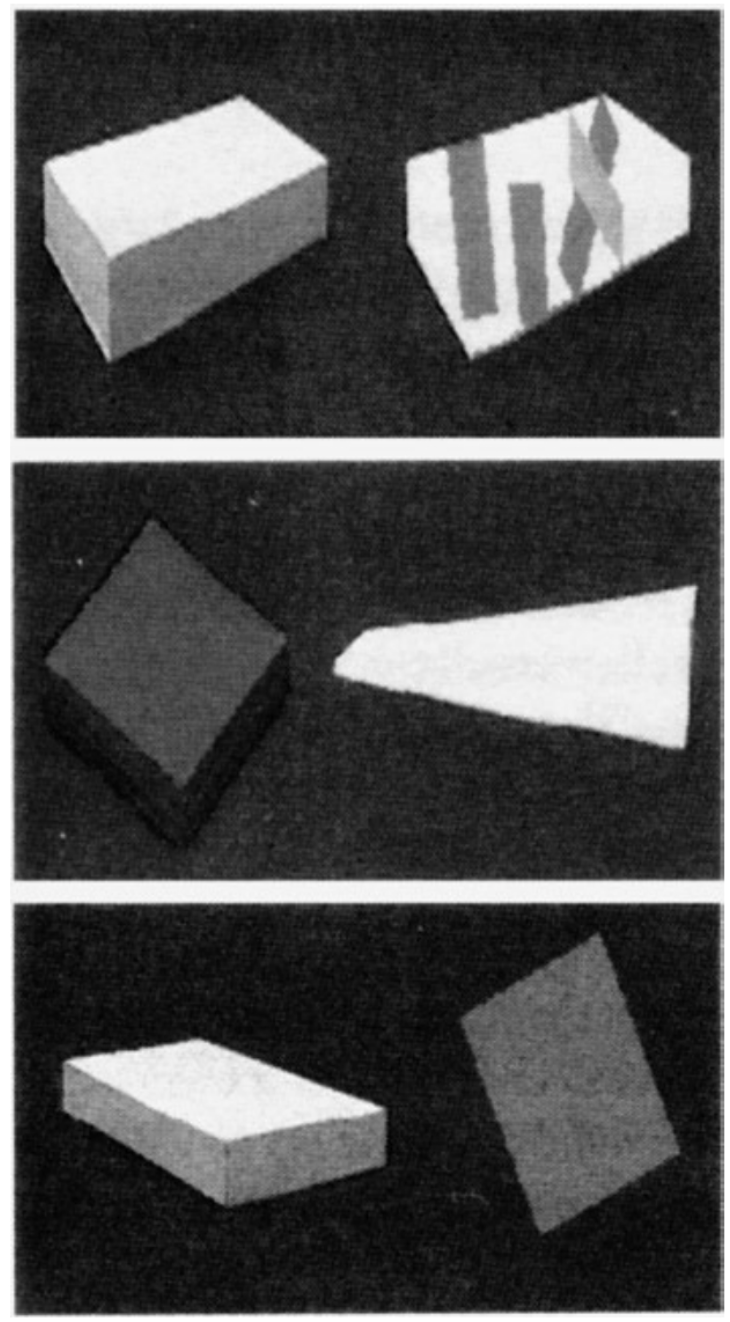
Pigeons use both perspective and shading to recognize the three-dimension-ality of two-dimensional images

Pigeons can perceive two-dimensional projections as representations of three-dimensional scenes much as we humans do

cattle (A), roe deer (B), and red deer (C) tend to sleep head facing north and rump facing south
Could be a sign of magnetic field sensing

After some training, the animal started to close the gill flap when just the mantle was touched
It learned that a mantle touch would follow with a shock (classical conditioning)

Baboons recieved attention when they would hurt themselves, but when they were ignore the rate of negative behaviors went down

Shows the percents of monkeys solving the task and if they made any errors
Those that made 1 error solved it 27% of the time
There were similar results for reversal

Reward conditions learned faster
The addition of the starved state made learning even faster