History and Examination, Classification, Terminology and IOTN
 Call Kai
 Learn
Learn Practice Test
 Spaced Repetition
 Match
Match Flashcards
 Knowt Play
1/62

There's no tags or description
Looks like no tags are added yet.
Name | Mastery | Learn | Test | Matching | Spaced | Call with Kai | Chat |
|---|
No analytics yet
Send a link to your students to track their progress
63 Terms
What is orthodontics?
Branch of dentistry concerned with the alignment and development of teeth and jaws
Overview clinical examination

History:
How could family history and past dental history be important?

In extra oral examination what 2 main things are being looked at?
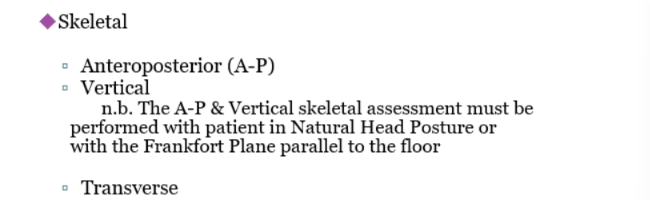
Skeletal
Soft tissue
What are 3 skeletal relationships?
Anteroposterior A-P (maxilla and mandible relative positioning to each other)
Vertical
Transverse
What 3 things can be assessed in soft tissue?
lip competence
Incisal display
Lip protrusion
2 Methods of A-P skeletal pattern assessment
Palpation (bimanual palpation method, do with fingers)
Zero meridian methods
What are the 3 possible classifications of skeletal pattern?
1 - normal relationship (between maxilla and mandible)
2 - mandible relatively retrusive
3 - mandible relatively protrusive

How to perform the palpation method?

How to perform zero meridian method?
tragus, infraorbital rim - frankfurt plane
zero meridan line is perpendicular through the Frankfurt plane and passes through the nasion

How to measure skeletal classification using the zero meridian method?
Deepest concavity of the lip - reference

Extra-oral examination:
2 measurements for vertical skeletal relations
Angular measurement
Linear measurement
What is angular measurement
2 planes and reference point
Frankfurt plane intersecting with mandibular plane - reference at the occiput - average both lines meet at the occiput in averagely proportioned individual
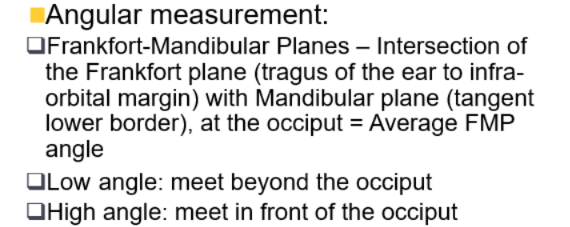
Linear measurements? (2 methods?)
Proportions - mid-eyebrows to base of nose should equal base of nose to base of chin
Absolute measurement
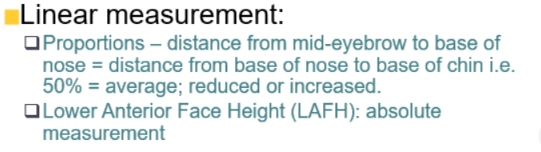
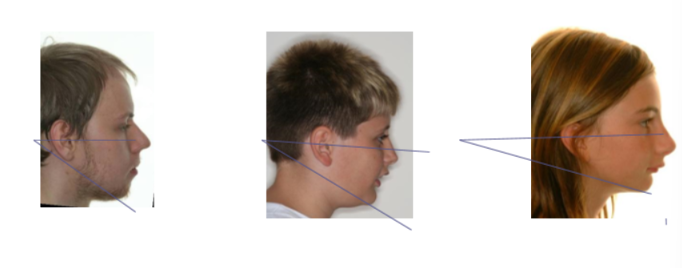
What is the Frankfurt Manidbular planes angle?
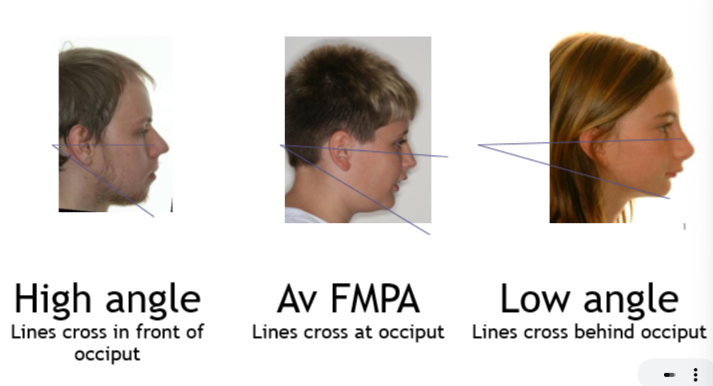
Again what are the references in vertical measurement?
lower anterioir face and midface
lower anterioir face height - soft tissue menton up to subnasale
midface height - glabella to subnasale
should be equal


What is the lower anterioir face heights?
what is absolute measurements based on?
lower anterioir face height (FMPA) with those with high angle
reduced lower anterior face height also usually associated with low angle
Based on Caucasian - 16 yo, males is 72 mm and 66 mm for females

Transverse skeletal relations
How can it be assessed?
Asses for facial symmetry - front above and behind (birds viewpoint)
mid eyebrow, tip of nose, philtrum chin should all line up (some people can have crooked nose, most people have a degree of asymmetry)
in occlusion and teeth apart (if there is a difference in the asymmetry of the mandible on closure)

Extra oral assessment: soft tissues
what are the 3 main structures?
lips
tongue
cheeks
What are 3 things to comment about lips?
Morphology
Competence at rest (should meet at rest or need strain to meet at rest then incompetent)
(lower lip should cover the incisal third of the upper incisors - get pt at rest and lift upper lip slightly up)
Function - not excessive contracture of muscles when lips are together - have a feel how tense the muscle are

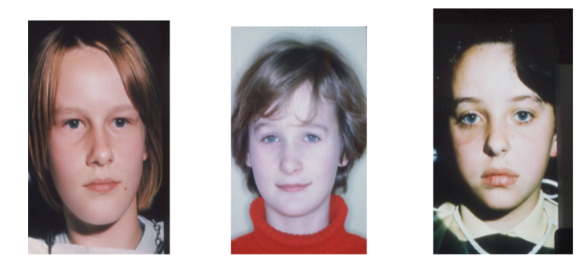
lip morphology?

What is the definition of competent lips?
Lips held together at rest
Minimal detectable electrical activity in circumoral musculature
Definition of incompetent lips?
(tend to breath through mouth)
Lips are apart at rest
some lips are held together by circumoral and mentalis contraction - check chin

What skeletal features are commonly associated with lip incompetence?
Skeletal 2 - mandible is behind maxilla so pt finds it difficult to close lips
increase LAFH - vertical distance is large so difficult to hold lips together - incisors are also in the way , the picture shows the activation of the chin muscles

What is soft tissue protrusion
what is the line called?
How much do lips protrude in relation to Rickett’s E-line (Esthetic)
far behind - retrusive
In front - protrusive


What is this showing?
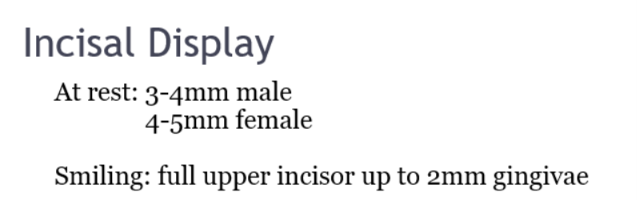
At rest peel the lower lip back - 3-4 mm for males and 4-5 mm for females
Majority of crown and up to 2mm of gingiva - when smiling is normal
Incisal display
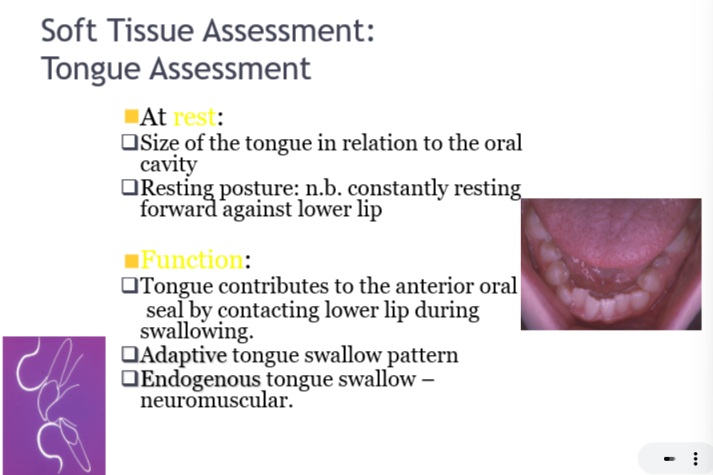
Tongue assessment?
at rest and function
Rest: size of the tongue in relation to oral cavity, resting posture
Function: adaptive tongue swallow pattern, endogenous tongue swallow - neuromuscular/down syndrome
Intraoral examination
2 main categories?
Intra-arch oral features - teeth at each arch individually
Inter-arch

What are 3 things to look for in intra-arch assessment?
Alignment of teeth - rotations
Spaced or crowded - graded
Inclination - normal, retroclined and proclined
mesio-Labial and disto-palatal rotations is the same thing so pick one

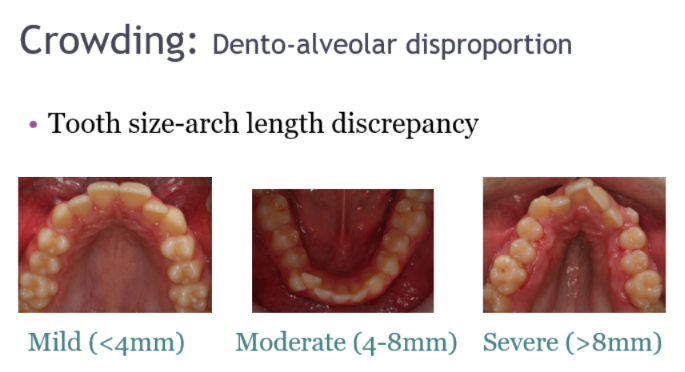
Crowding classification
How much space is missing for all teeth to be aligned within the length of the arch
“ There would need to be 8 more mm in the arch for all the teeth to be comfortably aligned”
Spacing - how is it categorised
generalised or localised
Maxillary median diastema
1st picture - localised in the upper anterior segment
2nd picture median diastema in the maxillary and mandibular arch


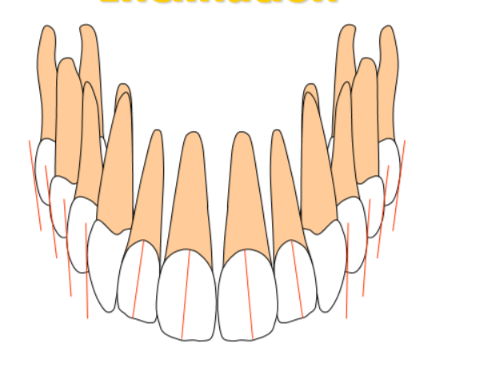
Angulation of teeth - mesiodistal tip - intra arch assessment
mesio-distal relationship between crown and the root
most teeth - crown is little more mesial to the root - particularly anterioir teeth

Inclination: bucco-lingual orientation
crown and root position relationship
applies mainly to anterioir teeth
crown is slightly more labial than root in anterioir teeth
posterior segment - root is not more buccal than crown - root is not more buccal than crown
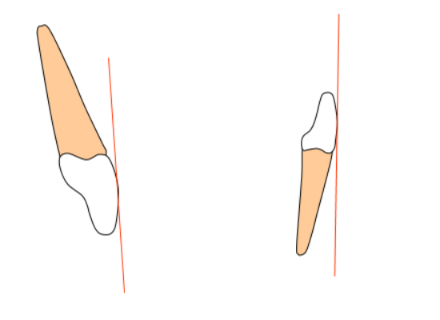
incisor inclination avg degrees
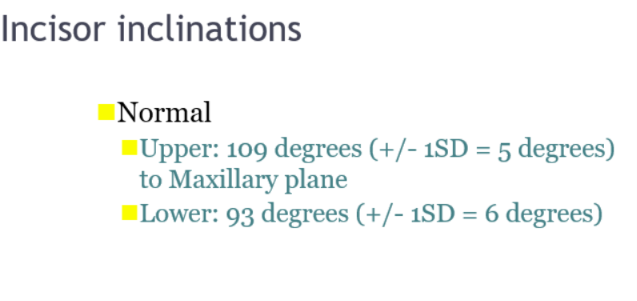

retroclined if crown is further forwards than expected
proclined with an overjet

Interarch
occlusal traits
Incisal relationship is between what
Relationship of lower incisors to palatal aspect of upper incisors
What are the 3 incisor relationships?
overjet is normal in div 2 but teeth are retroclined which explains why the overjet is not increased and could even be reduced
div 1 - class 2 with normal inclination leads to inc overjet and made worse with proclination
class 3 - can meet at the lower incisal third or anterioir
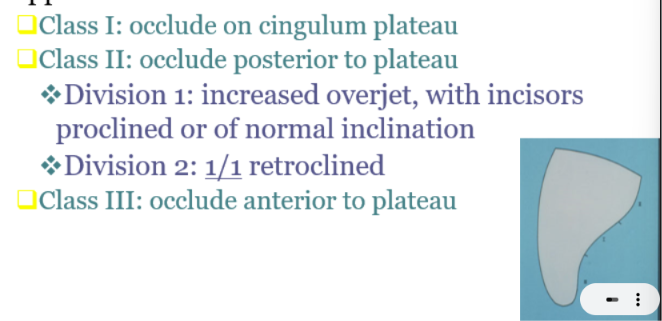

What relationship is this?
Can use a mirror under the incisal edge to see this
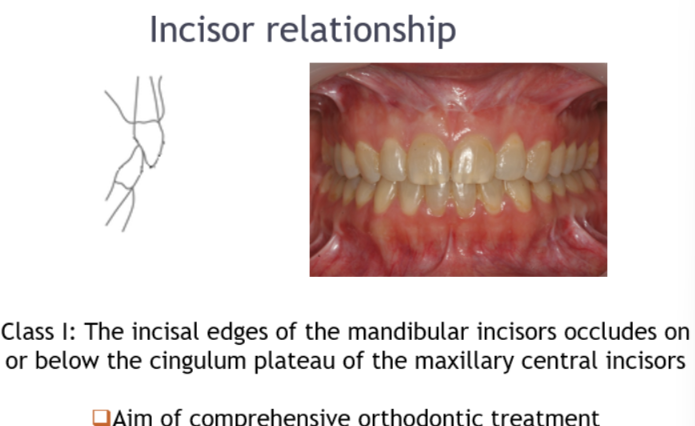

What incisor relationship is this?
about 12mm overjet


What incisor relationship is this?
features tend not to show overjet such as in div 1


Relationship?
not necessary to have a reverse bite for class 3

What is overjet and overbite?
After classification
overjet - AP measurement distance between labial surface of lower incisors and incisal edge of upper incisors
Overbite - overlap between upper and lower incisors
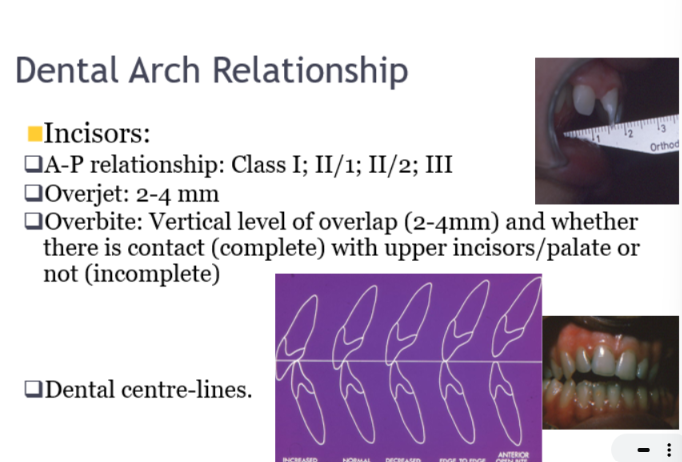
How can overjet be described as?
Increased, normal, reduced or a reversed overjet
Ideally 2-4 mm

Overbite ideal measurement?
1/3 up to ½ of lower incisor covered by upper incisor?

Classifications of overbites?
normal, reduced, increased, anterior open bite (when you look in front)
complete (teeth in contact with something/teeth/gingiva/palate) or incomplete (no contact)
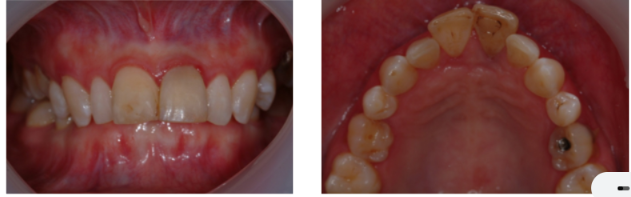
Describe this in terms of the level and if complete or incomplete?
complete (to palatal mucosa) increased overbite - traumatic as there is indentation of the mower incisors on the palate
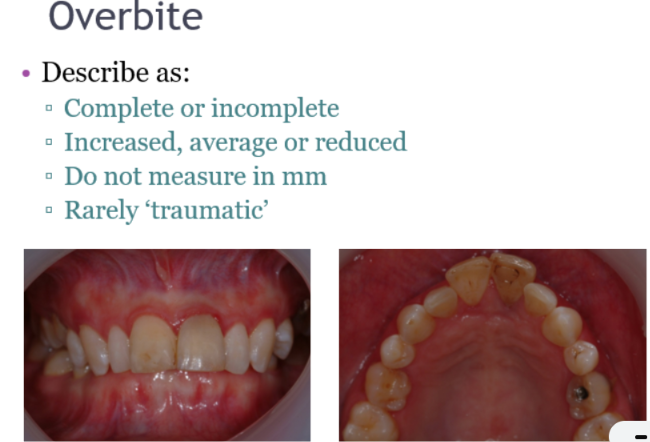


What are centrelines?
4 points
Could be dental reasons or skeletal asymmetry

What is a molar class 1 relationship
Mainly based on the 6, if not present then use other teeth
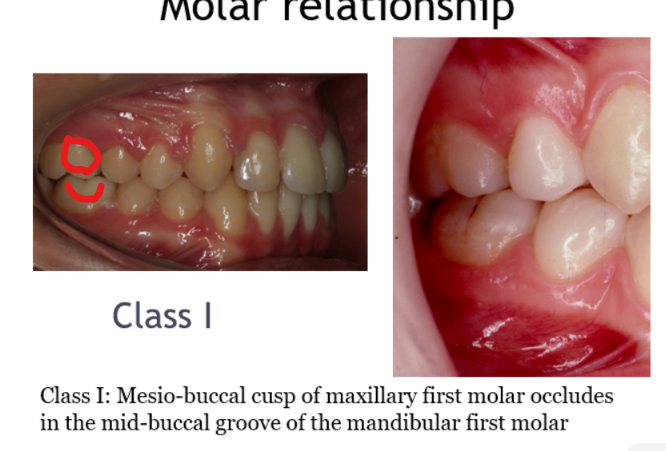
What is a class 2 and 3 molar relationship?
full unit 2 relationship - the distobuccal cusp occludes where the mesial buccal cusp should occlude

Molar relationship using canines?
in a class 1,2 1 unit, 2 ½ unit, 3 ½ unit

Crossbites:
Upper teeth should occlude x to lower teeth
what are the categories of crossbites?
buccal
anterioir or posteiror
unilateral or bilateral

Once you decide there is a crossbite, what must you then decide
Displacement?
Shift between Retruded contact and ICP

Aetiology of malocclusion? (4)
Genetic control - skeletal relations
Environmental factors - soft tissues and habits
Dento-alveolar local factors

TX aims
facial (1)
dental (5)
Facial: accept or address skeletal pattern
Dental:
relieve dental crowding and align teeth
reduce overbite and overjet (if incorrect)
eliminate cross-bite and associated mandibular displacement
achieve class 2 incisor and molar relationship
Retention at the end

How to present patients

Ideal static occlusion?
(4) andrews

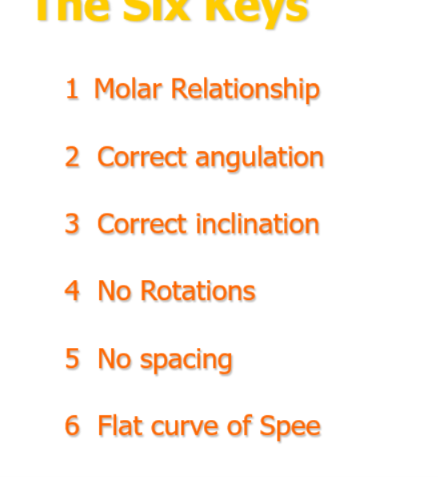
Andrews ideal occlusion
what are the 6 keys?
molar relationship
correct angulation
correct inclination
no rotations
no spacing
flat curve of spree
IOTN - index of orthodontic treatment needs

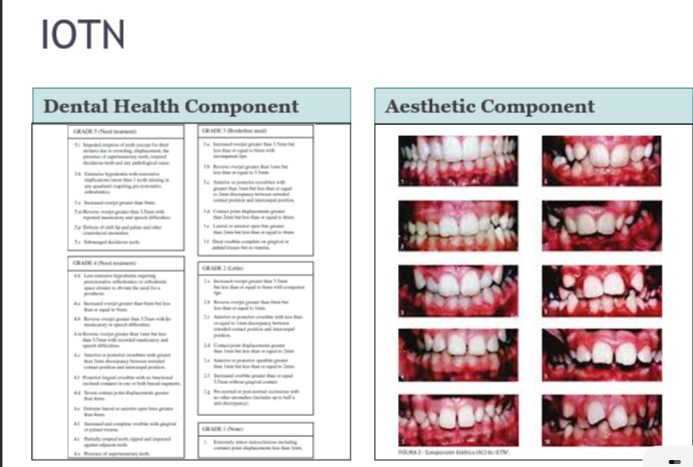
2 aspects of the IOTN
grades 1-5 for the dental health component
1-10 for aesthetics
give a score for each
MOCDO - dental health component
displacement of contact points - measure of most displaced contact points - crowding

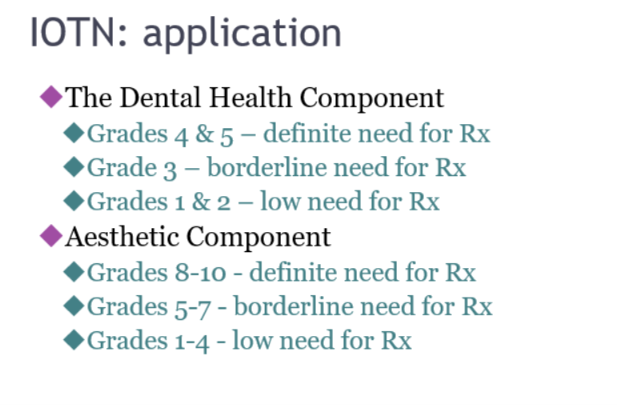
IOTN scores and meaning?