ED.09&10- EUKARYOTES
 Studied by 0 people
 Call Kai
 Learn
Learn Practice Test
 Spaced Repetition
 Match
Match Flashcards
 Knowt Play
1/23

There's no tags or description
Looks like no tags are added yet.
Name | Mastery | Learn | Test | Matching | Spaced | Call with Kai |
|---|
No study sessions yet.
24 Terms
what type of phyletic are prokaryotes and why
based on ribosomal RNA sequence data, the prokaryotes are paraphyletic. prokaryotic archaea are sister to eukaryotes. eukaryotes are embedded within archaea. the Bacteria may also be paraphyletic.
what are endosymbionts
organisms that live inside another organism (the host), often forming a mutually beneficial (mutualistic) relationship
endosymbionts in eukaryotes
mitochondria. they have their own DNA and ribosomes. the sequence of DNA has a strong homology to that of bacteria. Mito- alpha proteobacteria and plastids have cyanobacteria
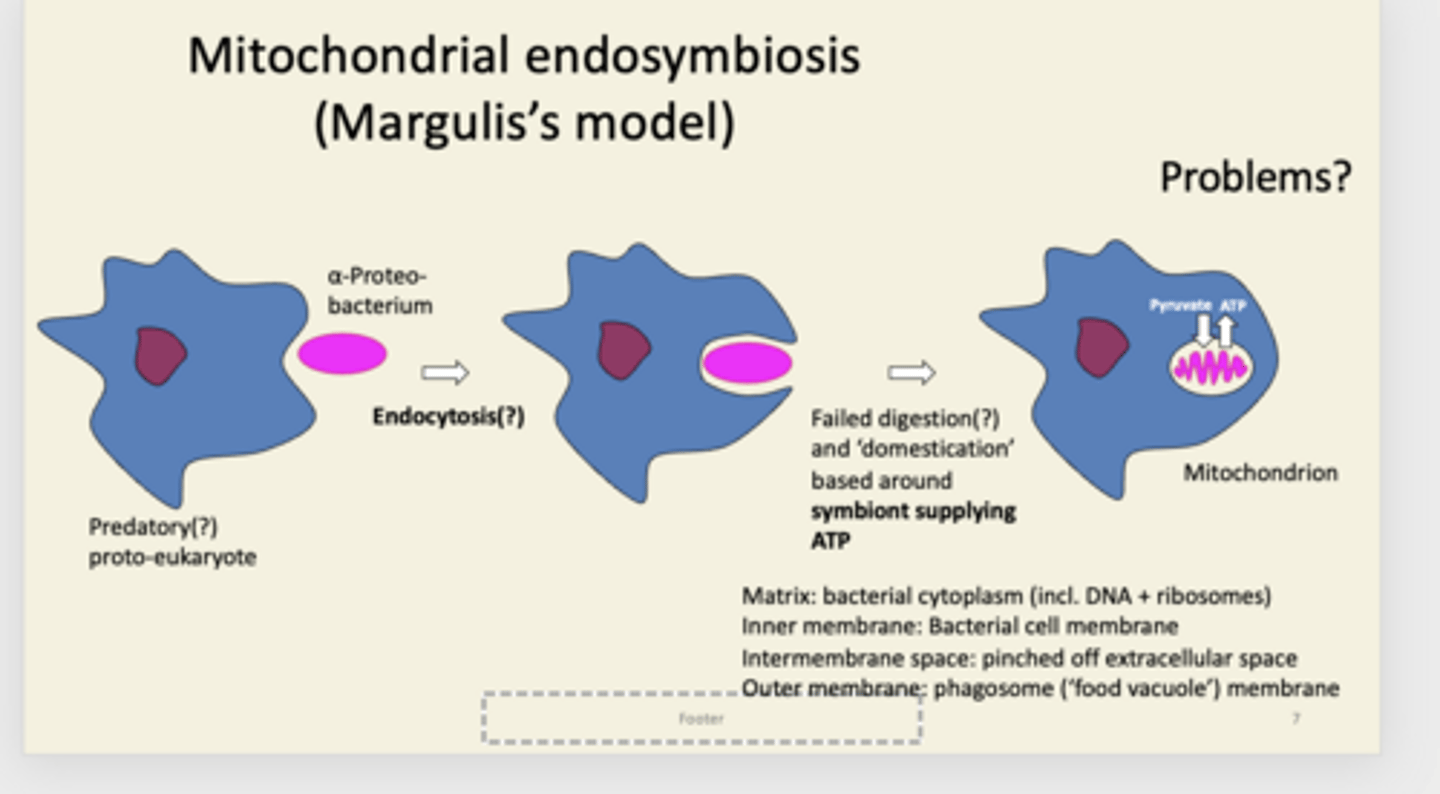
margulis's model
issue with margulis model
1. This proposes a one-off 'miracle' event. It's not impossible, but more plausible scenarios might build on a longer-term ecological association between two species that became more intimate over evolutionary time
2. A predatory cell presumably already had enough ATP and activity to engulf a bacterium - why would there then be an advantage to the symbiosis?
3. The nutritional flows are unclear: the host has to 'leak' pyruvate, and the mitochondrion has to 'leak' ATP for there to be an immediate advantage to the endosymbiosis. Neither is very likely: no bacterium actively exports ATP from its cell!
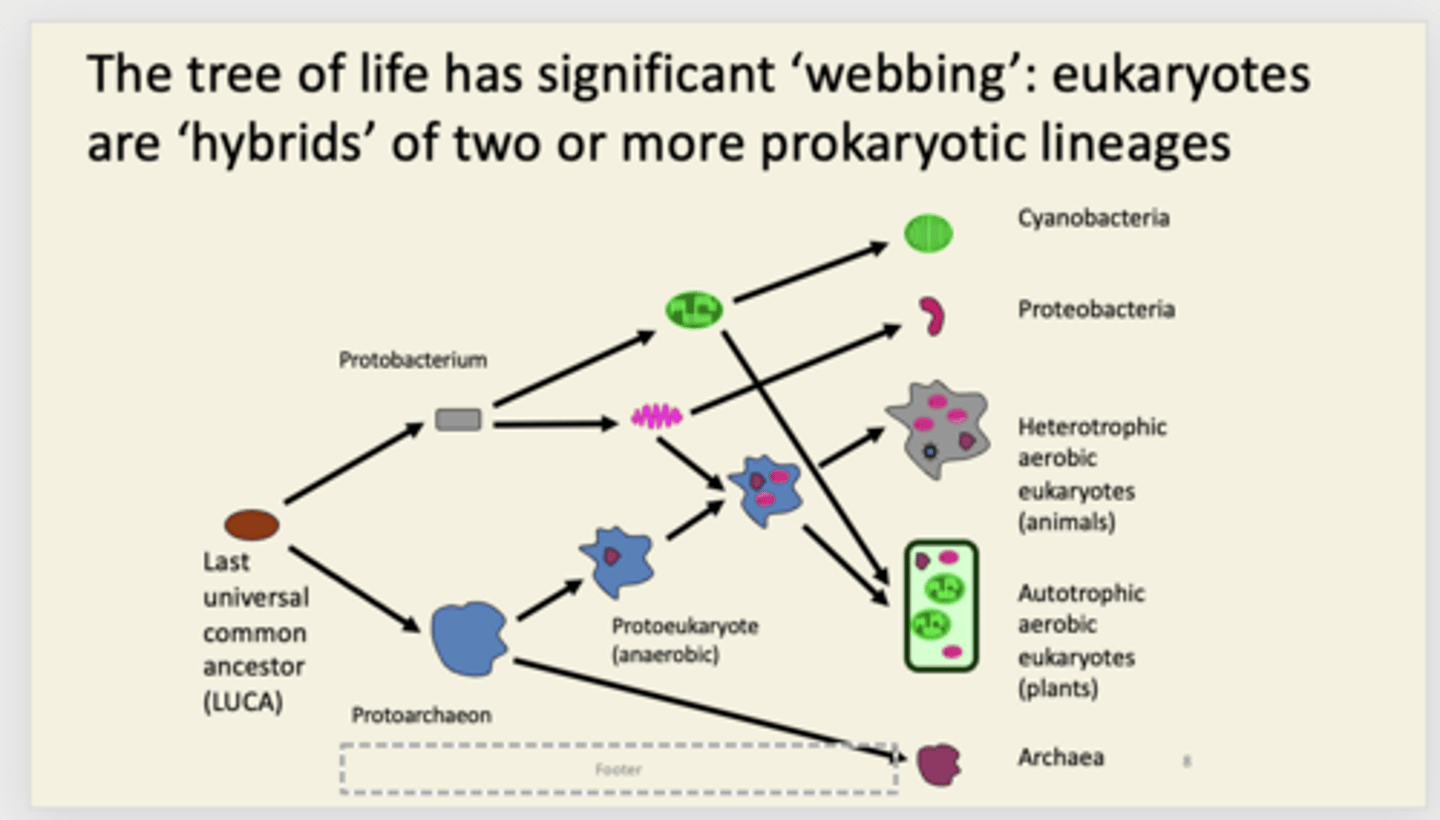
tree of life eukaryotes and archaea
Due to gene transfer from the endosymbiont to the host nucleus over evolutionary time, it is not entirely sensible to say that archaea are more closely related to eukaryotes than either are to bacteria. If you look at individual genes, some of the eukaryotic genes are of clearly (proteo and/or cyano)bacterial origin
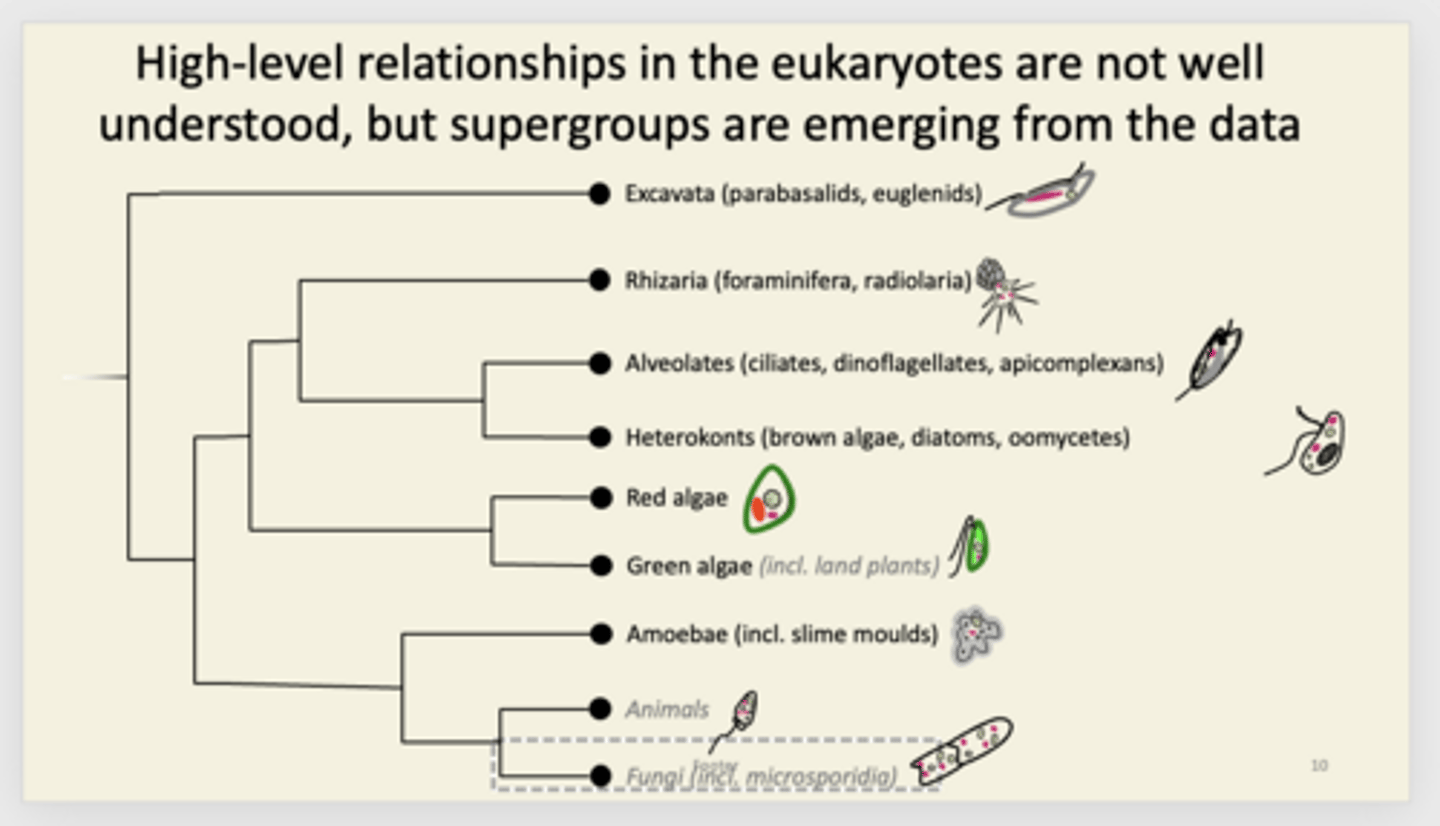
eukaryotes phylogenetic tree
excavata
unicellular, often multi-flagellate and have a feeding groove. mostly heterotrophic
rhizaria
heterotrophic marine amoeba in shells. chalk and flint. sponge spicules from Porifera and diatoms from bacillariophyta
amoebae
range from single cells to single cells that think they're multicellular
is algae mono para or poly
Polyphyletic. This is kind-of obvious from the distribution of photosynthesis/plastids across the tree. However, it's still worth doing the cladistic analysis: the result does support the idea that 'presence of plastids' is homoplasious in many cases (but that there are a couple of monophyletic subgroups: the brown+diatoms = Heterokont algae; and the green+red = Archaeplastida algae
chlorophyta
similar plastids to land plants
rhodophyta
similar plastids to land plants but also retain phycobilisomes of cyanobacteria which help harvest dim light. reef building. products- agar, carrageenan.
is green algae paraphyletic
yes wrt land plants but chloro rhodo and glaucophyte algae plus land plants form a monophyletic group
are glaucophytes primitive algae
No. 'Primitive' is not a word we should use in relation to groups, only to character states (and even there, 'plesiomorphic' or 'ancestral' is less value-laden, and is the preferred term). Glaucophytes are modern algae that happen to retain some traits of ancestral green algae, in the same way humans retain some ancestral traits of ancestral eukaryotes, in that they are unable to photosynthesise
phaeophytes
ecologically and economically important multicellular heterkont algae.
diatoms
unicellular heterokonts with silica cell walls. phytoplankton- base of food chain. shelled, hence microfossil record. Diatoms are characterised by having two half-shells (frustules), one fitting inside the other, like a Petri dish. During cell division, a new shell is formed inside each old half, so at every cell division, one of the daughter cells is slightly smaller than the parent. Eventually, this smallification becomes so extreme that the diatom has to shed the shell altogether: this process is coupled to sexual reproduction. They lack flagella, except the sperm cells of centric species, which have an anterior tinsel flagellum, betraying their relationships with the other stramenopiles.
dinoflagellates
characterised by having 2 flagella one wrapped around the cell in a groove in the shell and other is posterior. Jekyll and Hyde of marine algae. some are mutualistic and some parasitic.
phytophthora infestans
oomycetes have homoplasiously developed the being a fungus- mycelium, spores, plant pathogens. zoospore of oomycete and brown algae similar.
heterokont plastid
secondary endosymbiosis derived from red algae: count the 4 membranes
apicomplexans
malaria
ciliates
filter feeder ( vorticella) , use cilia to waft food in mouth ( stentor ). euplotes uses cilia to scuttle around hunting for food.
alveolate relationship with plastids
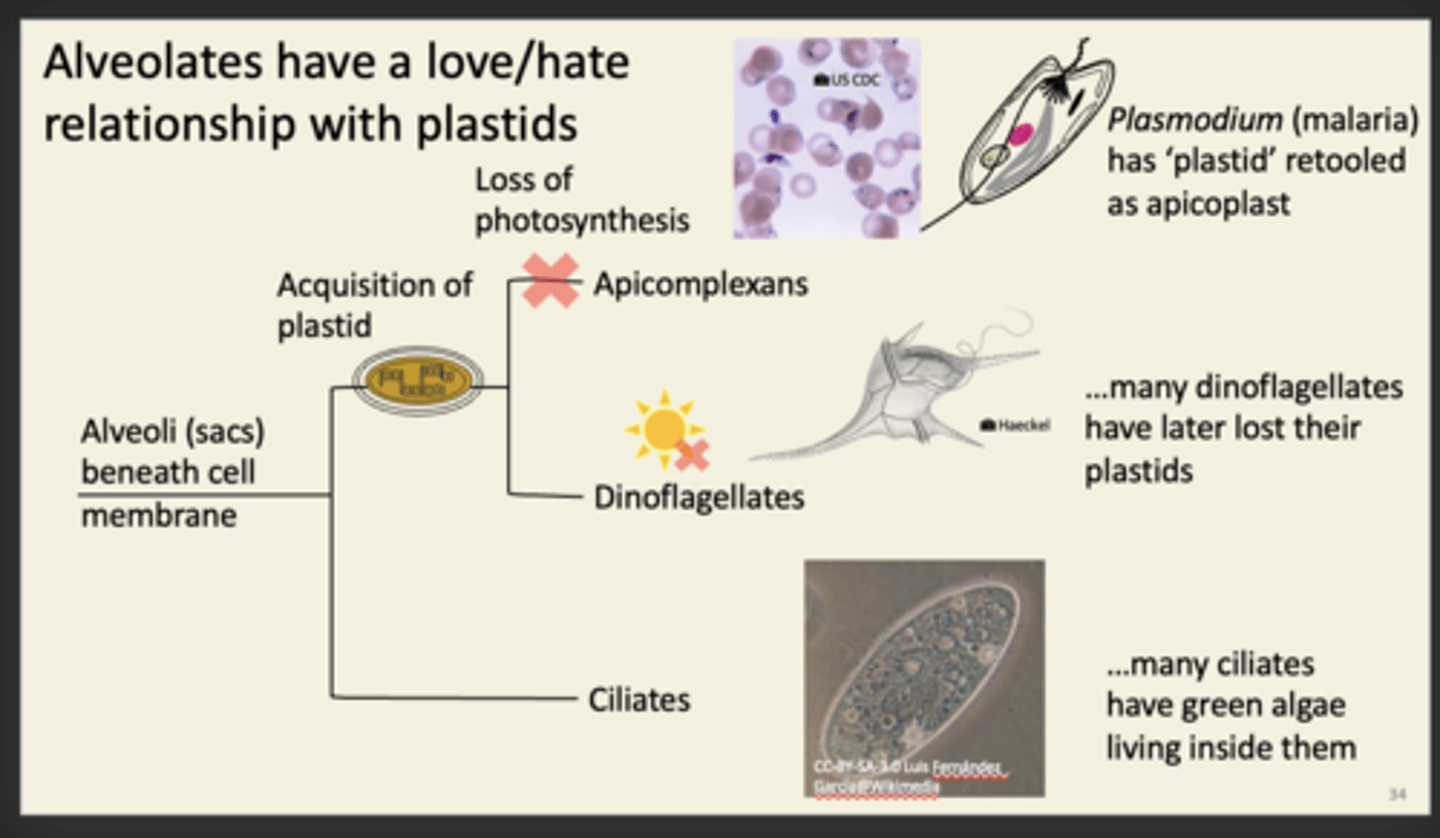
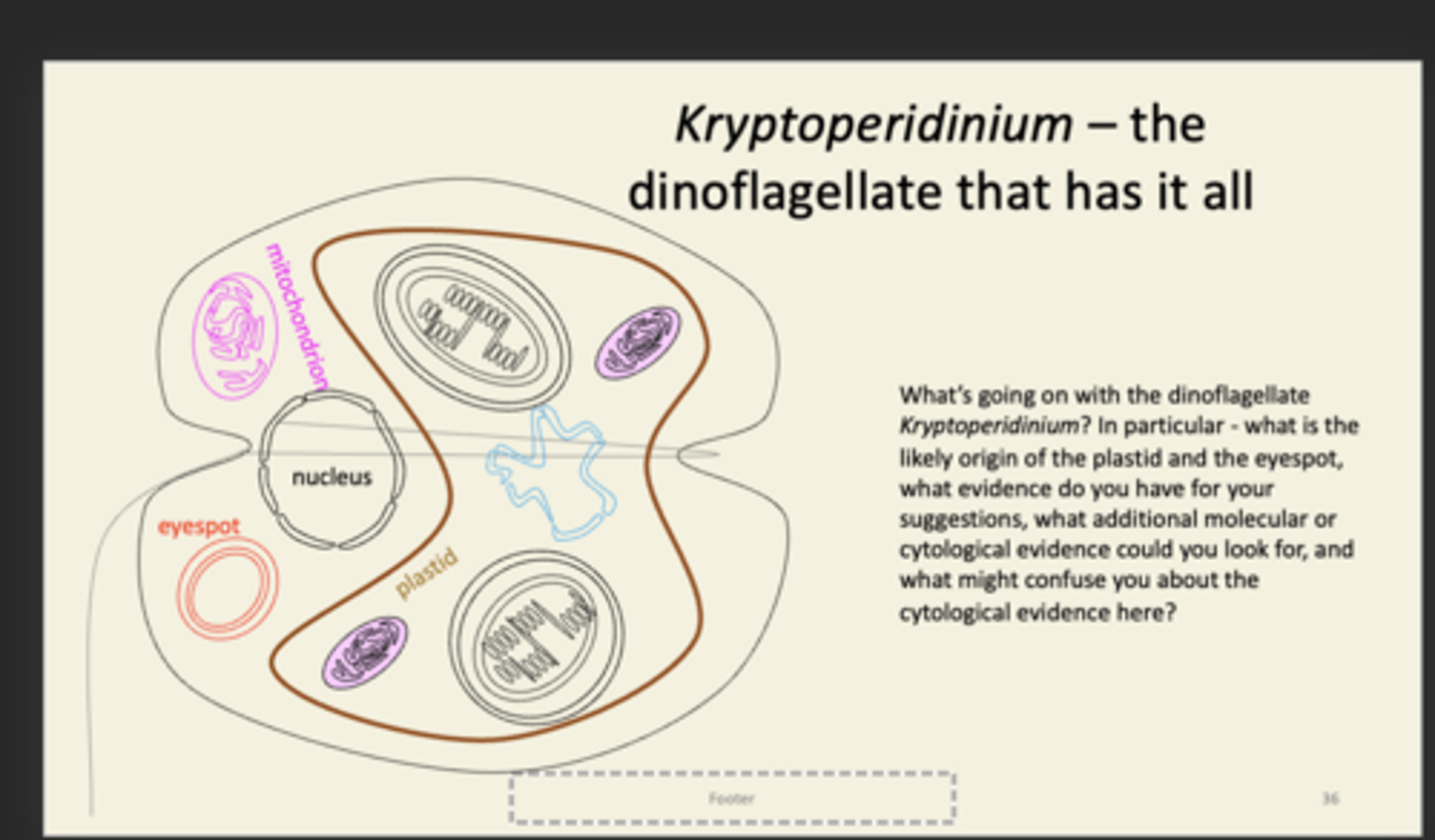
kryptoperidinium