Vascular System - Arterial System and Venous System
 Call Kai
 Learn
Learn Practice Test
 Spaced Repetition
 Match
Match Flashcards
 Knowt Play
1/104

There's no tags or description
Looks like no tags are added yet.
Name | Mastery | Learn | Test | Matching | Spaced | Call with Kai | Chat |
|---|
No analytics yet
Send a link to your students to track their progress
105 Terms
Three Components of CV System
Pump (heart), conduits (blood vessels), and transport medium (blood).

Arteries Function
Transport oxygenated blood away from the heart to the capillaries.
Capillaries Function
Primary site of nutrient, gas, and metabolic product exchange.

Veins Function
Return blood from tissues back to the heart.
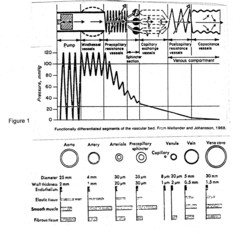
Highest Resistance Blood Vessels
Arterioles.
Greatest Pressure Drop Location
Occurs across the arterioles.
Control of Arteriolar Resistance
Regulated by the sympathetic nervous system.
Lowest Blood Velocity Location
Capillaries, due to their large total cross-sectional area.
Blood Velocity Formula
v = Q / A (Velocity = Flow divided by Cross-Sectional Area).
Systolic Pressure (Ps)
Maximum pressure in systemic arteries during a cardiac cycle.
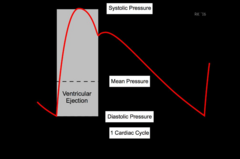
Diastolic Pressure (Pd)
Minimum pressure in systemic arteries during a cardiac cycle.
Determinants of Systolic Pressure
Volume of blood in arterial system near end of systole and arterial compliance.
Determinants of Diastolic Pressure
Volume of blood in arterial system at end of diastole and arterial compliance.
Pulse Pressure (PP) Formula
PP = Ps - Pd (Systolic Pressure minus Diastolic Pressure).

Pulse Pressure Definition
The pressure wave felt as a pulse during cardiac contraction.
Mean Blood Pressure (MBP) Formula (Pressures)
MBP = Pd + (PP / 3).
Mean Blood Pressure (MBP) Formula (Flow/Resistance)
MBP = CO × TPR (Cardiac Output times Total Peripheral Resistance).
Diastolic vs Systolic Duration Ratio
Approximately 2/3 of cardiac cycle is spent in diastole, 1/3 in systole.
Why MBP is Below Midpoint
Heart spends more time in diastole than in systole during each cycle.
Age Effect on Arterial Pressures
Both systolic and diastolic normal values increase with age.
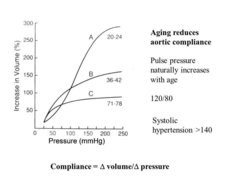
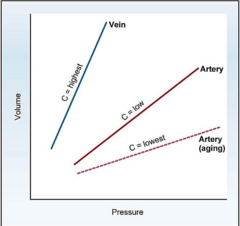
Age Effect on Arterial Compliance
Arterial compliance decreases with age, making arteries stiffer.
Age Effect on Pulse Pressure
Pulse pressure widens/increases with age due to stiffer arterial walls.
Age Effect on Ventricular Afterload
Increases with age as arterial walls become stiffer.
MBP Response to Exercise
Rises because Cardiac Output increases proportionately more than TPR decreases.
Essential Hypertension Mechanism
Elevated MBP driven primarily by increased total peripheral resistance (TPR).
Compliance (C) Definition
Ratio of change in volume to change in pressure (C = ΔV / ΔP).
Stiffness Definition
The reciprocal of compliance (C⁻¹ or ΔP / ΔV).
Pressure Required to Fill Stiff Vessel
Higher pressure is required compared to a compliant vessel.
Venous Compliance Value (Example)
Cv = 300 mL / 5 mmHg = 60 mL/mmHg (high compliance).
Arterial Compliance Value (Example)
Ca = 250 mL / 100 mmHg = 2.5 mL/mmHg (low compliance).
Arteries vs Veins Compliance
Veins have much higher compliance and lower stiffness than arteries.
Primary Pump of CV System
Left ventricle of the heart.
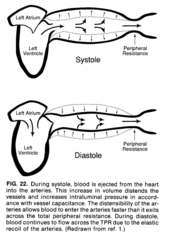
Secondary Pump Action of Aorta
Elastic recoil during diastole drives continuous blood flow to organs.
Role of Aorta Compliance
Buffers stroke volume, preventing excessive surge in systolic pressure.
Arterial Blood Volume Determinants
Inflow rate (Cardiac Output) versus outflow rate into capillaries (TPR).

Effect of Increased TPR on Arterial Volume
Less blood shifts into capillaries, increasing arterial blood volume and pressure.
Systemic Venous Blood Volume Fraction
Approximately two-thirds (2/3) of total blood volume is in systemic veins.
Venous System Function as Reservoir
Acts as an emergency blood reservoir that can be mobilized.
Central Venous Pressure (CVP) Range
Low pressure, normally less than 12 mmHg.
Mean Systemic Arterial Pressure Range
High pressure, approximately 90 mmHg.
Sympathetic Effect on Veins
Causes venoconstriction, reducing compliance and shifting volume into circulation.
Sympathetic Effect on Arteries
Constricts arterioles, increasing Total Peripheral Resistance (TPR).
Venous Return Definition
Volume of blood flowing back into the heart per minute.
Cardiac Output Formula
CO = SV × HR (Stroke Volume times Heart Rate).

Frank-Starling Mechanism in Venous Return
Increased venous return → increased preload → optimal sarcomere overlap → increased SV.
Gravity Effect on Bipedal Circulation
Causes blood pooling in lower limbs due to hydrostatic pressure in compliant veins.
CV Pressure Sources
Heart contraction force plus hydrostatic weight of the blood column.
Effect of Gravitational Pooling on Preload
Decreases blood volume in heart, lowering preload and cardiac output.
Hypothetical Rigid Vessels and Gravity
If blood vessels were rigid, gravity would have minimal effect on circulation.
Mechanisms Counteracting Gravitational Pooling
Venous valves and the skeletal muscle pump.
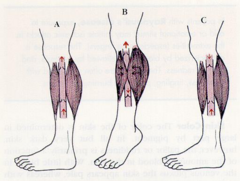
Function of Venous Valves
Prevent retrograde blood flow and break up the fluid column height.
Skeletal Muscle Pump Function
Muscle contraction compresses veins, propelling blood toward the heart.
Cause of Varicose Veins
Incompetent venous valves causing blood pooling and vessel distention.
Intrathoracic Pressure During Inspiration
Decreases (becomes more negative).
Right Ventricle Preload During Inspiration
Increases due to lower right atrial pressure promoting venous return.
Right Ventricle Stroke Volume During Inspiration
Increases due to elevated right ventricular preload.
Left Ventricle Preload During Inspiration
Decreases due to pulmonary vascular pooling.
Left Ventricle Stroke Volume During Inspiration
Decreases due to lower left ventricular preload.
Intrathoracic Pressure During Expiration
Increases (becomes less negative).
Right Ventricle Preload During Expiration
Decreases as intrathoracic pressure rises.
Right Ventricle Stroke Volume During Expiration
Decreases.
Left Ventricle Preload During Expiration
Increases as pulmonary blood is pushed into the left heart.
Left Ventricle Stroke Volume During Expiration
Increases.
Acute Regulation of Venous vs Arterial Compliance
Venous compliance is acutely regulated by nerves; arterial compliance is not.
Venoconstriction Effect on CVP
Increases CVP (filling pressure), shifting blood to active circulation.
Right Atrial Pressure During Inspiration
Decreases transiently, boosting venous return to the right heart.
Right Atrial Pressure During Expiration
Increases transiently, reducing venous return to the right heart.
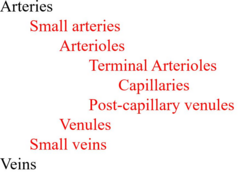
Vascular Bed Order from Heart
Aorta → Large Arteries → Small Arteries → Arterioles → Capillaries → Venules → Veins → Vena Cava.
Ventricular Afterload Definition
Pressure the ventricle must overcome to eject blood into the aorta.
Aortic Pressure Waveform Peak
Represents the Systolic Blood Pressure.
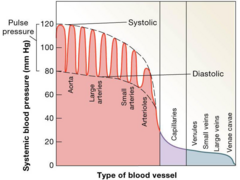
Aortic Pressure Waveform Trough
Represents the Diastolic Blood Pressure.
Preload Definition
End-diastolic stretch/volume of myocardial fibers before contraction.
Capillary Cross-Sectional Area vs Velocity
Highest cross-sectional area produces the lowest blood flow velocity.
Arteriolar Vasodilation Effect on TPR
Decreases Total Peripheral Resistance.
Arteriolar Vasoconstriction Effect on TPR
Increases Total Peripheral Resistance.
Hydrostatic Pressure in Lower Extremity Veins
High when standing due to column weight of blood.
Primary Driver of Active Circulation Shift
Sympathetically induced venoconstriction reducing venous compliance.
Compliance Symbol Formula
C = ΔV / ΔP.
Stiffness Symbol Formula
Stiffness = ΔP / ΔV = C⁻¹.
Pulse Pressure Determinant (Volume)
Stroke Volume ejected into the aorta.
Pulse Pressure Determinant (Vessel)
Compliance of the arterial walls.
Venous Valve Closure Mechanism
Prevents gravity from pulling blood downward during muscle relaxation.
Systemic Circulation Low Pressure Side
Venous system.
Systemic Circulation High Pressure Side
Arterial system.
Capillary Exchange Drivers
Diffusional and hydrostatic pressure gradients across endothelial wall.
Effect of Decreased Compliance on ΔP
Larger ΔP generated for a given ΔV.
Effect of Increased Compliance on ΔP
Smaller ΔP generated for a given ΔV.
Arterial Recoil Function
Maintains continuous forward blood flow during cardiac diastole.
Venous Return and Preload Relationship
Directly proportional: increased venous return increases right ventricular preload.
Effect of Sympathetic Activity on Heart Rate
Increases HR, contributing to higher Cardiac Output.
Effect of Sympathetic Activity on Stroke Volume
Increases contractility and venous return, enhancing Stroke Volume.
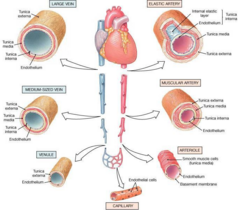
Conduit Component of CV System
Blood vessels (arteries, capillaries, veins).
Transport Medium of CV System
Blood.
Arterial System Compliance Characteristic
Low compliance, high stiffness, acts as pressure reservoir.
Venous System Compliance Characteristic
High compliance, low stiffness, acts as volume reservoir.
Impact of Upright Posture on Venous Return
Transiently reduces venous return due to gravity-induced venous pooling.
Inspiration Effect on Right Heart SV
Increases Right Ventricle Stroke Volume.
Inspiration Effect on Left Heart SV
Decreases Left Ventricle Stroke Volume.
Expiration Effect on Right Heart SV
Decreases Right Ventricle Stroke Volume.
Expiration Effect on Left Heart SV
Increases Left Ventricle Stroke Volume.