Kinesiology Test 1
 Call Kai
 Learn
Learn Practice Test
 Spaced Repetition
 Match
Match Flashcards
 Knowt Play
1/43

There's no tags or description
Looks like no tags are added yet.
Name | Mastery | Learn | Test | Matching | Spaced | Call with Kai | Chat |
|---|
No analytics yet
Send a link to your students to track their progress
44 Terms
Kinematics vs Kinetics
-kinematics - study of the form, pattern, or sequence of movement without regard for the forces that produce that movement
-kinetics - study of the effects of internal and external forces on the body
axial vs appendicular skeleton
axial = head neck down to pelvic bones
appendicular = appendages
Bone tissue Function
- Supports and protects organs
- Provides levers and attachment site for muscles
- Stores calcium and other minerals
- Stores fat
- Marrow is site for blood cell formation
Lever systems
lever, fulcrum, effort, load

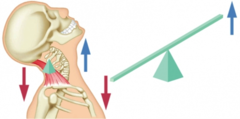
1st class lever
fulcrum in the middle; see-saw, hammer, scissors (mechanical advantage varies)
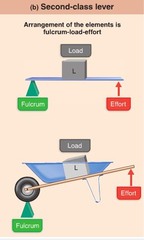
2nd class lever
fulcrum at the end, load in the middle; wheel barrow, car-jack (mechanical advantage is always greater than 1, movement same side as fulcrum)
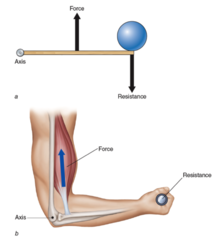
3rd class lever
fulcrum at the end, effort in the middle; tweezers, baseball bat (mechanical advantage is always less than 1, movement arm same side as fulcrum)
Bone composition
collagen
inorganic salts (do not contain carbon)
water
osteocytes
Cortical Bone vs Trabecula bone
Cortical
- compact
- 80%
- Porosity less than 15%
- Lamella
Trabecula
- spongy
- porosity over 70%
- Trabecula
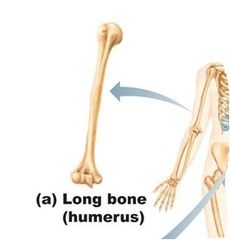
Long Bones
- diaphysis
- epiphysis
longer than they are wide
- diaphysis: shaft of bone
- epiphysis: end of bone
Short bones
carpals and tarsals

flat bones
bones of the ribs, shoulder blades, pelvis, and skull

irregular bones
bones of the vertebrae and face

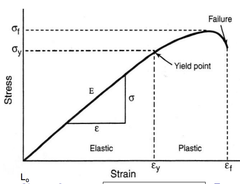
stress strain curve
The relationship between the stress and strain that a particular material displays
anisotropic
exhibiting different mechanical properties in response to loads from different directions
viscoelastic
having the ability to stretch or shorten over time
hyaline cartilage
Most common type of cartilage; it is found on the ends of long bones, ribs, and nose
Fibrous Joints: synarthroses
bones of joints fit together closely, thereby allowing little or no movement
who is most at risk for osteoporosis
-Smaller stature of women that have not been active
- steroid users for a prolonged time
Cartilaginous Joints: symphyses, amphiarthroses
sternocostal joints, with little movement
synovial joints; diarthroses
Also called movable joints
At ends of long bones
Within articular capsules
Lined with synovial membrane
types of synovial joints
plane, hinge, pivot, condyloid, saddle, ball and socket

Muscle tissue properties
Irritability (respond to stimuli)
Contractility (ability to shorten)
Extensibility (ability to lengthen)
Elastic (ability to return back to resting length)
Muscle functions
Movement
Posture and Position
Stabilize Joints
Other functions (thermogenesis, communication)
Skeletal Muscle Structure
Parallel Fiber Arrangement
Flat
Fusiform (bicep brachii)
Convergent
Circular
Penniform Fiber arrangement
Unipennate (form at the same angle
Bipennate (2 different angles)
Multipennate (multiple angles greater than 2)
Individual muscle structure
Sarcolemma
Sarcoplasm
Myofibrils
Muscle FIber
Fasciscles

superficial to deep muscle
Epimysium
Perimysium (binds fibers)
Endomysium
microstructure
Myofilaments
Sarcomere
Z-line (anchor the actin)
A-Band (contain myosin and actin)
I- Band (contain actin)
H-Zone (small region that only contains myosin)

sliding filament theory
theory that actin filaments slide toward each other during muscle contraction, while the myosin filaments are still
Force generation (excitation- contraction coupling)
Troponin (really high affinity for calcium)
Tropomyosin (covering the actin sites)
Acetylcholine (name of neurotransmitter for communication for neuron in cell membrane)
Steps of EC Coupling
1. Action potential travels down axon, reach acetylcholine release binds Nicotinic receptors on the sarco level
2. Action potential generated on sarcolevel enters the fiber by way of the t tubules
3. DHP receptor communicators Ryanadine receptor that there is a charge change
4. Opens calcium channels on the sarcoplasmic reticulum and is released
5. Calcium binds troponin
6. Active sites are exposed and cross bridges are formed
7. Cross bridge cycle occurs
8. To stop the cycle calcium is pumped back in too SR, ACH esterase occurs and the process stops
pure fiber types
Type 1a (slow twitch oxidative)
- Smaller
- Slower velocity
- Fatigue resistant
Type 11a (fast twitch oxidative glycolytic)
- More fatigue resistant
- More aerobic activity
Type 11x (Fast twitch glycolytic)
- Fatigue easily
- Strongest, biggest, and fastest
Mechanical model of Musculotendinous
Contractile component
Parallel Elastic Component
Series Elastic component
Net Muscle Actions
isometric, concentric, eccentric
Biarticulate Muscles
muscles that cross two joints
Limitations of biarticulate muscles
Passive (stress)and active (contract) insufficiency (cannot maximally contract or stress) across two joints)
Length Tension Relationship
The resting length of a muscle and the tension the muscle can produce at this resting length.

Factors influencing force production
Cross-bridge formation
Muscle Length
Fiber Type
Neural activation
Factors influencing velocity shortening
Muscle length
Shortening rate
Muscle fiber arrangement
Fiber type
open vs closed kinetic chain
Open kinetic chain
- Hands and feet are not fixed and you can throw the weight
Closed kinetic chain
- Hands and feet are fixed more safe
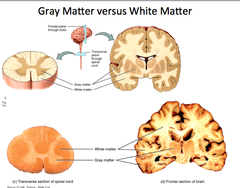
gray matter vs white matter
-White matter is myelinated axons and Glia
Gray matter is the cell bodies, dendrites, axons and glia
All or none principle
Refers to the fact that the action potential in the axon occurs either full-blown or not at all.
rate coding (summation of tension)
15-50 impulses/sec
80-120 impulses/sec
Sensory receptors and reflexes
Muscle spiders
Stretch reflex (recruit more fibers)
Autogeneic facilitation
Reciprocal inhibition