Chapter 4 - Prokaryotes
 Call Kai
 Learn
Learn Practice Test
 Spaced Repetition
 Match
Match Flashcards
 Knowt Play
1/73

There's no tags or description
Looks like no tags are added yet.
Name | Mastery | Learn | Test | Matching | Spaced | Call with Kai | Chat |
|---|
No analytics yet
Send a link to your students to track their progress
74 Terms
What are all the properties of life?
Composed of cells.
Reproduce.
Grow and Develop.
Metabolism.
Evolve.
Maintain homeostasis.
Respond to their environment.
Transport materials in and out of cells.
Heredity.
What are the minimum structures of a cell?
Cell membrane.
Cytoplasm.
Chromosome.
Ribosomes.
Cells can be divided into ____ and _____
Prokaryotes and Eukaryotes
Prokaryotic cells are the basic structural unit of _____ and _____.
Bacteria and archaea.
T or F: Prokaryotes lack a nucleus and membrane-bound organelles.
True.
Multi-celled organisms are…
Composed of eukaryotic cells.
Eukaryotic cells contain…
Membrane-surrounded nucleus and a number of organelles that function in specific ways.
Minimum structure of cells? Must have…
Cell membrane
Cytoplasm
Chromosome
Ribosomes
Size, most prokaryotes are:
1-8 micrometers; smallest 0.2.
What are the common structures to all prokaryotes?
1 or 2 lipid membranes.
Cytoplasm.
Ribosomes.
One chromosome.
What is the cell cytoplasm? What does it do?
A dense, gelatinous solution containing proteins, ions, nutrients, etc.; encased by cell membrane.
What are Prokaryotic Chromosomes?
Circular DNA molecules that are clustered in the nucleoid.
Aside from Prokaryotic chromosomes, prokaryotes also have plasmids. What are those?
Small circular DNA molecules; contain additional genes.
CAN BE TRANSFERRED TO OTHER CELLS.
What are Ribosomes?
Tiny molecules that are free floating in cytoplasm/ attached to membrane.
Made of protein and RNA.
What do ribosomes do?
Synthesize new proteins.
Some antibiotics attack function.
What is a cell envelope? Purpose?
The external covering that surrounds the cytoplasm; provides protection, regulates internal environment.
What makes the cell wall rigid?
Peptidoglycan.
What are the layers of the cell envelope?
Cell membrane.
Cell wall.
Glycocalyx (surface coating).
Glyccoalyx is a mixture of _____ and _____.
Carbohydrates & Protein.
What are the glycocalyx types?
Slime layer: loosely attached.
Capsule: thicker and tightly attached.

Why is it called the FLUID mosaic model?
Because lipid membranes are not static.
Lipids and proteins move freely around (fluid).
Make a “mosiac.”
How are gram positive and gram negative bacteria different from each other?
They have different cell walls and membrane structures.
What are bacterial cell walls mostly made of?
Peptidoglycan
Alternating amino-sugars linked by amino acids.
Gram-Positive cells have…
1 membrane.
Thick cell wall.
Periplasmic space (region between membrane and cell wall)
Includes: Teichoic acid and Lipotechoic acid (for structure & adherence).
2 mian Phyla: frimicutes and Actinobacteria.
Gran-Negative cells have…
2 membranes: inner & outer.
Thin cell membranes (thin layer of peptidoglycan).
Well-developed periplasmic space.
Outer membrane containing lipopolysaccharides (LPS).
Compare the number of cell membranes a gram-positive and gram-negative cell have.
Positive: 1; negative: 2.
Compare the thickness of the cell walls of gram-positive and negative cells.
Positive: thick; negative: thin.
What does gram staining help us determine?
Helps us differentiate gram (+) and (-) cells.
What are the steps of gram-staining?
Crystal violet (primary dye).
Gram’s iodine (mordant).
Alcohol (decolorizer).
Safranin (red dye counterstain).
What happens in the crystal violet (primary dye) stage?
Both cell walls stained with dye.
What happens in the gram’s iodine (mordant) stage?
Dye crystals trapped in cell (+); no effect of iodine (-).
What happens in the alcohol (decolorizer) stage?
Dye crystals remain in cell (+); outer membrane weakened, lipids in outer dissolve, cell loses dye ➡ clear (-).
What happens in the safranin (red dye counterstrain) stage?
Red dye has no effect (+); Red dye stains the colorless cell (-).
Why do we care about bacterial cell walls and membranes?
Because gram-negative bacteria are harder to kill w/ antibiotics than gram-positive cells.
What do antibiotics do to the bacterial cell wall and membranes?
They break down or prevent cell wall synthesis.
Concept check: which of the following is NOT found in the Gram-Negative cell wall structure?
A. Porins.
B. Teichoic Acids.
C. Periplasmic Space
D. Lipopolysaccharides
E. Peptidoglycan
B. Teichoic Acids
What are bacterial endospores?
Dormant, compact cell form with a very tough coating.
Found in gram (+) cells.
What are some characteristics of bacterial endospores?
They are extremely resistant to heat, desiccation, pH ranges, salt, etc.
What are Flagella in Prokaryotes?
Tails that provide motility through corkscrew motion.
Prokaryote flagella move in a corkscrew motion, eukaryotic flagella move in a _____.
wavy/undulating motion.

What are the 3 parts of the flagella?
Filament.
Hook.
Basal body.
T or F: Hook and filament of prokaryotes rotate 360 degrees.
True.
What are the different flagelllar arrangements?
Monotrichous.
Amphitrichous.
Lophotrichous.
Peritrichous.
What is the monotrichous flagellar arrangement?
Single flagellum at one end.

What is the amphitrichous flagellar arrangement?
Flagella at both ends of the cell.

What is the lophotrichous flagellar arrangement?
Small bunches emerging from the same site.
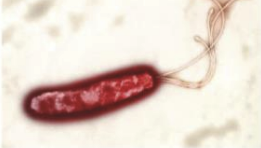
What is the peritrichous flagellar arrangement?
Flagella dispersed all over the surface of the cell.
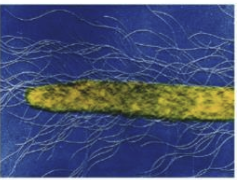
The type of arrangement of flagella determine the speed of a bacterial cell. What are the fastest cells and what are the slowest cells?
Fastest: Mono, Amphi, Lopho; Slowest: Peritrichous
What is chemotaxis?
The movement of a cell in response to a chemical stimulus.
What allows a cell to move towards beneficial substances and away from harmful substances?
Chemotaxis.
Which part of the cell has sensory appendages that detect and respond to stimuli?
Flagella.
What is positive chemotaxis?
The cell moves towards a favorable environment.
What is negative chemotaxis?
The cell moves away from repellent.
What do peripasmic flagella do?
Warp around inner cell membranes ➡ corckscrew-shaped cells.
Which bacteria are periplasmic flagella found?
Spirochete Bacteria.
Which of the following best describes the action of the prokaryotic flagellum?
A. It whips back and forth to move the cell.
B. It extends and contracts to move the cell.
C. It rotates to move the cell.
D. It attaches to the environment and pulls the cell.
E. It is capable of all of the above.
E. It is capable of all of the above.

What is the pilus?
A small tube used for the transfer of plasmid DNA.
What is conjugation?
DNA transferring directly from cell to cell.
Why is conjugation important?
Bacteria can transfer DNA that is antibiotic resistant.
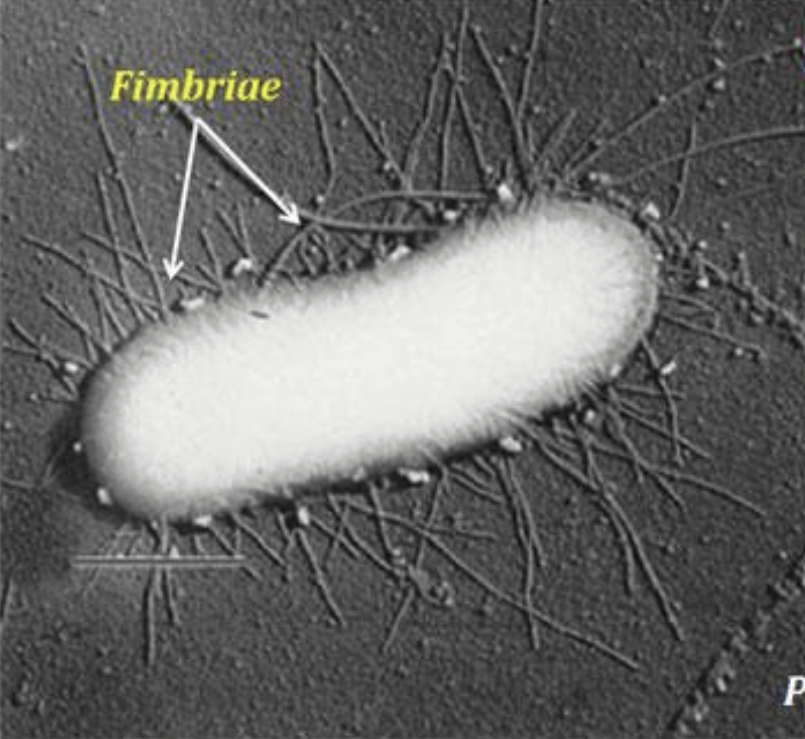
What are fimbriae?
Small finger-like projections that aid cells in adhering to surfaces of other cells.
What are Inclusions and Granules?
Condensed/crystallized clusters of various compounds.
What are the types of inclusions/granules in cells?
Inorganic nutrients (pink).
Magnetic particles (gray).
Nutrient storage reserves.
glycogen or polyhdroxybutyrate.

What is morphology?
The study of the structure of things (with microscopy).
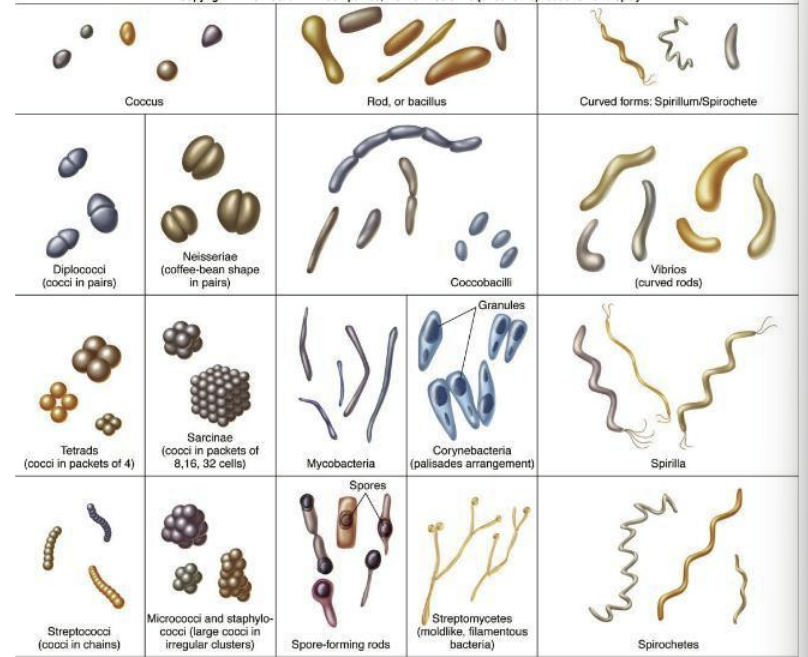
How can we identify/differentiate prokaryotes?
Morphology (with microscopy).
Biochemical Analyses (e.g. metabolic tests).
Discussed in lab.
Serological Analyses (e.g. antibodies).
Discussed later in this course.
Phylogenetic/Molecular Analyses (e.g. gene sequence comparison).
Do prokaryotes divide via mitosis?
No. They divide through binary fission.
What are the names of the variants of bacterial species?
Strains and types.
What do cyanobacteria do? (unusual adaptation of bacteria).
Provide oxygen to the environment.
Rickettsias and chlamydias are gram (-). What are unusual characteristcs about them?
They are small obligate intracellular parasites that replicate within cells of the hosts they invade; similar to a virus.
Archaea are extremophiles. What does that mean?
They like extreme environments (similar to those in early earth).
What does Bergey’s taxonomy manual of determinative bacteriology cover?
Reference to classify bacteria based on genetic information.
Two domains: Archaea and Bacteria.

What does the domain of archaea include?
prokaryotes w/ unusual morpholoy, ecology, and modes of nutrition.
Members are adapted to extremes of temperature, salt, acidity, pressure, or lack of oxygen (anerobic).
What does the domain of bacteria include?
Deeply branching and photosynthetic bacteria.
Prominent bacteria like cyanobacteria (photosynthesizers), thermophiles, radiation-resistant bacteria, halophiles, and sulfur metabolizers.
What is the diagnostic scheme of bacteria for medical use?
Phenotype qualities for indentification.
Restricted to bacterial disease agents.
Divides based on cell wall structure, shape, arrangement, and physiological traits.