LEGL Exam 1
 Call Kai
 Learn
Learn Practice Test
 Spaced Repetition
 Match
Match Flashcards
 Knowt Play
1/299

There's no tags or description
Looks like no tags are added yet.
Name | Mastery | Learn | Test | Matching | Spaced | Call with Kai | Chat |
|---|
No analytics yet
Send a link to your students to track their progress
300 Terms
What are the three branches of the U.S. government?
Legislative - Making laws (Congress)
Executive - Executing and enforcing laws (The President, Vice President, and Cabinet members such as the Secretary of State.)
Judicial - Interpreting laws and deciding legal cases. (The U.S. Supreme Court and other federal courts.)
What are “checks and balances”?
A system in which the branches of government can check or limit one another's power. (“check on power.”)
What is the definition of law?
Rules established by the government and backed up by enforcement
What is the Rule of Law?
The principle that laws are equally applicable to everyone and those who break the law are held accountable. It supports investment and business creation.
Why does the Rule of Law encourage business investment?
Because businesses can have greater confidence that laws will apply consistently and that legal rights will be protected.
What is property law?
A legal right that allows people to exclude others from interfering with what their efforts produce
What are the two types of ownership listed in the slides?
Public Property - Property owned or controlled for public use.
Private Property - Property owned by private individuals or entities.
Why are property rights important to businesses?
Businesses need confidence that they can own, control, and exclude others from their resources.
What are the three classifications of law
Common law and civil law (two major types of legal systems)
Civil law and criminal law
Public law and private law
What is an important feature of a common law system?
Judicial decisions and precedent play an important role. (US uses this)
What does a civil law system generally emphasize?
A comprehensive body of written laws or codes.
An example of common law?
Loving v. Virginia (1967). Interacial marriage
What is public law?
The regulation of society. Constitutional, administrative, and criminal law.
What is private law?
Legal issues that concern private resources. Property, contract, and tort.
What does civil law cover?
Torts and contracts.
How is a civil case generally written?
Plaintiff v. Defendant
What does criminal law cover?
Crimes. Duh.
How is a criminal case generally written?
State v. Defendant or United States v. Defendant.
What is the easiest way to distinguish civil and criminal cases?
Civil: Plaintiff v. Defendant
Criminal: State/United States v. Defendant
How can the word “contract” be abbreviated in?
With an uppercase K.
What is a tort?
Rules for compensation when an owner's legal boundaries are crossed by another and usually requires an actual injury to the owner's resources, including themselves.
What are the five sources of law in the United States listed?
U.S. Constitution
U.S. statutes
State constitutions
State statutes
Judicial decisions
What three levels are shown in the Federal Law diagram?
Constitution
Legislation
Administrative law or regulation
What four levels are shown in the State Law diagram?
State constitution
Statutes or acts - The legislation passed by Congress
Regulatory law of state administrative agencies
Ordinances - Laws that apply only in towns, cities, and counties
What are judicial decisions also called?
Case law
What is precedent?
A previous judicial decision that acts as a model for deciding a later case.
What is stare decisis?
A principle or rule that requires adherence to precedent.
What is the difference between precedent and stare decisis?
Precedent is the model; stare decisis is the principle/rule requiring adherence to the model.
What case is used in the slides as an example of stare decisis and precedent?
Obergefell et al. v. Hodges et al., 576 U.S. 644 (2015). and Loving v. Virginia (1967)
What are the two basic formats for case names
Civil: Plaintiff v. Defendant
Criminal: State v. Defendant
What information can be found in a legal case citation?
Case name, volume, reporter abbreviation, page where the case starts, series, pinpoint page, court, and year of decision.
What does the case name identify?
The parties involved in the case.
What does the court information identify?
The court that decided the case.
What does the year in a case citation identify?
The year the decision was made.
Is a lawsuit a civil or criminal case?
A lawsuit is a civil case.
How are the parties in a civil lawsuit identified?
Plaintiff(s) v. Defendant(s).
What does a civil lawsuit start with?
A Statement of Claim, also called a Complaint or Complaint for Damages.
Who files the complaint in a civil case?
The plaintiff.
Who is the complaint filed against?
The defendant.
How are the parties in a criminal case identified?
State v. Defendant or United States v. Defendant.
What are three things that can start a criminal case?
Arrest
Warrant
Indictment
What is a remedy?
The ability to take another party's resources.
What does a criminal case generally result in?
Punishment
What does a civil case generally result in?
Money damages or specific performance.
What is a breach of contract?
Failure to perform a contractual promise. (Civil case)
What are the two broad types of remedies for breach of contract listed?
Damages and specific performance.
What are damages in a breach-of-contract case?
Money. (Compensatory damages, Consequential damages)
What is specific performance?
A court order requiring someone to perform under the contract.
Is tortious conduct civil or criminal?
Civil
What two types of damages are listed for tortious conduct?
Compensatory damages - Money intended to compensate for the harm.
Punitive damages - Money awarded for punishment.
What does SCOTUS stand for?
Supreme Court of the United States.
What is the difference between a judge and a justice?
Judges are associated with trial courts, while justices are associated with reviewing/appellate courts.
What are the major types of juries/trial arrangements
Grand jury - 16–23 people
Petit jury/trial jury - 6–12 people, plus alternates.
Bench trial
What does a grand jury determine?
Whether there is probable cause for a case to move forward to trial.
What does it mean when a grand jury "indicts" a case?
Indict is the verb describing the grand jury's decision that there is probable cause for the case to move forward.
What is the purpose of a petit jury?
It serves as the trial jury during the actual trial.
What is the difference between a grand jury and a petit jury?
Grand jury: 16–23 people; determines probable cause and issues indictments.
Petit jury: 6–12 people plus alternates; participates in the actual trial.
What is a bench trial?
A trial in which the judge decides the case rather than a jury.
What is the difference between a jury trial and a bench trial?
In a jury trial, the jury makes the decision; in a bench trial, the judge makes the decision.
How does the chapter describe lawyers in relation to the court?
Lawyers are "officers of the court."
What is attorney-client privilege?
A legal protection concerning confidential communications between an attorney and client.It protects certain communications between an attorney and client from being disclosed.
What can happen if an attorney breaks attorney-client privilege?
The attorney can be disbarred ( loses the ability to practice law) and can face other consequences.
What is malpractice insurance?
Insurance associated with professional liability/malpractice; the lecture specifically mentions lawyers, doctors, and accountants in connection with malpractice insurance.
Because posting on social media can affect or even harm a person's legal case.
Social-media posts can become relevant to legal proceedings, so people should understand that what they post may have legal consequences.
Can a plantiff/defendant hire an attorney in a civil case?
Yes
In a criminal case, who initiates the case?
The state/government. Only the state/government can initiate a criminal case.
Can a defendant hire an attorney in a criminal case?
Yes. A defendant may hire an attorney to defend against a criminal case.
When may a defendant be appointed an attorney for free?
A defendant may be appointed an attorney for free in criminal cases only
What does pro se mean?
Representing yourself in a civil/criminal legal case.
State-Level Criminal Attorneys:
District Attorney (DA) and Assistant District Attorney (ADA) – also called State’s Attorney (Represents government)
• Public Defender and/or Defense Attorney (Represent a defendant in a state criminal case)
Federal-Level Criminal Attorneys:
US Attorney General and US Attorney for each federal district, and Assistant US Attorney (AUSA)
Federal Public Defender and/or Defense Attorney (For defendant)
What is jurisdiction?
Power over the issues involved in the case.
What abbreviation can you use for jurisdiction in your notes?
jx
What is subject matter jurisdiction?
Whether a particular court has jurisdiction over the subject matter of the case.
What is an example of subject matter jurisdiction?
Magistrate Court has subject matter jurisdiction over small claims and evictions.
Why does jurisdiction matter?
It determines:
Where the plaintiff can file a lawsuit.
Where the parties will go for court.
What judges they will have, among other things.
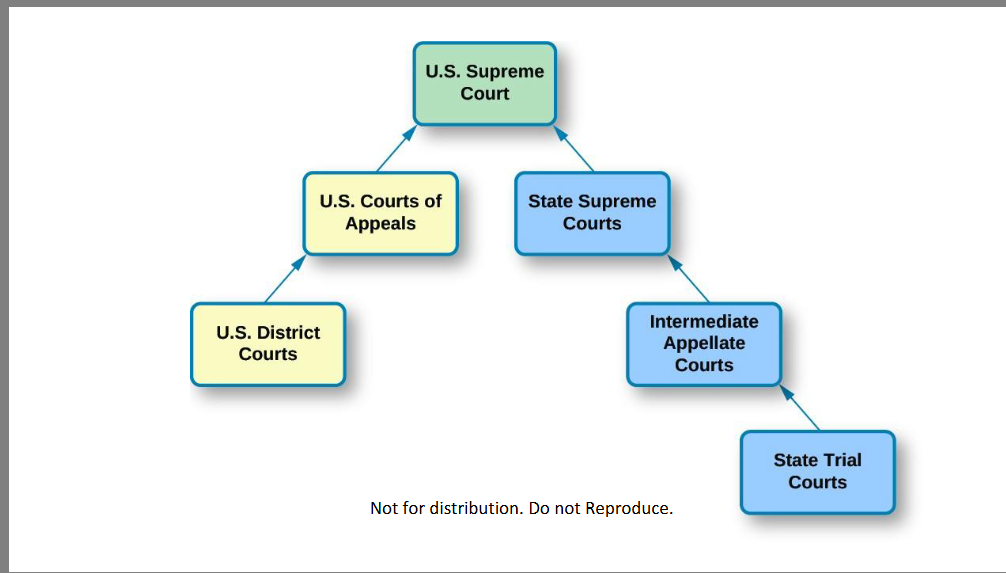
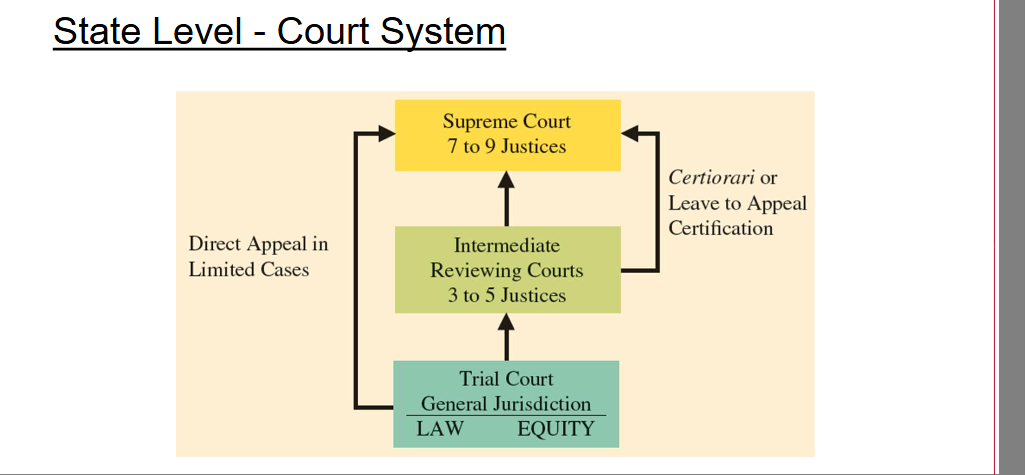
What is the general hierarchy of state level courts?
Lower-level courts (Juvenile courts, Magistrate courts, Municipal courts, Traffic courts, Probate courts) → Trial courts (State Court and/or Superior Court.) → Appellate courts → State Supreme Court
What happens in a state trial court?
It is the initial level for filing lawsuits or prosecuting crimes.
What is the basic organization of the court system in general?
Trial Courts → Appellate Courts → Supreme Courts.
When did the Georgia Statewide Business Court start?
2020
Why was the Georgia Statewide Business Court created?
To make complex business cases more efficient.
What type of expertise does the Georgia Statewide Business Court provide?
Specialized expertise for complex business cases.
What type of disputes does the Georgia Statewide Business Court handle?
High-value commercial disputes.
Why is the Georgia Statewide Business Court especially relevant to Business Law?
It specializes in complex business cases and high-value commercial disputes.
What constitutional article establishes the federal judiciary?
Article III of the U.S. Constitution.
What are the major types of federal jurisdiction listed in the chapter?
Federal courts have jurisdiction over:
Questions of federal law.
Cases where the United States is a party.
State disagreements.
Suits between citizens of different states (diversity jurisdiction).
Structure of Federal Courts
District courts are where trials are held
Each state is split into federal districts
At least one district court in every state and the District of Columbia and territories (Guam, Puerto Rico, etc.)
What happens after a federal district court?
A case may proceed to a Federal Court of Appeals
What happens after the federal Court of Appeals?
A case may proceed to the U.S. Supreme Court
What are federal appellate courts divided into?
Geographic circuits.
What circuit is Georgia in?
11th
What is diversity of citizenship?
A type of federal jurisdiction involving parties who are citizens of different states.
What basic fact should you look for when determining whether diversity jurisdiction might exist?
Whether the parties are citizens of different states.
Where is a corporation considered a citizen for diversity jurisdiction purposes?
A corporation has citizenship in:
The state where it is incorporated, and
The state(s) where its principal place of business (“nerve center”) is located.
What does SCOTUS call the test for determining a corporation's principal place of business?
The "nerve center test."
If a corporation is incorporated in Delaware but has its principal place of business in Georgia, where is it a citizen?
Delaware and Georgia for purposes of corporate citizenship in diversity jurisdiction.
Why does jurisdiction matter?
Determines where Plaintiff can file a lawsuit
Determines where the parties will go for court, what judges they will have etc.
Who can use jurisdiction strategically?
Both sides of a lawsuit can potentially use jurisdiction strategically.
How can a defendant use jurisdiction to their advantage?
The defendant can try to remove the case from one court system to another.