(IB Biology SL) D1.1: DNA Replication
 Call Kai
 Learn
Learn Practice Test
 Spaced Repetition
 Match
Match Flashcards
 Knowt Play
1/34

There's no tags or description
Looks like no tags are added yet.
Name | Mastery | Learn | Test | Matching | Spaced | Call with Kai | Chat |
|---|
No analytics yet
Send a link to your students to track their progress
35 Terms
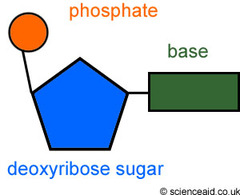
What is the structure of DNA?
Phosphate group, pentose sugar, nitrogenous base (pyrimidine or purine).
What reaction joins DNA nucleotides?
Condensation reaction.
What is the name of the bond between DNA nucleotides?
Phosphodiester bond.
What is key in order for DNA to replicate?
Complementary base pairing.
Why does DNA need to replicate?
Cell Division- new cells need new DNA for growth and tissue repair.
Reproduction- gametes require DNA to pass on genetic information.
How does semi-conservative replication work?
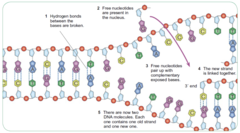
What does the enzyme "DNA Helicase" do in replication?
Breaks hydrogen bonds and unwinds the molecule.
What does the enzyme "DNA Polymerase" do in replication?
Forms the phosphodiester bonds between nucleotides.
What are the 3 different theories for DNA replication?
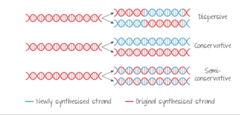
What is some for the evidence for semi-conservative replication?
They cultured E. coli bacteria in the presence of a heavy nitrogen
isotope, 15 N. DNA contains nitrogen in its nitrogenous bases (ATCG), so the radioactive 15 N would end up in the DNA of the
bacteria. The result was that all bacterial DNA had 15 N in its bases. They then transferred the bacterial culture into a fresh medium
where the nitrogen was replaced by 14 N, a lighter isotope, and
the bacteria were allowed to grow for several generations.
What is semi-conservative replication?
The way in which double-stranded DNA replicates itself, each strand of the double helix serving as a template for synthesis of a new strand.
What is gel electrophoresis?
A technique for separating molecules such as proteins or nucleic acid fragment son the basis of their net charge and mass, by their differential migration through paper, or through gel in an electric field.
How does gel electrophoresis work?
It uses an electrical current to move molecules through a semisolid medium. The molecules - usually DNA, RNA, or protein, are separated by their size and amount of charge.
What are the key principles of gel electrophoresis?
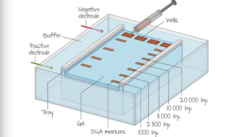
DNA and RNA molecules have a negative electrical charge and will move towards the positive electrode in an electric field. It also gets fragments of appropriate size, usually 250 - 30 000 base pairs in length. DNA fragments are loaded into small depressions called wells on one end of the gel. The gel is submerged in a buffer solution, an electric current runs through the gel, this slowly draws the DNA samples towards the positive pole.
How is DNA digested?
Special enzymes called restriction endonucleas.
What is happening in the following picture?
Gel Electrophoresis.
What is most often used to dye DNA fragments?
Ethidium bromide is commonly used because it binds to DNA and the fluoresces in UV light. However, it is mutagenic so sometimes alternatives are used.
What is PCR (polymerase chain reaction)?
It is a form of artificial DNA replication and it amplifies DNA fragments for further study or processing.
What does the PCR method require?
Small DNA sample, DNA polymerase, primers, nucleotides, and a thermocycler.
What is a thermocycler?
It controls and changes the temperature at programmed timings to trigger the different steps in PCR.
What happens in stage 1 of PCR (polymerase chain reaction)?
DNA fragments, primers, DNA polymerase and nucleotides are added to a thermocycler. 95C temperatures cause the DNA strands to separate (denature).
What happens in stage 2 of PCR (polymerase chain reaction)?
The primers anneal (join) to their complimentary bases (55-68 degrees C). This provides a starting point for DNA polymerase.
What is a primer that is used in PCR?
Primers are short DNA sequences that bind to the start of the DNA that needs to be amplified. They are designed to have a complementary sequence to the start of the target DNA that needs to be amplified.
What happens in stage 3 of PCR (polymerase chain reaction)?
Temperature is increased to 72C, the optimum temperature of DNA polymerase. Taq polymerase attached nucleotides along each of the separated DNA strands in complementary base pairing.
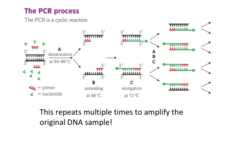
What is happening in the following picture?
The PCR process. It repeats multiple times to amplify the original DNA sample.
What are some advantages of PCR (In vitro cloning)?
It is very rapid, billions of copies can be made in hours. It also does not require living cells, it only requires a base sequence, no complex culturing is required.
Where can PCR be applied?
Tissue typing, detection of oncogenes, detecting mutations, identifying viral infections, monitoring the spread of infectious diseases, forensic science, and research.
What does PCR stand for?
Polymerase chain reaction.
What is meant by the term 'palindromic sequence'?
A sequence of DNA that consists of antiparallel base pairs/base pairs that read the same in opposite directions.
What are sticky ends and why are they useful?
Sticky ends are small tails of unpaired bases at the end of a DNA fragment. They can be used to bind/anneal the DNA fragment to another piece of DNA that has sticky ends with complementary sequences.
Where would the longest DNA fragments be found in a gel?
At the top/near the negative electrode.
What do you need to do to samples of proteins before they can undergo electophoresis?
You need to mix them with a chemical that denatures the proteins so they all have the same charge.
What is an example of a use for the electrophoresis of proteins?
It could be used to identify the proteins present in urine or blood samples, which may help diagnose a disease. (example)
How can a DNA profile be produced?
Extract DNA from a sample, digest the sample, separate the DNA using an alkaline solution, transfer to nylon membrane, hybridization DNA probes are added to label the fragments, then they are placed onto x-ray film and developed.
What is DNA profiling used for?
Forensic science, maternity/paternity testing, analysis of disease.