Chapter 21 - Microevolution
 Call Kai
 Learn
Learn Practice Test
 Spaced Repetition
 Match
Match Flashcards
 Knowt Play
1/51

There's no tags or description
Looks like no tags are added yet.
Name | Mastery | Learn | Test | Matching | Spaced | Call with Kai | Chat |
|---|
No analytics yet
Send a link to your students to track their progress
52 Terms
What is microevolution?
A heritable change in the genetics of a population.
What is the significance of penicillin in relation to microevolution?
Penicillin was the first antibiotic, and within four years, 14% of Staphylococcus strains were resistant.
How many Americans die each year from antibiotic-resistant infections?
30,000 to 40,000.
What causes the evolution of antibiotic resistance in bacteria?
The use of antibiotics inadvertently selects for the success of resistant organisms.
What are the two categories of phenotypic variation?
Qualitative and quantitative variation.
What is qualitative variation?
Variation that exists in two or more discrete states, independent of the environment.
What is quantitative variation?
Variation that exhibits small, incremental differences that can be measured.
What influences phenotypic variation?
Genetic differences, environmental factors, and interactions between genetics and the environment.
What are the two sources of genetic variation?
Production of new alleles and rearrangement of existing alleles.
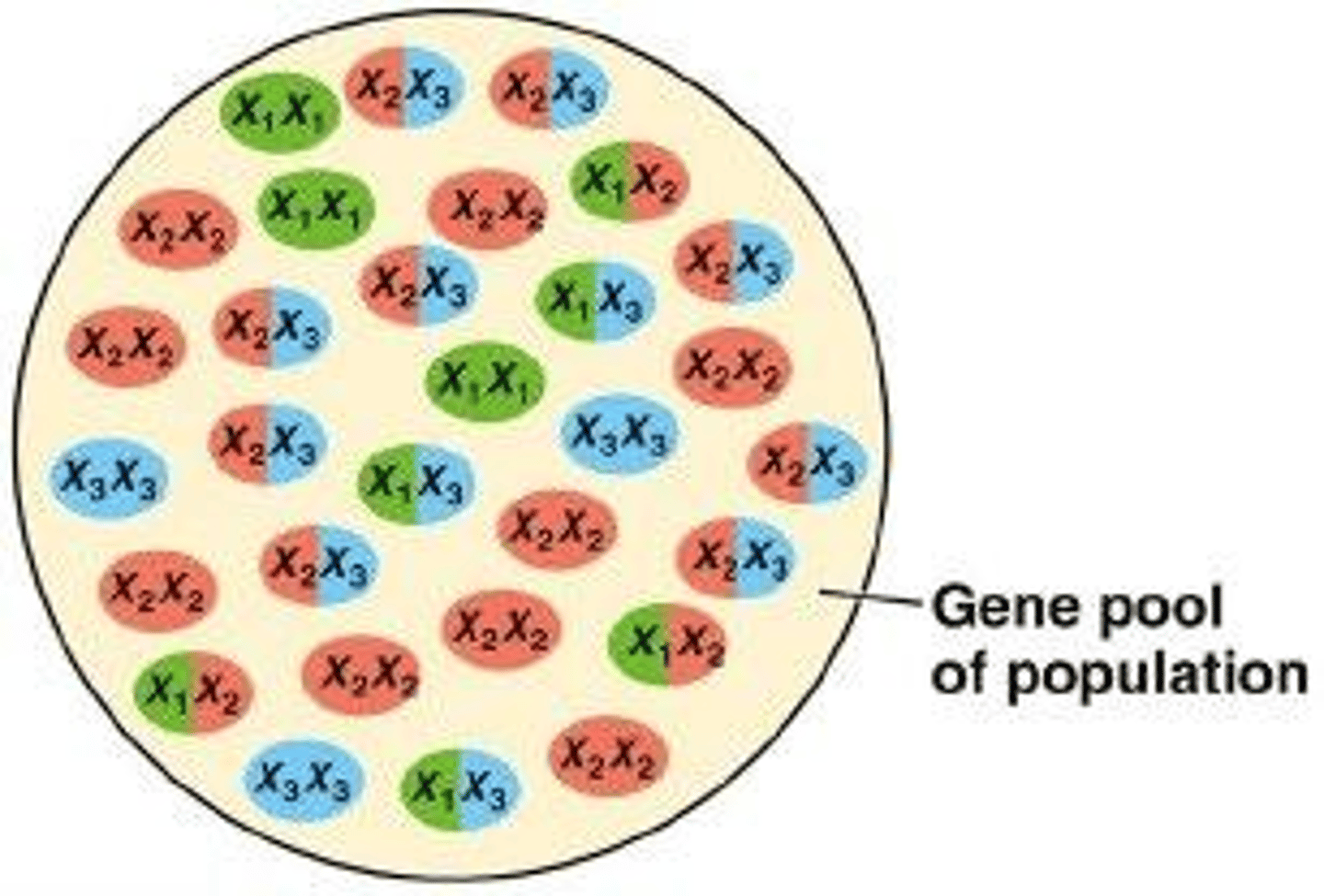
What is a population's gene pool?
All gene copies at all gene loci in all individuals in the population.
What does the Hardy-Weinberg principle describe?
How genotype frequencies are established in sexually reproducing organisms under genetic equilibrium.
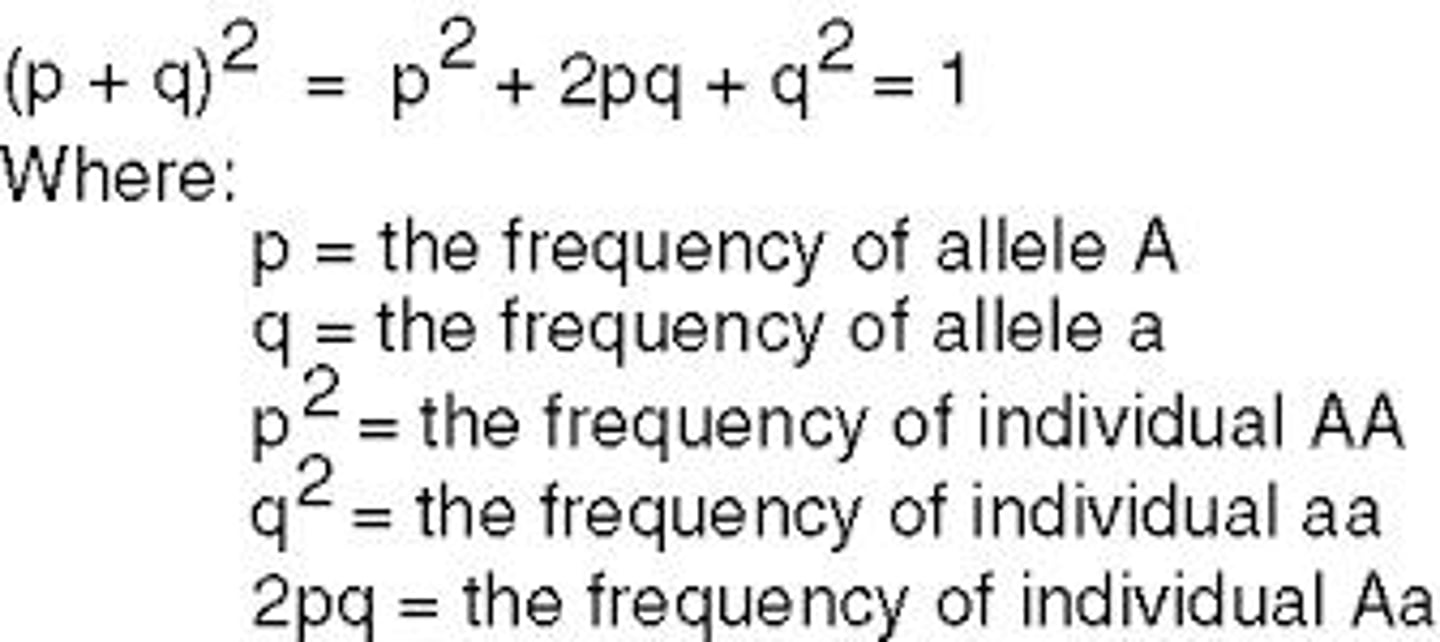
What conditions must be met for Hardy-Weinberg equilibrium?
No mutations, closed population to migration, infinite population size, equal survival and reproduction of all genotypes, and random mating.
What are the agents of microevolution?
Mutation, gene flow, genetic drift, natural selection, and nonrandom mating.
What is a mutation?
A spontaneous and heritable change in DNA.
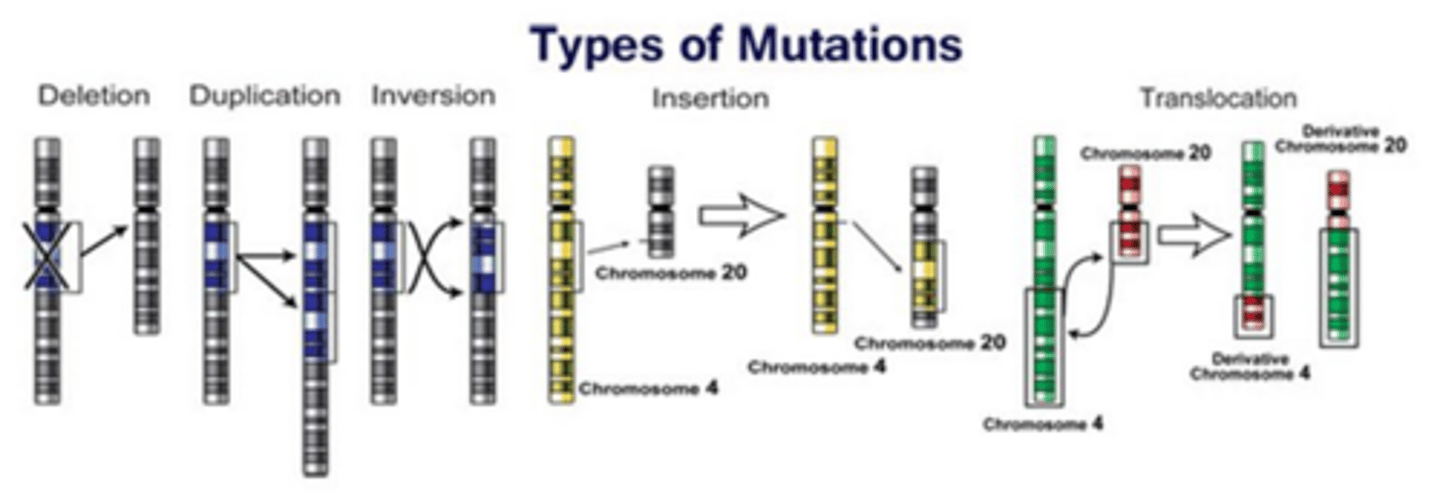
What types of mutations can occur?
Deleterious, lethal, neutral, and advantageous mutations.
What is an advantageous mutation?
A mutation that confers a benefit, potentially increasing its frequency through natural selection.
What is an example of a bacterium that evolved to digest nylon waste?
A bacterium discovered in 1975 that can live off chemicals from nylon production.
What is the difference between genotype and phenotype?
Genotype refers to the genetic makeup, while phenotype refers to the observable traits.
What is polymorphism in qualitative variation?
The existence of two or more distinct forms within a population.
How does environmental influence affect phenotype?
Environmental factors can alter the expression of genes, affecting the phenotype.
What is the relationship between genotype and phenotype?
Organisms with different genotypes can exhibit the same phenotype, and vice versa.
What is the significance of genetic recombination?
It rearranges existing alleles into new combinations, contributing to genetic variation.
What is the role of breeding experiments in genetics?
They can demonstrate the genetic basis of phenotypic variation.
What is the effect of deleterious mutations?
They can harm an individual's structure, function, or behavior.
What is genetic drift?
A process that causes allele frequencies to change due to random sampling effects.
What is gene flow?
The transfer of alleles or genes from one population to another.
What is the importance of null models in experiments?
They predict what would happen if a particular factor had no effect, serving as a reference point.
What role do dispersal agents play in gene flow?
Dispersal agents like wind or animals are responsible for gene flow in plant populations.
How does genetic drift affect allele frequencies?
Genetic drift causes allele frequencies in a population to change unpredictably due to chance events.
Why is genetic drift more common in small populations?
Only a few individuals contribute to the gene pool, making allele changes more pronounced.
What is a population bottleneck?
A dramatic reduction in population size due to factors like disease or starvation that reduces genetic variation.
Give an example of a species that has experienced a population bottleneck.
Elephant seals in the Pacific Northwest exhibit no variation in 24 proteins studied.
What is the founder effect?
When a few individuals start a new population, carrying only a small sample of the parent population's genetic variation.
What is natural selection?
The process by which heritable traits that enable some individuals to survive and reproduce better become more common.
Define relative fitness.
The number of surviving offspring that an individual produces compared with others in the population.
What are the three modes of natural selection?
Directional selection, stabilizing selection, and disruptive selection.
What is directional selection?
It favors individuals near one end of the phenotypic distribution, shifting a trait toward the favored extreme.
What is stabilizing selection?
It favors individuals expressing intermediate phenotypes and eliminates phenotypic extremes.
What is disruptive selection?
It favors extreme phenotypes over intermediate phenotypes, promoting polymorphism.
What is nonrandom mating?
When organisms select mates based on particular phenotypes and underlying genotypes.
What is inbreeding?
A form of nonrandom mating where genetically related individuals mate, increasing homozygous genotypes.
What is sexual selection?
A type of natural selection based on interactions between males and females or among members of the same sex.
What is heterozygote advantage?
When heterozygotes have higher relative fitness than either homozygote.
What is balanced polymorphism?
A situation where two or more phenotypes are maintained in stable proportions over generations.
How does frequency-dependent selection work?
Rare phenotypes have higher relative fitness than more common phenotypes due to predator focus.
What are neutral variations?
Genetic variations that are neither preserved nor eliminated by natural selection.
What is an adaptive trait?
Any trait that increases the relative fitness of an organism in its environment.
What constraints exist on adaptive evolution?
Selection preserves successful alleles under current environmental conditions; new mutations are rare.
What is the significance of studying adaptive traits?
It helps understand how traits may have different functions in the past and their current adaptive value.
What is the impact of genetic drift on small populations?
It can eliminate harmful recessive alleles more quickly due to reduced genetic variability.
How does natural selection affect alleles over generations?
Favorable alleles are passed to the next generation, while unfavorable ones may be eliminated.
What is the role of environmental conditions in natural selection?
Natural selection works primarily with existing alleles, adapting organisms to the conditions their parents lived under.