The Multi-store model of memory
 Call Kai
 Learn
Learn Practice Test
 Spaced Repetition
 Match
Match Flashcards
 Knowt Play
1/14

There's no tags or description
Looks like no tags are added yet.
Name | Mastery | Learn | Test | Matching | Spaced | Call with Kai | Chat |
|---|
No analytics yet
Send a link to your students to track their progress
15 Terms
Multi-store model
A representation of how memory works in terms of 3 stores.
Sensory register
Short term memory
Long term memory
Also describes how information is transferred from one store to another, what makes some memories last and others disappear.
Sensory register
The memory stores for each of our 5 senses like vision (iconic) and hearing (echoic).
Coding in the iconic sensory register is visual and in the echoic sensory register is acoustic. The capacity of SRs is huge. Information lasts for around 0.05 seconds for iconic but up to 3 seconds for echoic memory
Atkinson and Shiffrin
Made the multi-store model.
Describes how information flows through the memory system
Suggests memory is made of 3 stores (boxes) linked by processes (arrows)
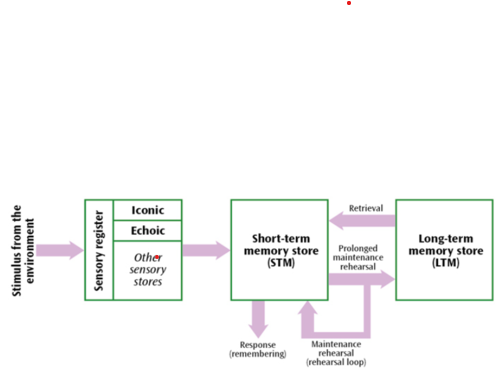
Pathway of information to long-term memory
Environmental input and senses receive it. Gets put in the sensory registers
Passes onto STM when attention paid to information.
Held in STM if information is rehearsed.
Transfer to LTM when rehearsed elaboratively.
Goes back into STM through retrieval.
Information can leave STM or LTM through forgetting it
STM in the multi-store model
Mainly encoded acoustically and lasts about 18 seconds unless rehearsed. Temporary store.
Limited capacity as it can hold a certain number of things before you forget it. 5-9 items
Maintenance rehearsal
We repeat materials to ourselves over and over again. We keep the information in STM if we rehearse it.
Passes into LTM if we rehearse it long enough
LTM in multi-store model
Permanent memory store for info that has been rehearsed.
Encoded semantically. Duration up to a lifetime.
Retrieval
Transfer from LTM to STM
Murdock research
Gave participants 20 words to remember. Each word flashed up for a second before next word was shown.
Write as many as they can after the last word
Highest % recall at the start and end
U-shaped graph
Primacy effect
First words heard so they can be rehearsed so we can recall them from our LTM
Recency effect
Most recently heard words so we can recall them as they are still in our STM
S Squire
Identified the separate stores.
Prefrontal cortex was active when doing STM tasks.
Hippocampus was active when doing LTM tasks.
Suggests that STM and LTM are independent stores
W Ranganath + Blumenfield
Hippocampus was used in STM tasks for new or complex information.
Suggested that separating STM and LTM is weak.
W Craik + Watkins
Rehearsal type is better than the amount.
Information can go into LTM without maintenance rehearsal.
Doesn’t explain how to get information into long term storage
W Tulving
Proposed that LTM could be subdivided into different types of LTM.
Semantic and Episodic - Knowledge about the world and memories for events in your life.
Cognitive psychology focuses on different types of memory and ignores the MSM