Neurophysiology Exam 1
 Call Kai
 Learn
Learn Practice Test
 Spaced Repetition
 Match
Match Flashcards
 Knowt Play
1/126

There's no tags or description
Looks like no tags are added yet.
Name | Mastery | Learn | Test | Matching | Spaced | Call with Kai | Chat |
|---|
No analytics yet
Send a link to your students to track their progress
127 Terms
Cytoarchitecture definition
How cells are arranged in tissues
Nissl stain characteristics
lacks true morphology
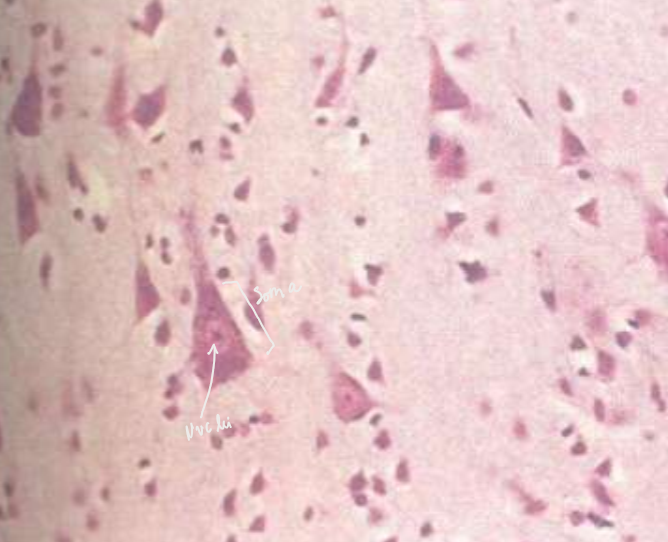
Golgi stain characteristics
Shows better morphology than golgi stain
uses a silver chromate solution

Reticular theory
the nervous system is a single continuous physical network rather than a collection of separate cells
Neuron doctrine
the nervous system is composed of discrete, individual cells rather than a continuous network
____ supported the reticular theory
____ supported the neuron doctrine
Golgi
Cajal
What is the MAP implicated in Alzheimer’s disease?
Tau
Tau role in Alzheimer’s
stabilizes cellular tracks called microtubules in healthy brain neurons, but it becomes hyperphosphorylated and forms toxic tangles in Alzheimer’s disease.
What technique was used to learn about Tau
Immunohistochemistry staining
Use primary antibody specific to target, then use secondary antibody specific to primary antibody
secondary antibody had a fluorescent tag
Axoplasmic transport
move molecules down the axon (usually proteins)
what specifically carries molecules down the axon?
motor proteins (require ATP)
Define anterograde transport
Transport from the soma → axon terminal
Define retrograde transport
Transport from the axon terminal → soma
What protein facilitates anterograde transport
kinesin
What protein facilitates retrograde transport
dynein
What methods are used to trace neuronal tracts in the brain?
anterograde + retrograde transport
Application of Horse Raddish Peroxidase (HRP)
selectively taken up by axon terminals and then transported retrogradely to the soma. A chemical reaction can then be initiated to visualize the location of the HRP in slices of brain tissue after the experimental animal is euthanized.
What happens if you kill neurons in the CNS?
they do not come back
Disruption of dendrite structure/function can lead to
mental disorders
dendrites in a healthy vs intellectually disabled patient differences
In intellectually disabled patients, the dendrites tend to be thinner and longer

Neurite definition
Projection coming off the soma (axons/dendrites)
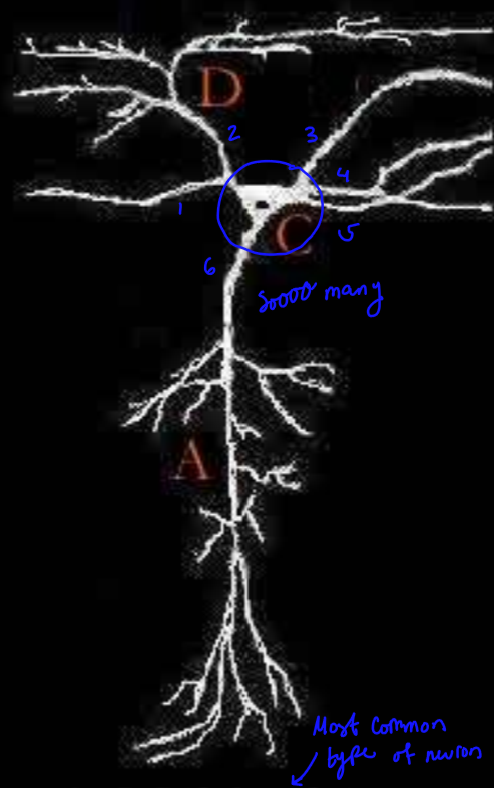
Multipolar neuron def
multiple neurites coming off the soma
ex- motor neurons, interneurons
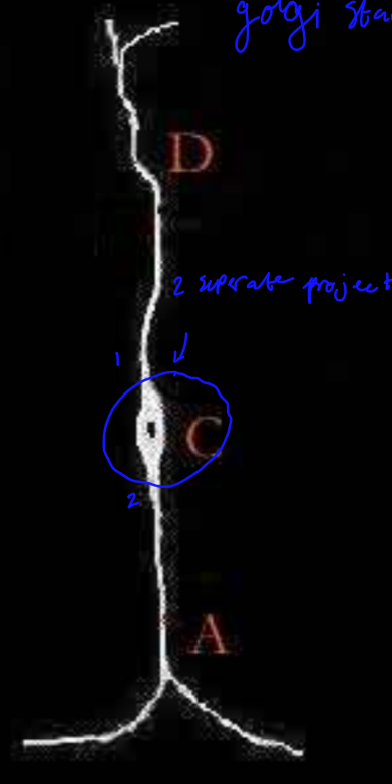
bipolar neuron def
two neurites coming off the soma
ex- visual system, audio system
pseudo-unipolar neuron def
one neurite splits into 2 right away
ex- general senses: touch, temp, etc

Golgi type 1 neurons
long axon length
go from one part of the brain to another
long-distance
Golgi type 2 neurons
short axon length
do not reach much beyond the vicinity of the cell body
short-distance
“local circuit neurons”
primary sensory neurons function
bring sensory information (from skin, eyes, ears, etc) into the CNS
Motor neurons function
connect with muscles and cause movement
interneurons function
neurons connecting with other neurons
(most of the neurons in the brain)
cholinergic def
neurons that release acetylcholine
glutamatergic def
neurons that release glutamate
glia main role
support cells for neurons
without glia, neurons would not function properly
Astrocytes features
most abundant glial cell
smaller than neurons
end feet

Astrocytes functions
fill in space between neurons
process of spatial buffering - controls chemical composition of CSF
myelinating glia
glial cells that produce myelin
myelin sheath
collection of myelin → collective larger structure that surrounds many axons
Oligodendrocytes main role
myelin in the CNS
Schwann cells main role
myelin in the PNS
Because neurons have high metabolic needs, neurons have many…
mitochondria
What cells produce CSF
Ependymal cells
What makes one cell different from another
The proteins expressed
Voltage (V) def
The difference in electrical potential between 2 spots
How is voltage created in cells?
The different ion concentrations inside vs outside the cell
What is the driving force for electrical current?
Voltage
Resistance (R) def
Relative inability of current to flow
Inverse of conductance
Rm =
resistance at membrane
Ri =
resistance inside the cell
Conductance (g) definition
Relative ability for current to flow
inverse of resistance
What does conductance rely on in the cell?
open and permeable ion channels
g and R relationship
g = 1/R
Current (I) def
The movement of a charged particle
current application in nervous system
focuses on the movement of ions
Ohm’s law
I = V/R
I = Vg
ion channel physical properties
4-6 subunits with a pore in the middle
subunit composition determines different/other properties
What is ion gating
ion channels open/close only under specific conditions
Mechanically gated ion channels open/close in response to…
a physical force
voltage gated ion channels open/close in response to…
changes in voltage
ligand gated ion channels open/close in response to…
ligand binding
leak channels definition
channels that are not gated and always open
all cells have
they determine the resting membrane potential
Vm rest is maintained when…
neurons are not firing action potentials
Vm sign and magnitude are critical for…
normal neuronal function
Vm rest normal value
-65 - -70 mV
equilibrium potential def
Voltage across the membrane where the concentration and electrical gradient are balanced
equilibrium potential sign
Eion
In what way do ions move
in such a way to make Vm=Eion
What does it mean if Vm = Eion
There will be no net movement of that ion at that point
The Nernst Equation limitations
membrane is permeable to more than one ion - equation only takes one ion into account
Ions have different relative permeabilities - ex membrane is ~40X more permeable to K+ than Na+
When do you use the Goldman equation?
To determine Vm rest
What two important factors does the Goldman equation take into account?
The ration of [ion]out and [ion]in
their different relative membrane permeabilities
Key determining factor for Vm
K+
K+ channel structure
4 subunits, barrel shape, pore loop

K+ channel describe the pore loop
aa that line the pore
shape creates a selectivity filter (K+ can pass thru, other ions can not)

Describe the disorder experienced by weaver mice
single aa mutation in pore loop of K+ channel in cerebellum → Channels are less specific to K+ → Na+ permeability in channel → Vm less negative → neuronal disfunction → neuronal death → abnormal movements, cannot maintain posture
Depolarization def
V becomes less negative
Hyperpolarization def
V becomes more negative
What happens to Vm when the concentration of K+ outside the cell increases
depolarizes
Where does the blood-brain barrier come from?
Astrocyte feet - surround capillaries in CNS so K+ can NOT cross BBB
Extracellular K+ concentration is…
tightly regulated
Extracellular K+ concentration will still rise during normal activity because…
Action Potentials put K+ outside neurons
What helps clear extracellular K+
astrocytes
Define K+ spatial buffering
astrocytes take up extra K+ and diffuse it away
How do neurons increase or decrease their action potential strength?
changing frequency and/or firing pattern
AP rising phase
Rapid membrane depolarization
AP resting phase
(-65) - (-70) mV
Peak value Vm
40 MV
AP Overshoot phase
Part of the AP where the inside of the neuron is positively charged w respect to the outside
AP falling phase → undershoot
rapid repolarization until inside of membrane is more negative than resting potential
Describe AP generation beginnings
initial depolarization arises different ways in different neurons
Activation of mechanically gated ion channels in the skin are activated by physical force
Electrophysiology def
The study of electrical properties of bio cells or tissues
Describe a typical electrophysiology experiment
stimulate a cell and record its response

What reflects stimulus magnitude
firing frequency
The AP firing rate increases as the depolarizing current…
increases
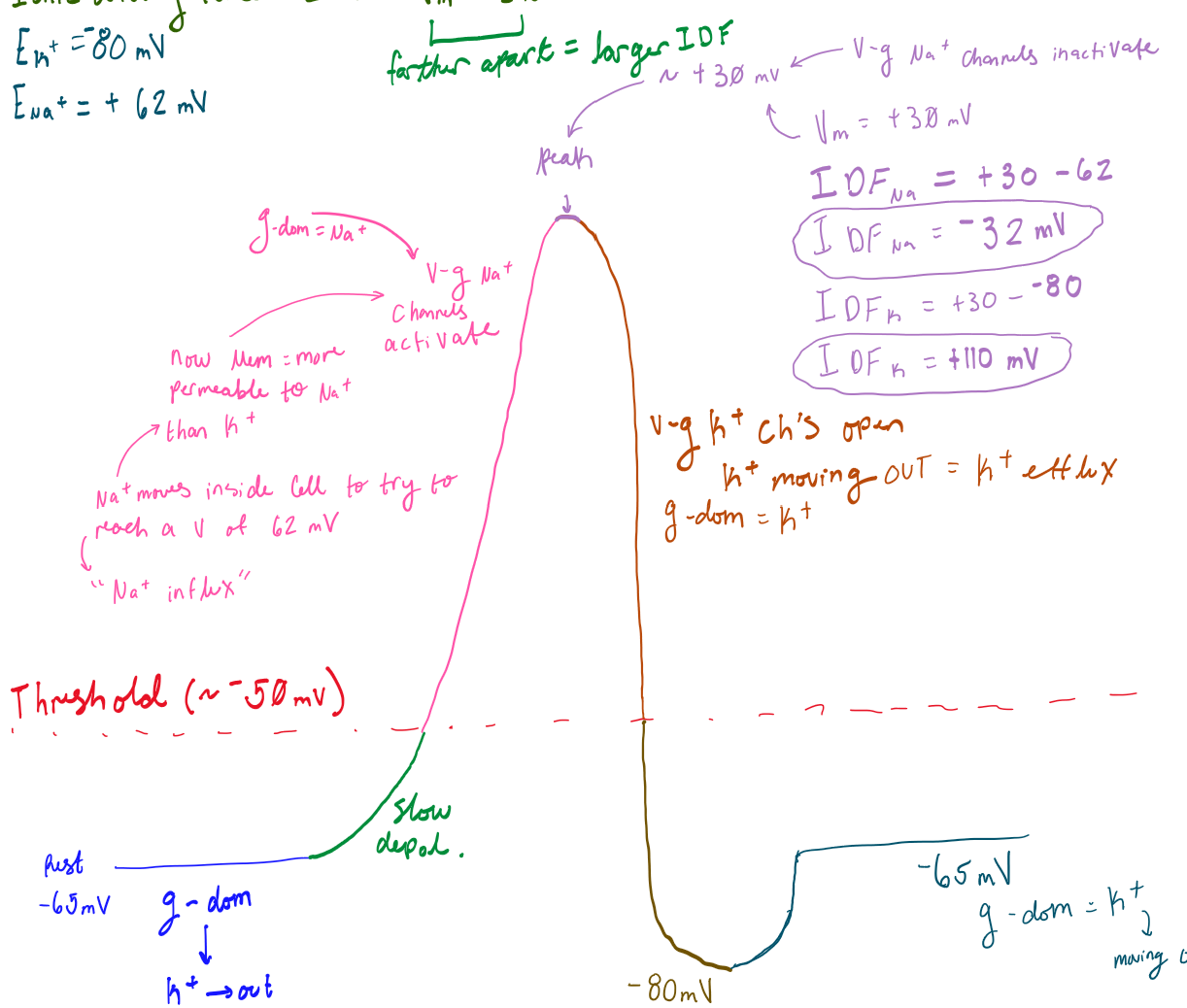
IDF =
Vm - Eion
G-dom at rest
K+
G-dom during rising phase
Na+
g-dom in falling phase + undershoot
K+
Time of total AP
2 ms

Label
Time of absolute refractory period
1 ms
Relative refractory period time
½ ms