physics (unit four)
 Call Kai
 Learn
Learn Practice Test
 Spaced Repetition
 Match
Match Flashcards
 Knowt Play
1/87

There's no tags or description
Looks like no tags are added yet.
Name | Mastery | Learn | Test | Matching | Spaced | Call with Kai | Chat |
|---|
No analytics yet
Send a link to your students to track their progress
88 Terms
what is a frame of reference?
a position from which events are observed
what is an inertial frame of reference?
a reference frame with no acceleration; either stationary or moving with a constant velocity
are newton’s laws obeyed in non-intertial frames of reference?
not necessarily
state Einstein’s postulates of relativity
the principle of relativity holds in all reference frames
no experiment can reveal whether you are at rest or have a constant velocity
the speed of light is constant in all reference frames
state the principle of relativity (*2)
there is no such thing as absolute rest
no experiment can reveal whether you are at rest or have a constant velocity
what is the formal definition of a metre?
describe how muon decay is justified by special relativity
muons are unstable fundamental particles (standard model reference) with a half-life of ~2.2microseconds. they travel at ~0.99c, allowing them to travel ~650m before half decay. muons are formed 10km above ground, meaning that very few should reach the earth. however, many more muons than expected are detected at ground level. this is justified by time dilation and length contraction. due to their high velocity, time passes more slowly in their frame of reference, causing their half-life to dilate. also due to their velocity, the distance traveled to earth contracts in their reference frame. these effects of spe, greatly increasing the number of muons that reach ground level before decaying.
describe how the momentum of high speed particles in particle accelerators justifies special relativity
muons are unstable fundamental particles (standard model reference) with a half-life of ~2.2microseconds. they travel at ~0.99c, allowing them to travel ~650m before half decay. muons are formed 10km above ground, meaning that very few should reach the earth.
define time dilation
time appears to move slower for people traveling at relativistic speeds as the speed of light is constant for all observers. dilated time is measured in the reference frame where
define a proper time interval
the time measured in the frame of reference where both events happen at the same place
define a relativistic time interval
the dilated time measured when objects travel at relativistic speeds
define length contraction
where the object
define proper length
the length measured by the frame of reference where the object is at rest; can be known as the ‘rest frame length’
define relativistic length
the length measured by the frame of reference where the object is not at rest
define rest mass
the mass of an object at rest
define relativistic momentum.
momentum increases at an increasing rate due to relativistic effects, given by p=m(o)v/sqr. rt. (1-v²/c²)
The half life of a muon is approximately 2.3 microseconds. If 1000 muons travel at 0.99c how many muons do you expect to detect after 48 microseconds?
t(dilated)=1.63×10^-6s
after 48microseconds, three half-lives have occured.
0.5³*1000=125
define the relativity of simultaneity
when two events appear simultaneous for
describe how the train paradox justifies the relativity of simultaneity
Man A is inside a train moving at relativistic speeds, and Man B is on the platform. there is a light bulb in the center of the train. when its light reaches the carriage’s doors, they will open or close. Man A experiences his surroundings as at rest. as light travels at a constant velocity of c, it will take the same amount of time to reach both doors. he will observe the doors opening simultaneously. Man B observes the train moving to the right, meaning that the distance the light must travel to the left door is shorter than the distance to the right door. as the speed of light is constant, he observes the time taken for the light to reach the left door as less than the time taken to reach the right door. the left door will be activated before t
what is the relationship between proper and dilated time?
t=
The period of a pendulum is measured to be 2.00 s on the surface of the Earth. The pendulum is then moved to a spaceship traveling at 0.9c. What is the period as measured by an observer on the surface of the Earth, to 3 significant figures?
t=4.59s
A scientist in a laboratory measures the lifetime of a subatomic particle travelling at 0.95c to be 1×10⁻³¹ms^-1.
From the perspective of the particle, what is its lifetime to 3 significant figures?
t=10^-3s
t(o)=3.12×10^-4s
what is the relationship between proper length and contracted length?
in what direction does length contraction occur?
only parallel to the direction of movement
A subatomic particle begins its lifetime at 4.60 km above the Earth's surface, as measured by an observer on the surface of the Earth.
If the particle is traveling at 0.99ccc, what distance does it measure to the Earth's surface?
L(o)=L=649m
The distance between Earth and Alpha Centauri is 4.20 light years as measured on the surface of the Earth.
If we were traveling in a spaceship at 0.5c, what would we observe the distance to be?
L(o)=4.2
can energy be influenced by special relativity?
yes; its equation is given in the same form as the other relativistic equations, E=m(o)c²/sqr. rt. (1-v²/c^
Why do particle collisions at relativistic speeds produce more energy than slower collisions?
mass is converted into energy
A proton has a mass of 1.67×10⁻²⁷kg and the speed of light is 3.00×10^8m/s.
What is the ratio between the momenta of a proton traveling at 0.999c and a proton traveling at 0.99c?
p(0.999c)=1.12×10^-17kgms^-1
p(0.99c)=3.52×10^-18kgms^-1
ratio=3.2
why is the speed of light the maximum speed?
mass dilation means that an infinite amount of force would be necessary to accelerate an object already at the speed of light.
A scientist on Earth is watching an astronaut fly past in a rocket that is travelling faster than the speed of light. The rocket is headed toward an asteroid and fires a laser to destroy it. Why is this a contradiction?
the laser would move slower than the rocket in the scientist’s frame of reference
A collection of mesons was observed by a detector to move an average distance of 11.0 m when traveling at 95% of the speed of light. However, based on their properties, the mesons were expected to travel an average distance of 3.4 m.
Explain the difference between the observed and expected average distances.
Muons travel close to the speed of light, causing relativistic effects. A consequence of this is that they experience time dilation relative to the observed time over the distance traveled. This means that the mesons will travel for a longer time and distance than would be expected.
Describe the effects of relativistic travel on an object.
An object traveling close to the speed of light will experience an increase in mass, which leads to an increased momentum. The object will also experience time slower compared to an observer in another, nonrelativistic frame of reference due to time dilation. Finally, an object moving at relativistic speeds will undergo length contraction, which would cause it to be observed as being shorter than it actually is.
explain how the double slit experiment justifies the wave model of light.
Young’s double slit was conducted by shining a light with a constant wavelength through two vertical slits. A second wall is placed behind the slits. Light reaches this wall with alternating bands of shadow and light. Where peaks and troughs coincide, bright light is visible due to constructive interference. Where they are opposite, destructive interference causes shadows. This phenomenon is fundamental to wave behaviour.
what is a black body?
an object that emits a spectrum of radiations when heated. this spectrum is entirely dependent on the object’s temperature. each temperature causes its own wavelength (therefore colour)
explain how black bodies are related to the quantum model.
Planck said that the energy emitted and absorbed by a black body is quantised.
lambda max = b/T, where T is the temperature in Kelvin and b is a constant.
this theory corroborates with experimental findings on the particle model of light, which are displayed on a graph comparing wavelength (x-axis) with intensity (y-axis).
what evidence is there against the wave model of light? (*2)
the photoelectric effect and black body radiation.
define the UV catastrophe
The classical model of light correctly predicted the intensity of a blackbody at high wavelengths but not at low wavelengths. At low wavelengths, it predicted unlimited intensity.
what is the relationship between photon energy and frequency?
E=hf, where f=6.626×10^-34
What is the energy of a photon of blue light? Blue light has a wavelength of 475nm.
E=hf
=4.18×10^-19J
A laser has a power output of 30mW and emits light with a wavelength of 650nm. Calculate the number of photons released by the laser every second.
c=f lambda
f=4.62×10^15Hz
E(photon)=3.058×10^-19
EL=Pt
=30×10^-3×1
=3×10⁻²J
El=nEp
n=9.81×10^16 photons per second
The graph below shows the electromagnetic radiation emitted from a black body cavity.
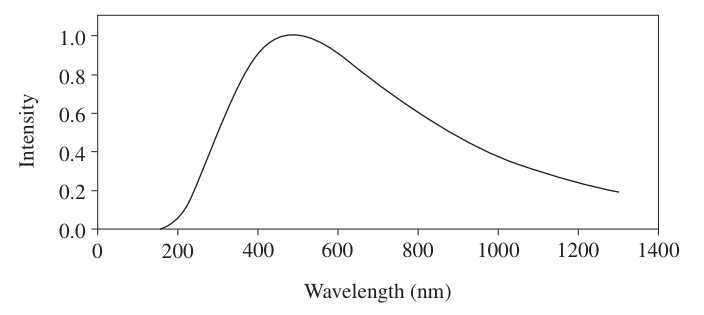
What is the best estimate of the temperature of this black body?
lambda max = b/T
=2.898×10^-3/490×10^-9
=5.9×10³K
The diagram shows the radiation curve for a black body radiator at a temperature of 5000K.
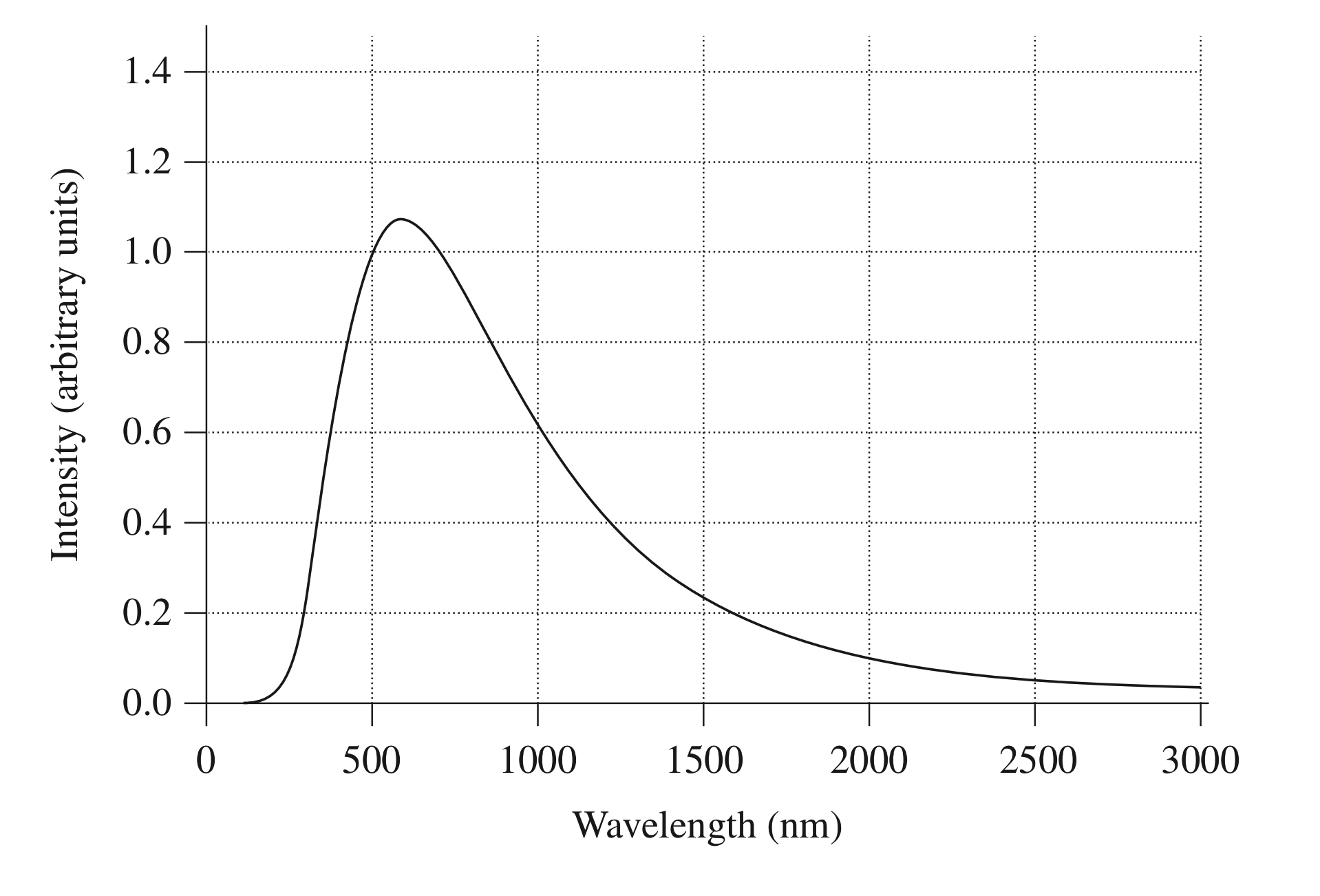
On the same diagram, sketch a curve for a black body radiator of 4000K and explain the differences between the two curves.
Differences between each curve
The new curve's peak wavelength is longer than the original curve's. By Wien's law, the peak wavelength of a black body is inversely proportional to its temperature. Since the 4000K black body is cooler than the 5000K black body, its curve's peak wavelength must be longer than the original curve.
The new curve is drawn completely underneath the original curve. Because temperature is proportional to intensity, at every wavelength the 5000K black body will emit radiation of higher intensity than the 4000K black body.
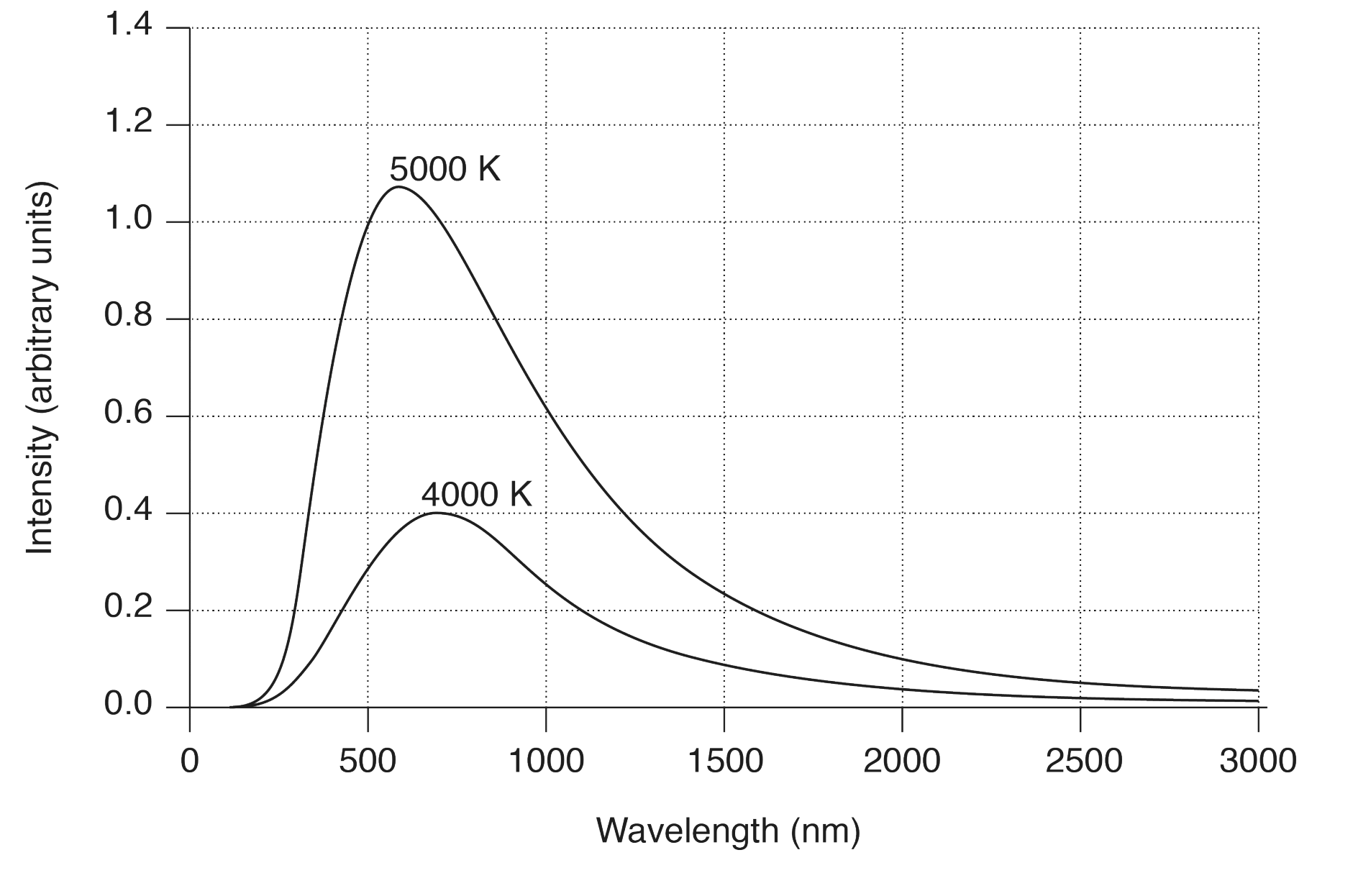
Explain how Planck accounted for the discrepancy between the experimental and theoretical black body radiation curves.
The theoretical black body curve suggested that intensity would diverge to infinity at lower wavelengths, however experimental evidence revealed that intensity actually dropped off at lower wavelengths.
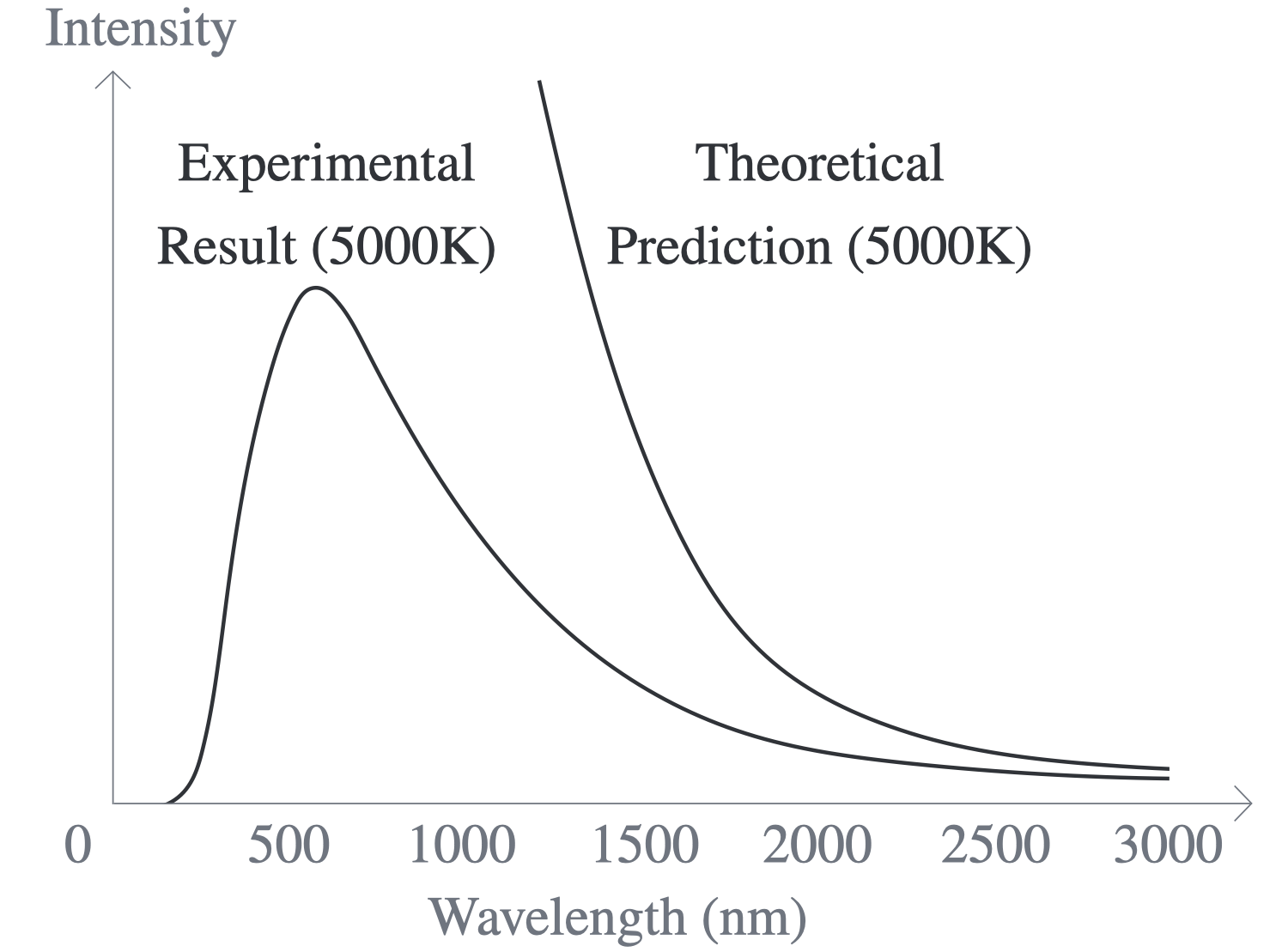
Planck proposed that electromagnetic energy was not emitted and absorbed continuously, rather in discrete packets called quanta. It followed from this that atoms must have discrete energy levels, and the discrete amount of energy released and absorbed to transition between energy levels was given by the equation E=hf. To explain the drop off in intensity at lower wavelengths, Planck suggested that changes in energy with such high frequencies were very unlikely, whereas energy transitions around the peak wavelength were the most likely.
give the formula for de Broglie’s wavelength
lamba=h/p
Outline de Broglie's contribution to quantum mechanics, mentioning a relevant equation.
De Broglie hypothesised that all matter exhibits both wave and particle behaviour. He proposed that the wavelength of matter is given by the equation:
λ=h/mv
Physicists use the expression 'wave-particle' duality because light sometimes behaves like a particle and matter sometimes behaves like a wave.
What evidence do we have that light behaves like a particle and matter behaves like a wave? Explain how this evidence supports the theory of wave-particle duality. (*2)
Particle model of light | Wave model of matter | |
|---|---|---|
Evidence | The photoelectric effect | Davisson Germer experiment |
Explanation | The existence of a threshold frequency suggested that light absorbs energy in discrete packets whose energy is proportional to the frequency of radiation. This showed that electromagnetic radiation is not absorbed and emitted continuously, but discretely, as if it were a particle. | The scattering of electrons in the experiment formed an interference pattern similar to that seen in wave diffraction. This supported the idea that matter, in the case of electrons, exhibits wave-like behaviour. |
describe the photoelectric effect
the emission of electrons from the surface of a conductor when subjected to electromagnetic radiation. photons collide with electrons, transferring their energy. the electron will absorb the photon if given adequate energy. if their energy is greater than the electron’s, additional energy will be kinetic.
What happens when a photon collides with an electron that has a larger orbital energy than the photon's energy?
The photoelectric effect is based on an all or nothing principle. No matter what, the photon will transfer all its energy to the electron. The electron is only ever emitted if the amount of absorbed energy is greater than the energy holding it in its orbit.
define ‘threshold frequency’
the frequency associated with the minimum energy that will emit an electron through the equation E=hf
define ‘work function’
he minimum energy that will emit an electron
give the work function equation
Ke(max) = hf - W
what does intensity influence in the photoelectric effect?
the number of photons
The work function of sodium is 2.92×10⁻¹⁹J and a particular UV radiation source emits light with a wavelength of 350nm.
What is the maximum kinetic energy of an electron on a sodium metal plate when subjected to this UV radiation?
Ke=2.76×10^-19J
describe how the photoelectric effect provides evidence for the quantum model of light
The graph shows the maximum kinetic energy of electrons ejected from different metals as a function of the frequency of the incident light.
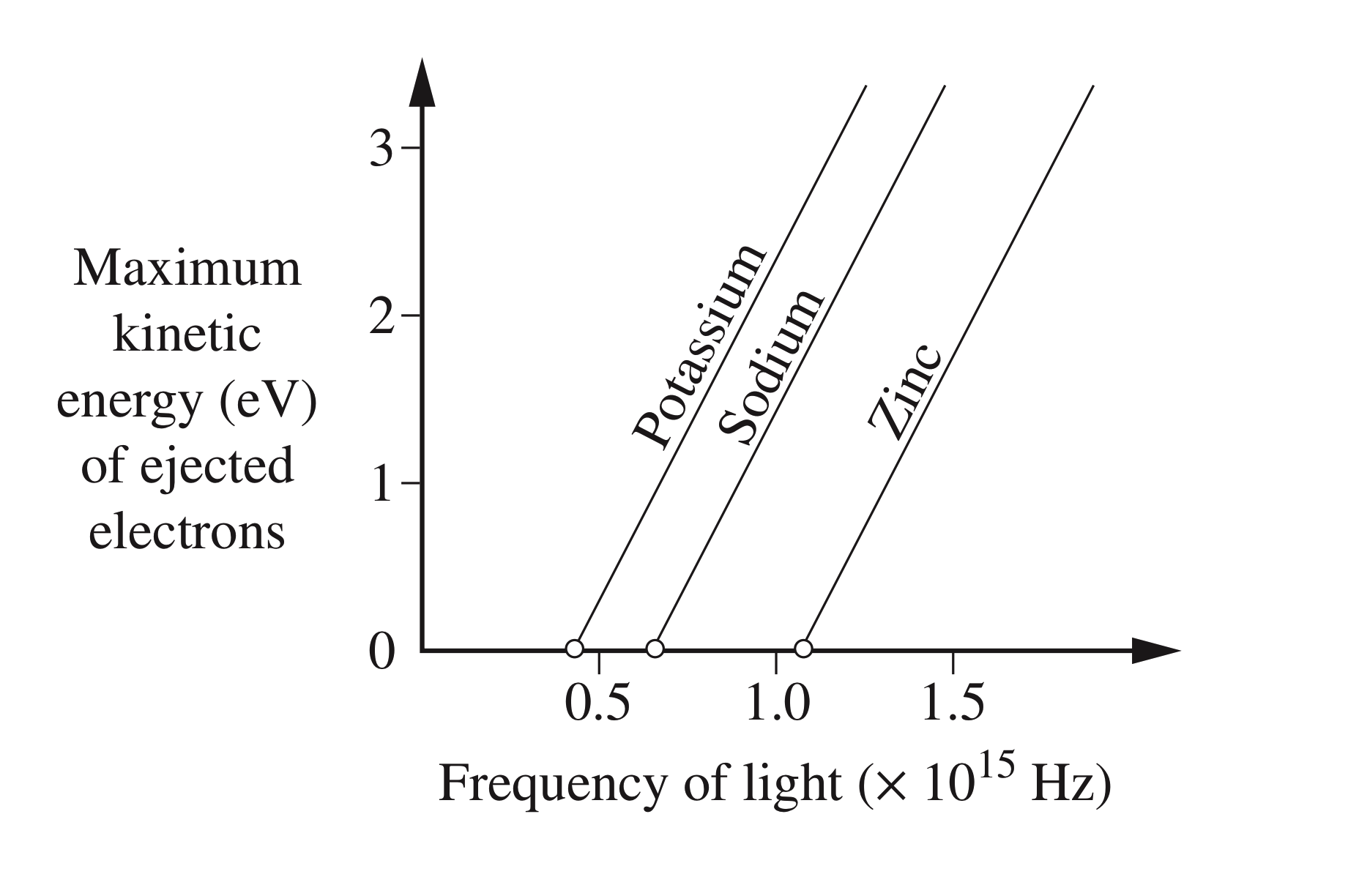
What can be deduced from this graph?
To cause an electron ejection, the incident electromagnetic radiation must have a frequency at least as large as the threshold frequency. From the graph, we can see that zinc has a higher threshold frequency than potassium. So any photon that causes ejection from zinc must have a frequency greater than potassium's threshold frequency. Hence, these photons can also cause ejection from potassium.
Explain how the failure of high wavelength electromagnetic radiation to cause the emission of electrons from materials demonstrates the particle nature of light.
The particle theory of light states that electromagnetic radiation is transmitted through packets of energy called photons, each with a discrete energy given by the equation E=hf. The particle theory of light is supported by the phenomenon of the photoelectric effect, in which electrons are emitted from a material when the frequency of the incident electromagnetic radiation exceeds a certain threshold frequency. So, the photoelectric effect explains that when longer wavelength (lower frequency) radiation is incident upon a material, electron emission does not occur. It was thought under the classical model of light that radiation of any frequency would cause electron emission so long as the intensity was great enough, as electrons would eventually absorb enough energy to be emitted. However, the photoelectric effect showed this was not true and thus provided evidence for the particle model of light.
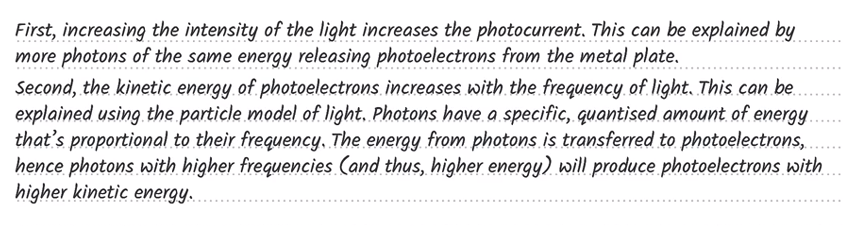
The results of photoelectric effect experiments provide strong evidence for the particle-like nature of light.
Outline TWO aspects of these results and explain why they provide evidence that is not explained by the wave model of light.
The existence of a threshold frequency
The wave model predicted that for any wavelength of light, there would be photoelectron emission from a metal surface so long as the intensity of the light was great enough or the metal was exposed long enough to the radiation. Instead, the photoelectric effect experiment observed that photoelectron emission had no dependence on intensity. Only when the incident radiation exceeded a particular threshold frequency was photocurrent observed.
The independence of kinetic energy from intensity
The wave model predicted that increasing the intensity of the incident radiation would increase the kinetic energy of the photoelectrons. It was predicted that by increasing the intensity, more photoelectrons would be released, and the photoelectrons would have a broad range of kinetic energies. The observations of the photoelectric effect instead showed that increasing the intensity only increased the number of photoelectrons, but had no effect on the kinetic energy of each photoelectron.
explain the progression from the plum pudding model to rutherford’s model
the Geiger-Marsden experiment was conducted by firing alpha particles as a thin sheet of gold foil. they attempted to affirm the plum-pudding model, where atoms were a ball of positive charge interspersed with electrons. they expected the particles to travel straight through the metal. however, occasionally particles were deflected from the foil. the alpha particles were repelled by the positive charge in the atom. the scientists theorised that atoms were made up of mostly empty space, with a small, dense centralised positive charge known as the nucleus. the rutherford model was developed through this evidence.
explain bohr’s postulates
bohr postulated that electrons exist in stable orbits around the nucleus at discrete radii, with specific energies for each orbit. electrons emit and absorb energy as electromagnetic radiation when moving between orbits, with the energy equal to the difference between the orbital energies. finally, the electron’s angular momentum is quantised.
explain how spectral lines justify the quantum model
moving from a higher orbit to a lower one releases a photon that causes a spectral line that corresponds the photon’s wavelength. these lines are discrete and do not fade into each other, showing orbitals’ quantised nature.
what is the quantified relationship between energy and orbitals?
E(n) = E(1)/n²
do electrons emit photons when jumping to a higher energy level?
no - to jump to a higher energy level, electrons must absorb photons.
A photon of wavelength 487nm strikes an electron in the second level of a hydrogen atom. The ground state of the hydrogen atom is E1=-13.6eV.
What level does the electron jump to?
c=f lambda
E=hf
=2.55eV
E(n)=E(1)/n²
E(1)=-13.6eV
E(2)=-3.4eV
E(3)=-1.51eV
E(4)=-0.85eV
Ex=E(2)+2.55
=0.85eV, therefore E(4)
compare rutherford and bohr’s models (limitations, traits)
rutherford
traits:
- electrons orbiting a dense positive mass, the nucleus
limitations:
- when an electron accelerates, it must lose energy in the form of electromagnetic radiation. the electrons’ circular direction means that it is accelerating. it should lose energy and spiral away from the atom.
- model cannot account for spectral lines
bohr
traits:
- electrons travel in stable orbits at discrete radii
- energy of each orbit is quantised
- electrons emit or absorb energy only when moving between radii → these postulates solve rutherford’s limitations
limitations:
- emission spectra; cannot predict spectra for atoms other than hydrogen, cannot explain varying intensity of spectra lines, cannot explain splitting of spectral lines, cannot explain the Zeeman effect (splitting of spectral lines in a magnetic field)
- does not offer any justification for electrons traveling in stable orbits
define the zeeman effect
the splitting of spectral lines (presence of hyperfine spectral lines) in a magnetic field
explain how bohr’s model offered a solution to a limitation of rutherford’s model.
Rutherford model limitation: Could not explain the emission and absorption spectrum of hydrogen.
Bohr model postulate that overcomes the limitation: Electrons could only exist in discrete energy levels around the nucleus, and movements between energy levels occur by emitting or absorbing electromagnetic radiation.
Explanation of the hydrogen spectrum:
For electrons to move between shells, they must emit or absorb electromagnetic energy with energy equal to the difference between the energy levels. The frequency of the lines within the spectrum corresponded precisely to the energy of each electron jump in the hydrogen atom.
what is the formula related to electrons’ movement between levels?
delta E = hf
are photons emitted when electrons travel down their radii (decrease in energy)?
yes
what is the equation for balmer’s series?
1/lambda=R(1/nf²-1/ni²), where R=1.09×10^7 (only applicable for hydrogen)
what is bohr’s
The image below shows the line absorption spectra of a mixture of different atoms in a gaseous state.

Account for the presence of absorption lines in the spectra shown above.
An absorption spectrum like the diagram shown is produced by shining a light source of many wavelengths onto a gaseous substance and observing the resulting spectrum.
The spectrum appears to be continuous with a set of black lines. The black lines correspond to wavelengths of light that are absorbed by the atoms in the substance. The photons matching these wavelengths will have an energy that is precisely equal to the amount of energy required for an electron to transition to a higher energy level.
Most of the absorption spectrum can be seen as a continuum of all wavelengths of light. This is because most wavelengths of light will not be absorbed by the atom, since the energy of each photon does not exactly match the energy required for an electron transition within one of the atoms. The wavelengths that are not absorbed by the atom fill out the continuum in the spectrum.
When gaseous mercury atoms are excited, they emit photons of varying wavelengths. Some of the energy levels in a mercury atom are shown in the diagram below.
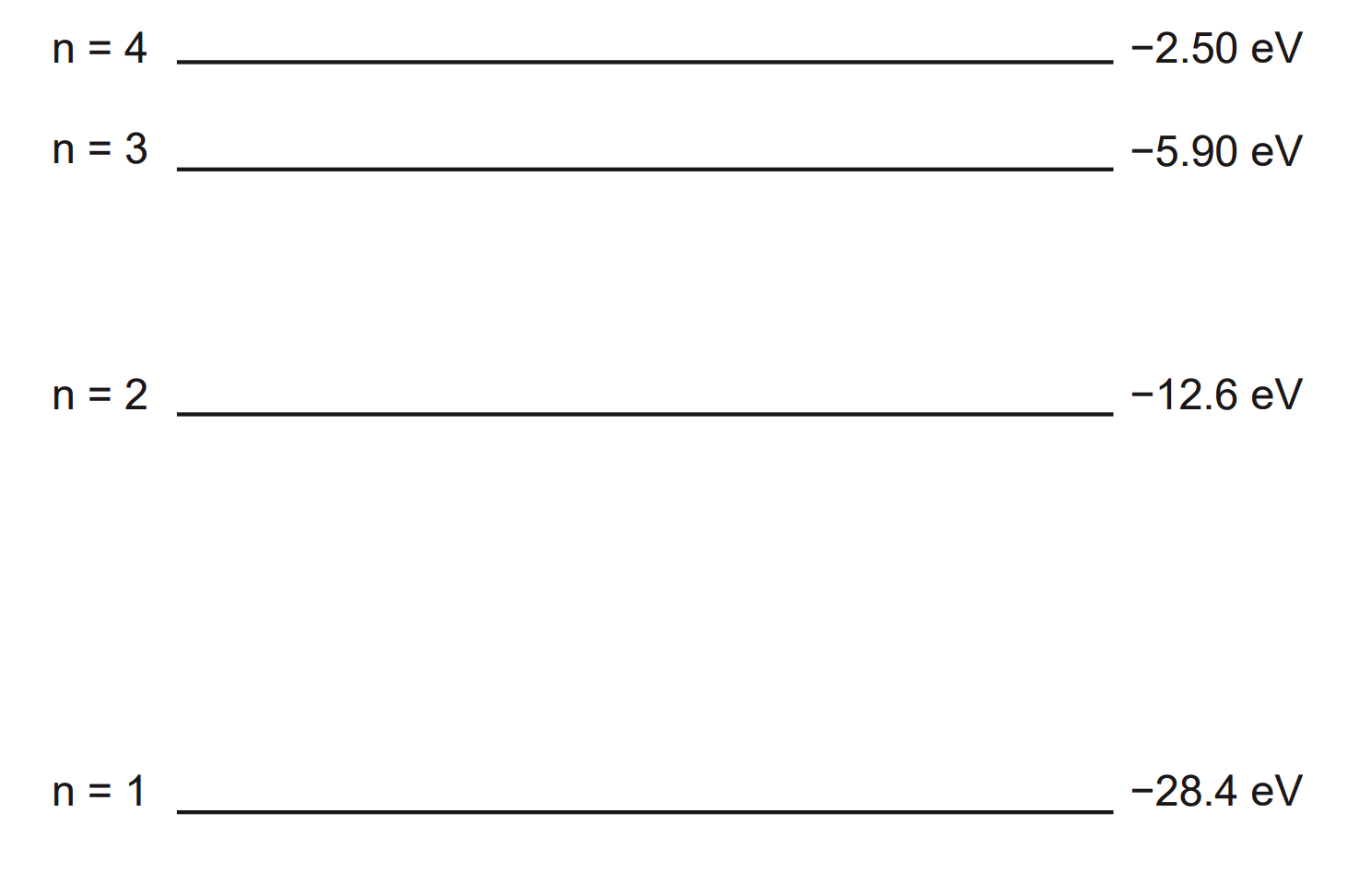
In a fluorescent tube, a mercury lamp is used to produce light which is first fed through a filter that eliminates all wavelengths except those produced from the n=2n=2n, equals, 2 to n=1n=1n, equals, 1 transition. The resultant light is then shone onto a potassium metal plate whose work function is 2.00eV. An electron is excited to an energy of 23.0V in the mercury lamp.
As a result of this excitation, calculate the maximum velocity of any electrons liberated from the potassium metal plate. Ignore relativistic effects.
delta E = 28.4 - 12.6
Ke=E(photon)-W
=13.8eV=2.208×10^-18J
Ke=0.5mv²
v=2.2×10^6J
what is a baryon?
a group of three quarks
what is a meson?
a pair of a quark and an antiquark
draw the standard model table
upper quark charge: 1/3
lower quark charge: -2/3
upper lepton charge: -1
lower lepton charge: 0
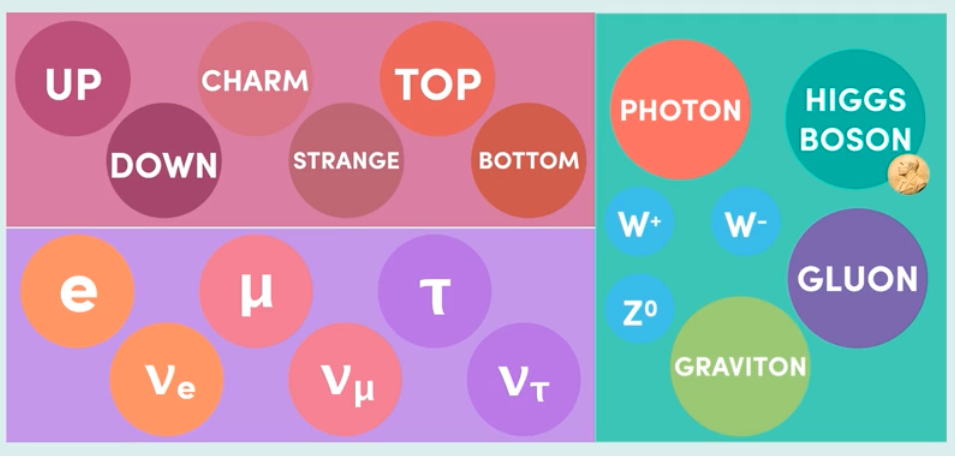
what quarks is a proton made up of?
uud
what quarks is a neutron made up of?
udd
which forces correspond to which bosons?
photon: electromagnetic
gluon: strong nuclear
W+, W-: weak nuclear
graviton: gravity
what is a boson?
a force carrying particle
Describe the hydrogen atom in terms of the Standard Model of matter.
The hydrogen atom is composed of a proton nucleus and an electron. A proton is a hadron consisting of three quarks: two up quarks and one down quark. The quarks are bound together through the strong nuclear force, an interaction which is mediated by the gluon.
The electron is classified as a lepton, a fundamental particle that can be isolated.
what is the baryon number of a quark?
1/3
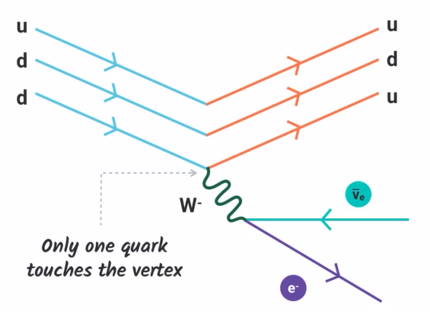
what occurs during beta - decay?
a neutron decays into a proton, releasing an electron and an antineutrino
what occurs during beta + decay?
a proton decays into a neutron, releasing a positron and a neutrino
describe the annihilation interaction
an electron and a positron meet → annihilate → produce energy as a photon of gamma radiation → photon pair produces another electron and positron
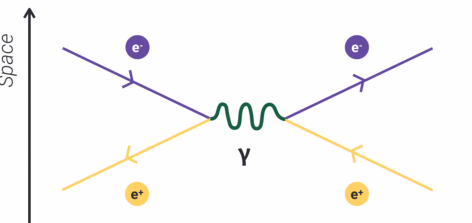
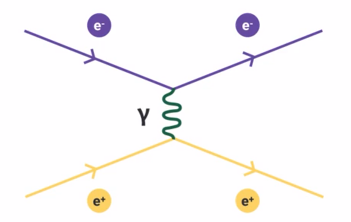
describe the bhabha scattering
the electron and positron’s charges mean that they interact with electromagnetic force, which involves the exchange of a photon
offer the diagram for beta - decay (whole particles)

offer the diagram for beta - decay (quarks)