Perio 6 - Influence of Systemic Factors on Periodontal Status (Dr. Shaikh)
 Call Kai
 Learn
Learn Practice Test
 Spaced Repetition
 Match
Match Flashcards
 Knowt Play
1/95

There's no tags or description
Looks like no tags are added yet.
Name | Mastery | Learn | Test | Matching | Spaced | Call with Kai | Chat |
|---|
No analytics yet
Send a link to your students to track their progress
96 Terms
What is the influence of systemic interactions on periodontal disease?
- Diagnosis is adjusted
- Treatment may be more (or less) aggressive
- Prognosis changes

What is the influence of periodontal disease on systemic interactions?
- Treatment of periodontal disease would become a medical necessity
- Health insurance would cover periodontal treatment

What are three examples of systemic factors that have a major impact on the loss of periodontal tissue by influencing periodontal inflammation?
- Rheumatoid arthritis
- Diabetes
- Obesity
What are two examples of systemic disorders that influence the pathogenesis of periodontal disease?
- Smoking
- Medications
What disease is the following:
- Chronic autoimmune disease, is depicted by synovial inflammation and hyperplasia leading to irreversible damage of the cartilage and bone in the joints, loss of function, chronic pain and progressive disability (stiffness, swelling and deformation of the joints)
Rheumatoid arthritis
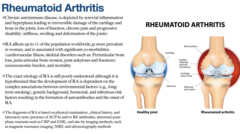
What percentage of the population worldwide does rheumatoid arthritis affect?
Up to 1%

Are men or women more commonly affected by rheumatoid arthritis?
Women (3x more prevalent)

What co-morbidities is rheumatoid arthritis commonly associated with?
- Cardiovascular illness
- Skeletal disorders (such as periarticular bone loss, juxta-articular bone erosion, joint ankyloses, and fractures)
- Socioeconomic burden
- Increased mortality

The exact etiology of rheumatoid arthritis (RA) is still poorly understood although it is hypothesized that the development of RA is dependent on the complex associations between environmental factors (e.g., long-term smoking), genetic background, hormonal, and infectious risk factors resulting in the formation of ______________ and the onset of RA
Autoantibodies
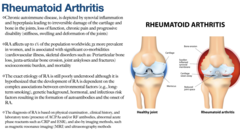
The diagnosis of __________ is based on:
- Physical examination
- Clinical history
- Laboratory tests (presence of ACPAs and/or RF antibodies, abnormal acute phase reactants such as CRP and ESR)
- Imaging methods, such as magnetic resonance imaging (MRI) and ultrasonography methods
Rheumatoid arthritis (RA)

A number of large epidemiological studies and smaller case-control and cohort studies have been published showing ______________ associations between Rheumatoid arthritis (RA) and Periodontal Disease (PD)
Positive
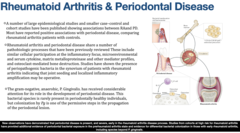
Which of the following is a shared pathobiologic process between rheumatoid arthritis and periodontal disease?
A. Similar cellular participation at the inflammatory focus
B. Microenvironmental and serum cytokine
C. Matrix metalloproteinase and other mediator profiles
D. Osteoclast-mediated bone destruction
E. All of the above
E. All of the above
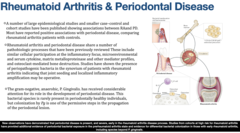
Studies have shown that periopathogenic bacteria in rheumatoid arthritis patients can be found where?
Synovium of joints
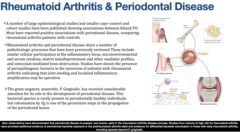
What does the presence of periopathogenic bacteria in RA patients' synovium suggest?
Joint seeding and localized inflammatory amplification may be operative
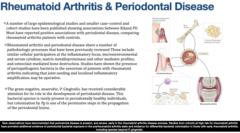
Which bacterial species has received considerable attention for its role in periodontal disease?
P. gingivalis (gram-negative, anaerobic, oral coccobacillus)

T/F: New observations have demonstrated that periodontal disease is not present, nor severe, early in the rheumatoid arthritis disease process
False! It IS present AND severe
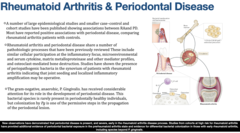
T/F: Studies from cohorts at high risk for rheumatoid arthritis have provided additional evidence of periodontal bacterial exposure in the prerheumatoid arthritis state and evidence for differential bacterial colonization in those with early rheumatoid arthritis, including species beyond P. gingivalis
True

What type of diabetes does the pancreas not produce insulin?
Diabetes Type 1

What type of diabetes do the cells not absorb glucose?
Both type 1 and 2

What type of diabetes is a chronic condition where the body does not respond to insulin?
Diabetes Type 2

What type of diabetes is more common?
Diabetes Type 2

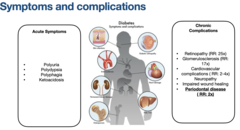
What are the acute symptoms of diabetes?
- Polyuria
- Polydypsia
- Polyphagia
- Ketoacidosis
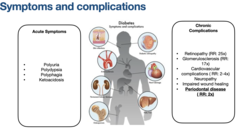
What are six chronic complications of diabetes?
- Retinopathy (RR: 25x)
- Glomerulosclerosis (RR: 17x)
- CV complications (RR: 2-4x)
- Neuropathy
- Impaired wound healing (ex: extractions)
- Periodontal disease (RR: 2x)
T/F: Diabetes is a minor risk factor for periodontitis
False (MAJOR risk factor)
Risk of periodontitis is approx. _____x in diabetic individuals compared with non-diabetic individuals
2x

for patients with diabetes, in order to prevent and manage periodontal disease, level of _______ is important
glycemic control

NHANES IIII, adults with HbA1c of >____% had a significantly higher prevalence of severe periodontitis than those without
>9%
In children over 18 years with type I diabetes, approximately what percentage showed increased attachment loss (AL) and bone loss compared with controls, despite similar plaque scores?
10%
t/f: type 1 and type 2 diabetes have both been shown to increase the risk of periodontal disease in uncontrolled patients
true
What are the three mechanisms that support the theory between diabetes and periodontal disease?
- Endothelial and vascular injury
- Altered leukocyte function
- Advanced glycation end products and collagen metabolism
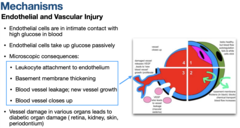
ID the mechanism:
- Endothelial cells are in intimate contact with high glucose in blood
- Endothelial cells take up glucose passively
- Leukocyte attachment to endothelium
- Basement membrane thickening
- Blood vessel leakage; new vessel growth
- Blood vessel closes up
- Vessel damage in various organs leads to diabetic organ damage (retina, kidney, skin, periodontium)
Endothelial and Vascular Injury Theory

Endothelial and Vascular Injury Theory is a theory that supports the relationship between ______ and periodontal disease
diabetes
ID the mechanism:
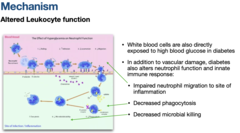
- White blood cells are also directly exposed to high blood glucose in diabetes
- In addition to vascular damage, diabetes also alters neutrophil function and innate immune response:
- - Impaired neutrophil migration to site of inflammation
- - Decreased phagocytosis
- - Decreased microbial killing
Altered Leukocyte Function Theory
Altered Leukocyte function Theory is a theory that supports the relationship between ______ and periodontal disease
diabetes

ID the mechanism:
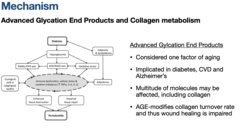
- Factor of aging
- Implicated in diabetes, CVD, Alzheimer's
- Multitude of molecules may be affected, including collagen
- AGE-modifies collagen turnover rate and thus wound healing is impaired
Advanced Glycation End Products and Collagen Metabolism Theory

Advanced Glycation End Products and Collagen Metabolism Theory is a theory that supports the relationship between ______ and periodontal disease
diabetes

Hyperglycemia could lead to an excess accumulation of which of the following?
A) Cytokines
B) Advanced Glycation End Products (AGE)
C) Fibroblasts
D) Mast cells
B) Advanced Glycation End Products (AGE)
Is bleeding on probing (BOP) increased in uncontrolled or controlled diabetic patients?
Uncontrolled diabetes

Is attachment loss higher in uncontrolled or controlled diabetic patients?
Uncontrolled diabetes

Is the risk of tooth loss higher in uncontrolled or controlled diabetic patients?
Uncontrolled diabetes

T/F: Effective control of diabetes increases the risk of the progression of periodontitis
False (lowers the risk)

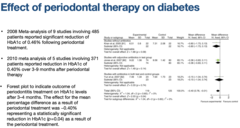
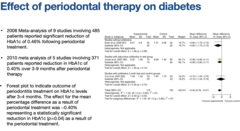
studies have shown that patients with diabetes who received periodontal therapy experience a ______________ in their HbA1C
decrease
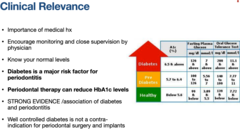
Is there EVIDENCE/association of diabetes and periodontitis?
Yes - There is STRONG evidence
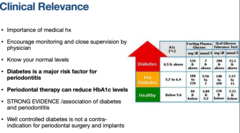
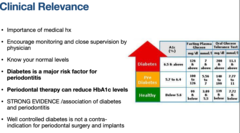
Is well controlled diabetes a contraindication for periodontal surgery and implants?
No (it NOT a contraindication)

Which A1c range indicates a healthy individual?
Below 5.6%

Which A1c range indicates pre-diabetes?
5.7 to 6.4%

Which A1c range indicates diabetes?
Above 6.5%
What disease is the following:
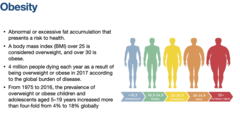
Abnormal or excessive fat accumulation that presents a risk to health
Obesity
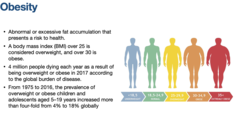
A body mass index (BMI) over ______ is considered overweight
25
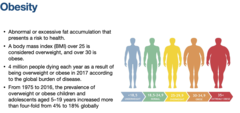
A body mass index (BMI) over _____ is considered obese
30

T/F: 4 million people dying each year as a result of being overweight or obese in 2017 according to the global burden of disease
True

T/F: From 1975 to 2016, the prevalence of overweight or obese children and adolescents aged 5-19 years decreased globally
False (increased more than four-fold from 4% to 18%)
What are the five diagnostic components of metabolic syndrome that are associated with increased risk for periodontal disease?
- Elevated blood pressure (>130/85 mm Hg)
- Elevated central adiposity (waist circumference: men >40 in, women >35 in)
- Elevated triglycerides (≥150 mg/dl)
- Low HDL cholesterol (men

Which of the following are mechanisms in the progression of periodontal disease in obese patients?
A) Changes to macrophages and adipocytes leading to chronic inflammation and insulin resistance
B) Increased number of M1 macrophages, B cells, regulatory B cells, T helper cells etc
C) Pro-inflammatory cytokines recirculate between different tissues
D) Decreased phagocytic activity
E) Impaired antigen presentation
F) All of the above
F) All of the above

individuals who are obese have a ____% increased risk of developing periodontitis compared with normal-weight individuals
35%

according to research, the increased risk of periodontal disease in patients who are obese tends to be _______ among women who are obese compared with men who are obese
more
Is there an indication that the response to periodontal treatment should differ for individuals who are obese versus individuals who are not?
No, not yet (NOT bidirectional)
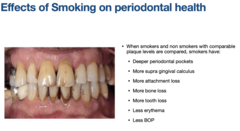
When smokers and non smokers with comparable plaque levels are compared, smokers have MORE of all of the following except:
A) Deep periodontal pockets
B) Bleeding on probing (BOP)
C) Supra gingival calculus
D) Attachment loss
E) Erythema
F) Bone loss
G) Tooth loss
B) BOP
E) Erythema
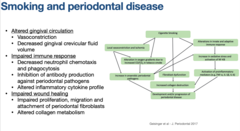
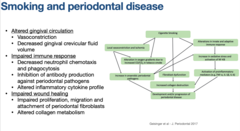
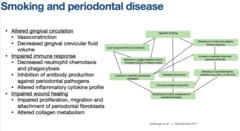
what are 3 mechanisms how smoking has an effect on periodontal disease?
- Altered gingival circulation
- Impaired immune response
- Impaired wound healing

The following are examples of ___________ associated with smoking:
- Vasoconstriction
- Decreased gingival crevicular fluid (GCF) volume
altered gingival circulation
The following are examples of ___________ associated with smoking:
- Decreased neutrophil chemotaxis and phagocytosis
- Inhibition of antibody production against periodontal pathogens
- Altered inflammatory cytokine profile
impaired immune response
The following are examples of ___________ associated with smoking:
- Impaired proliferation, migration and attachment of periodontal fibroblasts
- Altered collagen metabolism
impaired wound healing
What are the three types of smoking status?
- Current
- Former
- Non smoker (less than 100 cigs lifetime)

how do you calculate pack years for a patient?
# packs smoked per day X # years smoked

What is the pack-year history for a patient who smoked 2 packs daily for 10 years?
20 pack years
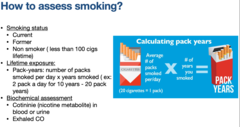
How many cigarettes are typically in 1 pack of cigarettes?
20 cigarettes

What are two biochemical assessments of smoking status?
- Cotininie (nicotine metabolite) in blood or urine
- Exhaled CO

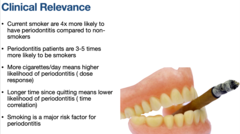
Current smokers are _____x more likely to have periodontitis compared to non-smokers
4x

periodontitis patients are ___-___x more likely to be smokers
3-5x

A patient that smokes more cigarettes per day has a ___________ likelihood of periodontitis
Higher (dose response)
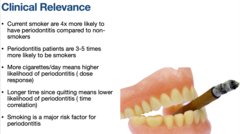
Longer time since quitting means _____________ likelihood of periodontitis
Lower (time correlation)
T/F: Smoking is a minor risk factor for periodontitis
FALSE (major risk factor)

Major, some, or no evidence:
There is ___________ evidence that periodontal disease therapy can result in a reduction in HbA1C
major

Major, some, or no evidence:
There is ___________ evidence that periodontitis is a risk factor for developing diabetes
major
Major, some, or no evidence:
There is ___________ evidence that diabetes is a risk factor for developing periodontal disease
major
Major, some, or no evidence:
There is ___________ evidence that individuals that are obese have a 35% increased risk of developing periodontal disease
major

Major, some, or no evidence:
There is ___________ evidence that current smokers are 4x more likely to have periodontal disease than non-smokers
major

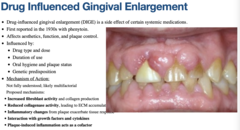
Drug-influenced gingival enlargement (DIGE) is most commonly associated with which factor?
Certain systemic medications

Drug-influenced gingival enlargement was first reported in the 1930s with the use of which drug?
Phenytoin

Drug-influenced gingival enlargement (DIGE) affects what three things?
- Aesthetics
- Functions (speech and mastication)
- Plaque control

Which of the following influence the severity of drug-influenced gingival enlargement?
A) Drug type and dose
B) Duration of use
C) Oral hygiene and plaque status
D) Genetic predisposition
E) All of the above
E) All of the above

T/F: The mechanism of action for drug-influenced gingival enlargement (DIGE) is fully understood
False (Not fully understood; likely multifactorial)

All of the following are proposed mechanisms of drug-influenced gingival enlargement EXCEPT:
A) Increased fibroblast activity and collagen production
B) Increased collagenase activity, leading to ECM accumulation
C) Inflammatory changes from plaque exacerbate tissue response
D) Interaction with growth factors and cytokines
E) Plaque-induced inflammation acts as a cofactor
B) Increased collagenase activity, leading to ECM accumulation (Should be REDUCED collagenase activity)
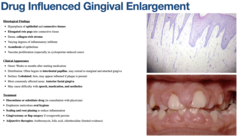
What do the following histological findings indicate?
- Hyperplasia of epithelial and connective tissues
- Elongated rete pegs into connective tissue
- Dense, collagen-rich stroma
- Varying degrees of inflammatory infiltrate
- Acanthosis of epithelium
- Vascular proliferation (especially in cyclosporine-induced cases)
Drug-influenced gingival enlargement (DIGE)
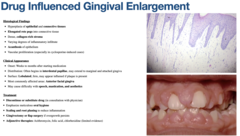
When is the typical onset of drug-influenced gingival enlargement (DIGE)?
Weeks to months after starting medication

Where is the typical distribution of drug-influenced gingival enlargement (DIGE)?
Often begins in interdental papillae, may extend to marginal and attached gingiva
How does the surface of drug-influenced gingival enlargement (DIGE) present?
- Lobulated
- Firm
- May appear inflamed if plaque is present
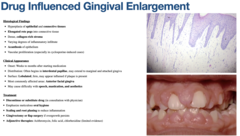
Which of the following is the most common site affected by drug-influenced gingival enlargement?
Anterior facial gingiva

What are five treatment options for drug-influenced gingival enlargement (DIGE)?
- Discontinue or substitute drug (in consultation with physician)
- Emphasize meticulous oral hygiene
- Scaling and root planing to reduce inflammation
- Gingivectomy or flap surgery if overgrowth persists
- Adjunctive therapies: Azithromycin, folic acid, chlorhexidine (limited evidence)

What drug has the following characteristics?
- DIGE Incidence: 50-70%
- Common in younger patients
- Onset: 1-3 months
- Tissue character: Firm, fibrotic
- Severity: Moderate to severe
Phenytoin
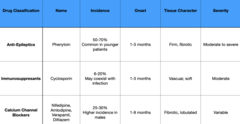
What drug classification is phenytoin?
Anti-epileptics

What drug has the following characteristics?
- DIGE Incidence: 6-20%
- May coexist with infection
- Onset: 1-3 months
- Tissue character: Vascular, soft
- Severity: Moderate
Cyclosporin

What drug classification is cyclosporin?
Immunosuppresant

What drug has the following characteristics?
- DIGE Incidence: 25-30%
- Higher incidence in males
- Onset: 1-9 months
- Tissue character: Fibrotic, lobulated
- Severity: Variable
- Nifedipine
- Amlodipine
- Verapamil
- Diltiazem

What drug classification are the following?
- Nifedipine
- Amlodipine
- Verapamil
- Diltiazem
Calcium channel blockers

What are a few examples of systemic disorders that can result in loss of periodontal tissue independent of periodontitis?
- Neoplasms
- Primary neoplastic diseases of periodontal tissue
- Oral squamous cell carcinoma
- Odontogenic tumors
- Secondary metastatic neoplasms of periodontal tissue
- Granulomatosis with polyangiitis
- Giant cell granulomas
