Comprehensive Tissue Types and Epithelial Cell Junctions in Human Anatomy
 Call Kai
 Learn
Learn Practice Test
 Spaced Repetition
 Match
Match Flashcards
 Knowt Play
1/109

There's no tags or description
Looks like no tags are added yet.
Name | Mastery | Learn | Test | Matching | Spaced | Call with Kai | Chat |
|---|
No analytics yet
Send a link to your students to track their progress
110 Terms
What is histology?
The study of tissues.
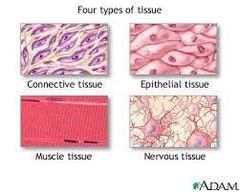
What are the four basic tissue types?
Epithelial, connective, muscle, and nervous tissue.
What is the primary function of nervous tissue?
Internal communication.
What types of muscle tissue exist?
Skeletal, cardiac, and smooth muscle.
What is the function of epithelial tissue?
Forms boundaries, protects, secretes, absorbs, and filters.
What is the main function of connective tissue?
Supports, protects, and binds other tissues together.
What are the two main types of epithelial tissue?
Covering and lining epithelia, and glandular epithelia.
What is the characteristic feature of epithelial cells?
They have polarity with apical and basal surfaces.
What is the role of microvilli in epithelial tissue?
They increase surface area for absorption.
What is the function of tight junctions?
Prevent fluids and most molecules from moving between cells.

What are desmosomes?
Anchoring junctions that bind adjacent cells together.
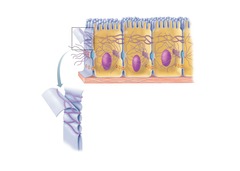
What is the function of gap junctions?
Allow small molecules to pass from cell to cell for communication.
What is the basal lamina?
A noncellular adhesive sheet of glycoproteins that acts as a filter and scaffolding.
What is the difference between simple and stratified epithelium?
Simple epithelium has one layer, while stratified epithelium has multiple layers.

What shape are squamous epithelial cells?
Flattened cells.
What is the function of simple squamous epithelium?
Allows passage of materials by diffusion and filtration.

Where is simple cuboidal epithelium found?
Kidney tubules and ducts of small glands.

What is the primary function of simple columnar epithelium?
Absorption and secretion of mucus and enzymes.

What distinguishes pseudostratified columnar epithelium?
It appears stratified due to differing cell heights but is a single layer.
What is the role of CAMs (Cell Adhesion Molecules)?
They help hold large sheets of epithelial cells together.
What is the function of glandular epithelia?
To synthesize and secrete products.
What are the two specialized locations of simple squamous epithelium?
Endothelium and mesothelium.
What is the function of stratified squamous epithelium?
Protects underlying tissues in areas subjected to abrasion.

Where is keratinized stratified squamous epithelium found?
In the epidermis of the skin.

What is the primary function of connective tissue?
To support, protect, and bind other tissues.
What type of epithelium lines the digestive tract?
Simple columnar epithelium.
What is the significance of intercellular connections in epithelial tissue?
They maintain the integrity and function of the epithelium.
What are the three types of membrane junctions?
Tight junctions, desmosomes, and gap junctions.
What is the primary function of ciliated pseudostratified columnar epithelium?
Secretion, particularly of mucus; propulsion of mucus by ciliary action.

Where is ciliated pseudostratified columnar epithelium located?
Lines the trachea and most of the upper respiratory tract.

What type of epithelium is found in sweat and mammary glands?
Stratified cuboidal epithelium.
What is the function of transitional epithelium?
Stretches readily and permits distension of urinary organs by contained urine.

Where can transitional epithelium be found?
Lines the ureters, urinary bladder, and part of the urethra.
What are the three classifications of glands?
By number of cells (unicellular or multicellular), site of product release (endocrine or exocrine), and mode of secretion (apocrine, merocrine, holocrine).
What distinguishes endocrine glands from exocrine glands?
Endocrine glands release hormones into interstitial fluid without ducts, while exocrine glands produce secretions onto epithelial surfaces through ducts.
What is the only unicellular gland in the body?
The goblet cell.
What are the three types of fibers found in connective tissue?
Collagen, elastic, and reticular fibers.
What is the primary function of collagen fibers?
Provide high tensile strength and resist force in one direction.
What is the role of elastic fibers in connective tissue?
Allow for stretch and return to original length after stretching.
What is the function of reticular fibers?
Stabilize functional cells and structures, resisting force in many directions.
What are the major functions of connective tissue?
Binding and support, protecting, insulating, storing reserve fuel, and transporting substances.
What is the common tissue of origin for all connective tissues?
Mesenchyme.
What are fibroblasts?
The most abundant cell type in connective tissue proper, responsible for secreting proteins and hyaluronan.
What do adipocytes do?
Store a single, large fat droplet.
What is the role of macrophages in connective tissue?
Eat pathogens and damaged cells; fixed macrophages stay in tissue while free macrophages migrate.
What is the function of mast cells?
Stimulate inflammation after injury or infection by releasing histamine and heparin.
What are lymphocytes?
Specialized immune cells in the lymphatic system that can develop into plasma cells producing antibodies.
What is the difference between merocrine, apocrine, and holocrine secretion?
Merocrine: products secreted by exocytosis; Apocrine: products accumulate and the membrane pinches off; Holocrine: products accumulate and are secreted by rupture of gland cells.
What is the structure of multicellular exocrine glands?
Composed of a duct and a secretory unit.
What are the two types of duct structures in exocrine glands?
Simple (does not branch) and compound (does branch).
What are the three types of secretory units in exocrine glands?
Tubular, alveolar (sac-shaped), and tubuloalveolar (both shapes present).
What type of connective tissue is the most abundant and widely distributed?
Connective tissue proper.
What are the four main classes of connective tissue?
Connective tissue proper, cartilage, bone, and blood.
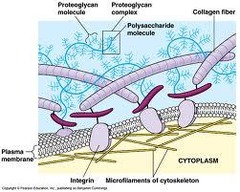
What is ground substance in connective tissue?
An unstructured material that fills space between cells and serves as a medium for solute diffusion.
What are the characteristics that distinguish connective tissue from other primary tissues?
Have mesenchyme as origin, varying degrees of vascularity, and an extracellular matrix.
What are the four main classes of connective tissues?
Connective tissue proper, cartilage, bone, and blood.
What are the two subclasses of connective tissue proper?
Loose connective tissues and dense connective tissues.
What is the primary function of loose connective tissue?
Wraps and cushions organs, plays a role in inflammation, and holds tissue fluid.
What type of cells are found in areolar connective tissue?
Fibroblasts, macrophages, mast cells, and some white blood cells.
Where is areolar connective tissue commonly located?
Under epithelia, forms lamina propria of mucous membranes, packages organs, and surrounds capillaries.
What is the primary function of adipose tissue?
Provides reserve food fuel, insulates against heat loss, and supports/protects organs.
What is the main characteristic of reticular connective tissue?
It forms a soft internal skeleton (stroma) that supports other cell types.
What is the function of dense regular connective tissue?
Attaches muscles to bones or to muscles and withstands great tensile stress in one direction.
Where can dense irregular connective tissue be found?
Fibrous capsules of organs and joints, dermis of the skin, and submucosa of the digestive tract.
What is the function of elastic connective tissue?
Allows recoil of tissue following stretching and maintains pulsatile flow of blood through arteries.
What are the three types of cartilage?
Hyaline cartilage, elastic cartilage, and fibrocartilage.
What is the primary function of hyaline cartilage?
Provides support, flexibility, and reduces friction between bones.
What distinguishes elastic cartilage from hyaline cartilage?
Elastic cartilage contains more elastic fibers, allowing for greater flexibility.
What is the main function of fibrocartilage?
Provides tensile strength and absorbs compressive shock.
What is the matrix of cartilage primarily composed of?
Polysaccharides (chondroitin sulfates) that bind to proteins, giving it a gel-like consistency.
What is the role of chondrocytes in cartilage?
Chondrocytes produce the matrix and reside in lacunae.
What is the periosteum?
A membrane that surrounds bones and contains blood vessels for nutrient delivery.
What is the primary function of bone (osseous tissue)?
Supports and protects organs, provides levers for muscles, and stores calcium and minerals.
What is the fluid matrix of blood called?
Plasma.
What are the formed elements found in blood?
Red blood cells (RBCs), white blood cells (WBCs), and platelets.
What is lymph?
Interstitial fluid returned to the blood supply via the lymphatic system, playing a role in the immune system.
What is the main characteristic of dense connective tissues?
They have more fibers and less ground substance compared to loose connective tissues.
What is the function of macrophages in connective tissues?
They phagocytize bacteria and play a role in inflammation.
What is the difference between appositional and interstitial growth of cartilage?
Appositional growth involves secretion of matrix against the external face, while interstitial growth involves chondrocytes dividing and secreting new matrix from within.
What happens to cartilage during normal bone growth?
Calcification of cartilage occurs.
What is the primary cell type in dense regular connective tissue?
Fibroblast.
Where is fibrocartilage commonly found?
Intervertebral discs, pubic symphysis, and knee joint discs.
What type of connective tissue is characterized by a high proportion of elastic fibers?
Elastic connective tissue.
What is the fluid matrix in blood called?
Plasma
What is the primary function of blood?
Transport of respiratory gases, nutrients, wastes, and other substances
What are the four types of epithelial membranes?
Mucous membranes, serous membranes, cutaneous membrane, and synovial membranes
What do mucous membranes line?
Passageways that have external connections in the digestive, respiratory, urinary, and reproductive tracts
What is the function of serous membranes?
Line cavities not open to the outside and reduce friction with fluid transudate
What are the three types of serous membranes?
Pleura, peritoneum, and pericardium
What is the cutaneous membrane?
The skin, which is thick, waterproof, and dry
What is the function of synovial membranes?
Line moving, articulating joint cavities and produce synovial fluid
What are the three kinds of muscle tissue?
Smooth muscle, skeletal muscle, and cardiac muscle
Where is smooth muscle found?
In hollow organs, blood vessels, and respiratory and reproductive tracts
What is the primary function of skeletal muscle?
Voluntary movement, locomotion, and manipulation of the environment
What characterizes cardiac muscle?
It is involuntary, striated, and found in the heart
What is neural tissue specialized for?
Conducting electrical impulses and processing information
What are the two kinds of cells in neural tissue?
Neurons and neuroglia
What is the function of neurons?
Transmit electrical signals from sensory receptors to effectors
What is the role of neuroglia?
Support and maintain the physical structure of nervous tissue
What are the signs of inflammation?
Swelling, redness, heat, and pain