Lab Week 4

0.0(0)
Studied by 0 people
call kaiCall Kai
Locked
learnLearn
examPractice Test
spaced repetitionSpaced Repetition
heart puzzleMatch
flashcardsFlashcards
GameKnowt Play
Card Sorting

1/263

encourage image

There's no tags or description

Looks like no tags are added yet.

Last updated 9:14 PM on 9/20/26
Name
Mastery
Learn
Test
Matching
Spaced
Call with Kai
Chat

No analytics yet

Send a link to your students to track their progress

264 Terms

1
New cards

Arthropoda General Features

Segmentation, paired jointed appendages, exoskeleton, molting, metamorphosis, reduced coelom, open circulatory system, complete digestive tract, and ventrally located nervous system.

2
New cards

Subphylum Chelicerata

Distinguishing features include a cephalothorax, no antennae, and chelicerae. Ex.) Spiders, horseshoe crabs, scorpions, mites.

3
New cards

Class Arachnida

Distinguishing features include book lungs and spinnerets versus silk glands. Ex.) Spiders.

4
New cards

Subphylum Crustacea

Distinguishing features include two pairs of antennae, one pair of mandibles, two pairs of maxillae, biramous or branched appendages, and being primarily aquatic. Ex.) Crayfish, crabs, lobsters, barnacles.

5
New cards
Class Malacostraca
Distinguishing features include a carapace, chelipeds, swimmerets, and sexual dimorphism. Ex.) Crayfish.
6
New cards
Subphylum Hexapoda
Distinguishing features include a three-part body plan, three pairs of legs on the thorax, and a single pair of antennae. Ex.) Insects, springtails.
7
New cards
Class Insecta
Distinguishing features include being articulated, tracheated, hexapod, and having sexual dimorphism. Ex.) Grasshopper.
8
New cards
<p>The crayfish on the left is what gender?</p>

The crayfish on the left is what gender?

Male

9
New cards
<p>The crayfish on the right is what gender?</p>

The crayfish on the right is what gender?

Female
10
New cards
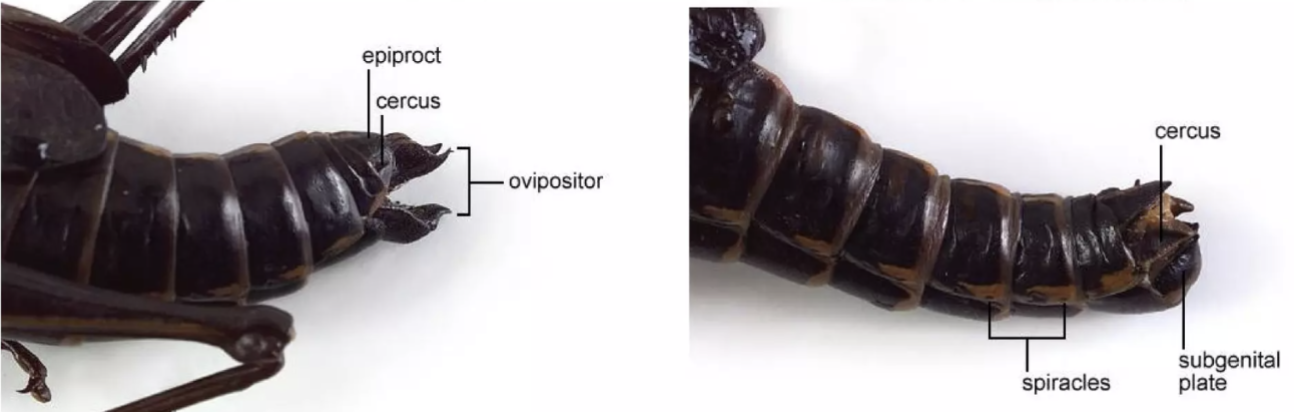
<p>The grasshopper on the left is what gender?</p>

The grasshopper on the left is what gender?

Female

11
New cards
<p>The grasshopper on the right is what gender?</p>

The grasshopper on the right is what gender?

Male
12
New cards
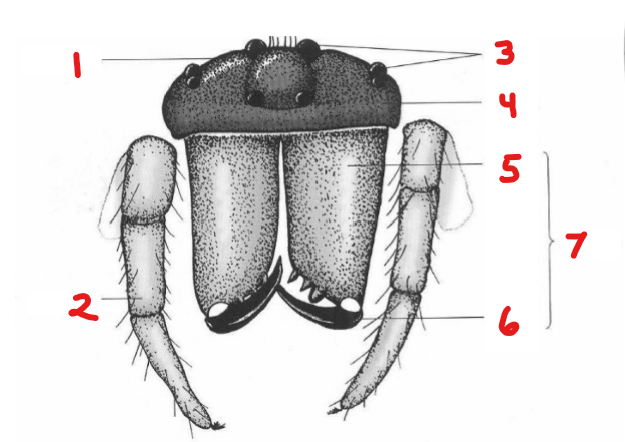
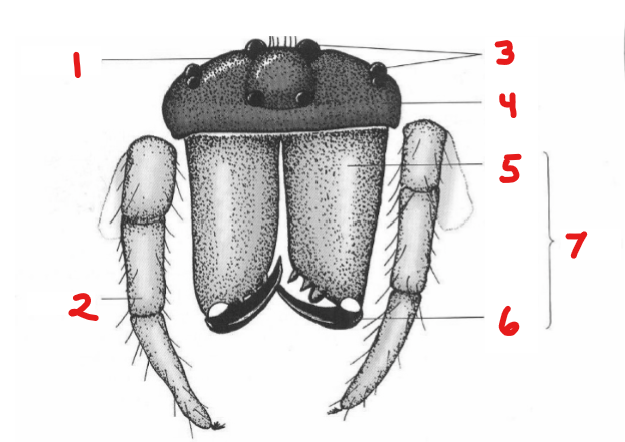
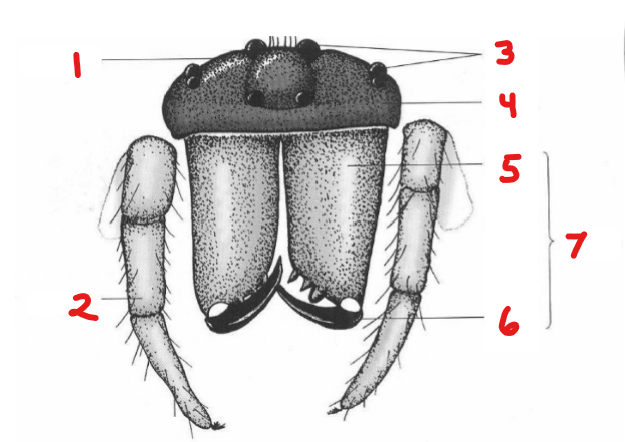
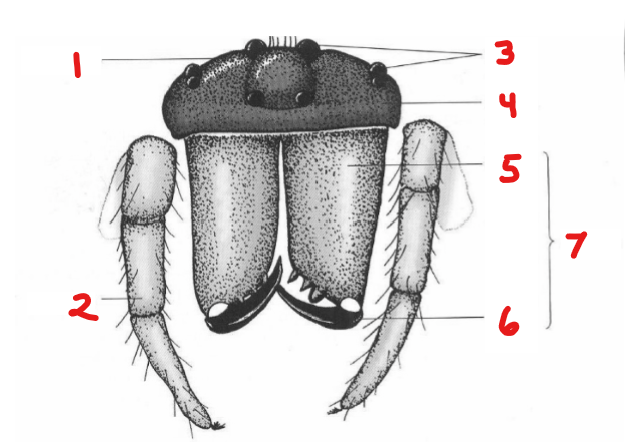
Spider General Body: Head
The anterior region of the spider's body that includes the carapace, ocelli, clypeus, paturon, fang, chelicera, and pedipalp.
13
New cards
Spider General Body: Pedipalp
An appendage near the mouth that is used for sensing and manipulating prey.
14
New cards
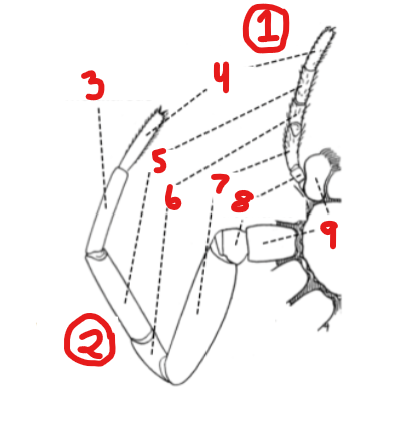
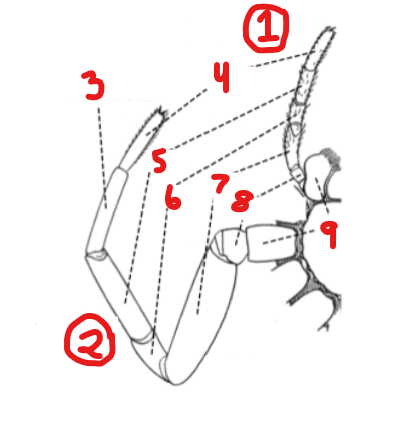
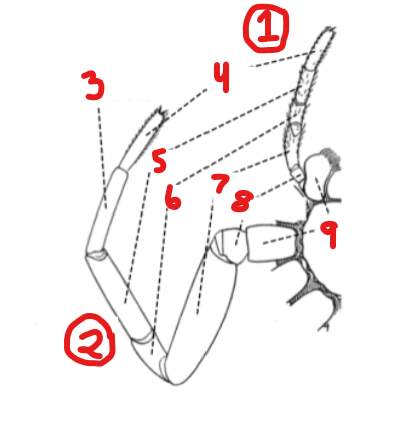
Spider General Body: Walking Legs
Four pairs of jointed legs used for locomotion.
15
New cards
Spider General Body: Sternum
The ventral plate on the prosoma where the coxae of the legs attach.
16
New cards
Spider General Body: Carapace
The hard covering of the prosoma that protects the cephalothorax.
17
New cards
Spider General Body: Prosoma
Also called cephalothorax, it is the anterior body region that contains the head and thorax fused together.
18
New cards
Spider General Body: Pedicel
The narrow region between the prosoma and opisthosoma, also called the waist.
19
New cards
Spider General Body: Opisthosoma
Also called abdomen, it is the posterior body region that contains the book lungs and spinnerets.
20
New cards
Spider Head: Ocelli
Simple eyes on the spider's head that detect light and dark.
21
New cards
Spider Head: Clypeus
The area between the eyes and the chelicerae on the spider's head.
22
New cards
Spider Head: Paturon
The basal segment of the chelicera that contains the fang.
23
New cards
Spider Head: Fang
The piercing structure at the end of the chelicera that injects venom.
24
New cards
Spider Head: Chelicera
The appendage that includes the fang and paturon, used for capturing prey and injecting venom.
25
New cards
Spider Walking Leg: Tarsus
The outermost segment of the walking leg that often has claws.
26
New cards
Spider Walking Leg: Metatarsus
The segment of the walking leg just before the tarsus.
27
New cards
Spider Walking Leg: Tibia
The long segment of the walking leg between the metatarsus and patella.
28
New cards
Spider Walking Leg: Patella
The segment of the walking leg between the tibia and femur.
29
New cards
Spider Walking Leg: Femur
The segment of the walking leg between the patella and trochanter.
30
New cards
Spider Walking Leg: Trochanter
The small segment of the walking leg between the femur and coxa.
31
New cards
Spider Walking Leg: Coxa
The basal segment of the walking leg that attaches to the body.
32
New cards
Spider Ventral Prosoma: Labium
The lower lip structure on the ventral surface of the prosoma.
33
New cards
Spider Ventral Prosoma: Sternum
The ventral plate on the prosoma where the coxae of the legs attach.
34
New cards
Spider Ventral Prosoma: Coxae
The basal segments of the legs that attach to the sternum.
35
New cards
Spider Ventral Opisthosoma: Book Lung Slit
The opening on the ventral surface of the opisthosoma where book lungs are located for gas exchange.
36
New cards
Spider Ventral Opisthosoma: Spinnerets
Structures at the posterior end of the opisthosoma that produce silk.
37
New cards
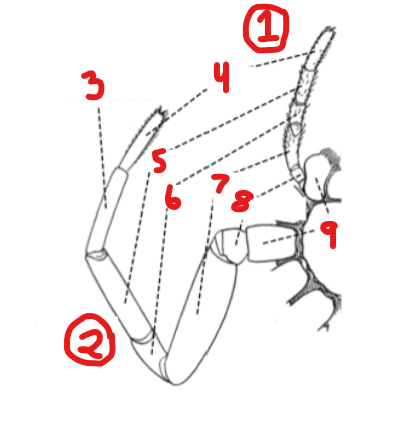
<p>1</p>

1

Pedipalp

38
New cards
<p>2</p>

2

Walking Leg

39
New cards
<p>3</p>

3

Metatarsus

40
New cards
<p>4</p>

4

Tarsus

41
New cards
<p>5</p>

5

Tibia

42
New cards
<p>6</p>

6

Patella

43
New cards
<p>7</p>

7

Femur

44
New cards
<p>8</p>

8

Trochanter

45
New cards
<p>9</p>

9

Coxa

46
New cards
<p>1</p>

1

Carapace

47
New cards
<p>2</p>

2

Pedipalp

48
New cards
<p>3</p>

3

Ocelli

49
New cards
<p>4</p>

4

Clypeus

50
New cards
<p>5</p>

5

Paturon

51
New cards
<p>6</p>

6

Fang

52
New cards
<p>7</p>

7

Chelicera

53
New cards
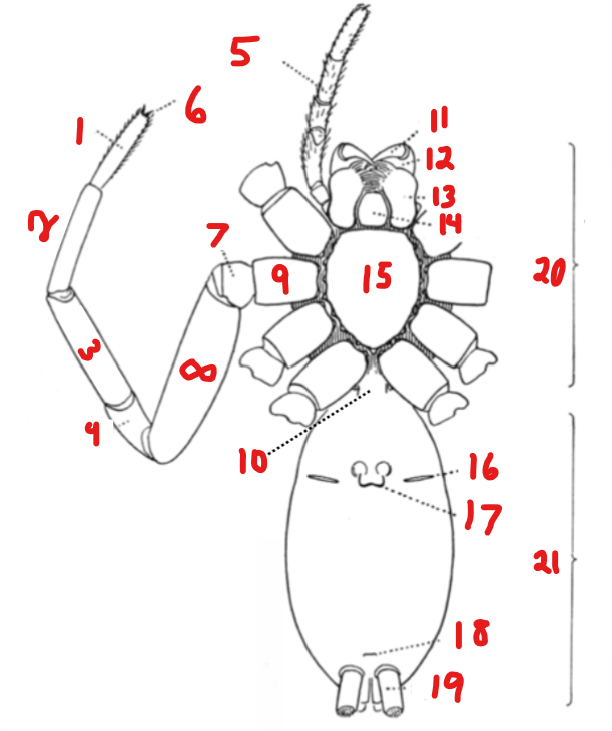
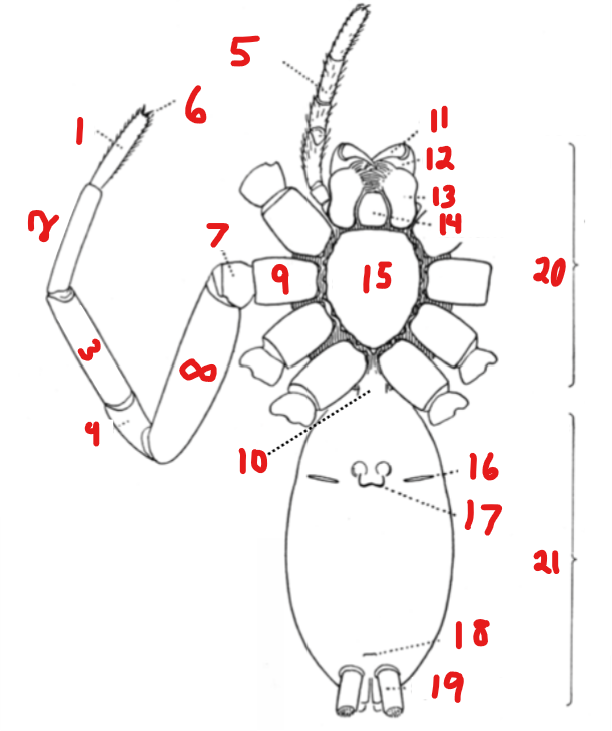
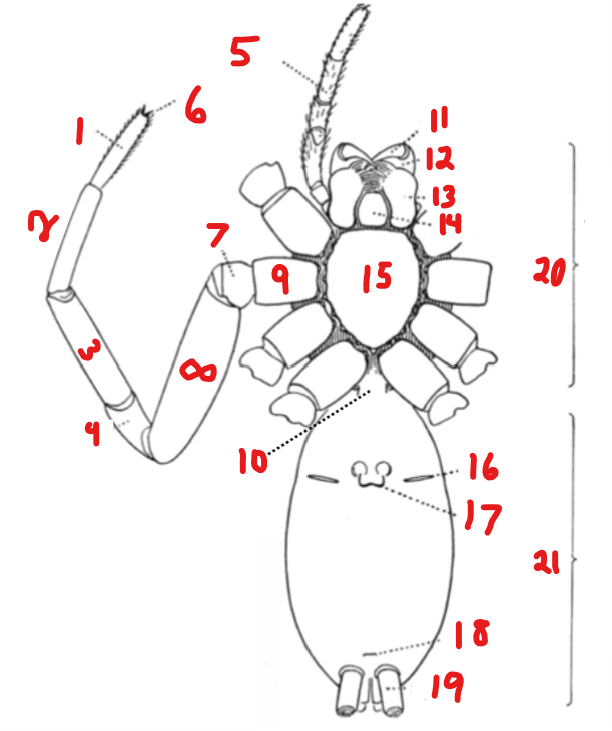
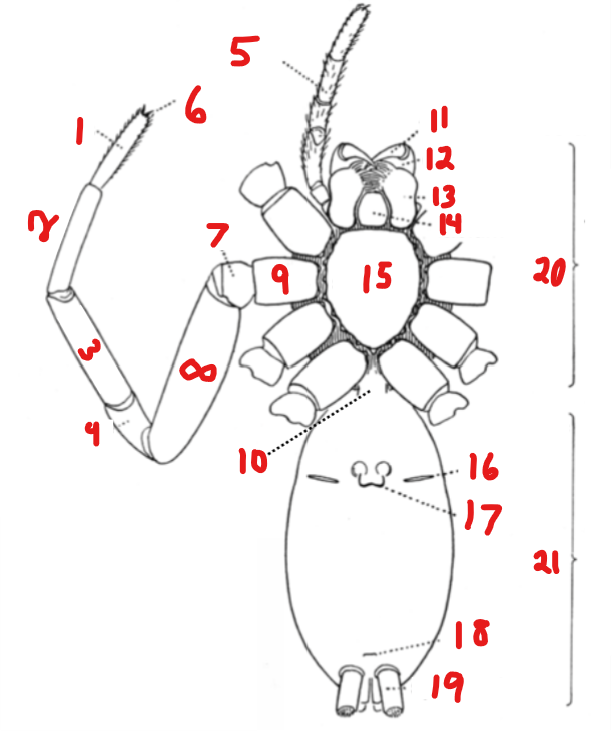
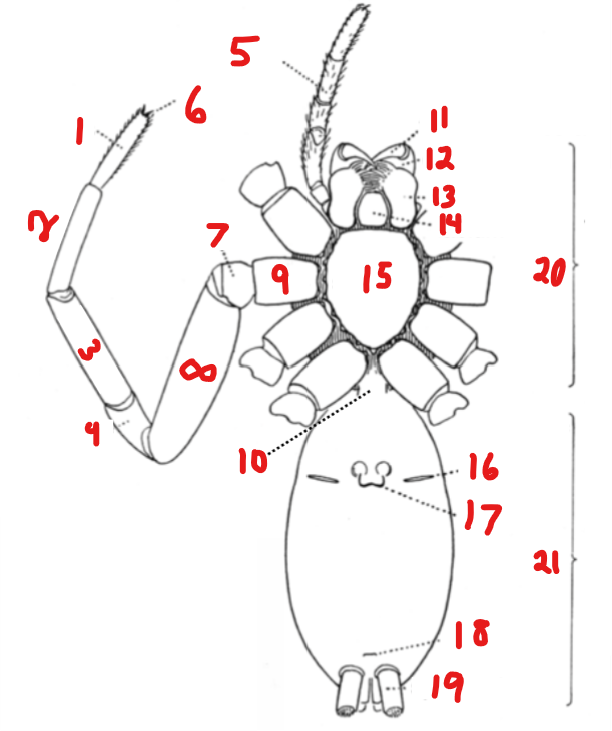
<p>1</p>

1

Tarsus

54
New cards
<p>2</p>

2

Metatarsus

55
New cards
<p>3</p>

3

Tibia

56
New cards
<p>4</p>

4

Patella

57
New cards
<p>5</p>

5

Pedipalp

58
New cards
<p>6</p>

6

Claw

59
New cards
<p>7</p>

7

Trochanter

60
New cards
<p>8</p>

8

Femur

61
New cards
<p>9</p>

9

Coxa

62
New cards
<p>10</p>

10

Pedicel

63
New cards
<p>11</p>

11

Fang of Chelicera

64
New cards
<p>12</p>

12

Chelicera

65
New cards
<p>13</p>

13

Maxilla

66
New cards
<p>14</p>

14

Labium

67
New cards
<p>15</p>

15

Sternum

68
New cards
<p>16</p>

16

Opening of Book Lung

69
New cards
<p>17</p>

17

Epigyne

70
New cards
<p>18</p>

18

Opening of Trachea

71
New cards
<p>19</p>

19

Spinneret

72
New cards
<p>20</p>

20

Cephalothorax

73
New cards
<p>21</p>

21

Abdomen

74
New cards
Grasshopper General Body: Exoskeleton
The hard outer covering made of metameres or somites that protects the body.
75
New cards
Grasshopper General Body: Head
The anterior body region that contains the antennae, ocelli, compound eyes, and mouthparts.
76
New cards
Grasshopper General Body: Thorax
The middle body region comprised of prothorax, mesothorax, and metathorax, and it bears the wings and legs.
77
New cards
Grasshopper General Body: Abdomen
The posterior body region that contains the digestive and reproductive organs.
78
New cards
Grasshopper General Body: Forewings
The anterior pair of wings that are often hardened and protect the hindwings.
79
New cards
Grasshopper General Body: Hindwings
The posterior pair of wings that are membranous and used for flight.
80
New cards
Grasshopper General Body: Legs
Three pairs of jointed legs used for locomotion, with the hind legs modified for jumping.
81
New cards
Grasshopper General Body: Tympanic Membrane
The eardrum-like structure on the abdomen used for hearing.
82
New cards
Grasshopper General Body: Ovipositor
The structure at the end of the female's abdomen used to lay eggs.
83
New cards
Grasshopper General Body: Cercus
Sensory structures on the dorsal-lateral side of the last abdominal segment.
84
New cards
Grasshopper Head: Antenna
Sensory appendages used for touch and smell.
85
New cards
Grasshopper Head: Ocelli
Simple eyes that detect light and dark.
86
New cards
Grasshopper Head: Compound Eye
The eye made of many light-sensing units that detects movement and form.
87
New cards
Grasshopper Head: Vertex
The top of the head between the compound eyes.
88
New cards
Grasshopper Head: Frons
The forehead area of the head.
89
New cards
Grasshopper Head: Gena
The cheek area of the head.
90
New cards
Grasshopper Head: Clypeus
The area below the frons that forms the upper lip.
91
New cards
Grasshopper Head: Labrum
The upper lip that covers the mandibles.
92
New cards
Grasshopper Head: Labium
The lower lip that covers the maxillae.
93
New cards
Grasshopper Head: Mandible
The hard mouthparts used for chewing food.
94
New cards
Grasshopper Head: Maxillary Palp
Sensory appendages on the maxillae used for tasting and manipulating food.
95
New cards
Grasshopper Head: Labial Palp
Sensory appendages on the labium used for tasting and manipulating food.
96
New cards
Grasshopper Leg: Tarsus
The outermost segment of the leg that often has claws.
97
New cards
Grasshopper Leg: Tibia
The long segment of the leg between the tarsus and femur.
98
New cards
Grasshopper Leg: Femur
The segment of the leg between the tibia and trochanter, and it is enlarged in the hind legs for jumping.
99
New cards
Grasshopper Leg: Trochanter
The small segment of the leg between the femur and coxa.
100
New cards
Grasshopper Leg: Coxa
The basal segment of the leg that attaches to the body.