Module 7 - Timber
 Call Kai
 Learn
Learn Practice Test
 Spaced Repetition
 Match
Match Flashcards
 Knowt Play
1/45

There's no tags or description
Looks like no tags are added yet.
Name | Mastery | Learn | Test | Matching | Spaced | Call with Kai | Chat |
|---|
No analytics yet
Send a link to your students to track their progress
46 Terms
Timber
Wood that has been processed into beams and planks for construction or engineering purposes.
Softwoods
Wood from needle-leaved conifers (gymnosperms) that usually grows faster and is commonly used for structural framing.
Hardwoods
Wood from broad-leaved deciduous trees (angiosperms) that typically has a more complex structure and is used for finishes or furniture.
Sapwood
The living outer layer of a tree that transports sap and stores food; it is generally lighter in color and less durable than heartwood.
Heartwood
The inactive inner core of a tree that provides structural support and is more resistant to decay and insect attack.
Cambium
A microscopic layer of reproductive tissue located between the inner bark and the wood where new cell growth occurs.
Pith
The small, soft core at the center of the tree trunk around which the first growth takes place.
Annual Rings
Concentric layers of wood produced during one growth season, used to determine the age of a tree and environmental conditions.
Earlywood (Springwood)
Wood formed at the beginning of the growing season, characterized by large, thin-walled cells and lower density.
Latewood (Summerwood)
Wood formed later in the season with smaller, thicker-walled cells that provide significantly more strength.
Cellulose
The primary structural component of wood cell walls that provides tensile strength and axial stiffness.
Lignin
A complex organic polymer that acts as the "glue" or binder to hold cellulose fibers together.
Anisotropy
The property of wood where physical and mechanical characteristics differ significantly depending on the direction of the grain (Longitudinal, Radial, or Tangential).
Moisture Content (MC)
The ratio of the weight of water in a wood sample to its oven-dry weight, expressed as a percentage.
Free Water
Liquid water found within the cell cavities (lumens) of wood.
Bound Water
Water that is chemically or physically absorbed within the cell walls of the wood.
Fiber Saturation Point (FSP)
The moisture content (roughly 25% to 30%) where cell cavities are empty of free water but cell walls are fully saturated with bound water.
Dimensional Stability Rule
Wood only begins to shrink or swell when its moisture content changes below the Fiber Saturation Point.
Tangential Shrinkage
Shrinkage occurring along the direction of the growth rings; it is the largest and most significant form of wood shrinkage.
Radial Shrinkage
Shrinkage occurring across the growth rings, typically measuring about half the magnitude of tangential shrinkage.
Longitudinal Shrinkage
Shrinkage along the length of the wood fibers; it is minimal (0.1% to 0.2%) and usually ignored in structural design.
Equilibrium Moisture Content (EMC)
The moisture level wood eventually reaches when exposed to a specific temperature and humidity in its environment.
Seasoning
The controlled process of reducing wood's moisture content to improve stability, strength, and resistance to decay.
Air Drying
A seasoning method where lumber is stacked in open air to dry naturally, which is slow but consumes little energy.
Kiln Drying
A seasoning process using a heated chamber with controlled humidity to dry lumber more rapidly and uniformly.
Lumber Grading
The classification of wood based on its strength (structural grading) or its appearance (appearance grading).
Knot
A defect formed by the base of a branch embedded in the tree trunk, which interrupts grain flow and reduces tensile strength.
Check
A seasoning defect involving a lengthwise separation of wood that typically extends across the annual growth rings.
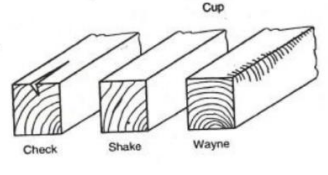
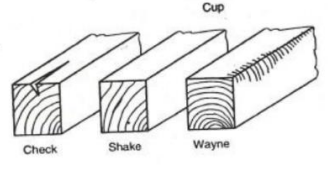
Shake
A structural defect characterized by a separation of wood fibers along or between the annual growth rings.
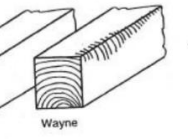
Wayne
The presence of bark or the lack of wood on the edge or corner of a piece of lumber. Areas where the lumber has been cut too closely to the edge of the log and there is bark on the boards.
Warp
Any dimensional distortion in lumber (such as bow, crook, twist, or cup) caused by uneven shrinkage during seasoning.
Plywood
An engineered wood panel made of thin veneers glued together with alternating grain directions to provide dimensional stability and strength.
Glulam (Glued Laminated Timber)
A structural member made of multiple layers of dimensional lumber bonded with moisture-resistant adhesives, with the grain of all layers running parallel.
CLT (Cross-Laminated Timber)
Large engineered panels made of layers of lumber stacked and glued perpendicularly, used for structural walls and floors.
LVL (Laminated Veneer Lumber)
A high-strength engineered product made of thin wood veneers glued with the grain parallel to the long axis, used for beams and headers.
OSB (Oriented Strand Board)
An engineered panel made of wood strands or flakes oriented in specific directions and bonded with resin under heat and pressure.
Directional Strength Ratio
Crucial engineering fact that wood is 20 to 40 times stronger when loaded parallel to the grain than perpendicular to it.
Preservative Treatment
The application of chemicals to wood to protect it from decay-producing fungi and wood-boring insects.
Creosote
An oil-borne preservative distilled from coal tar, used for heavy-duty industrial applications like railroad ties and marine pilings.
Water-Borne Preservatives
Odorless and paintable chemical treatments (like CCA) commonly used for residential lumber and general construction
Humid
Low dimensional stability produces expansion in ________ environments
Dry
Low dimensional stability produces contraction in _____ environments.
Stud
Lumber used for load bearing and stud walls. (2" × 4" and 2" × 6”-dimension)
15%
Air drying reduces moisture by up to _____
Bark Pockets
______ is formed when the bark is wholly or partially encased in wood
Marine Boring Organisms
Damage by _________ in the oceans is principally caused by shipworms, pholads, Limnoria, and Sphaeroma. These organisms are almost totally confined to salt or brackish waters.