Biology 2.1.5- Biological Membranes
 Studied by 1 person
 Call Kai
 Learn
Learn Practice Test
 Spaced Repetition
 Match
Match Flashcards
 Knowt Play
1/17

There's no tags or description
Looks like no tags are added yet.
Name | Mastery | Learn | Test | Matching | Spaced |
|---|
No study sessions yet.
18 Terms
What model is used to describe the plasma cell membrane and why?
The fluid mosaic model, as the cell membrane is able to move and shift and is studded with cholesterol and proteins including glycoproteins, glycolipids and transport proteins
What is the structure of the cell membrane?
Cell membranes are made up of phospholipids in a bilayer, where the hydrophilic phosphate heads face outwards towards the aqueous solution, and the hydrophilic fatty acid tails face towards each other
This means that most water soluble substances can’t pass through, including polar molecules and ions, due to the non-polar fatty acid tails
What is the function of cholesterol in the cell membrane?
Cholesterol regulates the fluidity of the membrane by binding to the hydrophobic tails, packing them more closely but preventing them from being too close
What is the function of glycolipids and glycoproteins in the cell membrane?
Glycoproteins are intrinsic proteins with a carbohydrate chain attached, which can bind to substances and other cells, and act as a receptor molecule involved in endocytosis, and signalling using hormones and neurotransmitters
Glycolipids are lipids with a carbohydrate chain attached, which act as antigens (cell markers) involved in the immune system
What is the function of transport proteins in the cell membrane?
Transport proteins are intrinsic and allow polar molecules and ions to pass through the membrane (channel and carrier proteins)
This allows the cell to regulate which substances can enter or leave the cell
How and why does temperature affect membrane structure and permeability?
As temperature increases, the kinetic energy of the phospholipids increases so they spread out more, making the membrane more fluid and more permeable
Proteins in the membrane can denature at high temperatures, which disrupts the structure and can affect the movement of substances which require transport proteins
How and why does solvent concentration affect membrane structure and permeability?
Non-polar organic solvents can dissolve the phospholipids in the membrane, causing the membrane to lose its structure, becoming more permeable
In lower concentrations the molecules can’t dissolve the membrane but can still disrupt it by entering the cell membrane
What factors affect rate of diffusion and how?
Steep concentration gradient = fast diffusion
High temperature = more KE = fast diffusion
High surface area = fast diffusion
Large molecules = requires more energy to move = slow diffusion
Long distance/thick membrane = slow membrane
What substances can diffuse across the cell membrane?
Small, non-polar molecules like oxygen and carbon dioxide can diffuse across a membrane rapidly
Small, polar molecules like water and urea can travel across a membrane by simple diffusion, but only very slowly
Ions can’t travel across a membrane by simple diffusion
Large molecules can’t travel across a membrane by simple diffusion
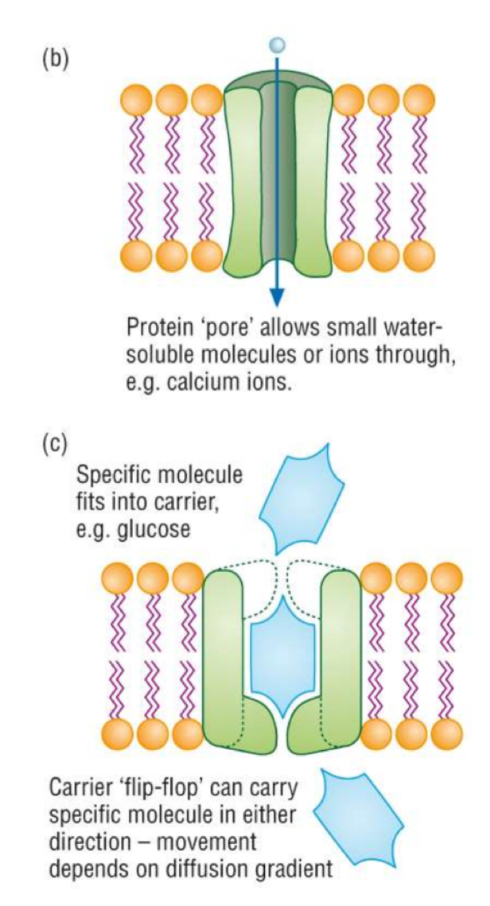
How does facilitated diffusion work?
Large molecules, polar molecules and ions which can’t cross the membrane by simple diffusion can be transported by:
Channel proteins- a hydrophilic channel
Carrier proteins- proteins that can change shape
They are highly specific and only allow one type of molecule or ion to pass
This is still a passive process, it requires no energy
How does active transport work?
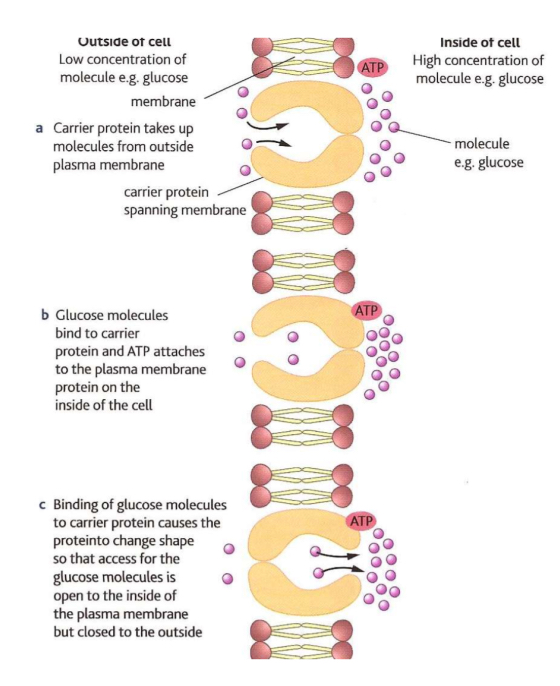
Active transport is the movement of substances against the concentration gradient, which requires energy from respiration
This occurs by specific carrier proteins, which use energy provided by ATP (adenosine triphosphate) to change shape and transfer the substance
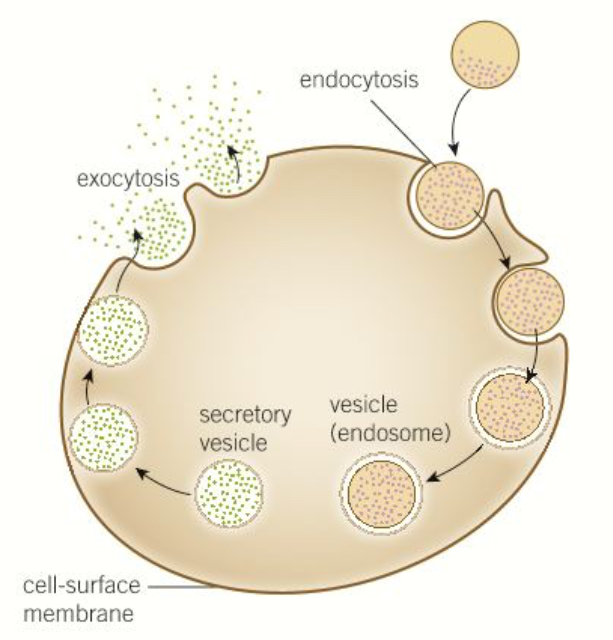
How does endocytosis work?
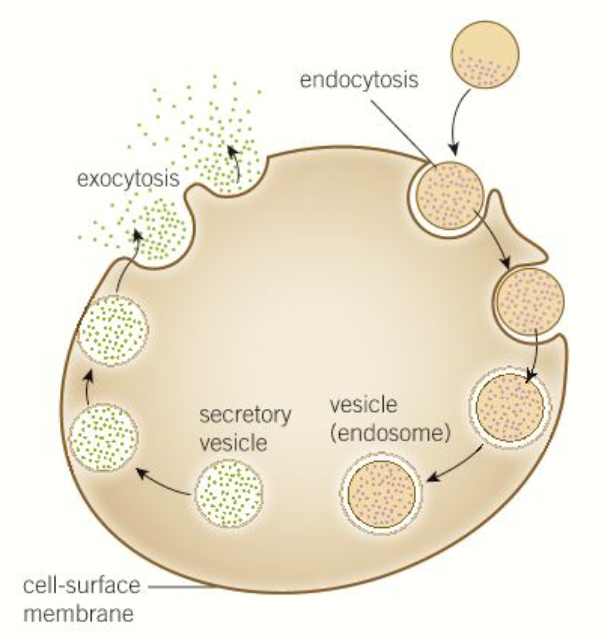
Endocytosis- the bulk transport of material into cells
This includes:
Phagocytosis intakes solid material- the membrane bends inwards and engulfs the material, creating a vacuole around it
Pinocytosis is the same process but intakes liquids
Energy is required for this process- it is a form of active transport
How does exocytosis work?
Exocytosis- the bulk transport of material out of cells
Vesicles formed by the Golgi apparatus carry the material to, and fuse with, the cell membrane, releasing it
Energy is required for this process- it is a form of active transport
What is water potential?
Water potential measures the tendency of water molecules to move
Pure water has a water potential of 0 kPa
All solutions have a negative water potential
A more concentrated solution has a lower (more negative) water potential than a dilute solution
Between solutions of different concentrations, there will be a net movement of water from the solution with the higher water potential (less concentrated) to the lower water potential (more concentrated)
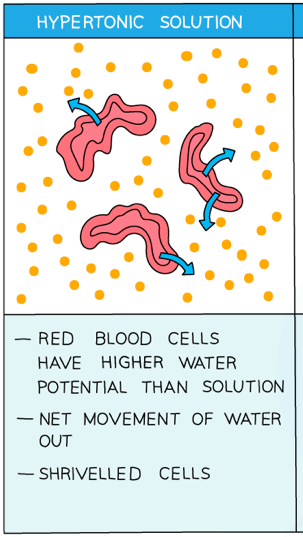
What will happen if animal cells are put in a more concentrated solution?
More concentrated solution (hypertonic)
Lower water potential outside the cell
Water will move out of the cell by osmosis down the water potential gradient
The cell will crenate (shrivel)
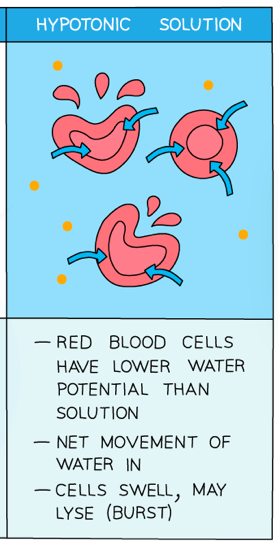
What will happen if animal cells are put in a less concentrated solution?
Less concentrated solution (hypotonic)
Higher water potential outside the cell
Water will move into the cell by osmosis down the water potential gradient
The cell will expand and burst during cytolysis
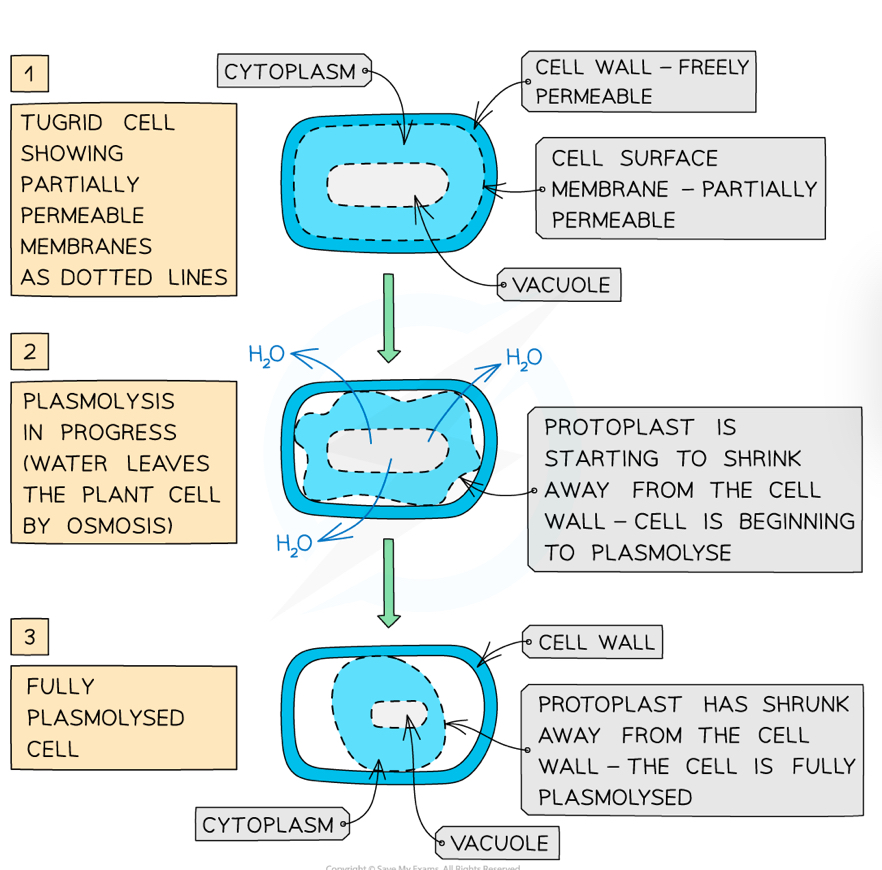
What will happen if plant cells are put in a more concentrated solution?
More concentrated solution (hypertonic)
Lower water potential outside the cell
Water will move out of the cell’s vacuole by osmosis down the water potential gradient, decreasing the pressure
The protoplast (cell contents) shrinks away from the cell wall through plasmolysis
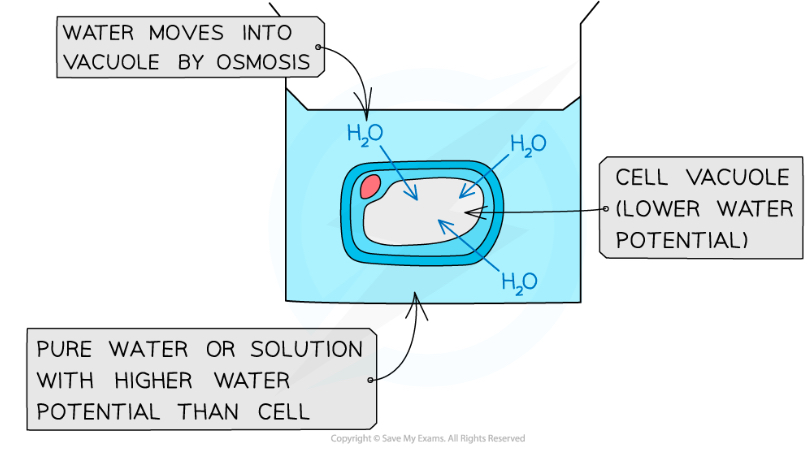
What will happen if plant cells are put in a less concentrated solution?
Less concentrated solution (hypotonic)
Higher water potential outside the cell
Water will move into the cell’s vacuole by osmosis down the water potential gradient, increasing the pressure
The protoplast (cell contents) expands, making the cell turgid