Muscle Contraction
 Call Kai
 Learn
Learn Practice Test
 Spaced Repetition
 Match
Match Flashcards
 Knowt Play
1/69

There's no tags or description
Looks like no tags are added yet.
Name | Mastery | Learn | Test | Matching | Spaced | Call with Kai | Chat |
|---|
No analytics yet
Send a link to your students to track their progress
70 Terms
True or false: When muscle contracts, the length of the thick and thin filaments changes.
false
(DOES NOT change)
When muscle contracts, does the sarcomere get shorter or longer? Why?
shorter because Z lines come closer together when thin filaments are pulled inward
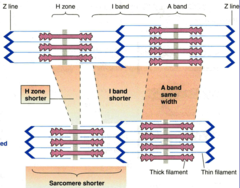
When muscle contracts, does the H zone get shorter or longer? Why?
shorter because thin filaments slide in over thick filaments
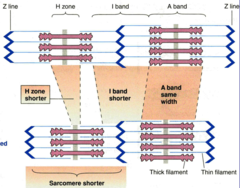
When muscle contracts, does the I band get shorter or longer? Why?
shorter because thick filaments slide out over thin filaments
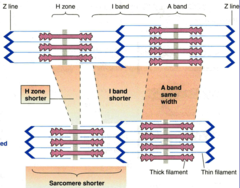
When muscle contracts, does the A band get shorter or longer? Why?
does not change because it is defined by the length of the thick filament, which doesn't change

According to the sliding filament mechanism, the...
A. A bands slide between the I bands
B. thin filaments slide inward toward the center of the A band
C. Z lines slide between the T tubules
D. contractile proteins shorten, thus shortening the sarcomere
E. filaments slide past the lateral sacs of the sarcoplasmic reticulum
B

Each thick filament is made up of over how many myosin proteins bundled together?
200

What is the basic structure of a single thick filament?
six peptide chains of myosin with head and tail regions
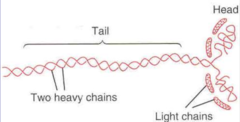
How many heavy and light myosin chains make up a single thick filament?
2 heavy, 4 light
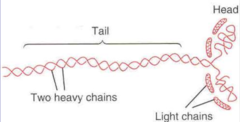
Out of the six peptide chains of myosin that make up a single thick filament, how many are light chains? What is their orientation?
4, two of them interact with each globular portion of the heavy chain in the heads
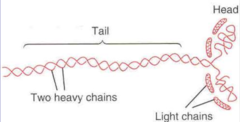
Out of the six peptide chains of myosin that make up a single thick filament, how many are heavy chains? What is their orientation?
2, they wrap around each other in a double helix formation to make up the tail

refers to the links between each myosin head and the thin filament
cross bridges
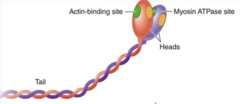
What two characteristics of each of the myosin heads contribute to their ability to form cross bridges with actin?
**myosin is a molecular motor!
ATPase site, actin binding site
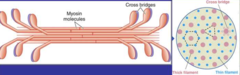
What is the arrangement of thick and thin filaments in a myofiber?
six thin filaments surround one thick filament
(and the myosin heads extend out to form cross bridges with these thin filaments)

What three proteins make up a thin filament?
actin, troponin, tropomyosin

What specific kind of actin is found in a thin filament? How does it fit in with the overall structure of a thin filament?
F actin, two strands of it form a double helix backbone for the thin filament with myosin binding sites

How does tropomyosin fit in with the overall structure of a thin filament?
wraps spirally around the sides of the F actin filaments

How does tropomyosin interfere with the binding of actin and myosin?
in the resting state, it blocks the myosin binding sites on actin
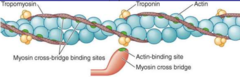
1/3 subunits of the troponin complex that has a strong affinity for actin - it binds to the actin itself on the thin filament and serves as a swivel
troponin I
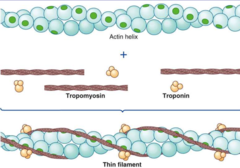
What does troponin I have a strong affinity for?
actin
What is troponin I bound to?
actin, troponin T, troponin C
1/3 subunits of the troponin complex that has a strong affinity for tropomyosin; bound to troponin I and tropomyosin
troponin T
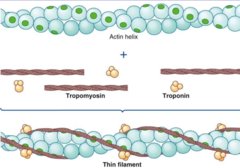
What does troponin T have a strong affinity for?
tropomyosin
What is troponin T bound to?
troponin I, tropomyosin
1/3 subunits of the troponin complex that has a strong affinity for calcium ions; bound to troponin I
troponin C
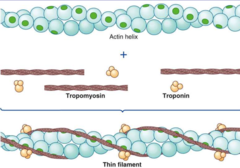
What does troponin C have a strong affinity for?
calcium
What is troponin C bound to?
troponin I
Mechanism of muscle contraction 1: Before contraction ever begins and the muscle is relaxed, the myosin heads bind to an ATP molecule at their ATPase site. What does this ATPase do?
cleaves ATP into ADP and phosphate, both of which remain bound to the myosin head
Mechanism of muscle contraction 2: Before contraction ever begins and the muscle is relaxed, the myosin heads bind to an ATP molecule at their ATPase site and cleave it into ADP and phosphate. When this cleavage occurs, how does the myosin head change its orientation?
starts to extend toward the thin filament
(but doesn't attach yet since tropomyosin is in the way and blocking the myosin binding site on actin)
Mechanism of muscle contraction 3: The motor neuron stimulates the muscle and the action potential runs down the T tubule and triggers the release of what ion from the sarcoplasmic reticulum? What does it bind to?
calcium, troponin C
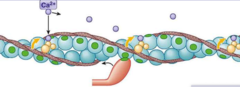
Mechanism of muscle contraction 4: When the action potential stimulates the release of calcium from the sarcoplasmic reticulum, it is released into the cytosol and binds to troponin C. This in turn triggers what to happen? What is the result of this?
conformational change in troponin I causes it to twist, and troponin T pulls tropomyosin away to expose myosin binding sites on actin

Mechanism of muscle contraction 5: The release of calcium from the sarcoplasmic reticulum caused the binding of calcium to troponin C. This caused a conformational change in troponin I which allowed troponin T to pull the tropomyosin away from the myosin binding sites on actin. Now, when the myosin heads bind to the myosin binding sites on actin, what is formed?
cross bridges
(Note: This binding is staggered! You always want to be able to stimulate contraction and not have all your myosin heads working at once)
Mechanism of muscle contraction 6: Once the myosin heads bind to the thin filament, it triggers the power stroke. How do the myosin heads cause the thin filament to slide over the thick filament to shorten the sarcomere overall?
binding of actin and myosin results in a conformational change that causes the myosin head to tilt toward the tail, dragging the actin filament with it

Mechanism of muscle contraction 7: During the power stroke, in which a conformational change causes myosin heads to tilt toward the tail and drag actin filaments with it, what "falls off" the myosin head?
ADP and phosphate
(frees up the myosin head for a fresh new ATP to bind)
Mechanism of muscle contraction 8: When the ADP and phosphate fall off the myosin head during the power stroke, this frees it up for a "fresh new" ATP molecule to bind. What happens when a new ATP does bind?
triggers the detachment of the myosin head from actin
(and then the myosin ATPase cleaves that ATP into ADP and phosphate and the cross bridge cycle starts again)
Where does the energy for muscle contraction come from?
cleavage of ATP upon its binding to myosin ATPase

What causes the ADP and phosphate that were initially formed from the cleavage of ATP to finally fall off the myosin head?
power stroke

What ultimately breaks the cross bridge between actin and myosin?
ATP
(it binds and triggers detachment)
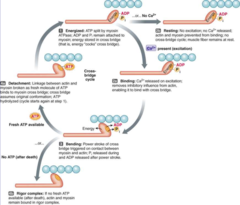
Overall, muscles contract when what two things are available to the cytoplasm?
ATP, calcium
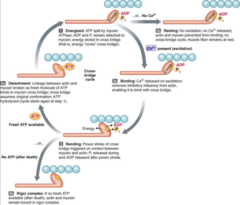
Cross bridge cycling happens until one of what two conditions occurs?
actin filaments pull the Z line up against the ends of the myosin filaments, or the load on the muscle becomes too great for further pulling

Which of the following proteins binds calcium ion?
A. troponin C
B. tropomyosin
C. troponin I
D. troponin T
A
Of the steps in excitation-contraction below, which step occurs BEFORE the others?
A. sodium channels open in the muscle fiber's membrane
B. exposed actin sites bind with myosin cross bridges
C. calcium is released from the sarcoplasmic reticulum
D. troponin binds calcium
E. attachment of ATP allows for cross bridge detachment
A
During a cross bridge cycle in skeletal muscle...
A. the myosin head is energized when it splits ATP into ADP and P
B. the myosin head must bind with ATPase before a power stroke will occur
C. Ca2+ directly causes tropomyosin to move off of the myosin's actin binding sites
D. ADP binds to the myosin head at the end of the power stroke
E. both A and B occur
A
During contraction, asynchronous cycling of cross bridges...
A. Prevents tetany
B. Prevents thick filaments from slipping backwards
C. Prevents thin filaments from slipping backwards
D. Utilizes less ATP
E. Does not do any of the above
C
True or false: ATP must be present in a muscle for it to relax.
true
ATP must be present in a muscle for it to relax. When you remove the ATP from a system, the muscle doesn't relax. Why?
ATP is needed to detach myosin from actin to break the cross bridge
When there is no ATP in a system after the power stroke releases ADP and Pi (such as after death), the muscle can't relax because myosin can't detach from actin and the cross bridge can't be broken. Therefore, the myosin and actin remain bound in what state?
rigor complex

stiffness of the body that sets in several hours after death due to depletion of ATP, since ATP is usually required to break the cross bridge and relax the muscles (so muscle contracts and stays contracted)
rigor mortis (contracture)
ATP is required to cause separation between actin and myosin cross bridges during muscle relaxation, so if there is no ATP, muscles remain in rigor until what happens about 15-25 hours later?
proteolytic enzymes destroy actin and myosin
How can forensic pathologists estimate time of death? What happens to muscles after death?
muscles are pliable, then stiff, then pliable again
True or false: There is a brief delay between action potential and the whole contractile cross bridge cycling response.
true
(since the action potential has to make it down to the T tubules first)

At what length (e.g., resting, shortened, stretched) of the sarcomere/overall muscle is there maximum tension so that there is an optimum overlap of thick and thin filaments and all cross bridges can participate in contraction?
resting
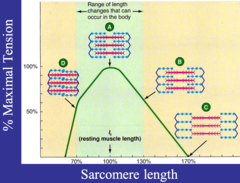
Is there minimum or maximum tension at resting muscle length?
maximum
(example: the resting length for your bicep occurs when your arm is slightly bent, so it is in this position that there is maximum tension; if your arm is more extended or more bent than this, you can't produce as forceful of a contraction and may have more trouble lifting weights)
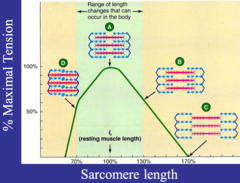
Why is there maximum tension at resting muscle length?
there is an optimum overlap of thin and thick filaments so that the maximum amount of myosin heads can bind to actin
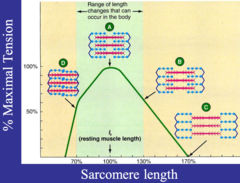
Is there increased or decreased tension at a decreased muscle length? (i.e. more shortened than resting)
decreased
(weaker contraction)
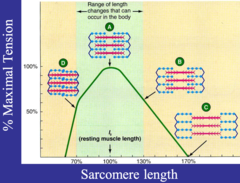
If you start the contraction at a decreased sarcomere/muscle length (NOT resting), why is there decreased tension and a weaker contraction?
Z lines are brought closer to the ends of thick filament so thin filaments are brought further into the H zone where there aren't myosin heads available for binding
(essentially, you've lost some of the myosin binding regions since they're empty in the H zone)
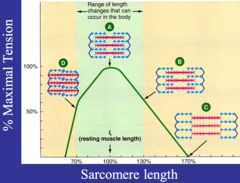
True or false: Part of the reason for decreased tension at a decreased muscle length is that the overlapping thin filaments from opposite ends of the sarcomere interfere and conflict with each other, restricting productive cross bridge building.
true
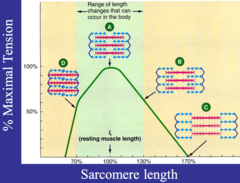
Is there increased or decreased tension at an increased muscle length? (i.e. more stretched than resting)
decreased
(weaker contraction)

If you start the contraction at an increased sarcomere/muscle length (NOT resting), why is there decreased tension and a weaker contraction?
decreased overlap of thick and thin filaments, so less cross bridges participate in the contraction
(thin filaments have been pulled farther away from the available myosin heads, so you have bare myosin heads that don't have any thin filament to bind to)
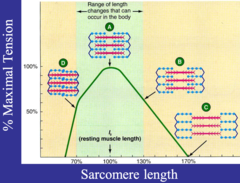
If you start the contraction at an overstretched sarcomere/muscle length, the thin filaments have been pulled almost to the ends of the thick filaments. Can any tension be developed at this point?
little to none
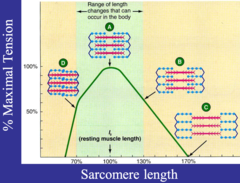
refers to tension generated during a contraction due to the sarcomere length-tension relationship; proportional to the number of cross bridges formed between thick and thin filaments in the sarcomere
resting muscle length = maximum tension
active

As muscle length decreases under resting, does active tension decrease or increase?
decrease
As muscle length increases past resting, does active tension decrease or increase?
decrease
refers to tension in the non-contracting parts of the muscle (blood vessels, membranes, tendons) that increases as the muscle is stretched to greater than resting length
**ONLY comes into play when we stretch/increase the length of the muscle
passive

What is the passive tension at resting muscle length?
none
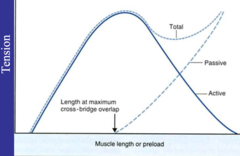
As muscle length increases past resting, does passive tension increase or decrease?
increase
(like stretching a rubber band, rubber bands only have tension when you stretch them, so passive tension only comes into play when muscle length increases)

What is the total tension of a muscle?
sum of active and passive tension
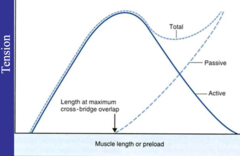
What is the only condition when passive tension is greater than active tension?
In this hypothetical instance, the total tension would coincide with the passive tension!
hyperextended state
(which is not physiological)
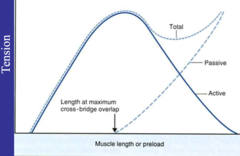
Based on the length-tension relationship...
A. stretching a skeletal muscle 30% longer than the resting length results in a greater contraction
B. varying the amount of overlap of thick and thin filaments does not greatly affect contraction force as long as tension remains the same
C. more tension develops if a muscle is 30% shorter than its resting length
D. muscle tension remains the same as long as the muscle's length is not more than + or - 30% of the resting length
E. a resting muscle that is shorter or longer than its resting length will generate less tension at the onset of contraction
E
Which of the following contributes to the active tension of skeletal muscle?
A. plasma membrane
B. sarcomere
C. tendon
B