PHIL 321 Final
 View linked note
 Call Kai
 Learn
Learn Practice Test
 Spaced Repetition
 Match
Match Flashcards
 Knowt Play
1/104

There's no tags or description
Looks like no tags are added yet.
Name | Mastery | Learn | Test | Matching | Spaced | Call with Kai |
|---|
No analytics yet
Send a link to your students to track their progress
105 Terms
What does it mean to make a decision under certainty?
In decision-making under certainty, the decision maker knows the exact outcome of each possible action, and the states of the world are fully known.
What is a decision under ignorance?
JA decision under ignorance occurs when the decision maker has no information about the probabilities of the possible states of the world.
What is a decision under risk?
In decision-making under risk, the decision maker knows the probabilities of the states of the world, but the outcomes are uncertain.
What is the difference between conditional and unconditional probability?
Unconditional probability is the probability of an event occurring without any conditions (Pr(A)), while conditional probability is the probability of an event given that another event has occurred (Pr(A|B)).
What is state-act independence/dependence?
State-act independence means that the choice of an action does not affect the probabilities of the states occurring.
State-act dependence means that the probability of a state occurring depends on the action taken by the decision maker.
What is a decision table?
A decision table is a tool that presents the possible outcomes for each action under different states, helping the decision maker compare the results and choose the most rational action.
What is a decision tree?
A decision tree is a diagram used to map out decisions and their possible consequences, including chance events and outcomes, helping the decision maker visualize their choices.
What is the Principle of Dominance?
The Principle of Dominance states that if one action is at least as good as another in all states, and better in at least one state, then the first action should be chosen.
What are preference orderings?
Preference orderings describe how a person ranks different options or outcomes based on their preferences. They indicate which options are preferred, which are worse, and which are equally preferred.
What features are needed to use an ordinal scale of preferences?
To use an ordinal scale, preferences must be complete (every pair can be compared), transitive (if A is preferred to B, and B is preferred to C, then A must be preferred to C), and reflexive (each option is at least as good as itself).
What is utility in decision theory?
Utility is a way to measure the satisfaction or value a person gets from an outcome. It quantifies preferences and helps in decision-making, especially when outcomes involve risk.
What is an ordinal utility function?
An ordinal utility function assigns ranking numbers to outcomes based on preference, but it doesn’t measure how much better one outcome is compared to another. It just indicates the order of preference.
What is an ordinal transformation?
An ordinal transformation changes the scale of a utility function (by adding or multiplying by a constant) without changing the order of preferences. For example, you could change all utility values by multiplying them by 10, but the preference order remains the same.
What does it mean if preferences are incomparable?
Incomparable preferences occur when a person cannot say if one option is better than another. For example, if someone likes both options equally or is unable to compare them meaningfully.
What are indifferent preferences?
Indifference means the person doesn’t prefer one option over the other. The two options are considered equally good (e.g., a choice between two different flavors of ice cream).
What is the maximin rule?
The maximin rule suggests choosing the option that maximizes the worst-case scenario. It's useful in situations where a person is risk-averse and wants to ensure the best of the worst possible outcomes.
What are some problems with the maximin rule?
The maximin rule can be overly conservative, ignoring potentially better options that carry some risk. It also doesn’t take into account probabilities or how much better one outcome might be compared to others.
What is minimax regret?
Minimax regret involves choosing the option that minimizes the maximum regret. Regret is the difference between the payoff of the best action and the actual payoff chosen. The goal is to avoid feeling the most regret from making a bad decision.
What are the problems with minimax regret?
Minimax regret might not lead to the best decision overall, as it focuses on avoiding the worst regret rather than maximizing the overall outcome. It can sometimes lead to overly cautious decisions.
What is a positive linear transformation in utility functions?
A positive linear transformation means changing the utility function by multiplying it by a positive constant or adding a constant to all values. This preserves the ranking order but changes the scale.
What is an interval scale in utility?
An interval scale measures the differences between utilities. For example, the difference between 10 and 20 is the same as between 20 and 30, but it doesn’t make sense to say 30 is twice as good as 15 (because there’s no true zero).
What is the optimism-pessimism rule?
This rule involves choosing an option where the best-case scenario is weighted by an "optimism index" (a measure of your optimism), and the worst-case scenario is weighted by the pessimism index. It tries to balance between being too optimistic or too pessimistic.
What are some problems with the optimism-pessimism rule?
The rule might not be well-suited for situations where the probabilities of different outcomes are not considered, and it can lead to irrational decisions by focusing only on extremes and not on average outcomes.
What is the principle of insufficient reason?
The principle of insufficient reason says that if you don’t know the probabilities of different outcomes, you should assign equal probabilities to all outcomes. This is useful when you're ignorant about the likelihood of outcomes.
What are the problems with the principle of insufficient reason?
This principle assumes that all outcomes are equally likely, even when there might be reasons to believe some outcomes are more probable than others. It over-simplifies situations where more information could be available.
What is the mixture condition?
The mixture condition says that if a person prefers one option over another, they should still prefer that option even if both are mixed with a third option. This ensures consistency in decision-making.
What is the irrelevant expansion condition?
The irrelevant expansion condition states that adding a new, irrelevant option should not affect the ranking between the original options. If the new option is irrelevant, it should not change the decision.
What is Rawls' veil of ignorance?
The veil of ignorance is a concept from philosopher John Rawls where individuals design a society without knowing their place in it (e.g., their wealth, gender, or race). This encourages them to create fair policies that benefit everyone equally.
What is the difference between Rawls' theory and Harsanyi's theory?
Rawls favors the maximin principle, which focuses on improving the situation of the worst-off individuals. Harsanyi, on the other hand, believes in assigning equal probabilities to different outcomes (principle of insufficient reason) and supports a utilitarian approach, focusing on maximizing overall well-being.
How does Rawls defend the maximin principle?
Rawls defends the maximin principle by arguing that justice should prioritize improving the worst-off individuals, ensuring fairness and equality in society. By focusing on the least advantaged, society can be more just.
What is Maximizing Expected Value (EMV)?
Maximizing EMV is a decision-making approach where you calculate the average value of all possible outcomes, weighted by their probabilities. The idea is to choose the option that gives you the highest average outcome over the long term.
What is Expected Monetary Value (EMV)?
EMV is the weighted average of the possible monetary outcomes of a decision, where the weights are the probabilities of each outcome occurring. It is used in decision theory to determine the most valuable option when there are uncertain outcomes.
What are the problems with EMV?
The EMV method assumes rationality and risk neutrality, which means it doesn’t account for people's aversion to risk or the subjective value they place on outcomes. It also fails to consider small probabilities of large payoffs, which might lead to irrational decisions in real-life situations.
What is the concept of Maximizing Expected Utility?
Maximizing expected utility is a decision-making process where, instead of just looking at the monetary value, you consider the subjective value or satisfaction you get from an outcome, and you choose the option that gives you the highest overall satisfaction.
What is probability calculus?
Probability calculus refers to the mathematical rules and formulas used to calculate probabilities, including the addition, multiplication, and conditional probability rules that help in calculating complex events.
What is the difference between absolute and conditional probability?
Absolute probability (or unconditional probability) is the probability of an event occurring without any conditions (e.g., the chance it will rain tomorrow).
Conditional probability is the probability of an event occurring given that another event has occurred (e.g., the chance it will rain tomorrow if today was cloudy).
What is probabilistic independence?
Two events are independent if the occurrence of one event does not affect the probability of the other event occurring. For example, flipping a coin and rolling a die are independent events.
What does it mean for events to be mutually exclusive?
Two events are mutually exclusive if they cannot happen at the same time. For example, drawing a red card or a black card from a deck is mutually exclusive, because a card can’t be both red and black.
What are the axioms of probability theory?
Non-negativity: Probability is always between 0 and 1.
Normalization: The probability of the entire sample space is 1.
Additivity: If two events are mutually exclusive, the probability of either occurring is the sum of their individual probabilities.
How do you calculate the probability of conjunctions (AND) and disjunctions (OR)?
Conjunction (AND): The probability of both events A and B occurring is P(A∩B)=P(A)×P(B∣A).
Disjunction (OR): The probability of either event A or B occurring is P(A∪B)=P(A)+P(B)−P(A∩B).
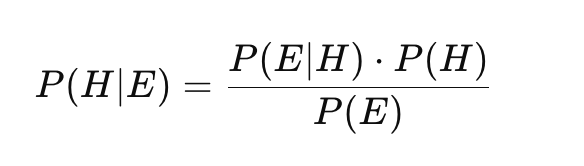
What is Bayes’ Theorem?
Bayes’ Theorem is a formula used to update the probability of a hypothesis based on new evidence. It combines prior probability with the likelihood of the evidence to compute the posterior probability.
What’s the difference between subjective and objective interpretations of probability?
Subjective probability is based on personal belief or judgment (e.g., I believe there is a 70% chance of rain based on my experience).
Objective probability is based on actual data and frequencies (e.g., the probability of rolling a 6 on a fair die is 1/6.
What are the problems with interpretations of probability?
Problems include subjectivity in personal beliefs (subjective probability), lack of data (objective probability), and confusion when interpreting probabilities, especially in one-time events.
What is actual relative frequency in probability?
The actual relative frequency is the empirical probability based on the observed frequency of an event happening in many trials. For example, if you flip a coin 100 times and get heads 55 times, the relative frequency of heads is 55%.
What is hypothetical relative frequency?
Hypothetical relative frequency refers to the probability of an event based on theoretical assumptions. For example, a fair coin has a 50% chance of landing heads, which is hypothetical.
What is the propensity interpretation of probability?
This interpretation suggests that probability reflects the tendency or nature of an event to occur in a given situation, based on the physical properties of the system (e.g., a biased die has a higher tendency to land on one side).
What is the degree of belief interpretation of probability?
Probability is a measure of how confident or how much belief someone has in the occurrence of an event. For example, if you believe it is 70% likely to rain, your degree of belief is 70%.
What is the Dutch Book Theorem?
The Dutch Book Theorem states that if a person’s probabilities are inconsistent with the rules of probability, a set of bets can be made that guarantees the person will lose money. It's a way to show that rational probability assignments are coherent.
What does coherence mean in probability theory?
Coherence means that the probabilities assigned to events must follow the basic rules of probability (such as additivity and normalization) to avoid situations where a Dutch Book can be made.
What is the Law of Likelihood?
The Law of Likelihood states that evidence should be used to increase the probability of hypotheses that make the evidence more likely and decrease the probability of those that make the evidence less likely.
What are diachronic and synchronic applications of Bayes’ Theorem?
Diachronic: Using Bayes’ Theorem over time to update your beliefs as new evidence comes in.
Synchronic: Using Bayes' Theorem at a single point in time to compare different hypotheses based on available evidence.
What is Bayesian Epistemology?
Bayesian Epistemology is a way of understanding how we update our beliefs based on new evidence, using probability theory. It treats beliefs as probabilities and updates them using Bayes’ Theorem. This approach allows us to revise our prior beliefs (initial probability) to form updated beliefs (posterior probability) as new evidence is introduced. It's based on subjective probability, where an individual's degree of belief can change over time with more information.
What are ratio scales in utility?
Ratio scales assign numbers to outcomes where both the differences and ratios between values have meaning. For example, if you have $100 and $50, $100 is twice as valuable as $50, and the difference between them is meaningful.
What does the diminishing marginal utility of money mean?
It means that as you get more money, each additional dollar provides you with less satisfaction or utility. For example, the first $100 you get is worth more to you than the 100th dollar you get.
What is Allais' Paradox?
Allais' Paradox shows that people don't always make decisions that maximize expected utility. It highlights that people prefer certainty over probabilistic outcomes, even when it violates expected utility theory. For example, people prefer a certain smaller amount over a gamble with a higher expected value.
What is Ellsberg’s Paradox?
Ellsberg’s Paradox shows that people prefer known risks over ambiguous risks, even if the expected utility is the same. People tend to avoid situations where the probabilities of outcomes are uncertain, which challenges traditional expected utility theory.
What is the St. Petersburg Paradox?
The St. Petersburg Paradox involves a game where the expected value of the game is infinite, yet people are not willing to pay an infinite amount to play. It demonstrates that people’s behavior doesn’t align with the theoretical expected value when dealing with extremely unlikely large payoffs.
What is Pascal’s Wager?
Pascal’s Wager is an argument for believing in God based on the expected utility of belief. It suggests that, even if the probability of God’s existence is low, the potential reward (eternal life) is so high that it's rational to believe in God.
What are the Von Neumann-Morgenstern (VNM) axioms?
The VNM axioms are the basic rules required for someone’s preferences to be consistent with expected utility theory. These include:
Completeness: You can compare any two options.
Transitivity: If A is preferred to B, and B is preferred to C, then A should be preferred to C.
Independence: If A is preferred to B, then mixing A with a third option C should still make A preferable to B.
Continuity: If A is preferred to B, and B is preferred to C, then there is a mix of A and C that will make the person indifferent to B.
What is the Von Neumann-Morgenstern Theorem?
The Von Neumann-Morgenstern Theorem states that if an individual’s preferences follow the VNM axioms, their preferences can be represented by a utility function, which allows them to make decisions by maximizing expected utility. This gives a mathematical basis for rational decision-making under uncertainty.
What is the Predictor Paradox?
The Predictor Paradox is a situation where a highly accurate predictor can predict your actions. You're given a choice between two boxes: one with a guaranteed reward, and another that only contains a large reward if the predictor believes you will choose it. The paradox explores the tension between rational decision-making (choosing the box with the guaranteed money) and predictive causality (acting in line with the predictor's forecast).
How do the principle of maximizing expected utility and the principle of dominance conflict?
The principle of maximizing expected utility suggests choosing the option with the highest expected value, while the principle of dominance suggests choosing the option that is better in all possible scenarios. These principles can conflict when one option has a better guaranteed outcome, but the other offers higher expected utility. In such cases, maximizing expected utility might lead to less certain outcomes, while dominance suggests avoiding risk altogether.
What is conditional causal probability?
Conditional causal probability is the likelihood of an event happening based on the assumption that one event causes another. For example, if you believe that taking an umbrella causes you to stay dry, the probability of staying dry is conditional on the action of taking the umbrella.
What is causal decision theory?
Causal decision theory focuses on the causal relationship between your actions and their outcomes. It suggests that you should make decisions based on how your actions directly affect the outcomes, rather than relying on correlations between actions and outcomes.
What is the difference between causation and correlation?
Causation means that one event directly causes another event to happen.
Correlation means that two events occur together but one does not necessarily cause the other. For example, just because ice cream sales and sunburns both rise in summer doesn’t mean one causes the other.
What is the Calvinism example in decision theory?
The Calvinism example involves a religious belief that people's fates are predetermined. In decision theory, it shows a conflict between a deterministic view of the world and the freedom of choice. It raises questions about how we make decisions if we believe everything is predestined.
What is Fisher’s smoking example?
Fisher's smoking example is a scenario where a person believes that smoking causes lung cancer. In decision theory, it highlights the difference between causation and correlation. Fisher’s example shows how one might mistakenly assume smoking directly causes cancer, when in fact the two might only be correlated (e.g., genetic factors, lifestyle).
What is evidential decision theory?
Evidential decision theory suggests that you should make decisions based on how your actions provide evidence about the world. It emphasizes correlations rather than direct causal effects. For example, if taking an umbrella correlates with rain, you may decide to take it based on this evidence, even if the umbrella doesn’t cause the rain.
What is Egan’s psychopath example?
Egan’s psychopath example is a thought experiment that challenges evidential decision theory. It involves a psychopath who makes decisions based on correlations between events, but not actual causal relationships. This example demonstrates the problem with relying on evidence (correlations) without considering the underlying causal factors. It suggests that relying solely on evidence can lead to irrational behavior.
What are the different kinds of games discussed in Peterson's work?
Peterson discusses different types of games, including zero-sum games (where one player's gain is another's loss), non-zero-sum games (where both players can gain or lose), and cooperative games (where players can cooperate to achieve a mutual benefit). These games help analyze strategic interactions between players.
What are the assumptions of game theory?
Game theory assumes that players are rational, meaning they always make decisions that maximize their own payoffs, and that they have complete information about the game and the actions of other players.
What is the minimax test for zero-sum games?
The minimax test is used to find the optimal strategy in a zero-sum game. It involves choosing a strategy that minimizes the maximum possible loss. Each player tries to maximize their minimum payoff, ensuring they perform well in the worst-case scenario.
What is the equilibrium in the Rock, Paper, Scissors game?
In Rock, Paper, Scissors, the equilibrium is a mixed strategy, where each player randomly chooses rock, paper, or scissors with a probability of 1/3 each. This ensures that neither player can predict the other’s choice and gain an advantage.
What is the equilibrium in the Prisoner’s Dilemma game?
In the Prisoner's Dilemma, the equilibrium is both players defecting (betraying each other) because each player has a better payoff by betraying, regardless of what the other does. However, mutual cooperation would yield a better outcome.
What is the equilibrium in the Chicken Game?
In the Chicken Game, the equilibrium occurs when one player cooperates (swerves) and the other defects (doesn’t swerve). Both players face a risk of disastrous outcomes if both refuse to swerve, but one player must back down to avoid a collision.
What is the equilibrium in the Stag Hunt?
In the Stag Hunt, the equilibrium is either both players cooperating to hunt the stag, or both players defecting to hunt the hare. The best outcome occurs when both cooperate for the stag, but mutual defection (hunting the hare) is also an equilibrium.
What is the equilibrium in the Hawk-Dove game?
In the Hawk-Dove game, the equilibrium involves a mix of hawks (aggressive players) and doves (peaceful players). The optimal outcome occurs when there are more doves than hawks, as the hawks are costly to the population.
What is the equilibrium in the Ultimatum Game?
In the Ultimatum game, one player proposes a split of resources, and the other can accept or reject. The equilibrium is typically where the first player offers a fair split (e.g., 50/50) and the second player accepts it, as rejecting would result in no benefit.
What is the equilibrium in the Dictator Game?
In the Dictator Game, one player decides how to split a resource, and the other player has no say. The equilibrium depends on the proposer’s preferences, but it often results in the dictator keeping most or all of the resource for themselves.
How do you solve zero-sum games?
To solve zero-sum games, use the minimax test where each player chooses a strategy that minimizes their maximum loss. Then, find the Nash equilibrium, which is the point where neither player can improve their payoff by changing their strategy unilaterally.
What is Tit for Tat in the Iterated Prisoner’s Dilemma?
Tit for Tat is a strategy where a player starts by cooperating, then mimics the other player's last move. In the iterated Prisoner’s Dilemma, this strategy promotes cooperation by rewarding it and punishing betrayal.
What’s the difference between ESS and evolutionarily stable states?
Evolutionarily Stable Strategy (ESS) is a strategy that, if most players adopt it, cannot be overtaken by any other strategy.
Evolutionarily Stable State refers to a stable equilibrium in a population where players consistently follow strategies that are resistant to alternative strategies.
What is the Clash of Wills (aka Battle of the Sexes) game?
The Clash of Wills is a coordination game where two players have different preferences, but both benefit from coordinating. The equilibria occur when both players cooperate, either choosing one option that satisfies both or one option each player prefers.
What are the problems and limitations of the notion of equilibrium in game theory?
One issue is that multiple equilibria can exist, and there is no clear way to predict which equilibrium players will choose. Equilibrium assumptions also assume players are fully rational, but in real life, people may act irrationally or suboptimally.
What is Pareto optimality?
Pareto optimality is a state where no player can be made better off without making someone else worse off. It’s about efficiency in allocating resources or making decisions.
How is the Prisoner’s Dilemma related to Newcomb’s Paradox?
In both scenarios, there’s a conflict between rational self-interest and cooperative behavior. In the Prisoner’s Dilemma, betrayal leads to a better individual outcome, but cooperation benefits both. In Newcomb’s Paradox, you face a choice between an option that seems to maximize expected utility but conflicts with predictive causality.
What is the Divide the Cake game?
The Divide the Cake game is an example of a game in which two players must decide how to split a resource (like a cake). The goal is to divide the cake fairly, taking into account the preferences and fairness of both players.
What is the Ultimatum Game?
The Ultimatum Game involves two players: one proposes a division of a resource, and the other can either accept or reject it. If the second player rejects the offer, both players get nothing. The game explores fairness and how people value fairness over simply maximizing their own gain.
What is Fisher’s sex ratio argument?
Fisher's sex ratio argument posits that, in a population of sexually reproducing organisms, the sex ratio will naturally evolve towards an equal split (50:50 between males and females). This occurs because, when one sex becomes rarer, the fitness of the rarer sex increases, leading to a balance between male and female offspring.
How does Skyrms argue that our sense of justice evolved?
Skyrms argues that our sense of justice and fairness evolved through evolutionary games where cooperation was beneficial. Games like Divide the Cake and the Ultimatum Game show that fairness is often favored because it encourages cooperation, which provides greater mutual benefits in the long term.
What is Nash Equilibrium?
A Nash equilibrium occurs when no player in a game can improve their outcome by unilaterally changing their strategy, assuming the other players keep their strategies the same. It represents a stable state where everyone’s strategy is the best response to the others' strategies.
What are the equilibria and Evolutionarily Stable Strategies (ESS) in the games Skyrms discusses?
Equilibria in Skyrms' games like Divide the Cake and the Ultimatum Game usually involve cooperation and fairness, where both players benefit from sharing resources.
ESS in these games is a strategy that, if adopted by most players in a population, cannot be invaded by other strategies. For example, fair division strategies in these games are often evolutionarily stable because they encourage cooperation.
Why doesn’t Skyrms think rational self-interest explains behavior in games like Divide the Cake or the Ultimatum Game?
Skyrms argues that fairness and justice often go beyond rational self-interest because people value cooperation and long-term mutual benefit. In these games, players often act fairly, even at their own expense, because they care about reputation, social norms, and creating an environment conducive to future cooperation.
What do psychological experiments show about Divide the Cake and the Ultimatum Game?
Psychological experiments show that fairness plays a key role in how people make decisions. In the Ultimatum Game, players often reject offers that are unfair, even at their own expense. This suggests that people value fairness and may make decisions that are not strictly based on maximizing their own payoff.
What is the Darwinian Veil of Ignorance?
The Darwinian Veil of Ignorance is a thought experiment that combines John Rawls' veil of ignorance with evolutionary theory. It suggests that people, when making decisions about society, should act as though they don’t know their social position. This encourages decisions that promote fairness and cooperation because people would want policies that benefit them no matter their position.
What are polymorphic problems in evolutionary game theory?
Polymorphic problems occur when there are multiple strategies in a population, each with different payoffs depending on the strategies of others. In evolutionary theory, these problems highlight the balance between different types of strategies that can coexist in a population.
What is the role of positive correlation in evolutionary game theory?
Positive correlation in evolutionary game theory means that players who adopt similar strategies tend to have better outcomes. This encourages cooperation between players who mirror each other’s behavior, leading to more cooperative and stable populations.
What are the problems with Skyrms' argument in evolutionary game theory?
Skyrms' argument is criticized for assuming that fairness and cooperation always arise from evolutionary pressures. Some argue that it doesn't account for cheating or selfish behavior that might undermine cooperation. Additionally, it’s debated whether fairness can always evolve as a stable strategy in real-world scenarios.
What happens with negative correlation in evolutionary games?
When there’s a negative correlation between players’ strategies, one player’s success tends to reduce the success of the other. For example, if one player cooperates and the other defects in the Prisoner’s Dilemma, they may both receive worse outcomes than if they cooperated. Negative correlation can lead to conflict rather than cooperation.
What happens when we add Mix as a strategy in the Divide the Cake game?
Adding a Mix strategy (a mix of cooperating and defecting) in the Divide the Cake game can shift the balance between fairness and selfishness. If players mix their behavior, it can reduce the predictability of actions and potentially lead to less fair divisions of the cake, as one player might end up taking advantage of the randomness.