PHIL 321 Final
Decision Theory
Normative vs Descriptive Decision Theory
Normative Decision Theory: Focuses on what should be done in an ideal rational framework.
Examples:
Expected Utility Theory (EUT), which suggests that individuals make choices by calculating the expected utility of all possible outcomes and selecting the option with the highest value. → optimize personal outcome
Maximin Principle (Rawls' approach), where the goal is to maximize the well-being of the worst-off individual in society.
If you’re deciding between two investment options, Normative Decision Theory would tell you to choose the one with the highest expected return, assuming you have perfect knowledge of risks and outcomes.
Descriptive Decision Theory: Focuses on how decisions are actually made in practice, incorporating cognitive biases and irrationality.
When deciding on an investment, Descriptive Decision Theory would explain that people might overvalue familiar companies or be influenced by recent news (anchoring bias), even if these factors don’t logically relate to the best financial decision.
Rational vs Right Decisions
A rational decision is based on logic and reasoning, not necessarily on what is morally right or good in a broader sense.
Example: Choosing to cheat on a test to get a better grade could be rational if you view it as a way to maximize your grade and future success. It’s based on the logical analysis of benefits versus risks.
A right decision is one that is morally or ethically correct. It is not necessarily about maximizing personal gain or utility, but about doing what is just or fair based on societal or ethical norms.
Example: Deciding not to cheat on a test, even though doing so might guarantee a higher grade, could be considered the right decision from an ethical standpoint, as it upholds principles of honesty and integrity.
Types of Decisions
Decision under Certainty: All possible states and outcomes are known.
Decision under Risk: Probabilities of outcomes are known.
Decision under Ignorance: No knowledge of probabilities or possible outcomes.
Decision Rules
Principle of Dominance: If one action (A) is better than another action (B) in every possible state, then A should be chosen.
Use this when the probabilities of the states are independent of the actions
Problems/Objections: The Principle of Dominance assumes that the probabilities of different outcomes or states do not depend on your choice of action; but often, actions affect the probabilities of outcomes → can’t apply
Maximin Rule: Choose the action with the best worst-case outcome.
Leximin Rule: If two actions have the same worst outcome, choose the action where the second worst outcome is the best, and so on.
Problems/Objections:
Conservative rule → The rule is very cautious because it focuses on minimizing the worst possible outcome, which might lead to choosing the safest option (the one with the least risk of a disaster). However, this strategy ignores the potential for significantly better outcomes in the more likely or best-case scenarios
Lexical Maximin → The Leximin Rule goes even further than the Maximin Rule in focusing on the worst-case scenario. It prioritizes the best worst-case, then looks at the second-worst, and so on, without giving enough attention to the best possible outcomes.
Optimism-Pessimism Rule: multiplying the best outcome of an action by the alpha index and the worst outcome by the other weight (e.g., alpha = 0.7, then multiple worst by 0.3)
alpha = 1 → maximax (best of the best)
alpha = 0 → maximin
= α × max + (1−α) × min
Problems/Objections: The Optimism-Pessimism Rule works on the assumption that the order and values of outcomes is preserved. if you preserve order but have different values, the rational action may change → doesn’t preserve under ordinal transformation (needs positive linear transformation)
Principle of Insufficient Reason: Assign equal probabilities to all outcomes when you have no information to suggest otherwise.
turning decision under ignorance to decision under risk
Problem/Objections:
If you change the number of possible outcomes or states, the rational decision according to the Principle of Insufficient Reason might change as well.
Why should we assign equal probabilities when we are ignorant of the actual probabilities of outcomes?
Expected Utility vs Expected Monetary Value
Expected Monetary Value (EMV): EMV = sum (probability of outcome * value ($) of outcome)
Expected Utility (EU): EU = sum (probability of outcome * utility of outcome)
Utility adjusts for diminishing returns on money.
Probability Theory
Probability Axioms (Kolmogorov Axioms)
define how probabilities are assigned to events and ensure that the behavior of probabilities is consistent and logically sound
0 ≤ P(A) ≤ 1
P(S) = 1 (where S is the sample space) (i.e., one of the outcomes in the sample space must occur, so the probability is 100%)
If A and B are mutually exclusive events, P(A ∪ B) = P(A) + P(B)
Types of Probability
Absolute Probability: P(A) is the probability of event A.
Conditional Probability: The probability of A given B is: P(A|B) = P(A ∩ B) / P(B)
Independence: Events A and B are independent if: P(A ∩ B) = P(A) * P(B)
Mutually Exclusive Events: Events A and B are mutually exclusive if they cannot both happen, i.e., P(A ∩ B) = 0.
Bayes’ Theorem
Bayes' Theorem allows updating probabilities given new evidence. The formula is: P(A|B) = (P(B|A) * P(A)) / P(B)
Dutch Books
A Dutch Book is a set of bets in which a person is guaranteed to lose money, regardless of the outcome of the individual bets. This happens when their probabilities don't conform to the laws of probability (such as the additivity and normalization axioms).
Incoherence arises when someone's probability assignments violate basic probability principles, such as:
Additivity: The sum of probabilities for mutually exclusive events should equal 1.
Normalization: The probability of the entire sample space must equal 1.
If a person’s probabilities are inconsistent, a set of bets can be constructed such that the person will end up with a guaranteed loss.
Utility Theory and Paradoxes
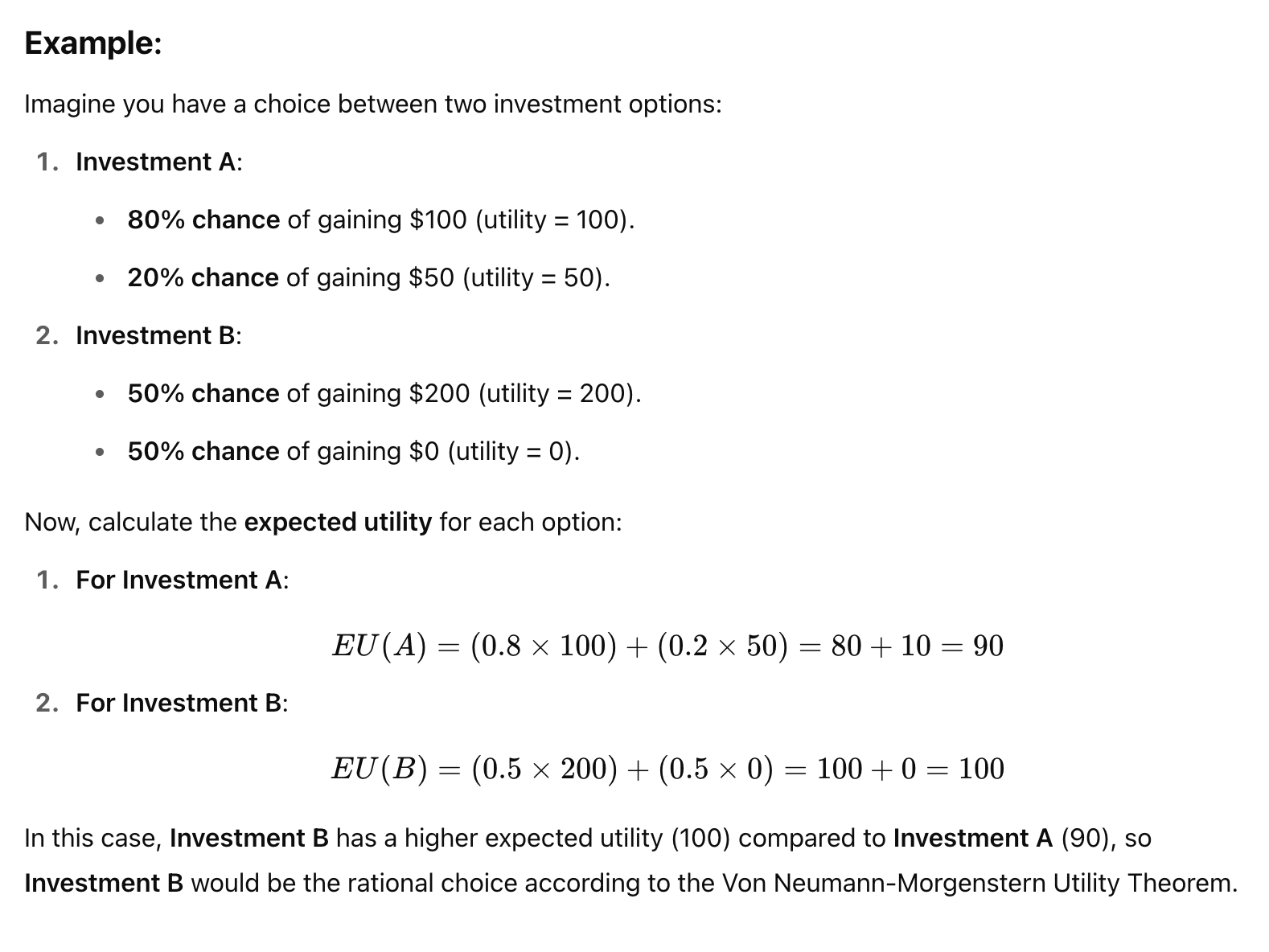
Von Neumann-Morgenstern Utility Theorem
helps individuals make decisions under uncertainty by converting preferences into utility values.
Preferences Can Be Ranked:
The individual can rank different outcomes based on their preferences (e.g., preferring $10 over $5).
This allows for the assignment of numerical utility values to the outcomes based on how much the individual values them.
Utility Values:
Each possible outcome x_i is assigned a utility value U(x_i), where higher utility represents a more preferred outcome.
Utility is a measure of the subjective satisfaction or value an individual derives from a particular outcome.
Expected Utility:
EU = sum (P(x_i) * U(x_i)) where P(x_i) is the probability of outcome x_i and U(x_i) is the utility of x_i.
Completeness: A≻B or B≻A or A∼B
Transivity: A≻B and B≻C → A≻C
Independence: A ≻ B if and only if ApC ≻ BpC (p > 0)
Utility Scales
Ordinal Utility: A ranking of outcomes, but no measurable difference between them.
Example: Suppose you prefer outcome A over outcome B, and outcome B over outcome C. You can rank the outcomes as A > B > C, but you cannot say how much more you prefer A to B or B to C—you only know the order.
Interval Utility: Differences between utilities are meaningful, but not ratios.
Example: If A = 10 units of utility, B = 5 units, and C = 0 units, you can say that A provides 5 more units of utility than B, and B provides 5 more units than C. But it doesn’t make sense to say that A is "twice as good" as B, even though A has twice the utility value of C.
Ratio Utility: Both differences and ratios between utilities are meaningful.
Example: If A = 100 units of utility, B = 50 units, and C = 0 units, then:
A is 50 units better than B.
A is twice as good as B (since 100 / 50 = 2).
Diminishing Marginal Utility
This principle states that as the quantity of a good consumed increases, the marginal utility (additional satisfaction) decreases.
For money, each additional dollar provides less utility. If u(x) is the utility for x units of money:
u(x_2) - u(x_1) < u(x_1) - u(x_0) (for x_2 > x_1 > x_0)
Paradoxes
Allais’ Paradox: A violation of expected utility theory showing that people prefer certain outcomes over probabilistic ones.
ticket 1
ticket 2-11
ticket 12-100
Gamble 1
$1M
$1M
$1M
Gamble 2
0
$5M
$1M
ticket 1
ticket 2-11
ticket 12-100
Gamble 3
$1M
$1M
0
Gamble 4
0
$5M
0
According to expected utility theory, if you prefer Gamble 1 over Gamble 2, then you must also prefer Gamble 3 over Gamble 4 (but people prefer Gamble 4 to Gamble 3 in this case)
Ellsberg’s Paradox: People prefer risks with known probabilities over ambiguous risks, even if the expected utility is the same.
RED (30)
BLACK OR YELLOW (60)
Gamble 1
$100
$0 $0
Gamble 2
$0
$100 $0
RED (30)
BLACK OR YELLOW (60)
Gamble 3
$100
$0 $100
Gamble 4
$0
$100 $100
Assume that you want to choose G1 because te proportion of the red ball is known for sure whereas one knows almost nothing about the number of black balls
Gamble 4 gives you a 2/3 chance of winning $100, and because you know the exact probability of drawing a black or yellow ball, it feels like a more rational choice compared to Gamble 3, where the chances of winning are not clearly defined by the situation
St. Petersburg Paradox: If you get heads on the first flip, you win $1.
If you get tails on the first flip but heads on the second flip, you win $2.
If you get tails on the first two flips but heads on the third, you win $4.
And so on, doubling the payout each time.
The expected value of a gamble becomes infinite, but most people wouldn’t pay an infinite amount to play it.
Pascal’s Wager: A decision-making problem where the expected utility of belief in God is much higher than disbelief, even with low probabilities.

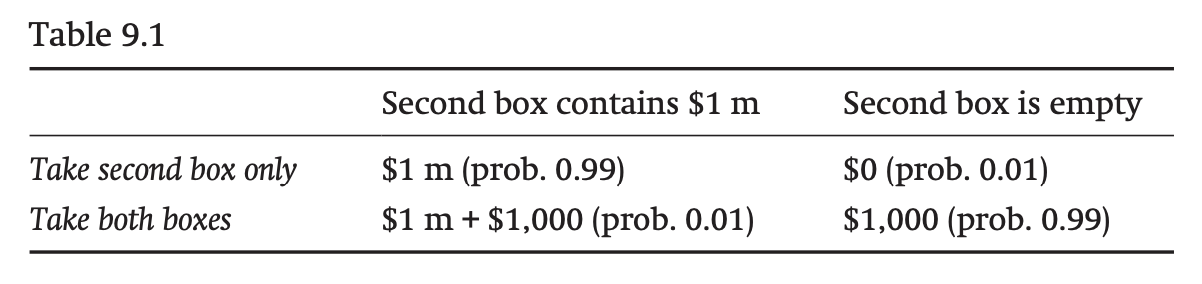
Predictor Paradox: In Newcomb’s Paradox, a Predictor can predict your decision with near-perfect accuracy. You face a choice between two boxes:
Box A: Contains $1,000.
Box B: Contains $1 million (if the Predictor predicts correctly), or nothing (if the Predictor predicts incorrectly).
Principle of Dominance vs. Maximizing Expected Utility:
Dominance: Choosing both boxes guarantees you $1,000, but the Predictor’s prediction affects the outcome in Box B.
Maximizing Expected Utility: If you assume the Predictor is accurate, choosing only Box B maximizes your expected utility.
Causal Decision Theory (CDT) vs. Evidential Decision Theory (EDT):
CDT: Focuses on causal relationships (i.e., your action will not change the contents of Box B, so take both boxes).
EDT: Focuses on correlations (i.e., your action correlates with the outcome, so choose only Box B to align with the Predictor’s prediction).
Game Theory
Zero-Sum Games
A zero-sum game is one where one player's gain is another player's loss. The minimax strategy is used to minimize the maximum possible loss. The formula for minimax is:
minimax strategy = min (max (payoffs))
Nash Equilibrium
A Nash Equilibrium is a situation where no player can improve their payoff by changing their strategy, given the strategies of others. The equilibrium condition is:
Payoff_i >= Payoff_j for all j ≠ i
Pareto Optimality: A situation where no player can be made better off without making someone else worse off.
Clash of Wills/Battle of the Sexes

If both players choose A, Player 1 gets a payoff of 2 (since Player 1 prefers A), and Player 2 gets 1 (since Player 2 is indifferent between A and B, but prefers coordination).
If both players choose B, Player 1 gets 1 (since Player 1 prefers A over B), and Player 2 gets 2 (since Player 2 prefers B).
If they choose different options, neither player receives anything (0, 0), which is the worst outcome.
Coordination: The key to this game is that both players want to coordinate on a common choice. They don’t mind which one (A or B), as long as they agree.
Conflict of Preferences: The players have different preferences for the outcomes. Player 1 prefers A, while Player 2 prefers B. This creates a conflict where each player wants to achieve a different outcome, but they still prefer to coordinate on the same choice rather than end up with nothing.
Chicken Game
2 pure strategy equilibrium == (straight, swerve) or (swerve, straight)
mixed equilibrium is at p = 1/3
Ultimatum Game
Player 1 (the Proposer) is given a certain amount of money (e.g., $100) and has to decide how to split this amount between themselves and Player 2 (the Responder).
Player 2 can either accept the offer or reject it.
If Player 2 accepts, the money is split according to the Proposer's offer.
If Player 2 rejects, neither player gets anything.
The Proposer might offer a small amount (e.g., $10) to the Responder, assuming that Player 2 will accept, knowing that something is better than nothing.
Player 2, however, might reject the offer if they feel that the division is unfair, even though rejecting the offer results in no money for either player.
Dictator Game
Player 1 (the Dictator) is given a certain amount of money (e.g., $100), and they decide how much to give to Player 2.
Player 2 has no power and must accept whatever Player 1 decides to give them.
Since Player 2 has no power to reject the offer, the Dictator can maximize their own payoff by keeping all the money. However, many people choose to give something to Player 2, indicating that people don’t always act out of strict self-interest and value fairness or generosity.
Non-Zero-Sum Games
the loss or gain made by each player is not the exact opposite of that made by the other player
Prisoner's Dilemma (PD): If both players cooperate (stay silent), they each get a light sentence (e.g., 1 year in prison).
If one betrays and the other cooperates, the betrayer goes free (0 years), and the cooperator gets a heavy sentence (e.g., 10 years).
If both betray each other, both get moderate sentences (e.g., 5 years).

Stag Hunt: If both cooperate and hunt the stag together, they both get a large reward (e.g., 10 points each).
If one defects and hunts a hare while the other hunts the stag, the defector gets a small reward (e.g., 5 points), but the cooperator gets nothing (e.g., 0 points).
If both defect and hunt hares, both get a smaller reward (e.g., 5 points each).

In the Prisoner's Dilemma, cooperation leads to a better outcome for both players, but the players, driven by individual rationality, betray each other and end up with a worse outcome than if they had cooperated.
In the Stag Hunt, cooperation yields the best outcome, but individual rationality (acting alone and hunting the hare) also provides a reasonable payoff, even though it is worse than the cooperative outcome.
Iterated Games and Tit-for-Tat Strategy
In Iterated Games, players interact multiple times, which allows for strategies to evolve based on previous moves.
The Tit-for-Tat (TFT) strategy is a key strategy in the Iterated Prisoner’s Dilemma. It works as follows:
Cooperate initially: In the first round, TFT starts by cooperating, showing goodwill.
Mimic the opponent’s previous move: In subsequent rounds, TFT mirrors the opponent's last move. If the opponent cooperated, TFT cooperates; if the opponent defected, TFT defects.
Evolutionary Game Theory
Instead of assuming players are always rational (as in classical game theory), EGT examines how strategies evolve over time in populations, where players (or individuals) may be driven by evolutionary pressures, such as survival or reproduction.
Skyrms’ Argument: cooperation and fairness are evolutionarily stable strategies that have developed over time because they promote long-term benefits, even if short-term outcomes may encourage self-interested behavior
Hawk-Dove: If two hawks meet, they will fight, and the winner gets the resource, but the loser suffers a cost (C).
If a hawk and a dove meet, the hawk gets the resource with no cost, and the dove gets nothing.
If two doves meet, they share the resource equally.
Stag Hunt: Cooperation (hunting the stag) leads to the best payoff for both players (10 points each), but it requires mutual trust and cooperation.
Defection (hunting the hare) gives a lower payoff (5 points) but is risk-free (you don’t need the other player’s cooperation).
Evolutionary Stable Strategy (ESS): A strategy that, if adopted by a population, cannot be invaded by any alternative strategy.
Skyrms and Evolutionary Justice
Skyrms’ Social Contract Theory
Evolutionary Game Theory:
focuses on how strategies evolve over time within populations. Unlike traditional game theory, which assumes rational players, evolutionary game theory looks at how behaviors develop and stabilize based on their effectiveness for survival and reproduction.
Cooperation as an Evolutionarily Stable Strategy (ESS):
An Evolutionarily Stable Strategy (ESS) is a strategy that, if adopted by a population, cannot be replaced by any alternative strategy because it leads to the highest payoffs over time.
Skyrms argues that cooperation can be seen as an ESS because it leads to long-term survival benefits for individuals and groups. Over time, cooperative behaviors—such as fairness and justice—became evolutionarily stable because groups that cooperated were more successful in competing with other groups.
Social Contract as a Mechanism for Cooperation:
Skyrms uses the concept of the social contract to explain how cooperation is established and maintained within societies. A social contract refers to an implicit agreement among individuals in a society to cooperate for mutual benefit and adhere to shared norms, including those related to fairness and justice.
In evolutionary terms, these social contracts arise when individuals realize that cooperating with others (and maintaining fairness) leads to better collective outcomes than acting in isolation or pursuing only self-interest.
Stag Hunt as a Social Contract
The Stag Hunt is a game theory scenario that helps explain how cooperation can lead to the best possible outcome for everyone involved.
Hunting the stag is the best option for both hunters, but it’s risky. If one hunter decides to hunt the hare alone (instead of cooperating), the other hunter won’t be able to catch the stag and gets nothing.
Hunting the hare is safer because each hunter can do it alone, but they get a smaller reward.
Cooperation (hunting the stag together) leads to the best collective outcome, but it requires trust. Both hunters need to know the other will cooperate, or else they’ll end up with nothing.
The social contract is similar to this situation. It’s like an agreement among people in a society to cooperate for the common good. If everyone agrees to cooperate (like hunting the stag), everyone benefits more. But if some people choose not to cooperate (like hunting the hare), the system breaks down, and everyone ends up with less.
Miscellaneous Topics
Causal vs Evidential Decision Theory
Causal Decision Theory deals with the causal effects of actions
e.g., If you are deciding whether to take an umbrella based on whether it rains, CDT says that you should focus on the direct causal link between carrying an umbrella and staying dry (if it rains), not the correlation between the umbrella and future rainfall.
Evidential Decision Theory focuses on the evidence actions provide about the state of the world.
e.g., If you take an umbrella and it rains, EDT suggests that taking the umbrella is evidence that rain is likely. Even though taking the umbrella doesn’t cause it to rain, the act of taking the umbrella is correlated with rain, so you may decide that taking it is the best choice.
Calvinism
it is predetermined (before you’re even born) whether you’ll go to heaven or hell
⇒ whether you choose to sin or not while you live, does NOT matter
x, y are positive
x = utility of going to heaven
y = utility of sinning
x >> y
so…
PMEU tells us not to sin
PMEU of not sinning = .99x + 0 = .99x
PMEU of sinning = .01(x+y) + y = .01x + 1.01y
dominance tells us to sin
Fisher’s Smoking
Type A gene | Type B gene | |
not smoking | heart disease | no heart disease |
smoking | heart disease + pleasure of smoking | no heart disease + pleasure of smoking |
Maximize EV suggests don’t smoke
Dominance suggests smoke
Rawls’ Theory of Justice vs Harsanyi’s Theory
Rawls’ Maximin Principle: Justice should focus on improving the worst-off in society.
Example: In choosing a policy, Rawls would prefer one that benefits the poorest or most disadvantaged people, even if it means sacrificing some potential gains for the better-off. This ensures that the most vulnerable are protected.
Harsanyi’s Principle of Insufficient Reason: If you don't know the probabilities, assign equal probabilities to all outcomes.
Example: In a decision under uncertainty, if you are unsure about how likely different social policies are to affect various groups, you assume each outcome has an equal chance of occurring, and then choose the one that maximizes overall utility.
The Loonie Auction and Rational Play
In decision-making under uncertainty, traditional models like Expected Utility Theory (EUT) suggest that individuals should make choices by weighing the probabilities and outcomes of various options. However, irrational strategies can emerge when maximizing expected utility is not the best approach.
e.g., in situations like the Loonie Auction,
According to EUT, the best strategy is to stop bidding once the price reaches $1 (the value of the coin), because continuing to bid beyond that point results in a loss.
People often fail to follow this rational strategy because of psychological factors like overconfidence, escalation of commitment, and a desire to win.
Despite the fact that continuing to bid is irrational and will lead to a loss, bidders may engage in a bidding war, driven by emotion or competitive spirit, causing them to bid more than the coin’s actual value.