📸A&P II - Chapter 24, The Digestive System Practice Questions
 Call Kai
 Learn
Learn Practice Test
 Spaced Repetition
 Match
Match Flashcards
 Knowt Play
1/47

Earn XP
Description and Tags
https://quizlet.com/459982185/ap-ii-chapter-24-the-digestive-system-practice-questions-flash-cards/
Name | Mastery | Learn | Test | Matching | Spaced | Call with Kai | Chat |
|---|
No analytics yet
Send a link to your students to track their progress
48 Terms
Which of following processes is the function of the smooth muscle layer of the digestive system?
a) Ingestion
b) Secretion
c) Mixing and propulsion
d) Absorption
e) None of these choices
c. mixing and propulsion
Which of following processes is the primary function of the villi of the small intestine?
a) Ingestion
b) Secretion
c) Mixing and propulsion
d) Absorption
e) None of these choices
d. absorption
Which of the following accessory organs produces a fluid that functions to emulsify dietary fats?
a) Teeth
b) Salivary glands
c) Liver
d) Gallbladder
e) Pharynx
c. liver
Which of the following accessory organs stores bile?
a) Teeth
b) Salivary glands
c) Liver
d) Gallbladder
e) Pharynx
d. gallbladder
The capability of the GI tract to move material along its length is called
1. Motility
2. Propulsion
3. Digestion
4. Defecation
a) 1 only
b) 2 only
c) 3 only
d) 4 only
e) both 1 and 2
both 1 and 2
This layer of the GI tract is composed of areolar connective tissue containing blood and lymph vessels.
a) Mucosa
b) Lamina propria
c) MALT
d) Muscularis
e) Epithelium
b. lamina propria
This layer of the GI tract is composed of areolar connective tissue that binds the mucosa to the muscularis.
a) Submucosa
b) Lamina propria
c) Epithelium
d) Serosa
e) None of these choices
a. submucosa
This layer functions by secreting a lubricating fluid.
a) Serosa
b) Submucosa
c) Muscularis
d) Mucosa
e) MALT
d) Mucosa
These are composed of prominent lymphatic nodules that function in the immune response.
a) Mucosa
b) Lamina propria
c) MALT
d) Submucosa
e) Serosa
c. MALT
This plexus is located between the longitudinal and circular smooth muscle layers of the muscularis.
a) ENS
b) Myenteric plexus
c) Submucosal plexus
d) Digestive plexus
e) Absorption plexus
b. myenteric plexus
Why do emotions such as anger or fear slow digestion?
a) Because they stimulate the parasympathetic nerves supplying the GI tract
b) Because they stimulate the somatic nerves that supply the GI tract
c) Because they stimulate the sympathetic nerves that supply the GI tract
d) They do not affect digestion
e) Because all emotions are controlled by the Vagus nerve
c. because they stimulate the sympathetic nerves that supply the GI tract
This portion of the peritoneum drapes over the transverse colon and coils of the small intestine.
a) Greater omentum
b) Falciform ligament
c) Lesser omentum
d) Mesentery
e) Mesocolon
a. greater omentum
This portion of the peritoneum attaches the liver to the anterior abdominal wall and diaphragm.
a) Greater omentum
b) Falciform ligament
c) Lesser omentum
d) Mesentery
e) Mesocolon
b. falciform ligament
This portion of the peritoneum is largely responsible for carrying blood and lymph vessels to the intestines.
a) Greater omentum
b) Falciform ligament
c) Lesser omentum
d) Mesentery
e) Mesocolon
e. mesocolon
Which of the following layers of the GI tract contains skeletal muscle?
Muscularis
Serosa
Mucosa
Submucosa
Muscularis
Which of the following secrete hydrochloric acid?
a) Mucous cells
b) Parietal cells
c) Chief cells
d) Serosa cells
e) Chyme cells
b. parietal cells
This cell secretes the hormone that promotes production of hydrochloric acid.
a) Neck cell
b) Chief cell
c) G cell
d) Chyme cell
e) Parietal cell
c. G cell
How long can food stay in the fundus before being mixed with gastric juices?
a) 10 minutes
b) 20 minutes
c) 30 minutes
d) 45 minutes
e) 1 hour
e. 1 hour
This major duct carries a fluid rich in bicarbonate ions.
a) Pancreatic duct
b) Hepatopancreatic duct
c) Cystic duct
d) Bile duct
e) Hepatic duct
a. pancreatic duct
Which of the following pancreatic enzymes digests lipids?
a) Trypsin
b) Elastase
c) Lipase
d) Pepsin
e) All of these choices
c. lipase
This is found on the liver and is a remnant of the umbilical cord in a fetus.
a) Coronary ligament
b) Falciform ligament
c) Round ligament
d) Kupffer ligament
e) Bile ductules
c. round ligament
This is the principal bile pigment.
a) Stercobilin
b) Bilirubin
c) Biliverdin
d) Both Stercobilin and Bilirubin
e) All of these choices
b. bilirubin
Which of the following is NOT a function of the liver?
a) Conversion of carbohydrates
b) Protein metabolism
c) Storage of bilirubin
d) Phagocytosis
e) Storage of vitamins
c. storage of bilirubin
Which of the following small intestine cells secrete lysozyme?
a) Goblet cells
b) Absorptive cells
c) Mucosa cells
d) Paneth cells
e) S cells
d. Paneth cells
Brunner's glands
a) Secrete an acidic mucus
b) Secrete an alkaline juice
c) Secrete an alkaline mucus
d) Secrete an acidic juice
c. secrete an alkaline mucus
Which of the following enzymes acts to produce monoglycerides as one product?
a) Lipase
b) Amylase
c) Trypsin
d) Phosphatase
e) Ligase
a. lipase
Which of the following pancreatic enzymes acts on glycogen and starches?
a) Chymotrypsin
b) Amylase
c) Trypsin
d) Phosphatase
e) Nucleosidase
b. amylase
Which of the following pancreatic enzymes acts on peptide bonds?
a) Chymotrypsin
b) Amylase
c) Pepsin
d) Phosphatase
e) Nucleosidase
a. chymotrypsin
This hormone functions to counteract the effect of gastric acid in the small intestine.
a) Pepsin
b) Secretin
c) Gastrin
d) Cholecystokinin
e) Amylase
b. secretin
This hormone is stimulated by high levels of dietary fat in the small intestine.
a) Pepsin
b) Secretin
c) Gastrin
d) Cholecystokinin
e) Amylase
d. cholecystokinin
This digestive aid, produced by the stomach, begins digestion by denaturing proteins.
a) Bicarbonate ion
b) mucus
c) Bile
d) Hydrochloric acid
e) Water
d. hydrochloric acid
This structure regulates the flow of material into the colon.
a) Ileocecal sphincter
b) Pyloric sphincter
c) Appendix
d) Sigmoid colon
e) Anal canal
a. ileocecal sphincter
What is line A pointing to?
a) Mucosa
b) Muscularis
c) Submucosa
d) Lumen
e) MALT
e. MALT
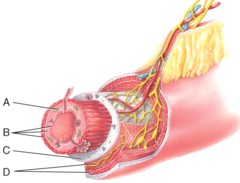
Which layer contains the lamina propria?
A
B
C
D
E
B
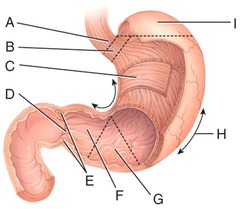
Which the portion of the stomach connects to the duodenum?
A
E
D
B
D
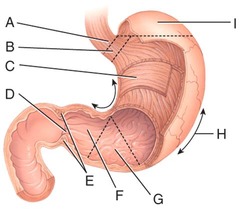
What does line G point to?
a) Greater curvature
b) Pyloric sphincter
c) Rugae
d) Pyloric antrum
e) Pylorus
d. Pyloric antrum
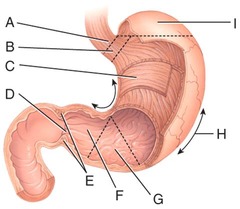
What is line I pointing to?
a) Fundus
b) Greater curvature
c) Cardia
d) Lesser curvature
e) Body
a. Fundus
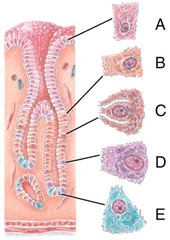
Which of the following cells secrete mucus?
B
E
C
D
B
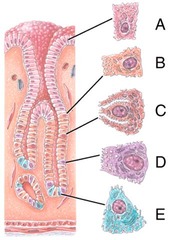
Which of the following cells secretes gastrin?
A
B
C
D
E
E
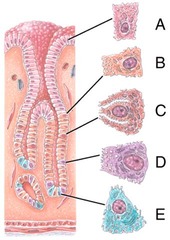
Which of the following cells secretes pepsinogen?
A
B
C
D
E
D
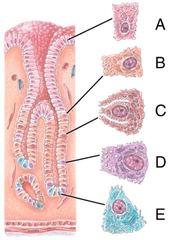
Name the structure labeled F
a) Chief cell
b) Gastric glands
c) Gastric pit
d) Simple columnar epithelium
e) Parietal cell
c. Gastric pit
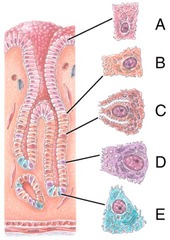
Name the structure labeled G
a) Gastric pit
b) Chief cell
c) Simple columnar epithelium
d) Parietal cell
e) Gastric glands
e. Gastric glands
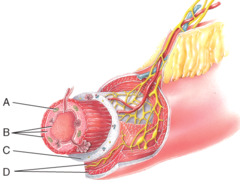
Name the layer labeled A
a) Circular muscle
b) Mucosa
c) Submucosa
d) Serosa
e) Longitudinal muscle
a. Circular muscle
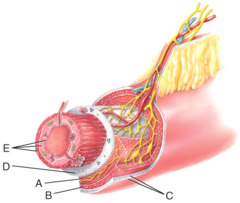
Name the layer labeled B
a ) Circular muscle
b) Serosa
c) Submucosa
d) Longitudinal muscle
e) Mucosa
d. Longitudinal muscle
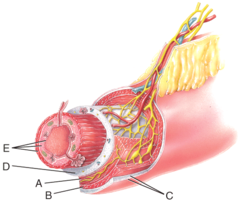
Name the layer labeled C
a) Circular muscle
b) Submucosa
c) Serosa
d) Longitudinal muscle
e) Mucosa
c. Serosa
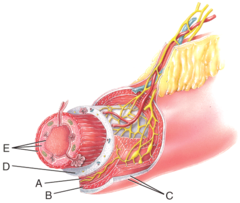
Name the layer labeled E
a) Serosa
b) Submucosa
c) Longitudinal muscle
d) Mucosa
e) Circular muscle
d. Mucosa
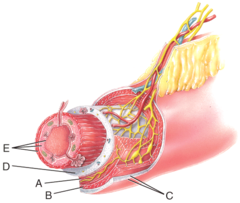
Name the layer labeled D
a) Submucosa
b) Serosa
c) Longitudinal muscle
d) Mucosa
e) Circular muscle
a. Submucosa
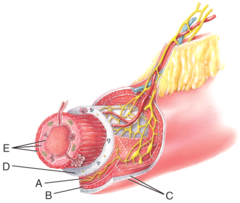
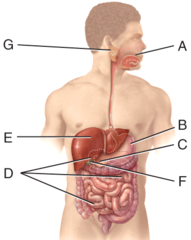
The enzyme, produced in the organ labeled C, which digests DNA is called:
a) Pepsin
b) Sucrase
c) Ribonuclease
d) Salivary amylase
e) Deoxyribonuclease
e. Deoxyribonuclease