MODULE 2 LESSON 2 - the process of labor and birth
 Call Kai
 Learn
Learn Practice Test
 Spaced Repetition
 Match
Match Flashcards
 Knowt Play
1/48

There's no tags or description
Looks like no tags are added yet.
Name | Mastery | Learn | Test | Matching | Spaced | Call with Kai | Chat |
|---|
No analytics yet
Send a link to your students to track their progress
49 Terms
Passageway-Passenger Relationship
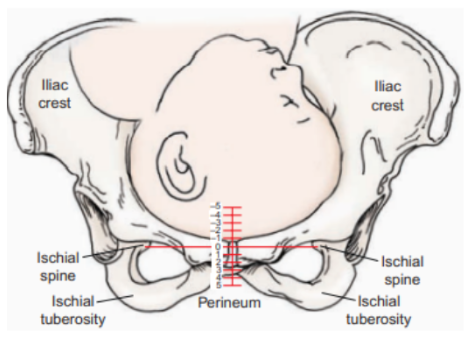
Right anterior
left anterior
right posterior
left posterior.
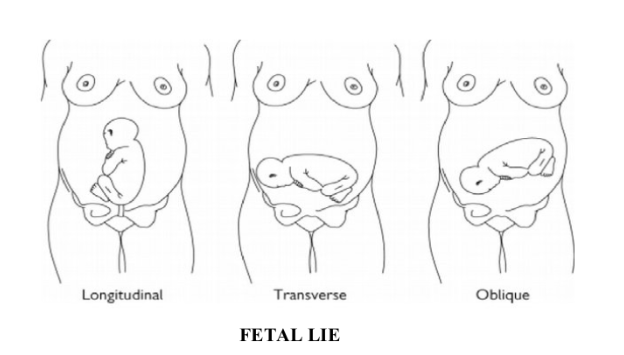
The relationship between the longitudinal axis of the fetus and the longitudinal axis of the mother.
Longitudinal Lie
Transverse Lie
Oblique Lie
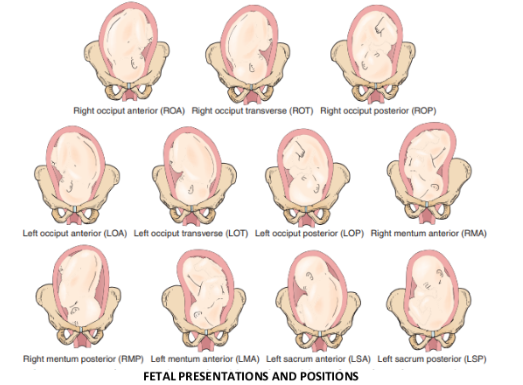
Occiput (O).
Vertex Presentation Landmark
Mentum (M) or chin.
Face Presentation Landmark
Sacrum (S).
Breech Presentation Landmark
Acromion Process (A).
Shoulder Presentation Landmark
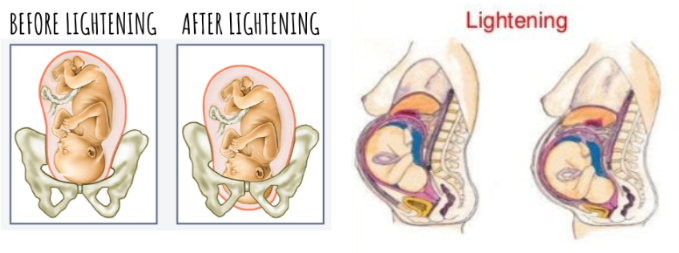
Lightening
Downward movement of the presenting part into the pelvic cavity.
Symptoms of Lightening
Leg cramps
increased pelvic pressure
increased urinary frequency
increased venous stasis (lower extremity edema)
increased vaginal secretions.
Braxton-Hicks Contractions (false labor)
Irregular contractions that prepare the uterus for labor but do not cause cervical change.
May occur every 10 to 20 minutes near term.
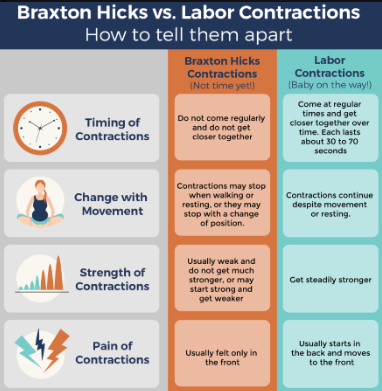
Irregular usually felt in the abdomen or groin and do not cause cervical dilation or effacement.
Characteristics of Braxton-Hicks Contractions
Bloody Show
Expulsion of the blood-tinged mucus plug.
Usually indicates labor may begin within 24 to 48 hours.
Weight Loss Before Labor
Loss of up to 3 pounds due to fluid shifts from hormonal changes.
Electrolyte shifts and decreased fluid retention caused by changes in estrogen and progesterone.
Premature Rupture of Membranes (PROM)
Spontaneous rupture of the amniotic sac before labor begins.
Occurs in about 12% of pregnancies.
Nitrazine Test
A pH test used to determine whether fluid is amniotic fluid. (ph indicator)
purpose: Detect rupture of membranes by measuring vaginal pH.
Positive Nitrazine Test
Vaginal pH increases due to the presence of amniotic fluid.
Fern Test
Microscopic examination of vaginal fluid for a ferning pattern.
purpose: Confirm rupture of membranes by identifying ferning.