2. Digestive System
 Call Kai
 Learn
Learn Practice Test
 Spaced Repetition
 Match
Match Flashcards
 Knowt Play
1/56

There's no tags or description
Looks like no tags are added yet.
Name | Mastery | Learn | Test | Matching | Spaced | Call with Kai | Chat |
|---|
No analytics yet
Send a link to your students to track their progress
57 Terms
Food groups necessary for a balanced diet
carbohydrates : source of energy
Protein : growth and repair
Lipid : insulation and long term store of energy
Dietary fibre : provides bulk (roughage) for intestines to push food through it
Vitamins : needed in small quantities to maintain health
Minerals : needed in small quantities to maintain health
Water : needed for chemical reactions to take place in cells
What is a balanced diet
A diet containing all nutrients in the correct amounts/proportions to provide energy
Vitamin C
Forms an essential part of collagen protein, which makes up skin, hair, gums and bones
If deficient : scurvy - bleeding gums, slow wound healing
Citrus fruit, strawberries, green vegetables
Vitamin D
Helps body to absorb calcium and so required for strong bones and teeth
Deficiency : rickets - weak soft bones and skeletal deformities
Oily fish, eggs, liver, dairy products, sunlight
Calcium
Needed for strong teeth and bones, involved in clotting of blood
Deficiency : osteoporosis
Milk, cheese, eggs
Iron
Needed to make haemoglobin, pigment in red blood cells that transports oxygen
Deficiency : anemia - tiredness and lack of energy
Red meat, liver, green vegetables
Vitamin A
Needed to make the pigment in the retina for vision
Deficiency : night blindness
Meat, liver, diary, leafy green vegetables (spinach)
Deficiency in food groups :
carbohydrates : fatigue, brain fog, constipation
Lipids : dry skin, brittle hair, fatigue
Protein : Kwashiorkor - slow muscle development
Fibre : constipation
Water : dehydration
What is malnutrition
Overnutrion : obesity from high amounts of fat/lipids/cholesterol/carbohydrates in the diet
Under nutrition : starvation and constipation
Sources of carbohydrates
Bread, cereal, pasta, rice, potato
Sources of Protein
Meat, fish, eggs, nuts
Sources of Lipid
Butter, oil, nuts
Sources of Fibres
Vegetables, whole grains
Sources of Vitamins
Fruit and vegetables
Sources of Minerals
Fruits, vegetables, meats, dairy products
What affects the dietary needs of an individual
Age : need of protein and carbohydrate needed for energy and growth
Activity level : if more active, requires more movement and energy
Pregnancy, Breast feeding : growth of foetus as well as increased mass mother carries around. Extra calcium to make breast milk and iron and calcium to build bones, teeth and blood of fetus
Gender : men need a higher caloric intake due to larger mass
Chemical elements present in carbohydrates, proteins, lipids
Carbohydrates ; C,H,O
Lipids : C,H,O
Proteins : C,H,O, N (nitrogen)
Basic units of carbohydrates, lipids, proteins
Carbohydrates : starch/glycogen → sugar
Lipids → glycerol and fatty acids
Proteins → amino acids
Test for sugars/glucose
Prepare food sample and add BENEDICTS solution
Place it in water bath over 80°C for 5 minutes.
If sugar is present, the solution will change colour depending on the concentration.
From light blue to green, yellow, orange, brick-red from (red having the most sugar)
Test for starch
Place food in spotting tile
Add a few drops of IODINE directly onto the Food
If present, it should turn from yellow - brown to blue black
Test for protein
Mix the food with a little bit of water and place in a test tube
Add BIURET solution and shake gently
If protein is present, it will turn from blue to lilac purple
Test for lipids
Mix sample of food with ETHANOL and shake
Put an equal part of water and shake
A cloudy milky white layer will form if lipid is present
What is semi quantitive data
Can show how much is present but not in statistical numbers
How to calculate energy content
Energy content (joules/gram) = (mass of water, g) x (temperature increases, °C) x 4.2 / (mass of food, g)
Calorimetry
Method of measuring the heat transfer within a chemical reaction
CP5 : Calorimetry
Measure out 20cm cubed of water with a measuring cylinder
Clamp the tube to the stand and place a thermometer inside
Record the starting temperature of water and place heat proof mats below the test tube
Record the weight of the piece of food being tested and stick it onto a mounted pin
Hold the food in the Bunsen flame until it can stay lit, hold it below the water
Relight if it goes out
Record the temperature of the water after all the food is burnt
Calculate the energy content using
Problems with Calorimetry (school practical)
Not all the food sample is burnt
Not all energy stored in food is transferred to water
Not all of water is an even temperature
Energy transferred to water is lost to surroundings
Features of a bomb calorimeter
is sealed in insulating material
There is a stirrer
Ignition wires (to combust food and release all energy)

Enzymes
Biological catalysts that speed up reactions, and remain unchanged/not used up
Lock and key diagram walk through
The substrate binds to the active site of the enzyme which is complementary in shape
An enzyme substrate complex is formed
The enzyme catalyses the reaction and breaks down large molecules into smaller ones

Catabolism
Speeding up the breakdown of large molecules into smaller ones
Why do we need enzymes in the digestive system
To break down large insoluble molecules into smaller soluble molecules that can pass through the walls of the digestive system to allow them to be absorbed
Enzymes (and location) to convert carbohydrate into simple sugars

Enzymes (and location) to convert proteins into amino acids

Enzymes (and location) to convert Lipids into glycerol and fatty acids


Label the digestive system

How does temperature affects the enzymes function
rate of enzyme reactions increases at temperature does until it reaches an optimum temperature (usually body temperature). After that, it begins decreasing as the enzymes begin to become denatured and the active site is no longer the correct shape as some of the bonds holding the enzyme together break
Anabolism
Joining smaller molecules together to form larger ones
How does pH affect enzyme reactions
If the pH is too high/low, the pH interferes with the bonds holding the enzyme together which changes shape of the active site, denaturing them
Function of stomach
It churns the food with its muscular walls and produces hydrochloric acid to kill bacteria and keep the pH of 2 for protease enzyme to work
Function of liver
Where bile is produced
Function of Gall bladder
Where bile is stored before it is released into the small intestine
Function of pancreas
Produces enzymes (protease, amylase and lipase) and releases it into the small intestine
Function of large intestine
Where excess water is absorbed from the food
Function of the small intestine
Produces protease, amylase and lipase enzymes to complete digestion. Where the digested food is absorbed out of the digestive system into the blood
Function of rectum
Where the faeces (indigestible food) is stored before they leave through the anus
Peristalsis
Automatic wave-like muscles contractions in the walls of the intestine and oesophagus to move food along intestine
What is the duodenum and ileum
Duodenum : first (and shortest) bit of intestine that is a ‘C’ shape which mixes food with bile and enzymes
Ileum : the last (and longest) bit of intestine which absorbs remaining nutrients missed earlier
Villi
Finger like projects lining the small intestine that maximize the absorption of digested food molecules into the blood
Adaptations of villi
Large surface area → have microscopic micro villi
One cell thick → short diffusion distance
Steep concentration gradient → each villus has a network of capillaries to constantly maintain the concentration difference
Presence of lacteal → absorbs fatty acids and glycerol
production and storage of bile
Is produced in liver and stored in gall bladder to travel allow the bile duct and enter the digestive system at the duodenum
Function of bile
released into small intestine
Neutralises stomach acids so amylase and lipase can function
Emulsify lipids : breaks down the fat globules into smaller fat globules which increases the surface area and rate of digestion
How to test for bile (simple)
Using phenolphthalein (which is pink when alkaline and clear when acidic) to see how long it takes for lipase to break down the lipids.
CP6 : enzymes and temperature
To investigate how enzyme activity can be affected by changes in temperature
3 water baths at various temperature
Place 2 test tubes of 3cm cubed starch solution and 3cm amylase solution (respectively) into each of the 3 water bath and leave it to equilibrate to the right temperature
Place 1 drop of iodine into each dimple on a spotting tile
Add the amylase to the starch
Start the timer : every minute remove a sample of the starch-amylase solution and place it in the iodine
Wait till the iodine remains yellow (signalling that all starch has been broken down into glucose)
Calculate the rate and repeat with different temperatures

CP7 : enzyme and pH
Investigate how changing the pH affects enzyme activity
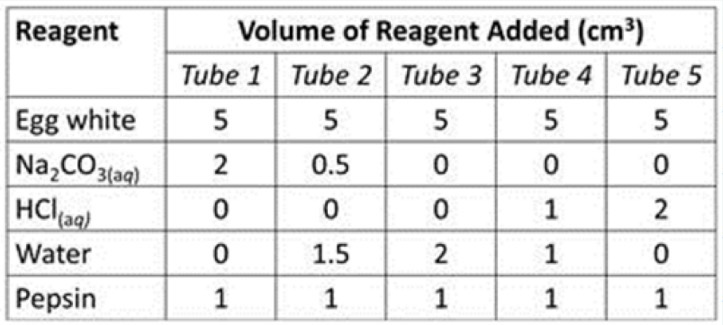
Make the following mixtures in 5 different test tubes, each will have a different pH but has water to ensure that the volume is the same as well as egg white for protein testing
Find and record the pH of the test tubes
Place the tubes in a water bath of 36°C to reach optimum temperature
Start the stopwatch and add Pepsin and wait till the solution turns clear (has to have presence of HCL to make it acidic for the reaction to turn clear)
Visking tubing and starch practical
Set up a beaker of with distilled water
Place starch and amylase in the visking tubing, wash (to prevent any starch on the outside) and place into water
Test the water surrounding the visiting tubing with iodine (starch) and Benedicts (sugar) before and after 15 min.