Aural Rehabilitation
 Call Kai
 Learn
Learn Practice Test
 Spaced Repetition
 Match
Match Flashcards
 Knowt Play
1/76

There's no tags or description
Looks like no tags are added yet.
Name | Mastery | Learn | Test | Matching | Spaced | Call with Kai | Chat |
|---|
No analytics yet
Send a link to your students to track their progress
77 Terms
rehabilitation
intervention designed for the reteaching of particular skills
Aural rehabilitation
the services and procedures for facilitating adequate receptive and expressive communication in individuals with hearing impairement
Aural rehabilitation (Boothroyd)
the reduction of hearing loss induced deficits of function, activity, participation, and quality of life through sensory management, instruction, perceptual training, and counseling
habilitations
intervention aimed at the initial development of skills and abilities
i.e. peds — trying to gain the skills
impairment
refers to a physiological disorder of condition, cosmetic disfigurement, or anatomical loss affecting body systems, or a mental or psychological disorder
i.e. damaged hair cells, 8th nerve degeneration, CHL could be otitis media, ossicular fixation, ossicular discontinuity
disbility
physical or mental impairment that substantially limits one or more major life activities
disadvantage or deficiency, especially a physical or mental impairment that prevents or restricts normal achievement
i.e. limits the ability to communicate, listen
what is JCIH
first established in 1969
national committe that supports and guide the implementation of IDEA’s EL services
early intervention services birth to 3 years old
representatives from professional organizations w/ interest in children w/ HL
Purpose of JCIH
position statements on infant hearing
preferred practice in early IC using electrophysiological measures
JCIH 1-3-6
in 2000, JCIH recommended:
universal screening by 1 month of age
audiological and medical evals by 3 months of age
needed to be diagnosed by 3 months
tone pip ABR supplemented click ABR, use of high frequency tympanometry
intervention by 6 months of age
amplification 1 month following diagnosis
family-centered EHDI (early hearing detection and intervention) system with information about all intervention and treatment options
Other JCIH wants
immediate access to high quality HAs, CIs, other ALDs
monitoring of HL
recommended every month: if HL drastically changes
every 3 months until child is age 3
every 6 months after that
check for possible progression
knowledgeable professionals
informational systems to interface w/ electronic health records, measure outcomes & effectiveness at community, state, and federal lvls
standard of care JCIH
hearing evaluation every 3 months in the first 3 years of life and then every 6 months
_% of children w/ SNHL experience progression
20-50
1 in 7 children w/ __ HL will develop loss in the good ear
unilateral
effects of HL on speech and language w/o intervention for slight or unilateral HL
may miss some consonants
mild difficulty w/ auditory language learning, listening at a distance and in noise
effects of HL on speech and language w/o intervention for mild HL
only hearing louder speech sounds
difficulty with auditory learning
some language/speech delays
inattention
baby is still talking and localizing to sound
effects of HL on speech and language w/o intervention for moderate HL
hears almost no speech sounds at normal levels
articulation differences
language delay
learning dysfunction related to language delays
inattention w/ 50 dB HL
flat, moderate HL can hear speech 50% of the time
effects of HL on speech and language w/o intervention for severe HL
hears no speech sounds at normal levels
very reduced speech intelligibility
verbal language delay
learning dysfunction related to language delay
inattention to verbal communication
effects of HL on speech and language w/o intervention for profound HL
hears no speech or other sounds
little or no speech intelligibility
little or no verbal language
learning dysfunction related to language delay
learns by visual cues or manually coded language systems
inattention to verbal communication
language acquisition
depends upon early phonetic learning in baby’s native language
neural connections created prior to 12 months of age (really 6 months w/ new research)
supports the need for consistent HA use so phonemic contrasts can be obtained
What is IDEA?
public law that states: all handicapped children have available to them a free, appropriate public education which emphasizes special education and related services designed to meet their unique needs, ensure rights of children w/ disabilities and their parents/guardians are protects, assist the States and localities to provide education of all children w/ disabilities and assess and assures effectiveness of efforts to educate children
APPROPRIATE ≠ OPTIMAL
schools may not be using latest tech
kids who qualify get IFSP or IEP plan
THE DISABILITY MUST IMPACT EDUCATION
HL is considered disability BUT if they’re not being impacted by education (low grades), won’t get equipment under IDEA, will get equipment under 504 plan
covers birth to age 21
IDEA: EI Provision
governs EI services for infants and todlers under age 3
Part C
All families of infants w/ any degree of permanent HL should be considered eligible for EI
If have a CHL, not qualifying for EI services
Audiologist has to argue if permanent HL
Kid can eventually get treatment once school-age
Four Principles of EI
Services are family centered
services are developmentally supportive and promote children’s participation in their natural environments
services are comprehensive, coordinated, and team based
services based on the highest quality evidence that is available
Services are Family Centered
parents have greater role during therapy sessions/respect parents communication choice
services are developmentally supportive and promote children’s participation in their natural environments
both home based and center based intervention options should be offered
services are comprehensive, coordinated, and team based
team session are a valuable option
services based on the highest quality evidence that is available
shortage of qualified clinicians
the legal side of early intervention
its the law — 2 working days
federal law requires reporting of any child age birth to three years that has been diagnosed w/ a significant HL (or other developmentally significant condition) to the local part C EI program, regardless of family financial status
IFSP individualized family service plan
written family-centered process that assists the family and team members
identify concerns, priority, and resources
identify functional outcomes based on the child’s everyday routines and activities
develop strats to achieve outcomes including supports, services, and community resources
Yoshinaga et al (1998)
children who were identified and amplified by 6 months of age demonstrated better receptive language skills on the Minnesota Child Development Inventory than children identified after 6 months of age
Primary Mission of Educational Audiology
Mission: to support students w/ HL by facilitating equitable access to communication and learning
Execution: promoting academic achievement and participation through advocacy and multidisciplinary collaboration
BOCES — Board of Cooperative Educational Services
an intermediate unit between school districts and the state
CSE Committee on Special Education
holds meetings for students aged 5–21
LRE — Least Restrictive Environment
Mandated by both IDEA and Section 504
HAT — Hearing Assistance Technology
assessed and monitored by the audiologist
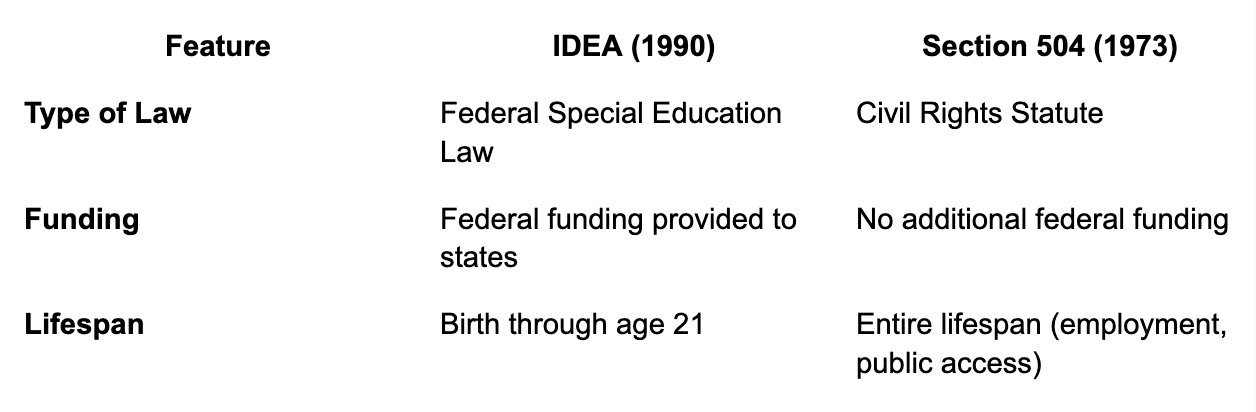
Compare the Foundation of IDEA vs. Section 504 (type of law, funding, lifespan)
Compare eligibility of IDEA vs Section 504 (criteria, requirement, documentation)
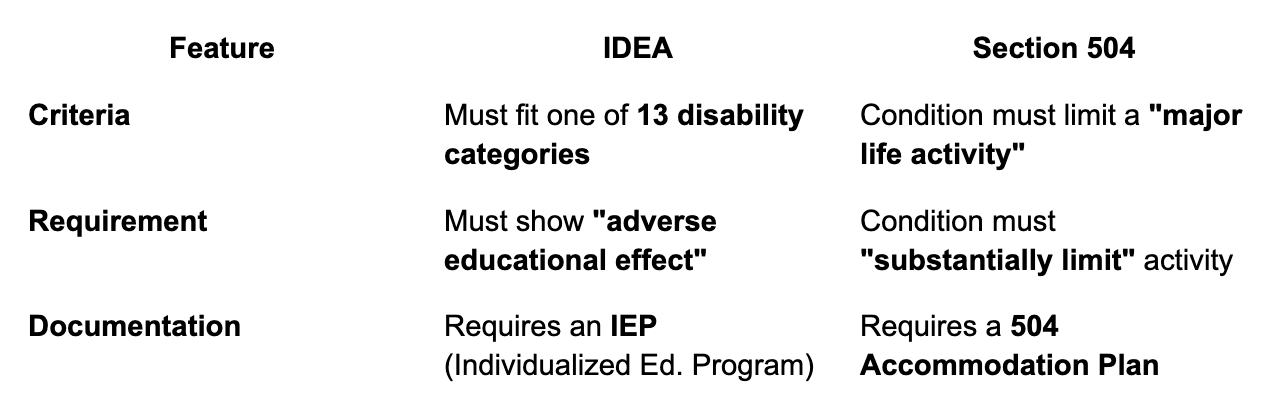
A student has a documented hearing loss but maintains a 4.0 GPA and shows no "adverse educational effect." Do they qualify for IDEA?
If they don’t qualify for IDEA, what could they qualify for instead?
No. IDEA requires the disability to adversely affect educational performance.
Alternative: They would likely qualify for Section 504, as hearing is a "major life activity" that is substantially limited.
Deafness
A hearing loss so severe that linguistic processing through hearing is impaired, with or without amplification.
Hearing Impairment
A permanent or fluctuating impairment that adversely affects performance but is not included under "deafness".
Classroom Acoustic Realities
Noise: Typical classrooms are noisy, with Signal-to-Noise (S/N) ratios ranging from –5 to +12 dB.
Reverberation: Causes speech "smearing," which is particularly damaging to the perception of consonants.
The Rule: Students with hearing impairment require a +15 dB S/N ratio for optimal perception.
Why does reverberation mainly affect consonants?
Vowels are louder and longer.
Their energy lingers (smears) in the room.
That lingering energy masks the softer consonants.
Since consonants carry much of speech clarity, speech understanding decreases.
Impact of Poor Acoustics on Learning
Excessive noise and reverberation negatively impact learning to read and attention span.
Persistence: Children give up more rapidly when material is difficult due to poor listening conditions.
Role of the Educational Audiologist (The "To-Do" List)
Assessment: Evaluate hearing, assess HAT needs, and monitor hearing aid function.
Environment: Identify acoustic barriers and suggest physical fixes, such as sealing gaps between walls and floors.
Collaboration: Participate in CSE meetings, write reports, and provide in-service training for teachers.
ADA Titles
Title I ADA: Employers
Title II ADA: state run places, state/federal
Title III ADA: Dr, Restaurants, public places that aren’t state run (AUDIOLOGY)
Title IV: Telephone and internet companies need to let callers w/ speech or hearing disabilities to talk, captioning services, any TV after 1990 needs captioning; telecommunication
Title V: misc
Compare the "Discordant Dysfunction Theory" to the role of IHC/OHC destruction in tinnitus severity. What is one test to show this in clinic?
OHC damage > IHC damage
↓ inhibition in DCN
↑ spontaneous firing → tinnitus
If BOTH IHC & OHC destroyed → ↓ tinnitus
Test done to show this in clinic: OAEs
Why are the Limbic and Autonomic Nervous Systems considered the primary drivers of "suffering" in the Jastreboff model?
Limbic = emotional expression and memory storage
Autonomic = fight-or-flight stress response
Negative emotional tag → attention → prevents habituation
Compare and Contrast: Habituation of Reaction vs. Habituation of Perception.
Reaction
emotional response decreases
occurs first
Perception
awareness of signal decreases
12–24 months
subconscious auditory pathway stops flagging it as relevant
Reaction BEFORE Perception
Define "Transparency" in a Remote Microphone HAT system and explain its clinical goal.
65 dB SPL to HA mic = 65 dB to remote mic
Equal output from both HA and remote mic
Goal: balanced listening (+15 SNR)
Procedure: Detail the two "Runs" required for HAT Transparency verification in a test box.
Run 1
HA in box
Remote muted
Run 2
Remote in box
HA outside
Average difference:
±2 dB
calculation: the average difference at 750 Hz, 1 kHz, 2 kHz between run 1 and run 2 must be w/in ±2 dB
Why is it unnecessary to measure the MPO of a Hearing Aid when it is connected to a HAT system?
MPO belongs to HA
Remote automatic gain control (AGC) changes input
False MPO
Differentiate between a "Device-Centered" vs. "Person-Centered" approach in the clinical process.
Device | PCC |
|---|---|
Audiogram | Person — life context |
Prescriptive Targets | Specific Communication Goals |
Hearing aid | Participation |
Technical Verification | Quality of life (hear grandson on phone) |
Apply the "HEAR" Framework to an initial aural rehab consultation.
H
Hear story — open-ended questions to understand journey and readiness to change
E
Explore situations — specific environments where struggle
A
Articulate SMART goals — personalized goals (“I want to”…)
R
Review progress — measure against THEIR specific goals, not just word-rec
Why is the "Mixing Point" critical in Sound Therapy, and how does it differ from masking?
Tinnitus still audible and perceived
Noise + tinnitus mix
NOT masking (masking covers tinnitus, removes brain’s chance to learn the signal is neutral)
Promotes habituation
Case Scenario: A patient has bothersome tinnitus and a moderate bilateral sensorineural hearing loss. Assign the Jastreboff Category and determine the intervention.
Tinnitus + HL: category 2
Counseling
Combination instrument (HAs + noise generators)
Hyperacusis vs Misophonia?
Hyperacusis
volume problem
painful
Misophonia
trigger sound
emotional reaction
Protocol: Describe the "SMART-PCC" requirements for writing effective rehabilitation goals.
Specific - to relationship/situation
Meaningful - to pt’s values
Achievable
Relevant - to IRL
Time-bound
PLUS
WRITTEN IN First person (I want to…)
What is "Third-Party Disability," and how is it addressed in Family-Centered Care?
Definition:
Family affected by patient's HL
Management:
SOS-Hear
Include family
Teach communication strategies
Jastreboff Category 0
Minimal impact
Tinnitus not significantly bothersome
No hyperacusis
Brief counseling ± sound enrichment
Jastreboff Category 1
Significant tinnitus
Normal/near-normal sound tolerance
Full counseling + low-level noise generators
Jastreboff Category 2
Tinnitus + hearing loss
Counseling + combination hearing aid/noise generator
Jastreboff Category 3
Hyperacusis present
Reduced sound tolerance is primary problem
Counseling + very low-level generators
Slow, graded increase
Define "Somatosound" and explain its relationship to the traditional term "Objective Tinnitus.
Formerly "objective tinnitus"
Physical sound source — generated from w/in body (vascular turbulence, muscle contractions)
May be heard with stethoscope
≠ subjective tinnitus
Explain the "Conditioned Reflex Arc" in the context of tinnitus suffering.
Tinnitus + negative emotion
→ conditioned reflex
→ limbic + autonomic activation
TRT goal:
Break the conditioned reflex.
How is the Tinnitus Handicap Inventory (THI) specifically scored?
25 items
Yes = 4
Sometimes = 2
No = 0
0–100 range
20-point improvement from initial= clinically significant
What is the relationship between a patient’s tinnitus pitch match and the frequency of external sounds?
The Rule: no clear frequency relation between the pitch matched by the patient and the frequency of external sounds.
Clinical Significance: supports the neurophysiological model, suggesting tinnitus is a central phantom perception
Why can we NOT assume that an ideal SNR has been achieved just because a HAT system is connected?
Different SPL input levels bc HAs and HAT microphones at different distances from sound sources
Compression/Automatic Gain Control (AGC)
Manufacturer differences — mixing HA and HAT brands
Why can increasing damage to the Inner Hair Cells (IHCs) sometimes DECREASE tinnitus?
Discordant Dysfunction Logic: Tinnitus is driven by the difference in activity between dysfunctional OHCs and functional IHCs (disinhibition).
Mechanism: If IHC damage increases to match the OHC damage level, the imbalance in the dorsal cochlear nucleus is reduced.
Result: The abnormal neural activity becomes less pronounced because the "gap" in activity between the two systems is smaller.
A clinical measure we can do to test Discordant Dysfunction: OAEs
What is "Disco Tinnitus," and what is its physiological cause?
Definition: Temporary tinnitus associated with exposure to loud music.
Physiological Cause: Loud sound causes a temporary disorganization of the cilia on the Outer Hair Cells.
Recovery: These cells are temporarily disabled, but if not irreversibly damaged, the cilia return to their normal state after a few hours or days
Compare/Contrast: Objective vs. Subjective Tinnitus
Objective (Somatosound): Has a mechanical/vibratory source in the body; can be heard by others; rare.
Subjective: A "phantom" perception with no acoustic source; results from central neural activity; represents the vast majority of cases
Compare/Contrast: TRT Patient Category 0 vs. Category 1.
Category 0: Tinnitus has minimal impact on life; no hyperacusis. Intervention: Brief counseling and environmental sound enrichment.
Category 1: Significant tinnitus (bothersome); normal sound tolerance. Intervention: Full directive counseling and noise generators set at low levels
Compare/Contrast: Goal Setting in Device-Centered vs. Person-Centered Care.
Device-Centered: Goals are clinician-defined and technical (e.g., "Improve word recognition scores by 20%" or "Increase wear time to 8 hours").
Person-Centered: Goals are patient-defined and functional (e.g., "I want to hear my grandson on the phone without asking him to repeat")
Tinnitus Prevalence and TRT Timelines
10–15%: Percentage of adults experiencing chronic tinnitus.
20% (1 in 5): Percentage of those cases that are "clinically significant" (bothersome).
12–24 Months: Typical duration of a full TRT program to achieve habituation.
80%: Reported success rate for patients treated with TRT.
Clinical Protocol: Transparency Verification Frequencies.
Calculation: You must calculate the average difference between Run 1 (HA only) and Run 2 (HAT active).
Specific Frequencies: The average is taken at 750 Hz, 1000 Hz, and 2000 Hz.
Pass/Fail Criteria: The average difference must fall between ±2 dB.
Clinical Protocol: TRT Follow-up Timeline.
Initial: Evaluation and category assignment (60–90 min).
Fitting: Device calibration if indicated.
Follow-up intervals: Approximately 3, 6, 12, and 18 months
Protocol: Managing Hyperacusis in Category 3 Patients
Priority: Hyperacusis is treated as the dominant issue over tinnitus.
Sound Therapy Rule: Use very low-level noise generators.
Progression: Implement a slow, graded increase in volume over time to desensitize the auditory system
TRT treatment timeline
Initial evaluation
Device fitting
Follow-up (3, 6, 12, 18 months)
Habituation (12–24 months)
What happens during each TRT stage?
Evaluation: 60–90 min + category assignment
Fitting: Noise generator/combination device
Follow-up: 3, 6, 12, 18 months
Habituation: Reaction → Perception