Chapter 1.4: Uncertainty in Measurement
 Call Kai
 Learn
Learn Practice Test
 Spaced Repetition
 Match
Match Flashcards
 Knowt Play
1/8

Name | Mastery | Learn | Test | Matching | Spaced | Call with Kai | Chat |
|---|
No analytics yet
Send a link to your students to track their progress
9 Terms
Uncertainty
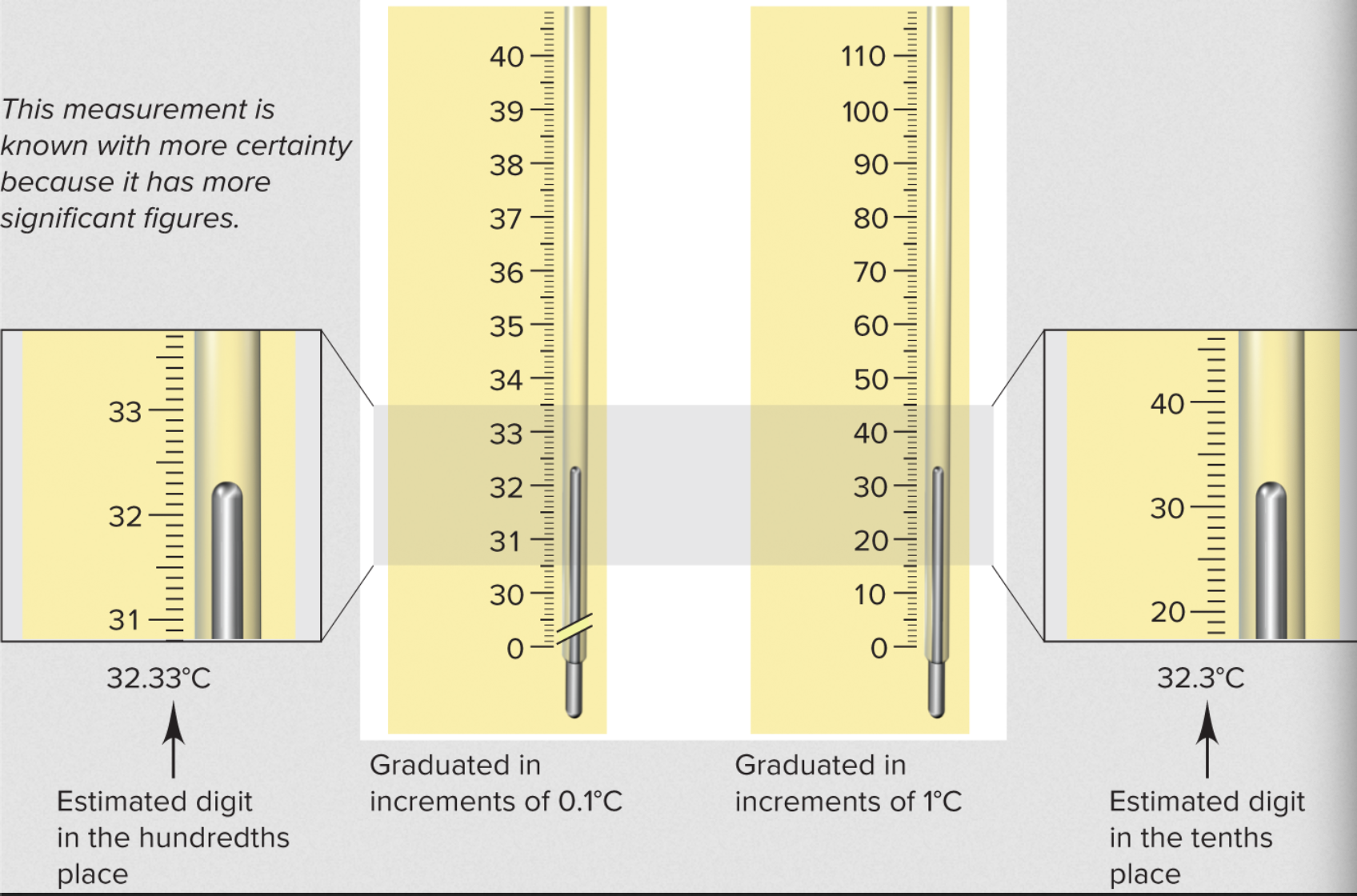
A characteristic of every measurement that results from the inexactness of the measuring device and the need to estimate when taking a reading
More digits allow for more certainty in measurements
The rightmost digit is always estimated, always assuming an uncertainty of one unit
Significant figures
The digits obtained in a measurement, signifying greater certainty in a measurement; includes:
All nonzero digits and zeroes between those digits (502 has 3)
Trailing zeroes, if the measurement has a decimal point (1.1300 has 5)
Can be signified in exponential notation by including trailing zeroes
Does not include:
Leading zeroes (0.00502 has 3)
Trailing zeroes without a decimal point (6500 has 2, 6500. has 4)
Can be identified if disappearing in exponential notation
Round-off
What is done to significant figures if there are too many compared to the data
The least certain measurement sets the limit on calculation certainty and thus determines the number of significant figures in the final answer
For multiplication and division, this is for the fewest significant figures
For addition and subtraction, this is for the fewest decimal places
Least certain measurement
Sets the limit on calculation certainty and determines the number of significant figures in the final answer
Multiplication and division use the fewest significant figures
Addition and subtraction use the fewest decimal places
Use instruments for your necessary level of certainty.
Exact numbers
Numbers with no certainty associated with them, like minutes to hours (60:1) or centimeters to inches (2.54:1)
These do not limit the number of significant figures in a calculation
Accuracy
The closeness of a measurement to the actual value
Minimizes systematic error
Precision
The closeness of measurements to each other but not necessarily the actual value
Minimizes random error
Systematic error
Error producing values that are either all higher or lower than the actual value
Can be caused by a faulty device or consistent mistakes
Calibration to a standard can remedy this
Random error
Error producing values that are higher and lower than the actual value
Always occurs, but depends on skill and instrument precision