Electron Transport Chain + ATP Synthesis
 Call Kai
 Learn
Learn Practice Test
 Spaced Repetition
 Match
Match Flashcards
 Knowt Play
1/10

Earn XP
Description and Tags
ETC, chemiosmosis, ATP synthesis, and their building blocks
Name | Mastery | Learn | Test | Matching | Spaced | Call with Kai | Chat |
|---|
No analytics yet
Send a link to your students to track their progress
11 Terms
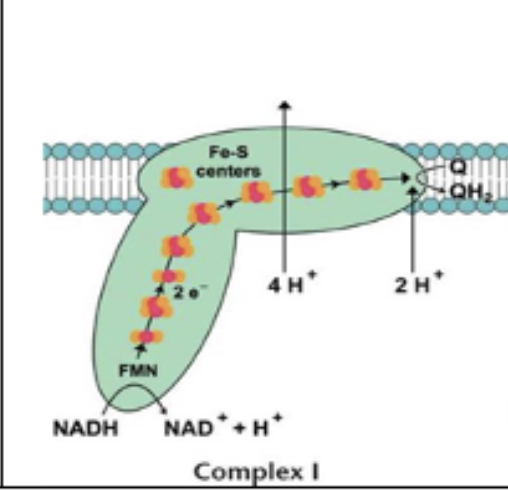
Complex I
NADH–coenzyme Q oxidation complex (NADH dehydrogenase)
uses Fe-S cluster to transfer NADH electrons to FMN
Fe-S moves electrons to CoQ, forming CoQH2
4 protons pumped
2 electrons transferred
Complex II
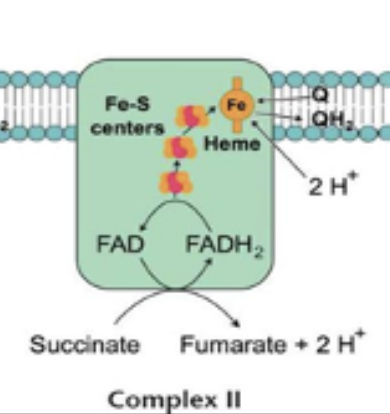
Succinate–coenzyme Q oxidoreductase complex (succinate dehydrogenase)
Uses Fe-S clusters to transfer electrons from succinate to FAD, generating FADH2
Electrons from FADH2 are then transferred to CoQ, froming CoQH2
No protons pumped
Complex III
coenzyme Q–cytochrome c oxidoreductase complex (cytochrome complex
Uses Fe-S cluster to transfer electrons from CoQH2 to heme, forming cytochrome c
Q cycle explains electron flow
2 electrons are transferred
4 protons pumped
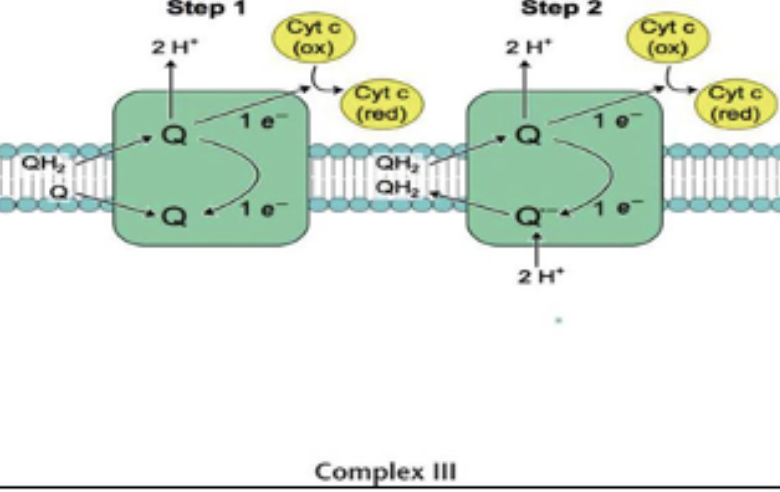
Q Cycle
Occurs inside of Complex III
1 electron is transferred to cytochrome c1, another is transferred via cytochrome b to a CoQ, making semiquinone
CoQ is released, CoQH2 transferes another electron to cytochrome c1 and its other is transferred via cytochrome b to a CoQ, making semiquinone

Complex IV
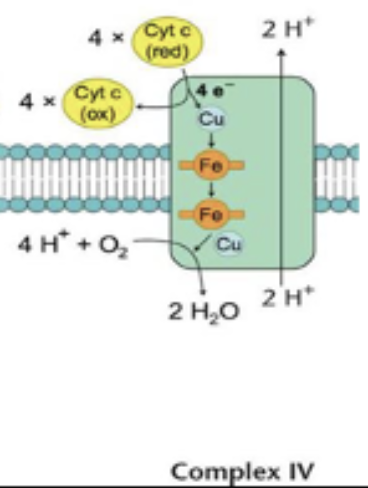
Cytochrome c oxidase
electrons are transferred from cytochrome c to Fe atoms in cytochrome a then to cytochrome a3
Cu2+ transfers electrons as H- to O2, forming H2O as it reduces
2 protons pumped (per pair)
Chemo
Flavoproteins
Flavoproteins use either flavin adenine dinucleotide (FAD) or flavin mononucleotide (FMN) as a prosthetic group
ex. NADH dehydrogenase and succinate dehydrogenase
transfer both electrons and protons
Iron-Sulfur Proteins
have an iron-sulfur (Fe-S) center
iron atoms in center are electron carriers
alternate between oxidized (Fe2+) and reduced (Fe3+)
transfer one electron at a time
Cytochromes
porphyrin prosthetic group: Heme
five types: b, c, c1, a, and a3
iron atom of heme serves as electron carrier
transfers one electron at a time
Copper-Containing Cytochromes
cytochromes a and a3 have one copper bound to heme group
associates with iron to form a bimetallic iron-copper center (Fe-Cu)
copper ions can be reversibly oxidized (Cu2+) or reduced (Cu+) by accepting or donating electrons
Fe-Cu center helps keep O2 bound to complex
Coenzyme Q
a quinone
CoQ is reduced twice to semiquinone (CoQH) and then dihydroquinone (CoQH2)
serve as collection point for electrons from reduced FNM and FAD
accepts both protons/electrons when reduced, releases when oxidized