Albatros, Physiology Basics, and Energenics Lectures:
 Call Kai
 Learn
Learn Practice Test
 Spaced Repetition
 Match
Match Flashcards
 Knowt Play
1/53

There's no tags or description
Looks like no tags are added yet.
Name | Mastery | Learn | Test | Matching | Spaced | Call with Kai | Chat |
|---|
No analytics yet
Send a link to your students to track their progress
54 Terms
Capital Breeders:
Decouple Feeding + Reproduction
- They store their food (dont eat while reproducing)
- Examples: Albatross, Salmon, Bears during hibernation, Sea Turtles, Penguins.
Income Breeders:
Constant feeding is required during Reproduction
- Have to eat constantly to supply themselves
- Examples: Ungulates
Laysan Albatross:
- Mate for life
- Males and females interchange incubation times
- The nest on the ground
- Population on Kuai
- Where they nest is very low in nutrients
- They are Capital Breeders (they go and eat every few weeks very far away)

Laysan Albatross Incubation:
Because the Albatross are Capital Breeders, they switch off who incubates the egg and who goes and gets food.
1. Females lay eggs and leaves to feed
2. Male incubates
3. Female returns and incubates Egg
4. Male goes to feed
5. Female incubates
6. Male returns
7. Female leaves
8. Eggs hatch

How can Albatross do this crazy incubation switch???
They can do this incubation switch because of...
Flight Morphology
and...
Fasting Physiology
Flight Morphology:
Flight Morphology:
Aspect Ratio: Wing length = larger aspect ratio = better glider
Dynamic Soaring: Shape of wing allows for flight without flapping
Low metabolic cost of soaring: It takes very little energy (due to wing morphology) and the cost of soaring flight is equal to the energy cost of sitting on an egg
They have bigger wings and therefore burn less energy while flying.

Fasting Physiology:
Fasting Physiology:
- Big Body Size - can hold high level of energetic reserves
- Can maintain fast without risking flight muscles
Stage 1: Burns energy stores in the stomach (less dense)
Stage 2: Burns through fat reserves
Stage 3: Does not burn through protein stores (muscles) until the fat is gone
Stomach -> Fat -> Muscles/Protein
They have larger bodies that can hold higher amounts of energy reserves.

What adaptations allow Albatross to separate foraging and reproduction (allow them to be capital breeders)?
Flight Morphology and Fasting Physiology
They have bigger wings and therefore burn less energy while flying (flight morphology). And they have larger bodies that can hold higher amounts of energy reserves (fasting physiology).
I. Homeostasis
II. Physiology - Levels of Study
III. Accumulation vs. Adaption
IV. Regulators vs. Conformers
I. Homeostasis
II. Physiology - Levels of Study
III. Accumulation vs. Adaption
IV. Regulators vs. Conformers
I. Homeostasis:
Homeostasis:
Specific regulation of the major systems - Regulates...ions, temperature, water, nutrients/waste, oxygen, hormones, ph.
Regulates internal enviornment based on the external environment
How = Receptor -> Control Center -> Effector

II. Physiology - Levels of Study
Physiology - Levels of Study:
- Regulation of the internal enviornment = physiology
Can be looked at many different levels...
- Molecular and genetic level - what genes induce hibernation
- Tissue/Organ - how does muscle not atrophy
- Plasma (blood) - different types of hibernation
- Organismal

Accumulation/Acclimation:
Accumulation/Acclimation:
Short-term change at the individual level of an animal
Reversable!
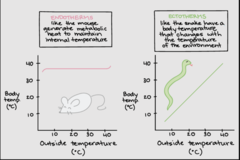
Ex: Winter Coat, Color Change (chameleons), Change in body temperature + BP, Hemoglobin/RBC - elevation change
Acclimation = In the Lab
Acclimatization = In nature

Adaption:
Evolutionary Change
Change in gene frequencies in a population over time
This is a longer term change in a population
Not reversable at the individual level

Accumulation/Acclimation vs. Adaptation:
Accumulation/Acclimation = short term change and occurs in the individual (reversable)
Adaption = long term evolutionary change that occurs in a population (not reversable)
Conformers:
Conformers:
Internal environment changes as the environment changes.
Conformers = Pink (in graph)

Regulators:
Regulators:
Maintain their internal environment independently of the external environment
Internal environment stays the same as external environment changes
Regulators = Purple (in graph)
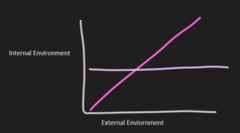
Conformers vs. Regulators:
Conformers:
Internal state is the same as their environment
Internal environment changes as the environment changes.
Regulators:
Maintain their internal environment independently of the external environment
Internal environment stays the same as external environment changes
Conformers = Pink (in graph)
Regulators = Purple (in graph)

Avoiders:
Avoiders:
Avoid changes in the enviornment
They do this by...
- Migration
- Estimation
- Hibernation
What are some other names that Regulators can be called?
Regulators:
- Homeotherms
- Endotherms
*All regulate their own internal environment - warm-blooded*
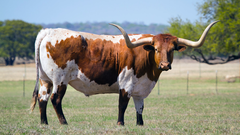
What are some other names that Conformers can be called?
Conformers:
- Ectotherms
*Regulate their internal environment based on the external environment - Cold-blooded*

Endotherms:
Endotherms = warm-blooded animals that maintain a constant body temperature independent of the environment.
Endotherms = Regulators
Endotherms = Homeotherms
Endotherms spend more energy on metabolism than Ectotherms.
Ectotherms:
Ectotherms = an animal that is dependent on external sources of body heat.
Ectotherms = Conformers
Ectotherms spend less energy on metabolism (more of that energy goes to form tissues)

Do Endotherms or Ectotherms spend more energy on Metabolism?
Endotherms spend more energy on Metabolism than Ectotherms.
This is because Endotherms use Metabolism to regulate their internal enviornment, whereas Ectotherms internal environment is dictated by the external environment (conforms to it).
Because Ectotherms use less energy on Metabolism, they are able to spend more energy to form tissues (production).

Homeotherms:
Homeotherms = maintain a stable internal body temperature regardless of external influence (independent of the environment).
Homeotherms = Regulators
Homeotherms = Endotherms
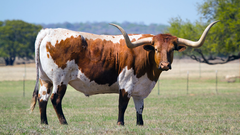
Are Homeotherms Regulators or Conformers?
Homeotherms are Regulators.
Homeotherms = maintain a stable internal body temperature regardless of external influence = Regulator

Cooperative Breeders:
Cooperative Breeders:
When animals have help from other animals during breeding
Primary Helpers = genetically related to the breeding pair
Secondary Helpers = unrelated to the breeding pair
Helpers do...
help defend territory
Act as sentinels
Provide food
Helpers don't...
Don't Build the nest
Don't incubate eggs/ brood nestlings
What do animals use energy for?
What animals use energy for:
- Gathering food/Feeding young
-Metabolism/Physiology/Homeostasis
- Evading predators
- Migration
- Reproduction
- Growth
Yellow Highlighted = Metabolism
Blue Highlighted = Production of Tissue (P)

What does C stand for in...
C
P
R
U
F
A
C stands for...
C = Total energy intake (gross energy in food)
P
R
U
F
A
C is the total amount that is consumed and is what goes to make up everything else.
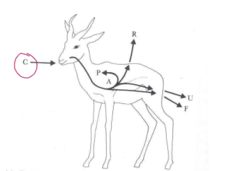
What does P stand for in...
C
P
R
U
F
A
P stands for...
C
P = Production of tissue
R
U
F
A

What does R stand for in...
C
P
R
U
F
A
R stands for...
C
P
R = Metabolic (Respiratory)
U
F
A
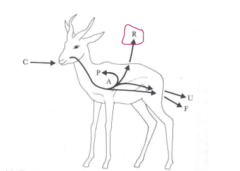
What does U stand for in...
C
P
R
U
F
A
U stands for...
C
P
R
U = Energy Lost in (Urine)
F
A
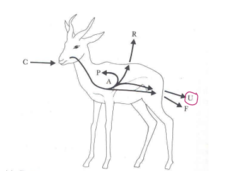
What does F stand for in...
C
P
R
U
F
A
F stands for...
C
P
R
U
F = Energy Lost in (Feces)
A

What does A stand for in...
C
P
R
U
F
A
A stands for...
C
P
R
U
F
A = amount of energy that is Assimilated/Absorbed (Assimilated Energy)

C = ________________________
C = P + R + U + F

A = ________________________
A = P + R + U

A/C =
A/C = Assimilation Efficiency
(How much energy an organism can absorb/assimilate given the amount of food that it has eaten (C))
A/C = Consumption -> Metabolism

Do Endotherms or Ectotherms have Higher A/C (Assimilation Efficiency)?
Endotherms have higher A/C (Assimilation Efficiency) than Ectotherms.
Endotherms have higher A/C because they use much of their assimilated food for metabolic production of heat, and therefore have less energy left over to use for growth and reproduction
A/C = Consumption -> Metabolism
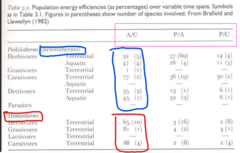
Do Carnivores or Herbivores have Higher A/C (Assimilation Efficiency)?
Carnivores have higher A/C (Assimilation Efficiency) than Herbivores.
They need to absorb more from what they eat.

P/A =
P/A = Production Efficiency
The amount of tissue (P) that can be produced given how much food is assimilated (A)
P/A = Assimilated -> Production
P/A is the percentage of energy stored in assimilated food that is NOT used for respiration/metabolism (R).
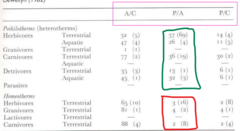
Do Ectotherms or Endotherms have higher P/A?
Ectotherms (cold-blooded) - have higher production efficiency (P/A) because they spend less energy on metabolism.
P/A is the percentage of energy stored in assimilated food that is NOT used for respiration/metabolism (R)
Therefore, Endotherms have lower production efficiency (P/A) because they spend a lot of their energy on respiration/metabolism (R) to self-regulate. Whereas Ectotherms only really need to rely on the external environment, and have more energy they can put towards production/tissues (P).
P/C =
P/C = Ecological Efficiency
The proportion of consumed energy that can be passed from one trophic level to another.
- (assumed to be 10%)
- Basis of food webs
- Ecological effeciency helps us understand energy flow through an ecosystem/trophic levels

Food Web Ecology:
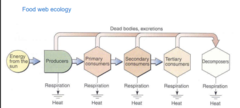
Energy enters the ecosystem through radiant light, Producers use the sunlight (some is lost as respiration).
Whatever is left over can be consumed by Primary Consumers, and whatever is left (some lost in respiration) by the primaries can be consumed by the Secondary Consumers, and whatever is left by the secondary (some lost in respiration) can be consumed by the Tertiary Consumers.
Only 10% of energy moves up each level (that is why some food chains are so small)...so much of it is lost in respiration.
Why are some food chains so short?
Only 10% of energy moves up each level (that is why some food chains are so small).

Beef must eat ______________ Cal corn to produce 3,000 calories for us.
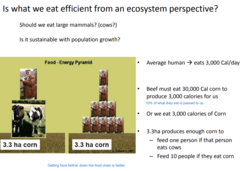
Beef must eat 30,000 Cal corn to produce 3,000 calories for us.
10% of what they eat is passed to us.
Is getting food from higher or lower down the food chain better?
Getting food farther down the food chain is better.

Do Endotherms or Ectotherms spend Less Energy on Metabolism.
Ectotherms send less energy on metabolism (good ) - more of that energy goes to form tissues.
That is why Ectotherms have a higher P/A
Where does the energy come from to produce offspring?
C (consumption)
- If an individual increases C (consumption) they are Income Breeders
P (Production)
- If an individual breaks down P (tissues) it can be used for energy - Capital Breeders
R (metabolism)
- If an individual decreases metabolic costs (ex. Birth during hibernation in bears, decrease in activity)

If an animal increases C (consumption) to produce offspring they are _______________ Breeders.
If an animal increases C (consumption) to produce offspring they are Income Breeders.
If an animal breaks down P (tissues) to produce offspring they are _______________ Breeders.
If an animal breaks down P (tissues) to produce offspring they are Capital Breeders.
Communicating Data Rubric:
1) What is the question
2) Explain the Axes
3) Explain the data collection
4) Explain the relationship between variables and what this means
5) How does this answer reflect the question?
In Graph 1 with the Kingfishers, the Naivasha Adults bring in more food and spend less energy because...Why?
There are three reasons...
In Graph 1 with the Kingfishers, the Naivasha Adults bring in more food and spend less energy because...
1) At Lake Naivasha, there is a higher energy yield per fish (compared to Lake Victoria) - they get more energy out of each fish
2) Lake Naivasha is closer to the nesting sight which causes less energy expenditure (unlike Lake Victoria)
3) There is less turbidity at Lake Naivasha which allows for less hovering time and less energy expenditure. - lmk if this is correct
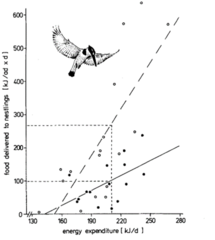
At 210kJ (energy expenditure that maintains neutral mass) Lake Naivasha adults bring in 267kJ vs. the 100kJ the adults bring in at Lake Victoria.
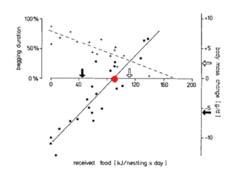
In Graph 3 with the Kingfishers, the nestlings at Lake Naivasha received more food, gained more mass, and had a shorter begging duration than the nestlings at Lake Victoria...How can we tell this from the graph?
In Graph 3 with the Kingfishers, the nestlings at Lake Naivasha received more food, gained more mass, and had a shorter begging duration than the nestlings at Lake Victoria...This is because...
We know nestlings at Lake Naivasha received more food because the White Arrow on the x-axis (Lake Naivasha) is above 85kJ and the Black Arrow on the x-axis (Lake Victoria) is below 85kJ.
85kJ is the amount of food needed to gain mass (red dot on the graph). If nestlings receive more than 85kJ a day, then they are able to gain mass.
We know that the begging duration decreased as the nestlings received more food (dashed line).
We know that nestlings at Lake Naivasha gained more body mass (White Arrow on the y-axis) than those at Lake Victoria (Black Arrow on y-axis)
What were the methods in the Kingfisher study?
They tested the hypothesis (that parents should accept or reject helpers according to need) by measuring first the daily energy expenditure (DEE) of feeding adult Pied Kingfishers in two ecologically different colonies, using doubly-labeled water. They then related the DEE of parents to their reproductive success, their behavior towards potential helpers and the begging duration of their young under normal conditions. Finally they manipulated clutch size, changing the begging of young and the energetic stress of parents.
They only considered secondary helpers (not related to breeders).
What did they find in the kingfisher study?
- While one and two helpers at Lake Victoria can reduce losses to 22% and 0% respectively, pairs with helpers as Lake Naivasha do not fledge significantly more young than those without.
- The high reproductive success and low DEE of parents at Lake Naivasha shifts the outcome of the breeder-helper conflict towards rejection of helpers, whereas the poor reproductive success and high DEE of parents at Lake Victoria favor acceptance.