A&P A.1 General anatomy terms.
 Call Kai
 Learn
Learn Practice Test
 Spaced Repetition
 Match
Match Flashcards
 Knowt Play
1/22

There's no tags or description
Looks like no tags are added yet.
Name | Mastery | Learn | Test | Matching | Spaced | Call with Kai | Chat |
|---|
No analytics yet
Send a link to your students to track their progress
23 Terms
Sagittal plane / Median (midsagittal) plane
Divides body or organ into left and right hemispheres/ divides body or organ into equal halves
Parasagittal planes
dividing body or organ into uneven hemispheres
Frontal Coronal plane
extends vertically but perpendicular to the sagittal plane. Divides body into anterior and posterior sections.
transverse (horizontal) plane
passes body or organ perpendicular to its long axis. divides body into superior and inferior portions.
ventral/ dorsal
toward the front or belly/ toward the back or spine
Anterior/ posterior
toward the ventral side/ toward the dorsal side
cephalic/rostral/caudal
toward the head or superior end/ toward the forehead or nose/ toward the tail or inferior end
superior/ inferior
above/ below
medial/ lateral
toward the median plane/ away from the median plane
proximal/ distal
closer to the point of attachment or origin/ farther from the point of attachment or origin. used especially in regards to anatomy of limbs.
Ipsilateral/contralateral
on the same side of the body/ on the opposite side of the body.
superficial/ deep
closer to body surface/ further from body surface
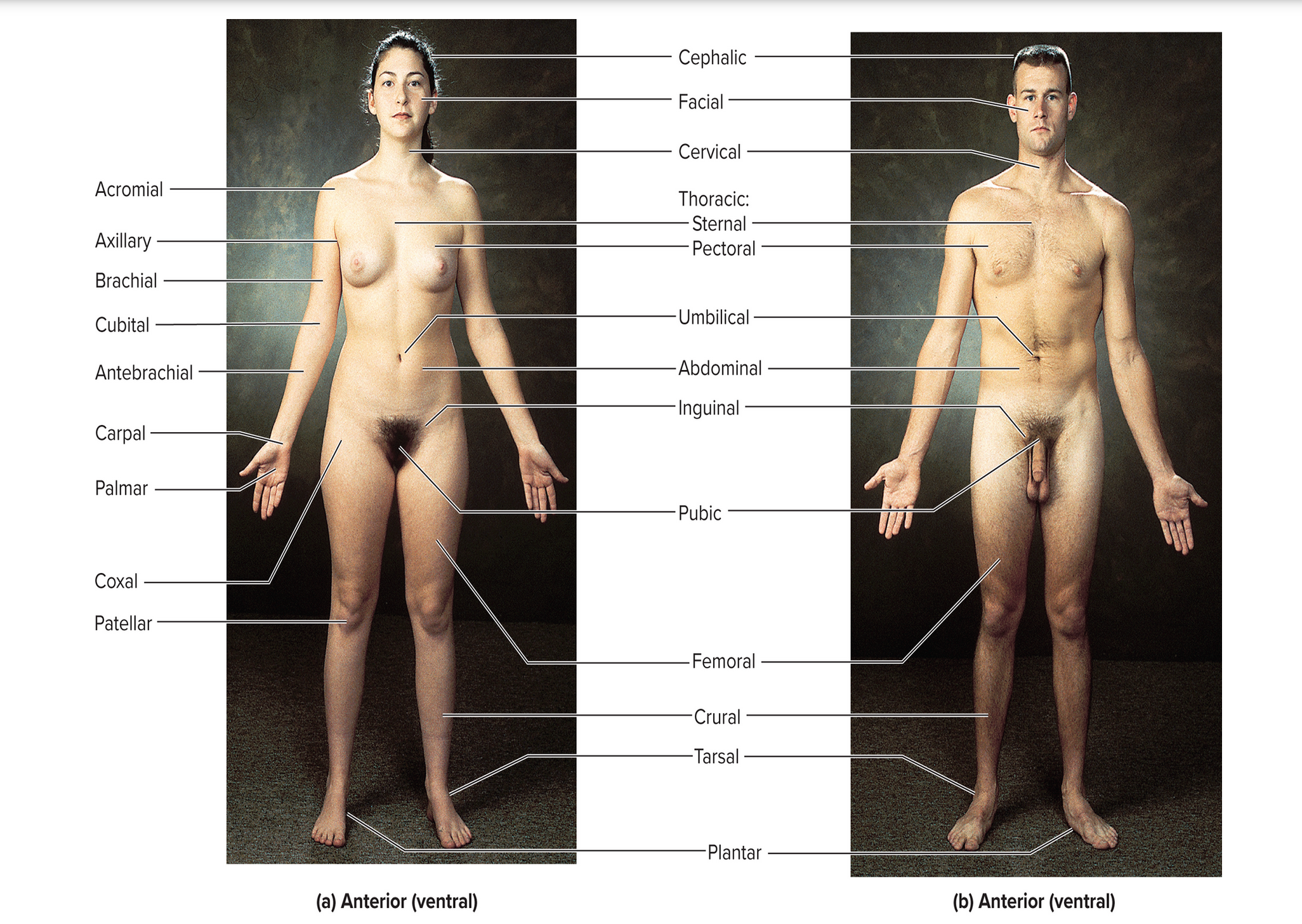
Anterior ventral
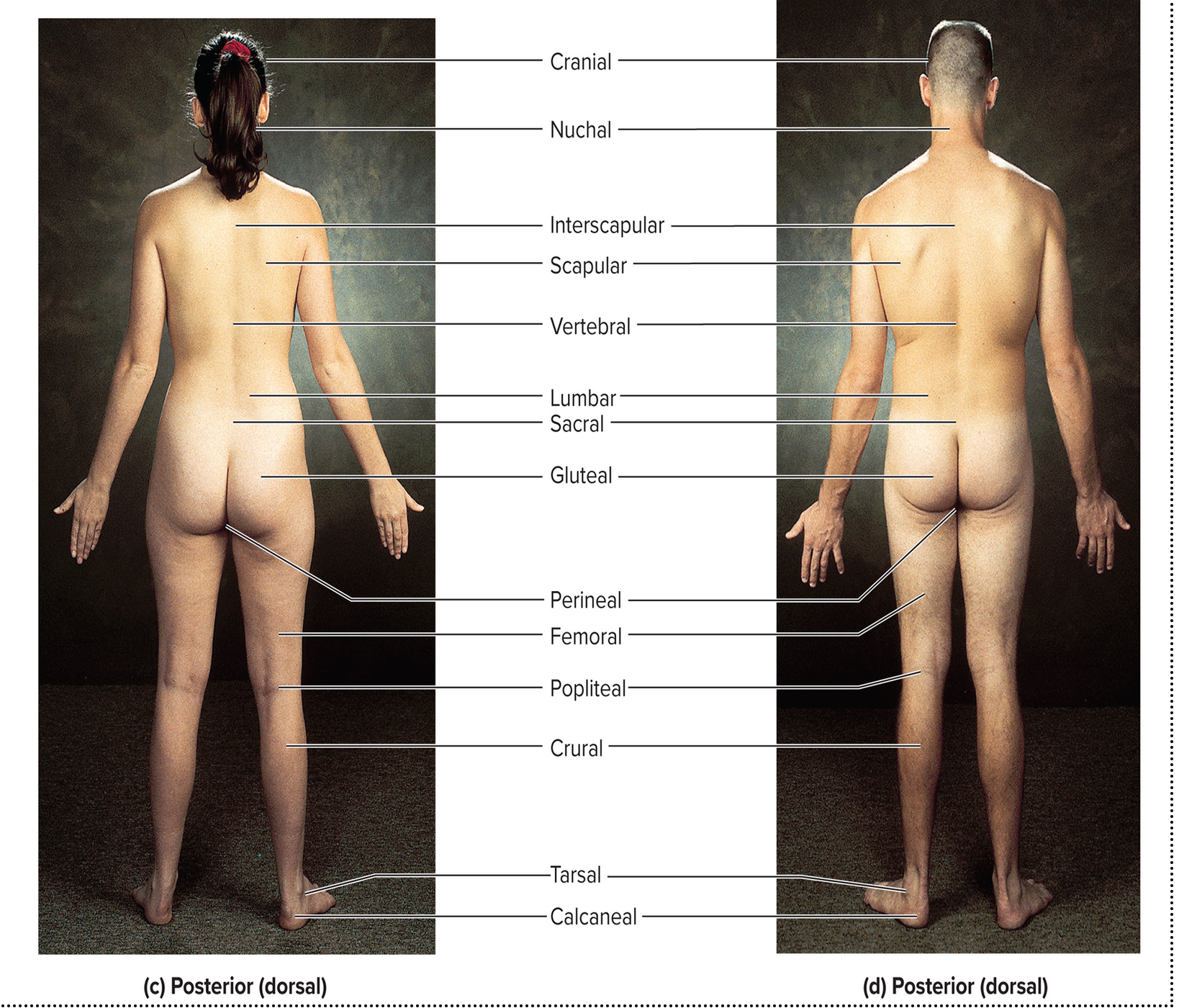
posterior dorsal
The Axial Region
consists of head, neck, cervical region, and trunk (trunk is further divided into the thoracic region above the diaphragm, and the abdominal region below it.
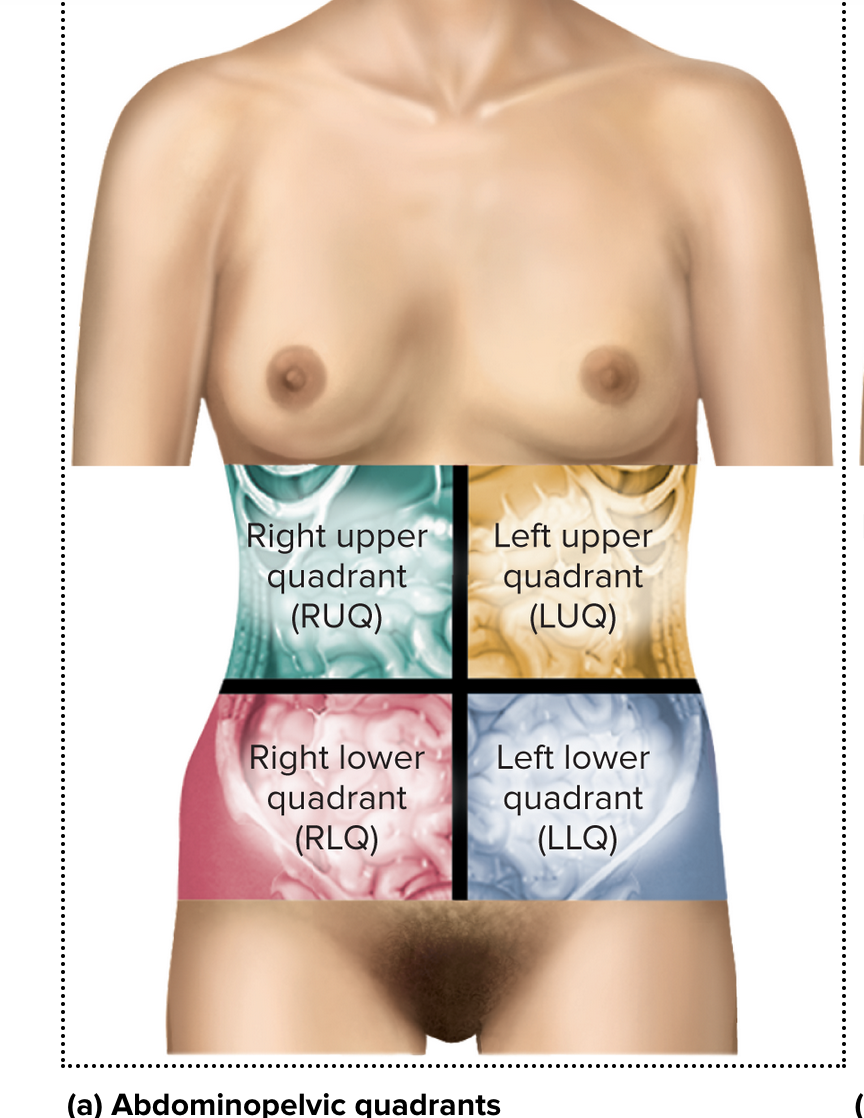
Two perpendicular lines intersecting at the umbilicus divide the abdomen into:
Right upper quadrant, Right lower quadrant, left upper quadrant, left lower quadrant.
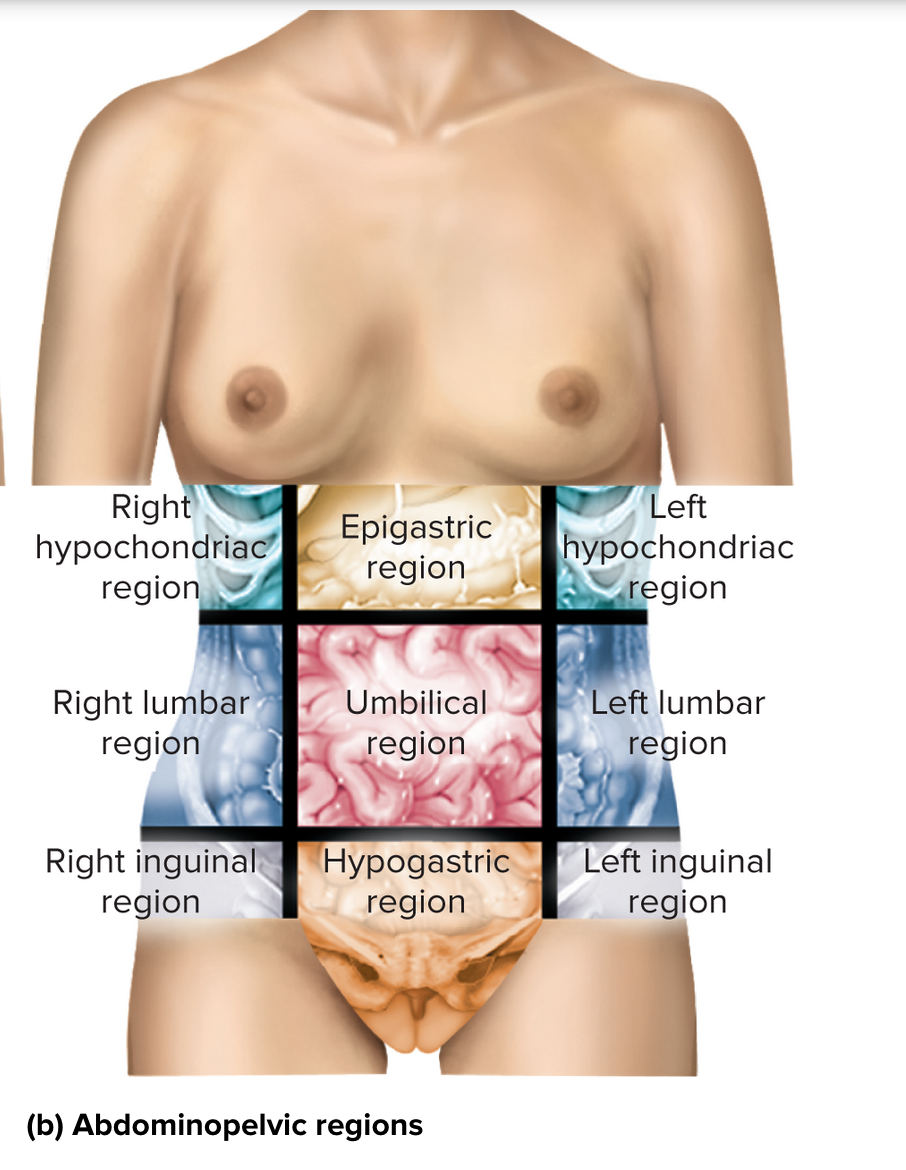
Abdomen divided into a tic tac toe grid:
Each vertical line creates a midclavicular line (passes through midpoint of the clavicle or collar bone). The superior horizontal line is called the subcostal line, because it connects the inferior borders of the lowest costal cartilages (cartilage connecting the tenth rib on each side to the inferior end of the sternum). The inferior horizontal line is called the intertubercular line because it passes from left to right between the tubercles (anterior superior spines) of the pelvis- two points of bone located about where the front pockets open on many pants.
The appendicular region
upper limbs and lower limbs. Upper limbs: arms (brachial region), forearm (antibrachial), wrist (carpal region), hand and fingers (digits).
Lower limbs: Thigh (Femoral region), leg (crural region), ankle (tarsal region), foot and toes (digits)
In strict anatomy terms arm refers to area beween shoulder and elbow, and leg refers to area between knee and ankle.
Segment
region between one joint and the next.
Body cavities
membrane lined and contains organ called viscera. some have two layers. Inner layer (against the organ) is called the visceral layer), and the more superficial layer is called the Parietal layer.
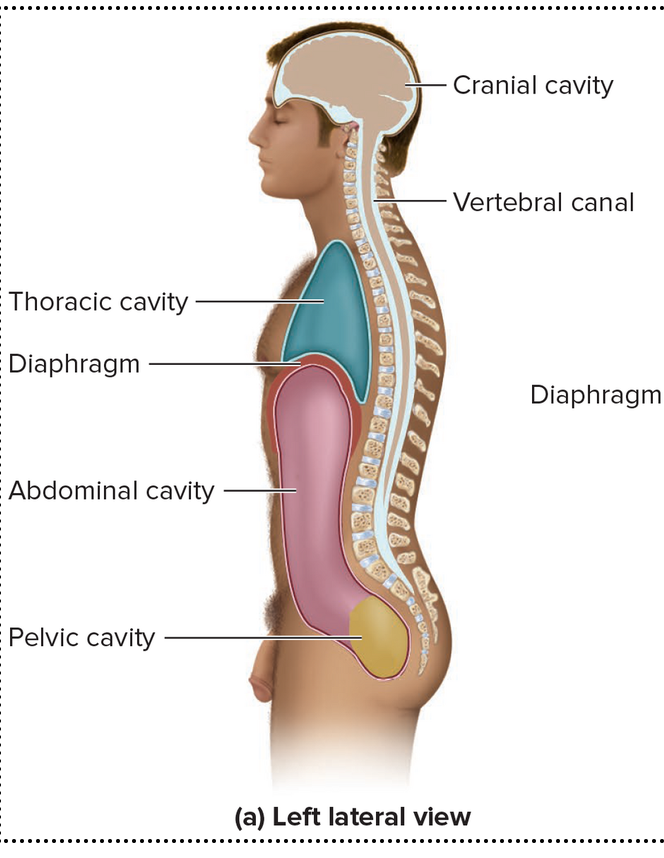
Major Body cavities: Lateral and anterior view
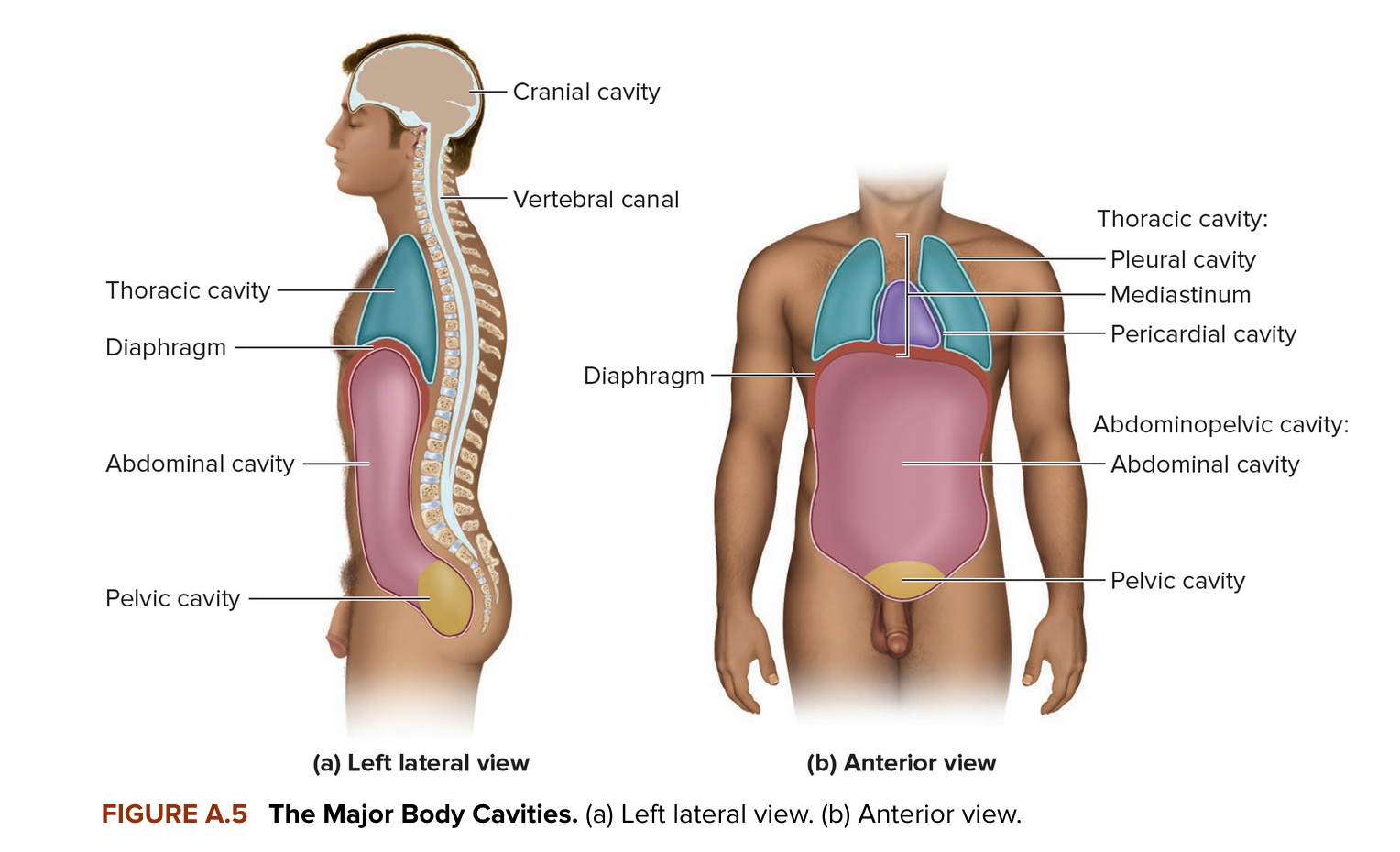
Cranial Cavity and vertebral Canal
Cranial cavity is enclosed by the cranium (brain case). Vertebral canal is enclosed by the vertebral column and contains the spinal cord. They are continuous with each other and contain three protective layers called the meninges (Three fibrous membranes between the central nervous system and surrounding bone: the dura mater, arachnoid mater, and pia mater).
A.3B: