💧 Lecture 3: Part 2 - Water-Soluble Vitamins + Minerals
 Call Kai
 Learn
Learn Practice Test
 Spaced Repetition
 Match
Match Flashcards
 Knowt Play
1/21

There's no tags or description
Looks like no tags are added yet.
Name | Mastery | Learn | Test | Matching | Spaced | Call with Kai | Chat |
|---|
No analytics yet
Send a link to your students to track their progress
22 Terms
B Vitamins – Water Soluble
Functions
• Act as coenzymes for cell metabolism or as precursors to coenzymes
B₁ – Thiamine
• Deficiency: Beriberi → edema and heart problems
B₂ – Riboflavin
• Deficiency: Ariboflavinosis → skin disorders and edema
B₃ Complex – Niacin
• Includes niacin (nicotinic acid) and nicotinamide
• Can be synthesized from tryptophan, but with poor efficiency
• Deficiency: Pellagra → skin disorders, dementia, and diarrhea
B₅ – Pantothenic Acid
• Precursor for coenzyme A
• Coenzyme A is a critical component for the TCAC
• Deficiency: Rare

B Vitamins – B₆ and B₇
Functions
• Act as coenzymes for cell metabolism or as precursors to coenzymes
B₆ Complex – Pyridoxine and Pyridoxamine
• Involved in amino acid metabolism
• Carnivores have an elevated requirement
• Deficiency: Dermatitis → skin inflammation
B₇ – Biotin
• Can be synthesized by gut bacteria
• May not be essential for ruminants
• Deficiency: Anemia and hair loss

B Vitamins – B₉ and B₁₂
Functions
• Act as coenzymes for cell metabolism or as precursors to coenzymes
B₉ – Folate (Folic Acid)
• Can be synthesized by gut bacteria
• May not be essential for ruminants
• Deficiency: Folate deficiency anemia
B₁₂ – Cobalamin
• Synthesized by gut bacteria
• All animals depend on microbially synthesized B₁₂
• Deficiency: Severe and irreversible brain and CNS damage

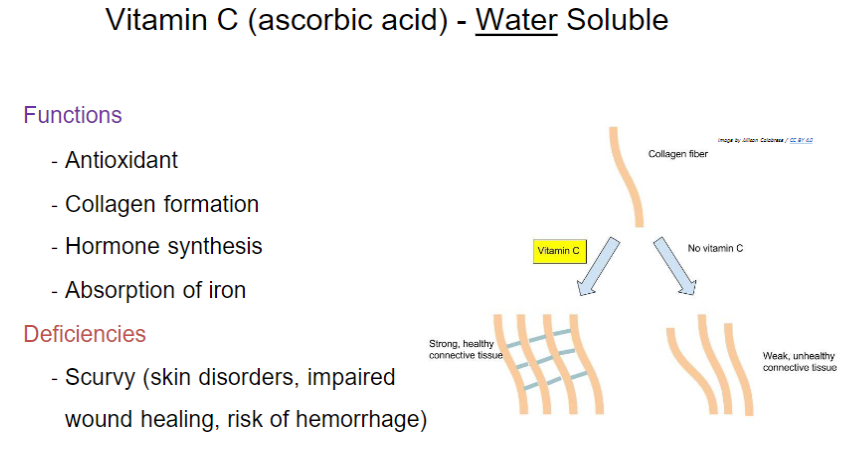
Vitamin C
Functions
• Antioxidant
• Collagen formation
• Hormone synthesis
• Iron absorption
Deficiency
• Scurvy
• Skin disorders
• Impaired wound healing
• Increased risk of hemorrhage
Vitamin C – Essentiality
Nonessential
• Reptiles
• Amphibians
• Some birds, mostly non-passerine
• Most mammals
Essential
• Bats
• Many passerine birds → “perching” birds
• Osteichthyes → “bony” fish
• Guinea pigs and capybara

Vitamin C – Synthesis
Starting Materials
• Glucose
• Galactose
Vitamin C Synthesis Pathway
• Glucose or galactose → D-glucuronic acid
• D-glucuronic acid → L-gulonic acid
• L-gulonic acid → L-gulono-γ-lactone
• L-gulono-γ-lactone oxidase converts L-gulono-γ-lactone → L-2-oxogulono-γ-lactone
• L-2-oxogulono-γ-lactone → ascorbic acid
• Final step occurs spontaneously
Key Point
• Ascorbic acid = Vitamin C

Vitamin C – Synthesis
Starting Materials
• Glucose
• Galactose
Vitamin C Synthesis Pathway
• Glucose or galactose → D-glucuronic acid
• D-glucuronic acid → L-gulonic acid
• L-gulonic acid → L-gulono-γ-lactone
• L-gulono-γ-lactone oxidase converts L-gulono-γ-lactone → L-2-oxogulono-γ-lactone
• L-2-oxogulono-γ-lactone → ascorbic acid
• Final step occurs spontaneously
Key Point
• Ascorbic acid = Vitamin C
• Humans lack L-gulono-γ-lactone oxidase, so we cannot synthesize Vitamin C and must obtain it from the diet.

Choline and Inositol – Water-Soluble “Vitamins”
Functions
• Choline and inositol are involved in the structure of cellular membranes
• Found in phosphatidylcholine and phosphatidyl-inositol
Choline
• Involved in lipid transport and metabolism
• Part of phosphatidylcholine
Inositol
• Involved in neurotransmitter synthesis
• Part of phosphatidyl-inositol
Key Point
• Both choline and inositol are water-soluble “vitamins” and contribute to cell membrane structure

Choline – “Vitamin B4”
Essentiality
• Conditionally essential → required in the diet under certain conditions
Synthesis
• Synthesized during methionine metabolism

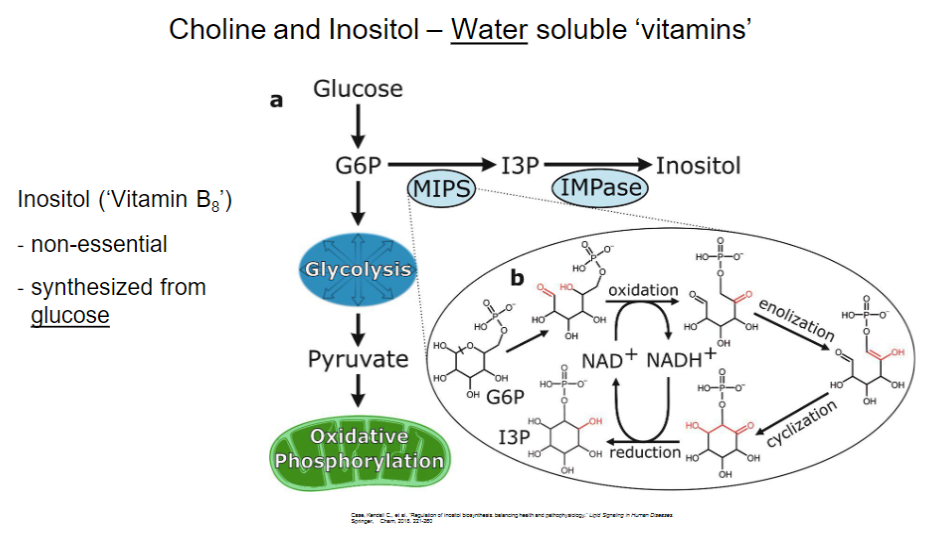
Inositol – “Vitamin B8”
Essentiality
• Non-essential
Synthesis
• Synthesized from glucose
Choline and Inositol – Essentiality
Choline – “Vitamin B4”
• Conditionally essential
• Synthesized from methionine
Inositol – “Vitamin B8”
• Non-essential
• Synthesized from glucose
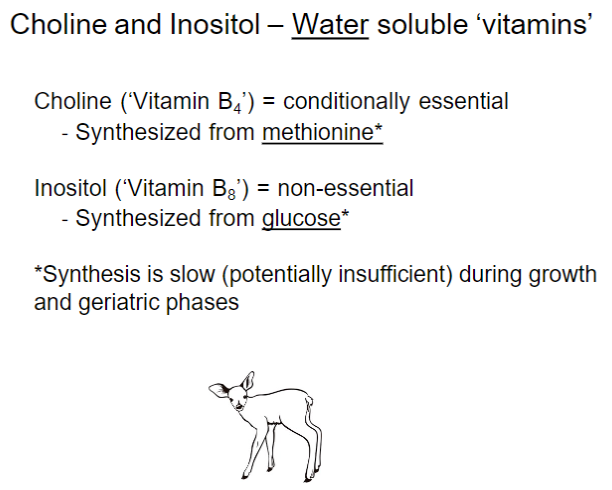
Synthesis During Certain Life Stages
• Synthesis is slow during growth and geriatric phases
• May be insufficient during these stages
Minerals
Definition
• Inorganic compounds → no carbon skeleton
• All are essential → cannot be synthesized by any animal or plant
Sources
• Must be obtained through the diet
• Plants → accumulate minerals from the soil
• Animals → accumulate minerals from eating plants or animals
• Free water → can provide minerals
Mineral Availability
• The environment has a large influence on mineral availability

Mineral Classification
Macrominerals
• Required in amounts > 5 g
• Sodium
• Potassium
• Chloride
• Sulfur
• Calcium
• Phosphorus
• Magnesium
MAIN Micro/Trace Minerals
• Required in amounts < 5 g
• Iron
• Zinc
• Cobalt (ruminants only)
• Selenium
• Iodine
• Copper
• Manganese
• Chromium
• Molybdenum
• Fluorine
OTHER Trace Minerals
• More than a dozen trace minerals can be found in the body
• Arsenic
• Nickel
• Silicon
• Boron

Functions of Minerals
1. Skeletal Structure
• Minerals are constituents of skeletal structures
• Calcium + phosphorus → found in bone
2. Osmotic Pressure
• Minerals help maintain osmotic pressure → movement of water between body fluids
• Sodium → mainly in extracellular fluid
• Potassium → mainly in intracellular fluid
3. Acid/Base Balance
• Minerals help regulate acid/base balance → maintain proper pH
• Chloride → involved in acid/base regulation in the kidneys
4. Components of Enzymes
• Minerals can be components of enzymes or other molecules needed for enzyme function
• Cobalt → part of vitamin B₁₂
5. Activators of Enzymes
• Minerals can activate enzymes
• Calcium → activates CaMKII
6. Components of Biological Units
• Minerals can be components of important biological molecules
• Iron → component of hemoglobin
• Iodine → component of thyroxine

Organic vs Inorganic Minerals
Nutritionally Organic Minerals
• Minerals that are chelated (bound) to a carbon-containing compound
• Example: amino acid
• Generally more bioavailable → easier for the animal to absorb and use
• Example: copper lysinate
Nutritionally Inorganic Minerals
• Elements or molecules without carbon
• Generally less bioavailable
• Example: copper sulphate

Calcium and Phosphorus
Calcium (Ca)
• 1st most abundant mineral in the body
• Main role → formation of bone, teeth, antler, eggshell, and milk
• Found in milk, eggs, bone, and vegetation
Phosphorus (P)
• 2nd most abundant mineral in the body
• Main role → formation of bone, ATP, and phospholipids
• Found in animal tissue, milk, grains, and vegetation

Phosphorus
Main Role
• Formation of bone, ATP, and phospholipids
Sources
• Found in animal tissue, milk, grains, and vegetation
• In plants, much of the phosphorus (P) may be present as phytate
Phytate
• Phytate = inositol hexaphosphate (InsP₆)
• A form of phosphorus found in plants

Calcium and Phosphorus – Deficiency and Requirement
Deficiency
• Rickets → occurs in young animals
• Osteomalacia → metabolic bone disease
Requirement
• Considered as a ratio
• Ca:P should be 1:1 – 2:1

Minerals – Electrolytes
Electrolytes
• Ca²⁺, P (PO₄³⁻), Mg²⁺, Cl⁻, Na⁺, K⁺
• Help maintain intracellular and extracellular fluid balance
• Create osmotic gradients → regulate body fluid status and movement
Cations
• Positively (+) charged ions
• Ca²⁺, Mg²⁺, Na⁺, K⁺
• Memory tip → “Pawsitively charged = Cations”

Minerals – Electrolytes
Electrolytes
• Ca²⁺, P (PO₄³⁻), Mg²⁺, Cl⁻, Na⁺, K⁺
• Help maintain intracellular and extracellular fluid balance
• Create osmotic gradients → regulate body fluid status and movement
Anions
• Negatively (-) charged ions
• P (PO₄³⁻) and Cl⁻
• Memory tip → “Negative = Anions”

Minerals – Electrolyte Imbalance
Electrolytes
• Ca²⁺, P (PO₄³⁻), Mg²⁺, Cl⁻, Na⁺, K⁺
Electrolyte Imbalance
• Chronic imbalance → cardiovascular issues
• Acute imbalance → fatigue and emesis (vomiting)

Trace Minerals – Cobalt
Cobalt (Co)
• Only essential mineral for ruminants → foregut-fermenting species
• Also essential for some monogastric hindgut-fermenting species
Function
• Required for the synthesis of vitamin B₁₂ (cobalamin)
