BIOC PART E
 Call Kai
 Learn
Learn Practice Test
 Spaced Repetition
 Match
Match Flashcards
 Knowt Play
1/120

There's no tags or description
Looks like no tags are added yet.
Name | Mastery | Learn | Test | Matching | Spaced | Call with Kai | Chat |
|---|
No analytics yet
Send a link to your students to track their progress
121 Terms
two membrane types of the cell?
function of membranes?
plasma membrane and organelle membrane
compartmentalize, communicate, convert energy and surface recognition
membrane composition is about 45% lipid, 50% protein and 5% carb, by surface area it is mostly _____
lipid
membrane phospholipids have hydrophillic and hydrophobic components making them _______
amphipathic
phosphoglycerides/glycerophospholipids
backbone made of ______
2 FA are in _____ link with glycerol
headgroup derived from _______
glycerol
ester
alcohol
most lipids in body are
phospholipids
what are 4 main head groups of phospholipids?
phosphatidic acid
phosphatidyl ethanolamine
phosphatidyl choline
phosphatidyl serine
phosphatidic acid
phosphatidyl ethanolamine
phosphatidyl choline
phosphatidyl serine
what net charges on each at pH=7?
(also draw out the structures of each group)
phosphatidic acid -2
phosphatidyl ethanolamine 0
phosphatidyl choline 0
phosphatidyl serine -1

Why is the net charge of phosphatidylethanolamine 0 when ethanolamine is +1?
Phosphatidylethanolamine has two charged groups
Ethanolamine group → protonated NH₃⁺ → +1 charge
Phosphate group → −1 charge
This makes phosphatidylethanolamine a zwitterion (both positive and negative charges but net 0).
sphingolipids
back bone made of ____
1 FA attached by _____ link
sphingosone
amine
sphingolipids have a net _____ charge
neutral
two types of sphingolipids are _______ and _______
ceramide and sphingomylein
ceramide and sphingomylein have what headgroups?
ceramide- none
sphingomylein- phosphocholine (phosphate considered part of head in sphingolipids unlike phosphoglycerides)
many sphingolipids have many complex _______
sugars
sphangolipids are structurally similar to phosphoglycerides but are _______ (smaller/larger)
smaller
many sphangolipids have carbohydrate head groups making them glycosphangolipids which in the body are commonly seen in _____
ABO blood type marking
ABO blood type markers include various carbohydrates taht show difference between blood types attaches to a _______ sphingolipid
ceramide
________ is the major animal sterol
cholesterol
describe cholesterol shape
4 fused rings termed the steroid nucleus (ABC hexagons and D pentagon)
planar structure
alkyl side chain (on D ring C17)
polar head group -OH (on A ring C3)
two major classes of lipids are _____ and ______
storage and membrane
storage lipids include:
TAGs (glycerol attached to 3FA)
subcatagories of membrane lipids are ______ and _______
phsopholipids and glycolipids
glycolipids include
sphingolipids (sphingosine, FA and mono or oligiosaccharide)
sulpholipids (glycerol, 2FA, mono or disaccharide -SO4)
phospholipids include
sphingolipids (sphingosine, FA, PO4-choline)
glycerophospholipids (glycerol, 2FA, PO4-, OH)
plasma membrane composition is similar between cellular/organelle membranes (T/F)
F, membranes have unique compositions depending of function, however phophatidyl choline is a major component of them all.
note: minor lipid doesnt mean its unimportant just in smaller quantity
while found in other membranes, the plasma membrane specifically has relatively a lot of ______
cholesterol
4 common structures of phospholipid organization and description
monolayer- form at air whater interface, polar head in water, two tails extend to air.
micelles- single tails cause a wedge shape to form which assemble into curves, tails interact with eachother and polar heads interact with environment (common in detergents)
lipid bilayer- stable, 2 tails, thick (3nm), basic matrix of bio membranes, impermeable to ions and polar molecules
liposomes (vessicles)- most resemble cellular bilayer, aqueous centre, allow for study of biomembranes and transporters
functions of membrane proteins
-transporters and channels
- receptors
- structural components
- adhesion proteins
- surface antigens
two types of membrane proteins
Peripheral membrane proteins
Integral membrane proteins
(a) covalently attached lipid anchor (kinda integral)
(b) transmembrane domain (properly integral)
fluid mosaic model
components of a bilayer move around in leaflet
by weight are lipids or proteins heavier?
proteins
how are peripheral proteins attached to the membrane? how are they removed from the membrane?
periphreal protein has negative charge and so does the phospholipid membrane, so Ca2+ is the postive needed to hold them together.
if Ca2+ is removed by a change in pH or by a chelator or urea, carbonate, etc.. the attraction is gone and the periphreal protein disassociates from the membrane
if you need to use a detergent to remove a protein from the membrane, what type of protein is it?
integral membrane/ transmembrane protein
(hydrophillic domain coated with detergent, is pushed out of membrane)
GPI anchored proteins (lipid anchored) are removed from membrane by __________
phospholipase
peripheral proteins can be embedded in the membrane at different depths depending on _________________
electrostatic interactions, hydrogen bonds, interaction with head group of lipid bilayer
some membrane proteins are lipid anchored in class we talked about 4 lipids that attach to proteins by what AAs?
palmitoyl attaches ______
N-myristoyl attaches ______
Farnesyl attaches ______
GPI attaches ______
palmitoyl attaches Cys or Ser
N-myristoyl attaches N term of Gly
Farnesyl attaches C term Cys
GPI attaches C term (complex)

describe glycophorin A structure
huge transmembrane protein, cytosolic region glycosilated, type 2 protein (N term out, C term in)
where are the N term, C term (and do they use STA or SA- MCB content)
type 1
type 2
type 3
type 4
type 1- N lumen, C cyt, STA, (and signal sequence cleaved)
type 2- N cyt C lumen, SA
type 3- N lumen, C cyt, SA
type 4- varied, SA, STA, more than 2 TMDs
(also GPI N in C in, C phospholipid anchor)
a hydrophobicity plot helps you determine what about a protein?
how many hydrophobic (TMD) it has
how many hydrophobic residues in a row often indicates a TMD?
20+ (approx how many needed to span membrane)
on hydrophobicity graph what do peaks indcate above 0? below zero?
hydrophobicity, hydrophilicity
Bacteriorhodopsin, a GPCR protein type has how many TMD? is N term in or out?
why interest of drug companies?
7 , N term out, C term in
many drugs of interest target GPCRs
what is an annular lipid?
lipids that stay on a protein even when detergent used, detected as part of the proteins structure. often to remove an annular lipid you must break the protein structure. lipids look simiilar to bilayer with hydrophobic tails trying to stick near the hydrophobic protein regions.
all proteins with TMD are a-helixes (T/F)
F, some can be B barrels
where are beta barrel TMD proteins found?
bacterial and mitochondrial outer membranes
(examples in class FepA, OmpLA, maltopotin)
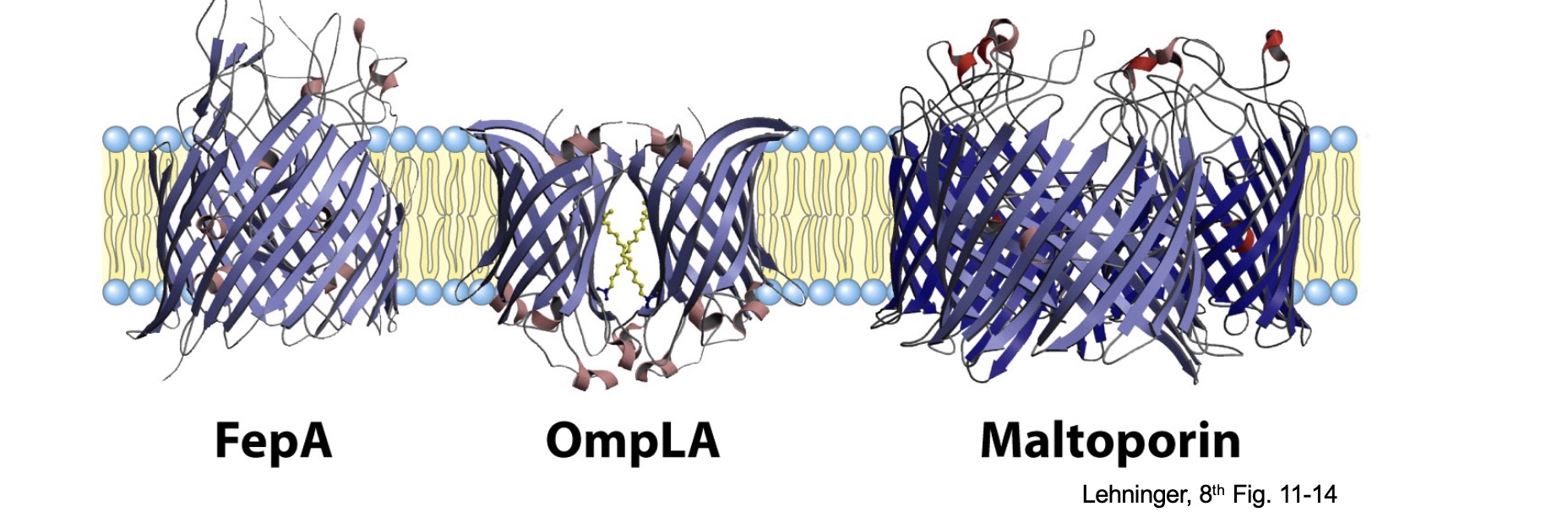
why cant beta barrel TMD always be detected on hydrophobicicity graph?
sometimes the residues are only 7 AA long (dont need to be 20+ like a helixes, because B barrel is a much more extended structure) so cant usually be sure
where are B barrel back bone hydrogen bonds?
between B strands (amine- carbonyl)
where are tyrosine and tryptophan residues concentrated in integral proteins? (Y and W)
where the polar head groups meath the acyl (FA) chains of the phsopholipids. this is because Y and W have both hydrophobic and hydrophillic regions
in beta barrels what is the general pattern of residues?
hydrophilic and hydrophobic AA alternate in sequence and point towards the prefered environment. (central hydrophillic, external hydrophobic bilayer)
where are Arg, Lys, Glu, Asp residues found?
hydrophillic areas (they are charged)
if a charged residue is in a hydrophobic area such as a TMD why might that be?
usually play a specific functional role
what are the two catagories of glycoproteins?
N linked and O linked
N linked glycoproteins sugars atttach by ______
O linked glycoproteins sugars attach by ______
N- attach by Asn side chain N (N-acetylglucosamine (GlcNAc))
O- attach by Ser/ Thr side chain OH (N-acetylgalactosamine (GalNAc))
what is the purpose of glycoproteins and glycolipids?
cell surface recognition, receptors
why is it important that a membrane is dynamic?
so shape can change without loss of integrity (leakage)
allow flip, flop, scramble
membranes usually bounce off eachother but can fuse with integrety loss
3 states of a membrane
gel- cold, motion constrained, paracrystaline, stiff tails, not a usual state
liquid ordered- physiological, motion of tails, and lateral movement of proteins
liquid disordered/ liquid fluid- constant aggregation and irregular motion
what do stearols such as cholesterol do?
act as buffer for fluidity of membrane
what type of FA can pack best in cell membrane? which type contribute to fluidity?
saturated fats pack tightly, unsaturated introduce a kink in the chain and pack less tight
cells can regulate fluidity (T/F)
T, cell may produce less saturated fats at a low temp for example
the behaviour of cholesterol in a membrane depends on temperature and composition, explain the effect of adding cholesterol in the following situations:
long chain saturated FA
unsaturated FA
high temp
low temp
long chain saturated FA- cholesterol interferes with acyl chain interactions and increases fluidity
unsaturated FA- cholesterol decreases fluidity by filling in the kinked regions for better packing
high temp- cholesterol helps to reduce fluidity as it is rigid and helps keep the flexible chains more straight in heat
low temp- cholesterol helps to increase fluidity by breaking up the straight chain acyl tails
(basically a buffer to bring membrane back to physiological in all situations)
uncatalyzed lateral diffusion happens very ________
transbilayer motion (flip flop) happens very _________
quickly
slowly (days)
why is transbilayer movement so slow?
hard for polar head to make it through hydrophoic bilayer
flipases, flopases and scramblases are transmembrane proteins that help facilitate transbilayer motion how?
act as an aqueous pore for the polar head of phospholipids to move through the hydrophobic membrane easier
flipases
flopases
scramblases
flipases- enzyme uses ATP, phosphoserine(-)/phosphatidylethanolamine, against gradient, outer→inner
flopases- enzyme uses ATP, ABC transporter, against gradient, inner→outer
scramblases- not an enzyme, moves lipids either direction with a gradient towards equilibrium (spontaneous)
lipids diffuse rapidly and freely often in a restricted region, and occassionally hop to a new restricted region (behave as if controlled by fences that they ocassionally escape) we know this by doing single particle tracking.
what keeps proteins confined to a small region
spectrin (part of cytoskeleton) and associated ankyrin
lipids are not randomly dispersed, rather often lipids of similar type can come together to form _________, which contain more _____ than surrounding membrane
lipid rafts (ex sphingolipid raft), more cholesterol
ions and small particles cross the membrane very slowly without help whereas _____ cross membrane very quickly
hydrophobic molecules and gasses(considered hydrophobic) such as steroids, O2, N2, CO2
Trp and Tyr are often in an inbetween zone due to hydrophobic and hydrophillic regions, often ______ are also there as they can serve as a link betwen hydrophillic and hydrophobic region
carbonyls
6 types of membrane transport
simple diffusion
facilitated
primary active transport
secondary active transport
ion channel
ionophore (down gradient)- not really gonna mention again
delta G is negative when molecule moves from ______ to _______ concentration
high to low
if log value is _____ than 1, then delta g is negative in ln (C2/C1)
smaller
when c1=c2 what occurs in diffusion?
ln(c2/c1)=ln1=0 therefor deltaG=0 and no net movement
to transport a hydrophillic solute across a membrane what do you need to do
with transporter
without transporter
with- low delta G, goes through aqueous channel (facillitated- down gradient)
without- need to expend energy to remove water from molecule, move through membrane, then put water back on in cytosol
what are the major differences between membrane channels and transporters?
channel- very fast rate of flux (only limited by rate of diffusion), regulated by gates, dont use ATP (like an open tunnel)
transporter- slower rate of flux (able to be saturated bc has binding sites), regulated by substrate avalibility, can use ATP or not (like a revolving door)
membrane channels are limited by _____
diffusion
are membrane channels saturable?
no
increasing _____ increases rate of diffusion of a channel
concentration of substrate
channels often transport ________
ions or water
what is the type of channel that water goes through?
aquaporin
aquaporins have 4 AA with specific functions, what are they and what function do they serve?
Arg195- electrostatic repulsion of H3O+ by its own pos charge
His180- prevents large molecules from going through channel (size exclusion)
Asn192, Asn76- H+ normally wants to jump around from H2O to H2O, these AA residues prevent this from happening by reorienting water molecules and excluding the H+ ions from bouncing around like a newtons cradle
all keep out OH-, H3O+ forms of water and allow H2O to pass (dont wanna fuck up cell pH by adding ions that are acidic or basic)
3 broad catagories of transporters
uniporters
co transporters: symporter (two things transported in same direction), aniporter (two things transported in oppisite direction)
passive transporters dont use _____ and go _____(with/against) concentration gradient
ATP, with
are transporters or channels more specific?
transporters- they are sterospecific (ex. a transporter can select for D glucose over L glucose)
passive transporters have a max rate (T/F)
T
passive glucose transporters include GLUT1 and GLUT2 what do each do differenty?
GLUT1- imports sugar (in erythrocytes)
GLUT2- exports glucose (in liver and intestine)
GLUT 1 is a: antiporter uniporter, or symporter? of L or D glucose? active or passive?
passive uniporter of D glucose (with gradient)
GLUT1 uniporter of D glucose (imports glucose into erythrocytes) has T1 and T2 states what are they?
T1- open to outside cell to bind glucose
T2- opens to cytoplasm to bring glucose into cell
active transporters use _____ to move molecules against their conentration gradient
ATP (many active transporters are atpases
in the sodium potassium transporter __Na+ are exported, __K+ are imported and __ ATP is used
3,2,1
(NOKIA 321- 3Na out, 2K in, 1ATO)
Vm=0 when transporter is at ____
equalibrium
ions can eaily pass through a membrane (T/F)
F (takes very long time if not facilitated or actively moved)
when an ion crosses the membrane a _____ imbalance results which causes membrane poteintial noted by delta psi ( trident lookin symbol)
charge
free energy of charges for a membrane equation
deltaG=zF delta psi
z- charge: electron (-) or proton (+)
F- faraday constant
delta psi- membrane potential
dela psi=
psi inside - psi outside
Class question: Given the transport equation:
ΔG = RT ln (c 2/c 1)
Which of the following about Na+ transport
across the cell membrane is true?
1) It will move down its concentration gradient
2) It will move up its concentration gradient
3) It will always be at equilibrium
4) None of the above
why?
the equation doesnt account for charge, it only accounts for concentration, to account for charge need to use the additive equation of delta G total that s concentration + charge
deltaG total = RT ln (c 2/c 1) + zF delta psi (know this equation he says)

typical plasma membrane has a charge of _____ inside
-60mV (cells neg inside normally pos outside)
about ¼ of your resting ATP is used for what process alone?
sodium potassium transporter (ATPase)- both ions move up (against) concentration gradient, requires a lot of energy
the Na+/K+ ATPase is a tertramer of a2B2, which subunits do the transporting?
a subunits
what are the main things that make the Na+/K+ transporter so important?
control cell volume
gradients maintained drive active transport of other species (ex. Na+/glucose symporter)
render nerve cells electrically excitable
in the Na+/K+ transporter teh phases of the cycle are
enz-I form of transporter binds ______ in cell
phosphorylation by ATP triggers P-enzII form
P-enzII form releases _______ to cytoplasm and picks up ______
dephoporylation triggers enz-I form
enz-I form releases ___ in cell
enz-I form of transporter binds 3Na+ in cell
phosphorylation by ATP triggers P-enzII form
P-enzII form releases 3Na+ out of cell and picks up 2K+
dephoporylation triggers enz-I form
enz-I form releases 2K+ in cell (and back to step 1)
primary vs secondary active transport
primary- ATP directly used to transport (ex. Na+/K+ transporter)
secondary- uses energy from ion gradient to move another substance against gradient (ex. Na+/glucose symporter)