Immunology Adaptive Immune Response: B cells, Antibodies, and MHC
 Call Kai
 Learn
Learn Practice Test
 Spaced Repetition
 Match
Match Flashcards
 Knowt Play
1/35

There's no tags or description
Looks like no tags are added yet.
Name | Mastery | Learn | Test | Matching | Spaced | Call with Kai | Chat |
|---|
No analytics yet
Send a link to your students to track their progress
36 Terms
features of the adaptive immune system
1) specificity (highly)
2) diversity (can recognize 10^9 antigenic determinants)
3) memory
4) self-regulaton
5) discrimination of self from non-self
antibodies
- can be found in B-cell membranes (called B-cell rceptors)
- called antibodies or immunoglobulins when secreted
antibody structure
- 2 light chains
- 2 heavy chains
- variable and constant domain

variable region of antibody
- where antigen binds
constant region of antibody
- complement fixing and Fc receptor binding activity
- on both light and heavy chains
- 5 different constant regions for 5 different types of antibodies - determines class
IgM
- 13% of serum antibodies
- 1st antibody produced during an immune response, but ONLY DURING FIRST EXPOSURE
- IgM is a pentamer held together by a J chain

IgG
- 80% of serum antibodies
- can bind to macrophage and neurotrophil via their Fc receptor (assists with opsonization)
- can cross the placenta (goo goo gaa gaa)
- provides passive immunity for baby by crossing placenta
IgA
- 6% of serum antibodies
- contained in body secretions (Achoo!)
-> saliva, mucus, tears, colostrum, milk (mom gives passive immunity to baby through breastfeeding)
- produced as a dimer
- secretory component associated

IgD
- 0.2% of serum antibodies
- B cell receptors (on surface with IgM)
- plays a role in eliminating B-lymphcytes generating self-reactive autoantibodies
- we know little about these
IgE
- 0.002% of serum antibodies
- most IgE is tightly bound to basophils and mast cells via its Fc region
- allergic reactions :/
- helps eosinophils recognize parasitic infections for toxin release
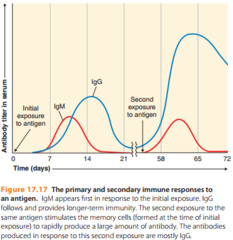
typical reaction time of antibodies: first exposure
- IgM reacts first each time, then IgG slowly takes over

typical reaction time of antibodies: second exposure
- IgM & IgG react quickly due to memory
somatic recombination
- variable region of antibody stays the same in each B cell but constant region changes based on which antibody type is going to be produced
diversity of antibodies
- junctional diversity (imprecise joining of VDJ regions)
- multiple combinations of light and heavy chains
- somatic hypermutation: introduction of minor DNA sequence variations
B cell development
1) pre B cell
2) immature B cell
3) mature B cell
4) activated B cell
5) memory B cell
pre B cell
- cannot respond to Ag since it does not express functional B cell receptors
immature B cell
- express surface IgM
- do not proliferate or differentiate in response to Ag
- encounter with Ag (such as self) results in execution of cell
mature B cell
- move out of bone marrow into periphery
- now responsive to Ag stimulation
- if do not encounter Ag, will die in 3-4 days
activated B cell
- when stimulated by Ag, proliferate and differentiate, producing more Ig in secreted form and less in membrane bound form
memory B cell
- some activated B cells persist as memory Ig expressiing memory cells
- survive for weeks without Ag stimulation
- stimulation of memory B cells with Ag leads to secondary Ab immune response
B cell activation
1) B cell triggered when it encounters a matching antigen
2) cell engulfs antigen and digests it
3) displays antigen fragments bound to unique MHC II molecules
4) attracts help of mature T cell
5) T cell secretes cytokines to help B cell multiply and mature into antibody producing plasma cells (or memory cells)
B cell class switching
- happens at the DNA level
- cell's genetic information is changed
- cannot go back to express IgM after switching to IgG for example
hyper IgM syndrome
- defect in immunoglobulin class switching
- pts able to make IgM but cannot switch to produce other Ig types
- defect in CD40-CD40 ligand interactions (B cells do not receieve needed signal via CD40 to initiate class switching)
hyper IgM syndrome presentation
- recurrent bacterial infections, including upper and lower respiratory tract infections
- neutropenia (neutrophil development requires CD40 for different reason), leading to frequent mouth ulcers, skin infections, inflammation around rectum)
functions of antibodies: Fc binding & opsonization
- neutralization (blocks binding sites and coats particles)
- agglutination of antigen-bearing particles
- precipitation of soluble antigens
-> enhance phagocytosis
functions of antibodies: complement activation
- complement fixation (activation of complement)
-> enhance phagocytosis, inflammation, lysis of microbes
functions of antibodies: ADCC
- antibody-dependent cell-mediated cytotoxicity
1) infected cells but epitopes on surface
2) antibodies bind to epitopes on surface
3) NK cell binds to antibody Fc receptors
4) NK induces apoptosis via perforin and granzymes
functions of antibodies: allergy
- an allergen bind to receptor on B cell
- B cell is activated and plasma cell makes high amounts of IgE for allergen
- IgE attaches itself to mast cells/basophils/eosinophils
- during second exposure, IgE binding causes release of inflammatory molecules
Bruton's Agammaglobulinemia or X-Linked Agammaglobulinemia (XLA)
- do not generate immature B cells from pre B cells
- due to mutation on X chromosome of gene Bruton's Tyrosine Kinase
- pts susceptible to bacterial and some viral infections, infections to intracellular pathogens and fungi are handled normally
MHC overview
- stands for major histocompatibility complex
- displayed on cell surface
- class I and II
- codominately expressed (has both alleles expressed) & high degree of polymorphism (multiple allelic forms within population)
- define an individual's tissue type
- principal determinant of graft rejection
class I MHC basics
- constitutively expressed on all NUCLEATED cells
- presents endogenously synthesized antigens (ex: viral proteins)
- checked by killer T cells (CD8), which have receptors for class I MHC proteins
class II MHC basics
- restricted expression on B lymphocytes, macrophages, dendritic cells, endothelial cells (APCs)
- expression can be induced in response to cytokines
- presnet exogenously derived proteins (ex: bacterial products)
- antigens presented to helper T cells (CD4), which have receptors for MHC class II proteins
biological roll of MHC molecules
- T cells can only recognize epitopes after they are bound to MHC molecules
class I MHC presentation
- bind peptides derived from endogenous antigens that have been processed within the cytoplasm of the cell, such as tumor proteins, bacterial proteins, viral proteins, or cellular proteins
- proteins are processed within the cytosolic pathway
-> fragments and class I MHC combined within ER then transported ot cell surface
class II MHC presentation
- peptides derived from exogenous antigens that are internalized by phagocytosis or endocytosis
- processed within the endocytic pathway
-> lysosomal proteases cleave antigen into peptide fragments, then vesicles containing fragments fuse with MHC II containing vesicles from ER
- complex travels to cell surface
graft survival
- MHC molecules discriminate self from non-self
- better match for MHC = more successful grafting
- graft vs host disease
- host vs graft disease