Comprehensive Guide to Non-Covalent Bonds and Their Physical Properties in Chemistry
 Call Kai
 Learn
Learn Practice Test
 Spaced Repetition
 Match
Match Flashcards
 Knowt Play
1/18

There's no tags or description
Looks like no tags are added yet.
Name | Mastery | Learn | Test | Matching | Spaced | Call with Kai | Chat |
|---|
No analytics yet
Send a link to your students to track their progress
19 Terms
non-covalent bonds
- They are weaker and more transient than a covalent bond.
- Types include dipole-dipole, hydrogen bonds, ionic bonds, Van der Waals interactions, and hydrophobic forces.
- These are electrostatic interactions between positive and negative charges that create a force between them.
- Physical Property Impact: Because these forces physically pull molecules together, stronger electrostatic interactions require more thermal energy to break. This directly results in higher melting points, higher boiling points, and lower vapor pressure (because fewer molecules have the energy to rip away and escape into a gas).
Van der Waals interactions
- These are weak attractions between molecules or parts of molecules that result from transient local partial charges.
- This interaction happens across all molecules and is based on the random, fluctuating movement of electrons.
- Because these temporary charges are so fleeting, the molecules HAVE TO BE VERY CLOSE for the force to work.
- Physical Property Impact: Larger molecules have larger electron clouds, making these random fluctuations stronger. This stronger temporary attraction holds the molecules together more tightly, which is exactly why larger nonpolar molecules have higher boiling points.

dipole-dipole interactions
- These are attractive forces that act between polar molecules or induced polar molecules.
- The interacting molecules typically have a partial positive and a partial negative end.
- Unlike Van der Waals forces, they don't have to be extremely close to each other, but they do need to be at a good distance.
- Physical Property Impact: Because the partial charges are permanent, they act like persistent magnets holding the liquid together. This makes it much harder for molecules to evaporate, significantly lowering the substance's vapor pressure compared to nonpolar liquids.
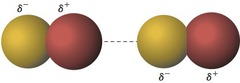
charged bonds
- These bonds happen between charged ions, such as CaCl2.
- They are the strongest of these interactions.
• The closer both of the charges are to each other, the more energy is required to break the interaction.
- Physical Property Impact: Because these direct, full-charge attractions are incredibly powerful, ionic compounds form highly stable, rigid crystal lattices. You have to input massive amounts of heat to overcome that electrostatic lock, giving them incredibly high melting points.
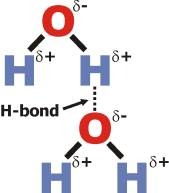
Hydrogen Bonds
- These are attractive forces in which a hydrogen covalently bonded to a very electronegative atom is also weakly bonded to an unshared electron pair of another electronegative atom.
- Because they actually share electron density, they are stronger than most other interactions.
- Physical Property Impact: This unique sharing of electron density creates a very tight, highly ordered molecular network. This intense gripping is the exact reason why water has an unusually high boiling point and extremely high surface tension compared to molecules of a similar size
Hydrophobic Interactions
- This is a type of weak chemical interaction caused when molecules that do not mix with water coalesce to exclude water.
- Physical Property Impact: As the water network physically squeezes these nonpolar molecules together to maximize its own entropy, it forces the nonpolar molecules to pack tightly. This tight physical packing is what dictates the density and structural integrity of lipid bilayers and folded proteins in biological environments.

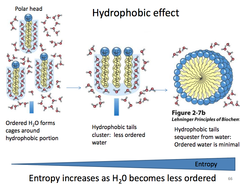
The Hydrophobic Effect & Self-Association
- Hydrophobic molecules do not actually pull themselves together or have an inherent chemical attraction to each other.
- They "self-associate" (clump together) purely because the surrounding water network aggressively squeezes them out of the way.
- Physical Property Impact: By clumping together, hydrophobic molecules minimize their exposed surface area. This physical squeezing is the primary driving force that makes complex proteins fold into their specific 3D shapes and causes lipid bilayers to assemble spontaneously.
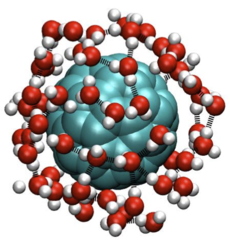
Clathrates (Water Cages)
- When water encounters a hydrophobic molecule, it cannot form hydrogen bonds with it.
- To maintain its own network, the water molecules are forced to build a highly ordered, rigid, ice-like cage structure around the nonpolar molecule.
- Physical Property Impact: Because this structure forces water to stop tumbling freely, it creates a state of very low entropy. This structural rigidity is the thermodynamic reason why nonpolar substances resist dissolving in water.
Entropy-Driven Aggregation
- Surrounding two separate hydrophobic molecules requires two individual water cages, trapping a huge number of water molecules in a rigid structure.
- When those hydrophobic molecules aggregate into a single drop, water only has to build one slightly larger cage, which takes far fewer water molecules.
- Physical Property Impact: The "extra" water molecules are released from the cage back into the bulk liquid, massively increasing the overall entropy (freedom of movement). This favorable increase in entropy is the actual physical reason oil and water separate.

Hydration Shells (Unclumping)
- Unlike with nonpolar molecules, water eagerly swarms polar and charged (hydrophilic) substances.
- The water molecules orient their partial charges to attract the exposed ions, overpowering the solid's internal forces and plucking particles off the surface one by one.
- Physical Property Impact: Once a particle is plucked off, water forms a 3D sphere around it. This hydration shell acts as a physical shield, completely preventing the ions from re-clumping and allowing the substance to remain fully dissolved as a liquid solution.

Dynamic Exchange
- When massive hydrophilic molecules like folded proteins are in water, they expose polar groups (like -OH or protonated amines) on their surface.
- Water molecules continuously tug at these surface groups, sometimes temporarily breaking the protein's internal hydrogen bonds to swap in their own bonds with the water.
- Physical Property Impact: This microscopic tug-of-war ensures the massive molecule stays highly interactive with the solvent, keeping it completely soluble and capable of freely drifting through an aqueous environment.
True or False: Hydrogen bonding only happens when water is present.
False.
- Hydrogen bonding happens between ANY molecules that meet the chemical requirements, even in pure mixtures of other substances like ammonia (NH3) or hydrogen fluoride (HF).
Which three specific atoms must hydrogen be covalently bonded to in order to act as a hydrogen bond DONOR?
- Nitrogen (N)
- Oxygen (O)
- Fluorine (F)
(Hint to remember: "NOF" or "Chemistry is FON!")
True or False: A molecule of methane (CH4) can form hydrogen bonds because it has hydrogen.
False.
- Carbon is not electronegative enough. The hydrogen must be bonded to N, O, or F to get a strong enough partial positive charge (+) to act as a donor.
What is strictly required for an atom (like N, O, or F) to act as a hydrogen bond ACCEPTOR?
- It MUST have at least one lone pair of non-bonding electrons.
- This unshared electron pair is what the partially positive hydrogen actually interacts with.
True or False: In a hydrogen bond between an -OH group and an -NH group, the hydrogen atom breaks its original bond and forms a new covalent bond with the nitrogen.
False.
- The hydrogen stays covalently bonded to the oxygen. The hydrogen bond is just a strong non-covalent, electrostatic attraction bridging the gap to the nitrogen.
Can hydrogen bonds form between two massive, complex molecules, or do they only form between small solvents?
They form between massive molecules too. As long as the specific polar groups (like -OH or -NH) are present, they will bond.
This is exactly how two separate strands of DNA zip together without any water involved in the actual bond.
True or False: Because dipole-dipole and hydrogen bonds rely on permanent partial charges, the bonds between the liquid molecules never break.
• False.
• The charges are permanent, but the bonds still constantly break and reform.
• Thermal energy causes the molecules to violently collide, which physically knocks the bonds apart even though their "magnets" are still on.
What is the exact difference between WHY a Van der Waals bond breaks versus WHY a hydrogen bond breaks in a liquid?
• A Van der Waals bond breaks because the temporary charge completely vanishes (the magnet turns off).
• A hydrogen bond breaks because a physical collision between molecules knocks them apart, but their partial charges remain permanently active.