Chemistry
 Call Kai
 Learn
Learn Practice Test
 Spaced Repetition
 Match
Match Flashcards
 Knowt Play
1/59

There's no tags or description
Looks like no tags are added yet.
Name | Mastery | Learn | Test | Matching | Spaced | Call with Kai | Chat |
|---|
No analytics yet
Send a link to your students to track their progress
60 Terms
Standard conditions for cell potential stuff
An ion concentration of 1.00 mol dm-3
A temperature of 298 K
A pressure of 1 atm
Standard eletrode potential def
Potential difference when a half-cell is connected to a standard hydrogen electrode under standard conditions.
Standard cell potential def
Potential difference between 2 half-cells under standard conditions of 1 atm, 298k, and all solutions at 1.00 mol/dm³
Lattice energy
Enthalpy change when 1 mol of an ionic compound is formed from its gaseous ions under standard conditions
Exothermic
Atomisation
Enthalpy change when 1 mol of gaseous atoms is formed from its element under standard conditions
Endothermic
Electron affinity
Enthalpy change when 1 mol of electrons is added to 1 mol of gaseous atoms to form 1 mol of gaseous negative ions under standard conditions
First exothermic, then endo
Enthalpy of solution
Enthalpy change when 1 mol of an ionic substance dissolves in sufficient H2O forming a very dilute solution under standard conditions
can be exothermic or endothermic
Enthalpy of hydration
Enthalpy change when 1 mol of specified gaseous ion dissolves in sufficient water forming a very dilute solution under standard conditions.
Exothermic
Hsol - Hlattice dissociation = H hydration
Entropy
Number of possible arrangements for the particles and its energy in a given system.
Rate of reaction
Change in concentration of a reactant or product per unit time
Rate equation
K only affected by temperature
Order only found experimentally
Half life
Time taken for concentration of limiting reactant to half
0.693/k
Order of reaction from half life
Zero order = Half lives decrease, takes less time for reactant conc to half
First order = half life constant
Second order = half life increases with time, takes more time for reactant conc to half
Mode of action of heterogeneous catalysts
Adsorption of reactants on catalyst surface
Reactant physically adsorbed onto surface by weak forces
Chemically adsorbed by stronger bonds
Causes bonds to weaken in atoms of reactants
Desorption, bonds between products and catalyst weaken, products break away.
Iron in haber process
N & H diffuse onto iron surface
Adsorbed onto iron surface due to bonds between iron and reactants
Those bonds weaken N-N & H-H bonds
N and H reacnt = NH3
Desorption, NH3 & iron bonds break and NH3 diffuse away
Catalytic converters
Removes oxides of nitrogen and CO, NOx → N2, CO → CO2
Honeycomb, small beads, platnium palladium rhodium
Adsorption of NOx & CO
Weakening of NO and CO bonds
Bonds form between adjacent N-N
CO and O form CO2
CO2 and N2 desorption, diffuse away.
Homogeneous, peroxydisulfate - iodine reaction
S2O8 + 2I- → 2SO4(2-) + I2
Negative reactants = repulsive = lots of energy
Fe3+ reduced to Fe2+ by I-
Fe2+ oxidised back to Fe3+ by S2O8(2-)
No repulsive forces by reacting wt +ve Fe ion, Ea lowered.
NO2 as catalyst
SO3 + H2O → H2SO4
NO2 + SO2 → SO3 + NO
NO + 1/2 O2 → NO2
Nitrates & Carbonates thermal stability trend
More thermally stable down group
Lower charge density = less polarisation = keeps No3/Co3 bond stable/doesnt distort its bonds.
Polarisation = drawing electrons towards itself.
Solubility of sulfates and hydroxides
Solubility of OH- increases down group
Solubility of SO4(2-) decreases down group
BaSO4 completely insoluble
Enthalpy of lattice energy
ΔHlatt decreases down group
Cations larger down group = more space between +ve and -ve ions
Weaker attractive forces
Less energy released when formed from gaseous ions
ΔHlatt becomes less exothermic
For explaining solubility down group 2
Enthalpy of hydration
Decreases down group 2
Larger cations = weaker ion dipoles
Less energy released when gaseous group 2 ions hydrated
ΔHhyd less exothermic
ΔHsol of hydroxides
OH- = small
ΔHlatt falls faster than ΔHhyd
ΔHsol more exothermic down G2
ΔHsol of SO42-
SO42- = large ion
ΔHlatt falls slower than ΔHhyd
ΔHsol becomes less exothermic down group
More exothermic ΔHsol = more soluble
Characteristics of benzene
Has delocalised e-/delocalised pi bond, gets attacked by electrophiles.
Conjugated-alternating double bonds & single bonds.
Resonance hybrid, similar to no2 co3- no3-
No sp3 hybridisation/all carbons sp2 hybridised.
All c-c bonds are same length ‘
c-h bonds are s-sp2 hybridised
c-c bonds have sp2-sp2 overlap and p-p overlap.
Planar
aromatic
Prefers electrophilic reactions
Decolourises bromine water
Has pi electrons above and below ring.
Conditions for being aromatic
Cyclic hydrocarbon
Planar molecule
Conjugated
No sp3 bonds
Obeys hekules rule - 4n + 2 (n = no of pi electrons)
Benzene nomenclature

Benzene vs intermediate
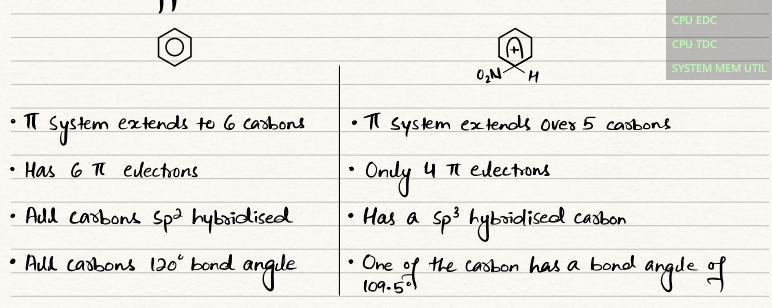
Nitration of benzene
Reagents - Conc HNO3 & conc H2SO4
At 25 to 60 C

Friedel-crafts alkylation
Reagents - ROCl & dry alcl3
Heat
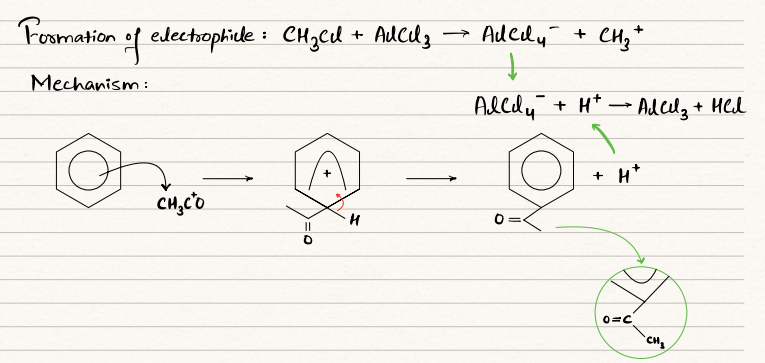
Halogenation of benzene
Reagents - Cl2/Br2 & AlCl3/AlBr3/FeCl3/FeBr3

Oxidation of benzene side chain
Reagents - Hot conc acidified KMno4 or alkaline KMno4 then acidification

Reduction of benzene
Reagents - Pt/Ni and heat

Methyl benzene reaction wt chlorine

Characteristics of substituent groups

Phenol characteristics
8 delocalised electrons
Oxygen in OH group has lone pair delocalised into benzene ring (O activates ring)
Phenols more reactive/susceptible to electrophiles bc lone pair of Ox bonded wt benzene ring, increases e- density and means reactions need less conditions to occur.
C=O bond gets stronger (wont react with PCl5)
Donation of e- by the oxygen outweighs it e- pulling effect.
Electrophilic substitution of phenols
Phenol + Dil HNO3 → 4 - nitrophenol
Phenol + conc HNO3 → 2,4,6 - trinitrophenol
Phenol + 3Br2 - > 2,4,6 tribromophenol + 3HBr, white ppt
Phenol + 3Cl2 → 2,4,6 trichlorophenol + 3HCl, white ppt
Acid nature of phenols
Acidic bc react wt water to give H3O+, phenol = weak acid.
Decreasing acidity - Phenol > water > alcohol.
Decreasing stability - Phenoxide > hydroxide > alcoxide.
Only COOH reacts with Na2CO3.
C6H6 + NaOH → C6H6O-Na+ + H2O
Esterification of phenol
Phenol + Ch3COCl wt naoh → phenyl ethanote + HCl

Oxidation of carboxylic acids special
HCOOH/HOOCCOOH + [O] → CO2 + H2O
Warm tollens reagent silver mirror
Warm Fehling’s solution, brick red
H+/K2Cr2O7 + heat, orange to green
H+/KMnO4 + heat, purple to colourless
Formation of acyl chlorides
RCOOH + PCl3 + heat → RCOCl + H3PO3 white fumes
RCOOH + PCl5 → ROCl + POCl3 + HCl(g)
RCOOH + SOCl2 + heat → RCOCl + SO2 + HCl
Reverse is hydrolysis
easiest to hydrolyse
RCOCl > chloroalkane > chlorobenzene
Acyl chloride to COOH draw

Esterification acyl chloride
RCOCl + ROH → RCOOR + HCL
RCOCL + phenol dissolved in naoh → RCOOR + HCL
nucleophile acyl chloride
RCOCL + nuc-h → RCOnuc + HCL
RCOCL + NH3 → RCONH2 + HCL
Amide formation
RCOCL + R’NH2 → RCONHR’ + HCL
Amine info
All react similar to ammonia due to lone pair, lp makes ammonia reactive and:
Act as base
Act as nucleophile(donate lp)Trigonal pyramidal shape 107 degrees.
Forms H-bonds wt another amines, high bp.
Formation of amines
Nuc sub - Rx + NH3 → RNH2 + HX
Reduce - RCN + 4(H) → RCH2NH2
H = h2 & Ni + heat or LiAlH4 in dry ether + heat
Reduction of amides
CONH + [H] → CH2NH
RCONH2 + 4[H] → RCH2NH2 + H2O
![<ul><li><p>CONH + [H] → CH2NH </p></li><li><p>RCONH2 + 4[H] → RCH2NH2 + H2O </p></li></ul><p></p>](https://assets.knowt.com/user-attachments/bee09a98-3524-47d3-a20a-7f6672153a5d.png)
Phenylamines formation
Reduction
Nitrobenzene + Sn + conc hcl and heat → Phenylamine
Amines as nucleophiles
RCOCL + R’NH2 → RCONHR’ + HCl
Amines acting as base
RCH2NH2 + H+ → RCH2NH3+
Basicity of amines
RNH2 > NH3 > phenylamine
Depends on how readily the amine donates its lp.
R group is e-donating and inductive effect
Phenylamine reactions
Phenylamine + 3Br2 → 2,4,6 tribromophenylamine
Phenylamine + NaNO2 at 5 C + dil hcl → diazonium salt + heat + h2o → phenol

Coupling reaction
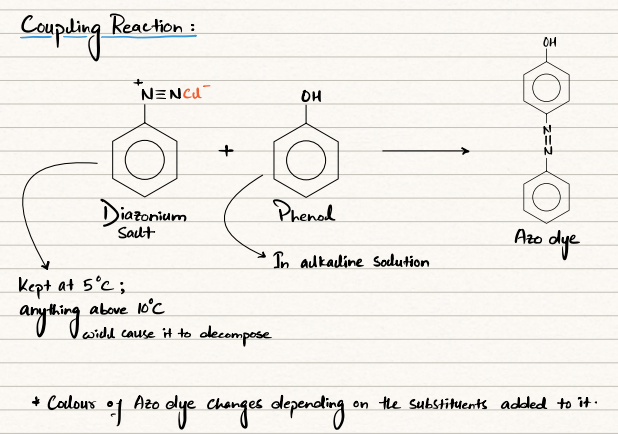
Common ion effect
A salt is less soluble in a solution which already contains the ions present in the salt.
If a solution containing one of the ions of the salt is added to a saturated solution, some of the salt will precipitate
Colour
Visible light hits transition metal ion, electrons excited to higher energy levels.
What affects delta E
High oxidation state = high E
More repulsion between ligands = high E
Copper and chromium electron configs
Cr = [Ar] 4s1 3d5
Cu = [Ar} 4s1 3d10
How to draw ion config transition
Take out of 4s orbital FIRST before taking out of 3D because filled 4s is higher in energy than 3d.
Why variable oxidation states
Due to small energy difference between 4s and 3d orbitals