comm1100 wk 3 + 4
 Call Kai
 Learn
Learn Practice Test
 Spaced Repetition
 Match
Match Flashcards
 Knowt Play
1/49

There's no tags or description
Looks like no tags are added yet.
Name | Mastery | Learn | Test | Matching | Spaced | Call with Kai | Chat |
|---|
No analytics yet
Send a link to your students to track their progress
50 Terms
What conditions must exist for perfect competition?
Firms sell homogeneous (identical) goods
Firms are price takers (cannot influence market price + must accept market price)
free entry/exit (Free entry and exit in perfect competition means there are no barriers, such as legal regulations, high startup capital, or patents, restricting firms from joining or leaving the market. This drives all long-run economic profits to zero, acting as a self-regulating mechanism for market equilibrium)
What is a monopoly?
A market with only one seller.
What is market power?
The ability to raise prices without losing many customers.
Why do most firms have some market power?
Because products are differentiated and firms face imperfect competition.
What is imperfect competition? Types?
A market structure between perfect competition and monopoly where firms have some market power
monopoly
Oligopoly (few large sellers eg: Coles Woolworths, Quantas Virgin)
monopolistic competition
What is monopolistic competition?
A market with many firms selling differentiated products.
What limits a firm's ability to set prices?
The demand curve it faces.
What is the demand curve faced by a monopolist?
What does the demand curve look like for a perfectly competitive firm?
A: The market demand curve.
A: A horizontal line at the market price.
Why is a perfectly competitive firm's demand curve horizontal?
Charging even slightly more causes it to lose all customers.
What happens to a firm's demand curve as competition increases?
It becomes more elastic (flatter)
What is a key determinant of price elasticity of demand?
Availability of substitutes.
What happens to demand elasticity when a product is highly differentiated?
Demand becomes less elastic (more inelastic).
How can a firm increase its market power?
By reducing competition or differentiating its product.
What is welfare economics?
The branch of economics that measures the social costs and benefits of economic activity and decisions.
What is economic surplus? What is consumer surplus? What is producer surplus?
Total benefits minus total costs from an activity.
Economic Surplus = Consumer Surplus (marginal benefit - price) + Producer Surplus (price - marginal cost)
(or marginal benefit - marginal cost)
The difference between what a consumer is willing to pay and what they actually pay.
How do economists measure economic efficiency? What is the efficient quantity?
By the amount of total economic surplus generated. More surplus = greater efficiency.
The quantity that maximises total economic surplus. when MB=MC
What three things do perfectly competitive markets achieve?
Production by lowest-cost producers.
Allocation to those with highest willingness to pay.
Production at the efficient quantity.
What happens if MB > MC or MB < MC?
MB > MC: Produce more → economic surplus increases.
MB < MC: Produce less → economic surplus increases.
MB = MC: Economic surplus is maximised.
What is market failure?
A situation where the market does not produce the economically efficient outcome (does not maximise total economic surplus).
What conditions are required for a perfectly competitive market?
Buyers are price takers.
Sellers are price takers.
Homogeneous (identical) products.
Free entry and exit.
Why can imperfect competition cause market failure?
Firms have market power due to product differentiation or barriers to entry, allowing them to influence prices and output away from the efficient level.
What are externalities? What is the difference between a negative and positive externality?
Costs or benefits imposed on third parties that are not considered by buyers and sellers.
Negative externality: imposes costs on bystanders (e.g. pollution).
Positive externality: creates benefits for bystanders (e.g. vaccination)
why is the marginal revenue curve steeper than the price curve on the graph
the firm must lower its price on all units sold to sell an additional unit
what quantity and price do monopolies vs perfect competition firms produce and charge?
Monopolies:
they produce quantity where mr = mc
they charge at this cost
Perf comp
What is the "market for lemons" problem?
Buyers may avoid beneficial transactions because sellers have more information about product quality, creating distrust and reducing market efficiency.
What are two limitations of maximising total economic surplus?
It ignores how benefits and costs are distributed.
It focuses on outcomes, not whether the process or decision was ethical.
Why markets
They produce the greatest economic surplus
Limitations of markets
Efficient allocations may not be equitable
willingness to pay reflects ability to pay
focuses on outcomes not how they were achieved
imperfect competition - charge price higher than marginal cost, produce less than efficient quantity - lost surplus
externalities
imperfect information (one party has info that other doesn’t)
week 4 !
What are the four core legal concepts affecting business decisions?
Control - what businesses can, cannot and must do
liability - responsibility for actions and harm caused
ownership - legal rights over property (including vehicles) and IP
agreement - legally enforceable relationships through contracts
What is the difference between an agreement and a contract?
An agreement is a mutual understanding, while a contract is a legally enforceable agreement.
What are the six key areas of law covered?
Competition, consumer, corporate, contract, privacy and property law.
What is the main competition law in Australia?
The Competition and Consumer Act 2010 (Cth).
Contract law
agreement (acceptance next but usually combined)
intention
consideration (valuable consideration eg: selling for $1)
Contract issues
. Privity of Contract
Only parties to a contract can enforce it.
A third party (someone not involved in the contract) generally cannot sue or be sued for breach of contract.
2. Unconscionability
A contract may be void if one party unfairly takes advantage of another party's special disadvantage or weakness.
Commercial Bank of Australia Ltd v Amadio (1983)
3. Agency Relationship (overcomes privity of contract)
Agent
A person who acts on behalf of another person when dealing with third parties.
person they are acting for is called the principal
Any/all parties may be an individual or a corporation
Principal
The person or organisation that the agent represents.
Example:
Real estate agent = Agent
Homeowner selling the property = Principal
anit competive bahvriour examples
Cartel conduct: competitors agree to fix prices, rig bids, share markets or restrict output.
Misuse of market power: a powerful firm uses its position in a way that has the purpose, effect or likely effect of substantially lessening competition.
Main Consumer Protections (Consumer Law)
Unconscionable conduct: businesses must not act in a seriously unfair or exploitative way.
Consumer guarantees: goods and services must work, be safe and match what was advertised.
Product safety: businesses cannot sell unsafe, banned or recalled products.
Fair contract terms: contracts must not unfairly disadvantage consumers or small businesses.
Fair sales practices: businesses must avoid unfair practices like pyramid schemes, unsolicited supplies or taking payment with no intention to supply.
How can a contract end?
By performance, agreement, frustration, convenience or breach.
Separate Legal Entity Principle? Benefits?
A company is legally separate from its shareholders, directors and management.
It protects directors and shareholders from personal liability for company acts.
What is constrained agency?
Managers have some discretion, but their choices are limited by competition and market conditions.
How is consumer surplus defined in a competitive market equilibrium?
Consumer surplus is the area above the demand curve and equilibrium price
Consumers are willing to pay more than the market price for the first few units
How does a negative externality affect the market outcome?
It causes the market to produce more than socially efficient quantity, resulting in lost economic surplus
What is the producer surplus at equilibrium given supply Q = 2P and equilibrium price P = 10? quantity Q = 20?
Producer surplus is equal to half the product of the quantity and equilibrium price because producer surplus is area above supply curve and below price, calculated as the triangle with base Q and height P. 0.5 × 20 × 10 = 100
How is total surplus affected when negative externalities exist but no government intervention occurs?
Surplus is smaller than optimal output because the market overproduces the good. External costs are not reflected in market prices, causing overproduction and deadweight loss that reduces total surplus.
Resale price maintenance
A supplier requires retailers to sell products at or above a specified minimum price.
Example
A manufacturer tells retailers:
"You cannot sell this product below $100."
Why It Is Problematic
Prevents price competition.
Keeps prices artificially high.
Under corporations law a company can:
incur debts
create contracts
sue or be sued
types of property law
real (land)
personal (vehicles)
intellectual (trademarks, patents, copyrights)
Why can’t a perfectly competitive firm lower/raise its prices?
higher - they would lose their customers as they would go to cheaper alternatives
lower - negative profit
Suppose that the price in a perfectly competitive market is above the equilibrium price. Explain how market forces will influence the price in the market
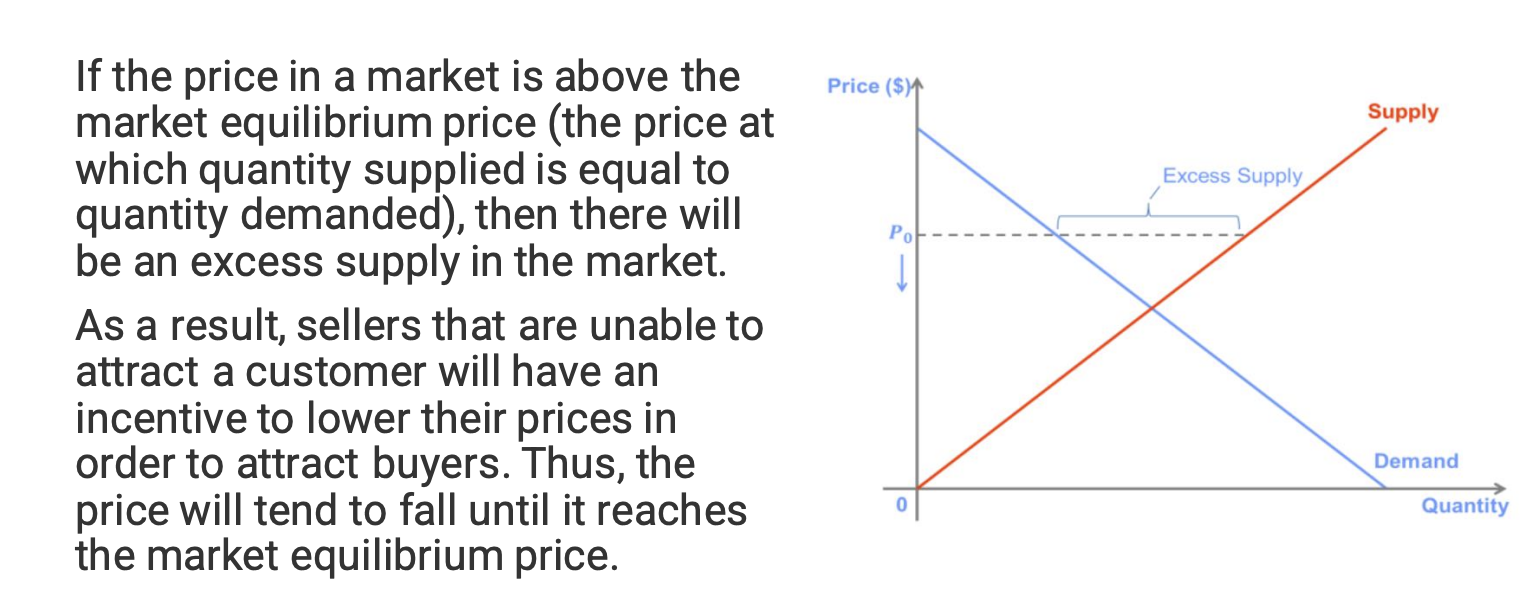
Explain why a firm with market power faces a downward sloping demand curve, while a perfectly competitive firm faces a horizontal demand curve.
A perfectly competitive firm has many competitors.
These competitors sell identical products.
Because products are identical, customers will buy from another firm if one firm charges a higher price.
This means a competitive firm is a price taker.
It can sell as much as it wants at the market equilibrium price.
But if it charges above the market price, it will sell nothing.
Therefore, a perfectly competitive firm faces a horizontal demand curve.
A firm with market power is large relative to the market or has some control over price.
It can increase price without losing all customers.
However, as price rises, it will still lose some customers.
Therefore, a firm with market power faces a downward sloping demand curve.
For a monopolist, the firm’s demand curve is the same as the market demand curve because it is the only seller.