Sensation & Perceptopm
 Call Kai
 Learn
Learn Practice Test
 Spaced Repetition
 Match
Match Flashcards
 Knowt Play
1/48

Earn XP
Description and Tags
Exam 1 Study Guide
Name | Mastery | Learn | Test | Matching | Spaced | Call with Kai | Chat |
|---|
No analytics yet
Send a link to your students to track their progress
49 Terms
Weber’s Law—Objective measurement (THE FACTS)
Can you detect a change or not? The just noticeable difference (JND) the bigger the stimulus, the bigger the change needs to be for you to notice it. (heavy weight needs more weight to be noticeable).
Fechner’s Law—Mathematical calculation with assumptions (THE THEORY)
What does the subjective sensation feel like? Based on Weber's data, but Fechner mathematically calculated what sensation should be like. Assumes all "just noticeable differences" feel equally big to your mind. Not always correct.
Steven’s Power Law—Flexible, realistic description (THEORY CHECKING)
How do people rate their subjective experience? Asks people to assign numbers to sensations (e.g., "How sweet is this?") Different senses follow different rules — some sensations grow fast with stimulus, others grow slowly
Recognizes that the relationship varies by sensation type.
Method of Limits
(GRADUAL) A measurement technique to find thresholds. In a hearing test, an audiologist plays tones that gradually get louder until you say "I hear it," then gradually get quieter until you say "I don't hear it anymore." The average of these crossover points is your threshold.
Method of Constant Stimuli
(SCATTERED) An audiologist plays tones of many different volumes—some barely audible, some very loud, some in between—in random order. You report whether you hear each one. After many trials, they plot which volumes you detected and which you didn't, finding where you detected sounds exactly half the time.
The method of limits is more efficient because it focuses only on stimuli near the threshold.
method of adjustment
(CONTROLLED) Instead of an audiologist playing tones at you, imagine you have a volume dial on headphones. You start with very quiet sound and gradually turn it up until you first hear it. Then you might start with loud sound and turn it down until it disappears. You're actively controlling when the stimulus changes.
Magnitude Estimation
(HOW INTENSE SENSATIONS FEEL) You're tasting different sugar solutions. One tastes mild, so you give it a "10." Another tastes twice as sweet, so you give it a "20." A third tastes three times as sweet as the first, so you give it a "30." These numbers reveal how your perception actually changes with stimulus intensity.
Cross-Modality Matching
(SOUND TO LIGHT MATCH) Imagine you're given a tone to listen to and asked to adjust the brightness of a light until it "feels" like it matches how loud the tone is. Even though sound and light are completely different senses, people can do this! You're essentially saying "this light brightness is as intense as that sound's loudness."
Question
What is a CRITERION?
your brain's decision-making rule for detecting whether something is actually there or not.
Criterion is flexible—you can adjust it based on how important it is to detect something. If you're waiting for a crucial call, you might lower your criterion, making yourself more likely to say "I hear it!" (though you might have some false alarms). If you're trying to focus and don't want distractions, you might raise your criterion, requiring a stronger signal before you respond.
hit, misses, and false alarms are…
response categories used to calculate independent measures.
1. Hits - You say "yes, I detect it" and the signal is actually there (correct detection)
2. Correct Rejections - You say "no, I don't detect it" and there's truly no signal (correct decision)
3. False Alarms - You say "yes, I detect it" but there's actually no signal (false positive)
4. Misses - You say "no, I don't detect it" but the signal is actually there (missed detection)
how long does a stimulus need to be present for someone to detect or perceive it? What is the method?
To get an accurate measure, researchers use a technique called masking. They present a target stimulus briefly, then follow it with a "masking" stimulus that stops further processing. The time between when the target stimulus starts and when the mask starts is called the stimulus onset asynchrony (SOA). This SOA reveals how long the brain actually needs to perceive something.
the amount of time needed to respond to a stimulus
can be measured by simple reaction time
how quickly a person will respond to a given stimulus?
Response times will vary depending on the sensory systems involved and the nature of the perceptual judgement.
motion aftereffects
Motion aftereffects reveal that motion detection works through an opponent-process system similar to color vision.
Your brain has neurons that detect motion in specific directions (like upward, downward, leftward, rightward). When you stare at downward motion for at least 15 seconds, the neurons detecting downward motion become adapted (tired). When you then look at something stationary, these adapted downward-sensitive neurons fire less, while the upward-sensitive neurons fire normally. Since the signals become imbalanced, your brain interprets this as upward motion—even though nothing is actually moving!
Change Blindness
The difficulty or failure to detect a significant change in a visual scene when that change occurs during a brief disruption (like a blank screen, a blink, or an eye movement). It proves our conscious visual awareness is highly limited.
Biological Constraint of Perception
The principle that our knowledge of the world is strictly limited by the physiological limits of our sensory organs and brain. What we cannot perceive is often just as biologically important as what we can.
Psychophysics
The scientific study of the quantitative relationship between physical stimuli (e.g., light intensity, sound frequency) and the psychological sensations/perceptions they produce.
Primary Sensory Areas
The specific regions of the cerebral cortex where sensory information from our eyes, ears, skin, nose, and tongue first enters the brain for advanced processing.
Sensory Receptors / Neurons
The fundamental cellular building blocks of the nervous system that transmit information via electrical impulses and chemical signals to allow perception to occur.
Bayesian Sensation/Perception Model
A mathematical framework proposing that the brain calculates the most likely interpretation of a sensory stimulus by constantly updating its "prior beliefs" (current assumptions) with incoming, real-time sensory data.
Rods
Multiple rods pool their signals into a single bipolar cell (high convergence). This makes them great for detecting faint light in the dark, but bad for fine detail HIGH SENSITIVITY LOW ACUITY
Cones
Cones often have a 1-to-1 connection to bipolar cells (low convergence), especially in the fovea. This preserves high spatial resolution (detail) but requires far more light to trigger a response. LOW SENSITIVITY HIGH ACUITY
Transduction (Visual)
The process of converting physical energy (light/photons) into electrical nerve impulses (neural action potentials) that the brain can interpret
Phototransduction (Mechanism)
Occurs in the outer segments of rods and cones. Light hits photopigment molecules (like rhodopsin), triggering a biochemical cascade that hyperpolarizes the photoreceptor, altering its neurotransmitter release.
Sensitivity vs. Acuity Trade-off
High Sensitivity (Rods): High convergence (many photoreceptors pool to one ganglion cell). Maximizes light detection but loses spatial detail.
High Acuity (Cones): Low convergence (1-to-1 mapping in the fovea). Maximizes spatial detail but requires bright light.
Retinal Ganglion Cell Receptive Field
The region on the retina (and the corresponding area in the visual field) in which light stimulation influences that neuron's firing rate. Characterized by a concentric "center-surround" antagonistic organization.
Center-Surround Antagonism
A receptive field organization where stimulation of the center of the field has the opposite effect of stimulating the surround (e.g., light in the center excites, while light in the surround inhibits). This enhances the perception of edges and boundaries.
Simulated Scotoma
AMD: AMD results in central visual field loss which can make it difficult to perform everyday tasks, such as recognizing faces.
RP: Progressive degeneration of rods in the peripheral retina, leading to "tunnel vision" and night blindness.
Phototransduction
converting light energy into neural energy—is the crucial first step in sensing light so that objects and surfaces can eventually be perceived.
Ganglion Receptive Fields
illustrates the patterns of light that ganglion cells, the neurons that actually transmit information from the eye to the brain, respond to.
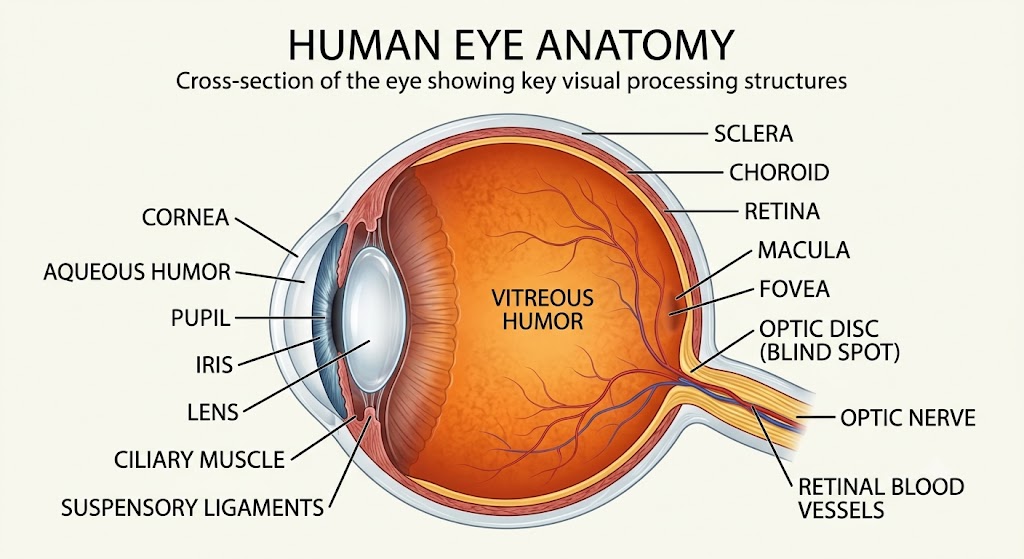
eye anatomy
cornea, pupil, iris, lens, optic disc, fovea, retina, optic nerve
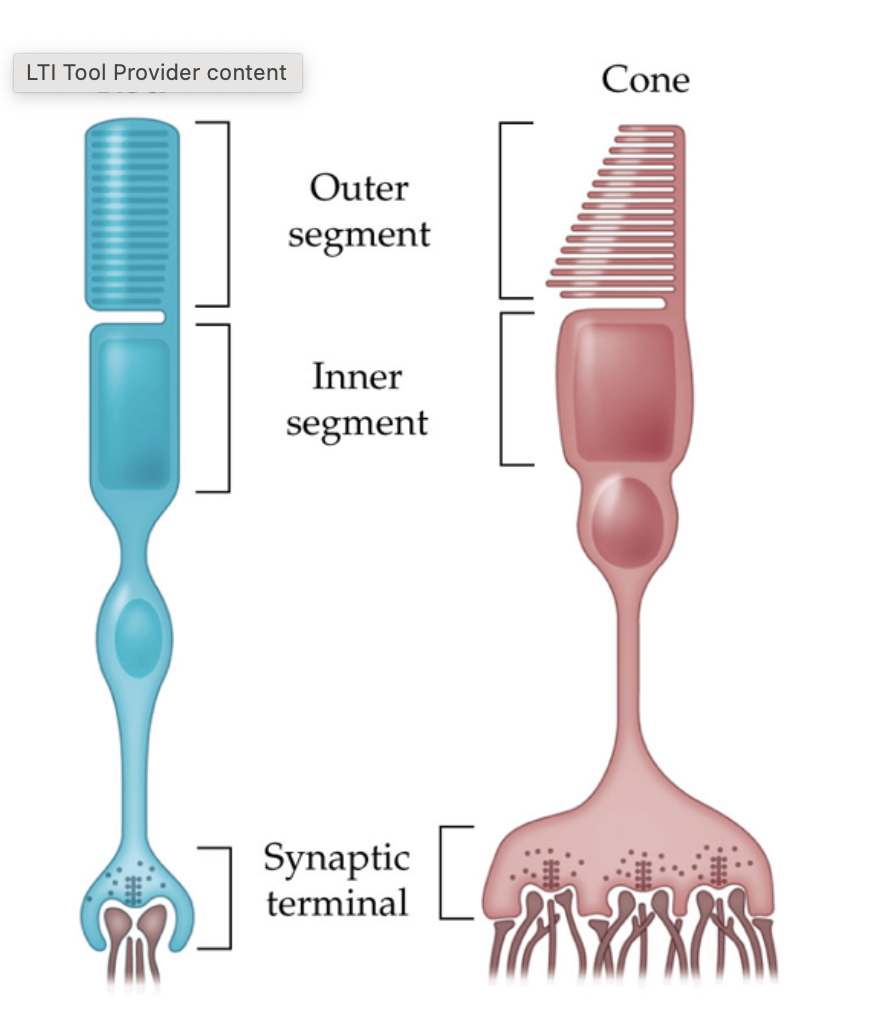
which is the rod, which is the cone, and how can you tell them apart anatomically?
Blue: Rod. I has a cylindrical, rod-like outer segment. A photoreceptor cell in the retina that is highly sensitive to light, allowing for vision in low-light (scotopic) conditions.
Pink: Cone. It has a tapered, cone-like outer segment. A photoreceptor cell in the retina that is specialized for high-acuity (sharp, detailed) vision and color perception in bright-light (photopic) conditions.
The "Spots to Stripes" Transition How does the representation of visual information change from the Retinal Ganglion Cells (RGCs) to the Striate Cortex (V1)?
RGCs: Respond to "spots of light" (center-surround receptive fields).
Striate Cortex (V1): Responds to "stripes," "bars," or "edges" of light at specific orientations.
Define Visual Angle and identify the two factors that determine it.
The angle of an object relative to the observer's eye, which determines how much space the object takes up on the retina.
Determined by: 1. The actual size of the object. 2. The distance of the object from the eye.
Note: A small object close up can have the same visual angle as a large object far away.
What is Cortical Magnification?
The fact that the amount of cortical area (in V1) devoted to the fovea is much larger than the area devoted to the periphery. Even though the fovea is small, the brain gives it massive "processing power" to ensure high resolution.
Why do vision scientists use Sine Wave Gratings or Gabor Patches to study V1?
Because neurons in the striate cortex are "tuned" to specific spatial frequencies (sizes) and orientations. These stimuli are the "ideal" inputs to trigger a response from V1 neurons.
What is the concept of Fourier Analysis in the context of perception?
A mathematical process that breaks down any complex visual image (or sound) into a set of simpler sine wave components. The brain is thought to analyze scenes by "filtering" these different spatial frequencies.
What are the three main features a bar of light must have to excite a specific neuron in the Striate Cortex?
Orientation: It must be tilted at the correct angle (e.g., vertical vs. horizontal).
Size (Spatial Frequency): It must be the correct width.
Location: It must fall within the specific part of the visual field the neuron monitors.
Define a Hypercolumn in the visual cortex.
A 1-millimeter block of striate cortex that contains "all the machinery" necessary to look at one tiny path of the visual world. It includes neurons representing all possible orientations and inputs from both the left and right eyes.
What is Hyperacuity?
The ability to perceive spatial differences (like whether two lines are aligned) that are smaller than the spacing between individual photoreceptors in the retina.
What is Object Ambiguity (sometimes called the inverse projection problem), and why is it a challenge for the visual system?
The Problem: The retina is a flat, 2D surface, but the world is 3D. An infinite number of different 3D shapes can cast the exact same 2D shadow/image onto the retina.
How the Brain Solves It: The brain uses heuristics, past knowledge, and "rules of thumb" to guess the most likely 3D shape causing the 2D retinal pattern.
What are Gestalt Grouping Principles? List at least 4 key examples.
A set of rules or heuristics the visual system uses to organize small, individual elements of a scene into a single, cohesive group or object.
Examples:
Similarity: Grouping elements that look alike (color, size, shape).
Proximity: Grouping elements that are physically close to each other.
Good Continuation: Preferring to see smooth, continuous lines rather than sharp, abrupt changes in direction.
Closure: Filling in gaps to perceive a complete, enclosed figure.
Common Fate: Grouping elements that move together in the same direction.
What is Figure-Ground Assignment? What are some cues the brain uses to decide?
The process by which the visual system determines which parts of an image belong to the foreground "object" (the figure) and which parts belong to the background (the ground).
Cues used:
Surroundedness: If one region is entirely surrounded by another, it's likely the figure.
Size: The smaller region is usually perceived as the figure.
Symmetry: Symmetrical regions are more likely to be seen as figures.
Parallelism: Regions with parallel contours tend to be grouped as a figure.
Explain the concept of "Perception by Committee" and how the Pandemonium Model represents it.
Concept: The idea that different parts of our brain calculate different, sometimes conflicting, rules of perception at the exact same time. The final perception is the "consensus" of these competing groups.
Pandemonium Model: A classic, hierarchical model of letter recognition where different "demons" (neurons/brain modules) scream based on features they detect:
Feature Demons: Detect simple lines/angles.
Cognitive Demons: Listen to feature demons and "shout" if they think they see a specific letter.
Decision Demon: Decides which letter is being seen based on which cognitive demon is screaming the loudest.
What is the difference between Feed-Forward and Re-Entrant processing?
Feed-Forward: The incredibly fast, initial "first pass" of visual information. Signals travel straight up the visual pathway from V1 to high-level object areas ($< 150 \text{ ms}$) without feedback.
Re-Entrant (Feedback): A slower process where higher brain areas send signals back down to lower-level visual areas to confirm details, resolve ambiguity, or focus attention. (Demonstrated by Object Substitution Masking).
Contrast Viewpoint Invariance (structural descriptions) with Viewpoint Dependence (views/templates).
Viewpoint Invariance: The theory that our brain recognizes objects by breaking them down into basic 3D parts (like "geons"). Because of this, we should be able to recognize an object equally fast from any angle.
Viewpoint Dependence: The theory that we store 2D "mental snapshots" of objects from specific angles. If we see an object from a novel angle, our brain has to mentally rotate it to match a stored template, which takes more time.
Reality: The brain likely uses a mixture of both depending on the complexity of the task.
What is the Face Inversion Effect and what does it tell us about how we process faces?
The finding that recognizing and processing faces is catastrophically disrupted when they are turned upside down—far more than any other type of object (like houses or cars).
What it tells us: We process upright faces holistically / configurally (paying attention to the precise spatial relationships between eyes, nose, and mouth), but we process inverted faces and regular objects part-by-part.
Define Prosopagnosia and identify the brain area typically associated with it.
An inability to recognize faces, despite having completely normal vision and intact general intelligence. People with prosopagnosia can see the parts of a face (eyes, nose) but cannot put them together to identify who the person is.
Brain Area: Frequently associated with damage or developmental differences in the Fusiform Face Area (FFA)located in the fusiform gyrus of the temporal lobe.
damage to frontal lobe alters which sense?
smell