Gov 370E Theriault Midterm #1
 Call Kai
 Learn
Learn Practice Test
 Spaced Repetition
 Match
Match Flashcards
 Knowt Play
1/177

There's no tags or description
Looks like no tags are added yet.
Name | Mastery | Learn | Test | Matching | Spaced | Call with Kai | Chat |
|---|
No analytics yet
Send a link to your students to track their progress
178 Terms
Congress of Confederation
Pre-Constitution
Unicameral
Congress of Confederation — How did the chamber function? What was a major function they were in charge of?
Unicameral
2-7 representatives from each state
Appointed by state legislature
Each rep. had 1 vote
Each rep. served no more than 3 yeas within a 6 year period
Elected a president for their chamber who served 1 year in any of their 3 years
Similarities between Congress of Confederation and Modern Congress
1 vote per state
Elect a speaker
States have different numbers of members
Constitution — Article 1. Who can run for HoR?
25+
Citizen for 7 years
2 year terms
Have to reside in state on day of election (NOT district) (Someone in Houston could run in Austin)
Constitution — Article 1. HoR Term Limits
2 year terms
No term limit
Constitution — Article 1. Who can vote in HoR elections?
Anyone who can vote federally can vote in HoR election
Constitution — Article 1. HoR Vaccancies
Replacement only through special elections
Must be called by state governor/election official
No temporary appointment
Seat stays empty until special election
Constitution — Article 1. Who can run for Senate?
30+ years old
9 year citizen
Resident on election day
Constitution — Article 1. Senate Term Limits
6 year term
Staggered (Only 1/3 active at a time)
No term limit
Constitution — Article 1, 7th Amendment. Senate Vacancies
Governors can make temporary appointments OR can run a special election
Few states require special elections
Some states require appointed senator be of the same party as the one who left
Constitution — Article 1. How are election disputes handled (both Senate and HoR)
The people within the respective chamber decide who wins
What is Reapportionment? How does it work? (Article 1, Section 3)
Decides how many seats each state gets
Decided based on census every 10 years
1 rep per 30k people (no longer applies, capped at 435 seats)
When reapportionment happens, redistricting happens
Which chamber is directly affected by reapportionment? Why?
Only HoR is affected by reapportionment
Decided based on state population, unlike Senate where every state has 2 senators
What is Redistricting? How does it work?
The restructuring of congressional districts
Supposed to happen every 10 years
Districts should have as close to even numbers of people as possible within the same state
Gerrymandering
Drawing districts in an attempt to get certain outcomes
Supreme court decides when gerrymandering is actually gerrymandering
Packing
Putting as many people within the same unwanted party into one district as possible (TX 37/Lauren Pena’s district)
No voice from unwanted demographic
Intended demographic wins due to unwanted demographic having no chance in other fully packed districts

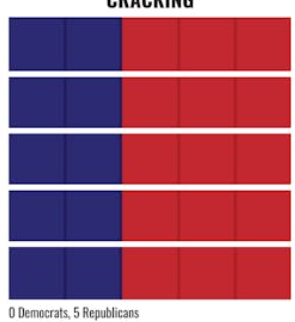
Cracking
Breaking apart a party across multiple districts where they are the minority
No interference from the unwanted demographic
Slightly more risky, small chance for members of intended majority to not vote in the expected way
unwanted demographic is fractured into districts where they are the minority in comparison
Stacking
Wants some input from unwanted demographic, but still heavily favors the other
Much riskier than Packing or Cracking
Unwanted demographic has a voice
Works best and is made for when the intended demographic is the minority

Texas v California National Redistricting Story
Texas redistricts in 2020 after Trump called Abbott
Some house republicans were hesitant due to heightened competitiveness within their district
Significantly lessened democrat influence
California redistricts in retaliation
lessens republican influence'
Band wagoning happens nationally
Alabama, Missouri, N. Carolina, Tennessee, Utah
Some states were forced into gerrymandering after supreme court claimed their districts were racially based and, therefore, illegal (Louisiana, Ohio)
What is the public opinion of Gerrymandering?
Bad.
Federalists 52-53 — How long should a House term be?
Madison argues 2 years
Perfect balance between public accountability & legislative competence
Federalists 52-53 — How does Madison justify the 2 year HoR terms creating balance? (5 reasons)
Single state laws are less complex
Fed. government handles FP
Travel + Accommodations (traveling by horse to every single year for meetings would be evil)
Yearly elections lead to oversight (Corrupt politicians have less time to get caught)
2 years gives just enough time for politicians to remain detached but not enough to become tyrannical
Federalist 62-63 — Why create a Senate?
P.O.I.S.E
Patriotism & pride (Breeds patriotism through a sense of national character & collective pride)
Overtime perspective (Longer term timeframe gives more time between terms to consider issues)
Institutional stability (6-year staggered terms ensure laws will not suddenly change with brief changes in public mood)
Security checks (Provides double security through checks & balances)
Emotional barrier (Stops sudden passions and resists waves of national anger/excitement)
What Congress are we currently in? What/When was the last congress? When was the 1st congress?
119th Congress (2024)
118th, 2022
1st, 1788
What happens to the majority in congressional chambers between presidencies?
Majority flips to the opposing side of the president
ex:
Trump gets voted in 2016, Congress majority is Republican
Midterm elections happen, democrats take majority
Democrats gain bigger majority when Biden gets elected in 2020
Which house has a the bigger majority? Why?
HoR has a bigger majority than the Senate. It is harder to flip the senate than the HoR because the senate relies on a state-wide vote & only 1/3 of the senate is up for election at a time
What is a major conflict in Ohio elections?
Data centers
What are the 2 rules for congressional elections?
Incumbent wins (99% of the times, which is worrying)
President’s party loses seats (in HoR)
Why are democrats more easily gerrymandered?
Democrats tend to congregate in big cities
How are the 2026 special elections going?
Republicans are struggling
6.6 points worse than the 2024 elections
Democrats are doing amazing in comparison
10.4 point improvement
Why should we take voting data from special elections with a grain of salt?
Special elections have lower voter turnout
Gives more weight to those who are more enthusiastic to vote
Midterms have a broader electorate
How many total democratic congressional districts are there?
205
How many Republican congressional districts are there total?
209
What are the 2 rules for Senate elections?
Incumbents win
They get less seats in the next election cycle
In the districts that Kamala won in 2024, how many would the democrats have to win to get senat majority?
All of them up to the 43.3% point
What has the special elections shown us about who is overperforming? Why? By how much?
Democrats are overperforming by almost 11% due to higher voter enthusiasm and the historical midterm trend of the opposing party of the president overperforming in the midterms
How is Trump’s approval rating?
Significantly lower than when he was elected (Under 40%)
Who won the South Carolina Runoff?
Alan Wilson
Who currently controls the House
Republicans
Who currently controls the Senate?
Republicans
What is science?
The accumulation of knowledge
What are dependent variables in political science?
The outcome, effect, or behavior that the researcher is trying to explain
What are the independent variables in political science?
The individuals within the government institutions and the rules that guide them
What are the 6 steps of scientific method?
Define the study (Did you vote for a republican?)
Develop a hypothesis (You’re more likely to be republican if you’re christian)
Gather data (run survey asking is people are christian, if they voted republicans, & other key questions)
Match the data to the hypothesis (excel spreadsheet)
Revise hypothesis (You’re more likely to be republican if you are christian and caucasian)
Becomes a law of political science when your result is pristine & solidified
What is the definition of a law in the study of political science? What are other examples of laws in this sense?
Something that has become known fact within the study (The law of the conservation of energy, the law of inertia, the laws of gravity)
MOC = SMSR
Members of Congress = Single Minded Seekers of Reelection
Aside from reelection, what are the other goals of Members of Congress?
Pass good public policy
Gain more prestige within the institution
Serve the majority party
Where does reelection fit into the priorities for Members of Congress? Why?
Reelection is the main goal for members of Congress
Necessary to achieve secondary goals (passing good public policy, gaining more prestige within the institution, serving the majority party)
What are the 3 activities for Members of Congress? Describe each one
Advertise themselves and their campaign (creating brand/name recognition)
Credit Claim (convince actors that they (congress members) personally had a hand in something the government did that is perceived as positive)
Position Taking (having an opinion on topics the public is concerned about)
What does Mayhew say congress members must be cautious about when position taking?
They must be careful to not have voting patterns that are too broad. Attempting to appeal to too many audiences may cause them to lose trust in their core constituents.
Define ‘Particularized Benefits’
Specific advantages and services distributed by the government
What are the 2 properties of particularized benefits?
Each benefit is given to a single individual, group, or geographical constituency
The scale of the recipient must be small enough for a single Member of Congress to recognized and realistically claimed
Each benefit is given out in an apparently ad hoc fashion to make the congress person seem like they played a massive role
Ad Hoc Fashion: Handling an immediate problem with a temporary or improvised solution instead of a pre-planned systemic approach
What type of accomplishment should Members of Congress focus on during Credit Claiming?
Individual Accomplishments
Mayhew — What 7 qualities should congress members emphasize during advertising?
Experience
Knowledge
Responsiveness
Concern
Sincerity
Independence
What is Mayhew’s opinion on name recognition?
“To be perceived at all is to be perceived favorably”
What facilities do members of congress have to aid their campaign process?
Offices
Committees
Parties
Mayhew — Why are offices so beneficial for congress members?
offices act as both management firms & political machines
Management : Constant staff availability
Political Machine: Casework capabilities
Mayhew — Why are committees so beneficial for congress members?
Can be good platforms for position taking
Some committees bring a lot of particularized benefits
function under universalism
Allows congress members to divide labor amongst each other
makes credit claiming easier
Mayhew — What is universalism?
Congress members working together to get bills on to the floor despite their party affiliations
Mayhew — Why are parties so beneficial for members of congress?
Act as an organizational apparatus to sort electoral ideals
Provide leadership hierarchies
Help further name/brand recognition
What is the correlation between facilities congress has to help get reelected and the reelection rate of incumbents?
The 3-part structure of offices committees, and parties is the absolute optimal system to promote their reelection.
What are the goals of the president for each term?
1st Term — Reelection
2nd Term — Legacy
What is currently President Trump’s legacy?
Extravagance in architecture (ballroom, gold plating, etc.)
Stop nuclear weapon production in the middle east
Continuation of the MAGA movement
What are the goals for Bureaucrats?
Lower interference
More freedom & ability to do their job as they see fit
What are the goals of Supreme Court Justices?
Legacy
Do NOT worry about reelection
What are the goals of parties?
Winning elections
Winning the majorities in Congress
What are the duties of Members of Congress?
Represent their constituents
Legislative (develop policy, vote on policy, etc.)
Oversee other institutions
Be good party members
Why study congress over other things?
Understanding motivations (predicting political behavior)
Gathering and understanding data (Elections give major data more often than other 4 year elections)
Easier to understand constitutional framework
Most representative of the nation within a certain timeframe
More members to study
More districts to study
Mayhew — What does Expected Incumbent Differential mean?
The difference between what incumbents may do if they return to office vs. what the opposition would do
Mayhew — What is the most vital campaign resource?
Money
Mayhew — Should Congresspeople’s behavior be categorized as maximizing behavior? Why or why not?
No
The goal is to stay in office, not maximize votes
Congressmen act in an area of high uncertainty
Experimenting risks irritating their voters
They already won twice (general + primary), if it ain’t broke, don’t fix it
How many committees are currently active in Congress?
40 committees
How many committees are currently in the House?
20 standing committees, 2 select committees
How many committees are currently in the Senate?
16 standing committees, 4 select committees
How many joint committees are there currently?
4 joint committees
What is a standing committee?
A committee that is permanent
What is a select committee?
A committee that is temporary and that is used for specific tasks and investigations
Which do modern campaigns focus more on: Candidates or Party? What impact does this have on the candidates?
Candidates, despite the power of national influences
National party organizations have majorly expanded efforts to recruit and finance campaigns but are still dependent on individual politicians to win
Individual candidates take on most of the risks, pains, and rewards of campaigning
What was a major concern about the constitutional framework for congress? Why?
Representation
Big States: Want representative numbers to be decided by population
Small States: Worried they’ll be drowned out if representative numbers are decided on population, wanted equal reps for each state
What bigger issue did the concerns about determining the number of seats for legislature raise?
Should the government be a national one and represent national citizenry, or should it be a federal one representing sovereign states?
What was the Great Compromise for the legislature?
Bicameral Legislature
House of Representatives will be based on population as to satisfy bigger states
Senate will consist of 2 senators from every state to satisfy smaller states
What year was the membership cap for the HoR established?
1910
What was the 1920 Census Crisis? What was the result of it?
1920 Census Crisis : Lots of people moved to big cities between 1910-1920, meaning seat losses would be majorly skewed towards urban areas
Result: 1929 decision to reapportion after each census
What did the 1964 Wesberry v. Sanders case establish?
1 person, 1 vote — voting district populations must be as close to one another as possible
What was the criticism against non-citizens (especially latinos) from conservatives? Did the 2016 supreme court agree or disagree?
Only eligibile voters should be counted in reapportionment calculations, not the actual population
Shut down by 2016 supereme court
What did the Trump admin try to do change about the 2020 census? Why? What did the Supreme Court say in response?
2018: Trump admin tried to get 2020 census to ask about citizenship status
Would discourage non-citizens from filling it out, which would affect democratic voters as non0citizens tend to lean towards the democratic party
2019: Supreme Court shuts that down because it was “done for disingenuous reasons”
After the Wesberry v. Sanders decision, what strategy was turned to instead?
Gerrymandering
Why is gerrymandering easier to calculate than to actually put into action?
Changes may conflict with other political necessities (ex: changing the voting demographic for incumbents)
1986 Davis v. Bandemer
Egregious partisan gerrymandering is unconstitutional
2002 Vieth v. Jubelirer
Supreme Court cannot block partisan/political gerrymandering because there is no clear rule to decide when a political map goes too far, but left the door open for future gerrymandering attempts
What happened in 2004 regarding the Vieth v. Jubelirer case?
Supreme Court rejects a challenge to the case, upholding the decision
2019 Rucho v. Common Cause
Federal court have no power is reviewing partisan gerrymandering, resulting in states doing what they wanted after 2020 census
What happened in 2002 when Colorado tried to redistrict early?
Blocked by Supreme Court due to an in-state law saying they can only redistrict every 10 years
What is the story of the 2002 Texas redistricting?
Texas successfully gets permission to redistrict in favor of republicans
Democrats try to stop it by fleeing en masse twice (to New Mexico and Oklahoma) to prevent legislative action
Democrat retaliation fails after 5 months and 2 special elections
What was the goal of 2006 Citizens v. Perry? What actually came of it?
Goal: To challenge the Texas mid-decade redistricting saying that the partisan redistrict diluted the voting power of latinos (voting rights act violation)
Result: Forced Texas to draw new district lines that do not violate VRA, resulting in a much more levels and fair playing field
1986 Thornburg v. Gingles
Resulted in the Voting Rights Act
Voting Rights Act (VRA)
Established by 1986 Thornburg v. Gingles court case
You cannot discriminate against racial minorities by interfering with the power of their vote, even unintentionally
What still happens despite the 1986 Thornburg v. Gingles court case ruling?
Racial gerrymandering, which is much more effective than partisan gerrymandering
1993 Shaw v Reno
Creating weird shaped districts to concentrate minority voters may violate the constitutional rights of white voters
What resulted from the 1995 Miller v. Johnson court case?
Race cannot be a major factor in deciding district lines due to constitution’s guarantee to equal protections
Resulted in a multitude of districts being considered unconstitutional