business law #1
 Call Kai
 Learn
Learn Practice Test
 Spaced Repetition
 Match
Match Flashcards
 Knowt Play
1/140

Earn XP
Description and Tags
kill me
Name | Mastery | Learn | Test | Matching | Spaced | Call with Kai | Chat |
|---|
No analytics yet
Send a link to your students to track their progress
141 Terms
stare decisis
a higher court's decisions are binding on lower courts. Stare decisis helps courts be more efficient and stable because having precedent saves time and creates predictable legal outcomes. Stare decisis is for the judicial branch. It can be overruled by a later decision of the United States Supreme Court, or perhaps by the legislative branch with a constitutional amendment, or even a new congressional law.
Primary function of law
to provide stability in social, political, and economic systems while simultaneously permitting change.
Blue laws
known as Sunday laws, are laws designed to restrict or ban certain activities on Sundays to promote a day for rest and worship
-these laws have historical roots in religious activities
-have religious historical roots like Christianity, intended to encourage the observance of the Sabbath
-Blue laws are a historical example of the intersection between law, religion and society.
Rule of Law
applies the law to every individual the same regardless of background etc. Everyone is held to the same law and the public shares an understanding of those laws
Law and Business
-law and government regulations affect almost all business activities.
-Making good business decisions is to gain a basic knowledge of laws and regulations governing activities is very important
-Business people must develop critical thinking and legal reasoning skills so that they can elevate how various laws might apply to specific situations and find the best solutions.
Business Decision Making
-Contracts
-Environmental law and stability
-Internet law, social media and privacy
-Sales
-Product liability
-Intellectual property
-Torts
Ethics & Business Decision Making
Business decision makers need to use both legal and ethical decisions
-ethics is defined by what is right or wrong behavior
-many underlying reasons for lawsuits in unethical duties and decisions. Many legal conflicts involve ethical issues that usually cannot be ignored
Primary Sources of Law
the constitution (U.S. and State)
-Statutory Law (passed by congress, state legislatures, and local gov bodies)
-Administrative Regulations (created by Fed and State Administrative Agencies)
-Cases and Common Law (Federal and State Cases and common law doctrines)
Constitutional law
the supreme law of the land and the main basis of all laws in the U.S (A law in violation of the constitution )
-a law in violation of the constitution, if challenged will be declared unconstitutional and will not be enforced, no matter the source.
-each state in the union has its own constitution
Statutory Law
The body of law enacted by legislative bodies (as opposed to constitutional law, or case law).
Federal and State Statues- Federal is passed by Congress and applies to all states while State is passed by a state legislature and only within those state borders
Uniform Law
A model law created by the National Conference of Commissioners on Uniform state laws and or the American Law Institute for the states to consider adopting
Case Law
rules of law announced in Court decisions, governs all areas not covered by statutory law or administrative law and is part of our common law traditions
Interprets: Statues, Regulations, Constitutional provisions, and other case law
Common Law
The body of law developed from custom or judicial decisions in English and U.S. courts, not attributed to legislation
Remedy
-The relief given to an innocent party to enforce a right or compensate for the violation of a right
Court of Law
-A court in which the only remedies that can be granted are things of value, such as money damages
Remedies at Law
-A remedy available in a court of law
Damages
-A monetary award sought as a remedy for a breach of contract or a tortious act
Administrative regulations
the body of law created by administrative agencies in order to carry out jobs and responsibilities.
Injunction
To ask the court to make a decree to prevent someone from doing something, for example to prevent the formation of a union
Equitable maxims
-1. whoever seeks equity must do equity (treat others the way you would be treated)
-3. One seeking the aid of an equity court must come to the court with clean hands (plaintiff must have acted honestly and fairly)
-5. Equity regards substance rather than form (equity is more concerned with fairness and justice than with legal technicalities)
-6. equity aids the vigilant, not those who rest on their rights(equity will not help those who neglect their rights for an unreasonable period of time)
-2. Where there is equal equity, the law must prevail. (The law will determine the outcome of a controversy in which the merits of both sides are equal)
-4. Equity will not suffer a wrong to be without a remedy. (Equitable relief will be awarded when there is a right to relief and there is no adequate remedy at law)
Procedure/Action at Law/Action in Equity
Initiation Lawsuit -filling complaint- filling a petition
Decision -by jury or judge- by judge
Remedy -Monetary damages or property- injunction or rescission
Controlling precedents- precedents that must be followed within a jurisdiction are controlling
Precedents-binding authority- any source of law that a court must follow
while deciding a case
Persuasive Authority
Any legal authority or source of law that a court may look to for guidance but need not follow when making its decisions
Jurisprudence- Science Philosophy of Law
Natural law school
The oldest school of legal thought is based on the belief that the legal system should reflect universal moral and ethical principles that are inherent to human nature.
-A higher law applies to all human beings.
-if each written law does not reflect the principles inherent to natural law then it loses its legitimacy and not be obeyed.
The Natural Law School
-oldest school of legal thought
-Legal System should reflect universal moral and ethical principles
Natural Law Theory
-higher law applies to all human beings
-if each written law does not reflect the principles that are inherent, then it loses legitimacy and need not be obeyed
-notion that all have natural rights stem from natural law tradition
Natural Law Connection
These rights are treated as inherent, not granted by the gov. Moral law supersedes positive law, people shouldn’t be forced to violate moral beliefs even if legal
Civil Disobedience
When individuals break the law to protect injustice
“An unjust law is no law at all”
Cons of natural law
modern rights is heavily grounded in natural law principles
Conscience based objections in healthcare
healthcare professionals asserting moral objections to certain procedures
-refusing assisted suicide
Pharmacists objecting to dispense certain medications
Legal Positivism
A school of legal thought centered on the assumption that there is no law higher than the laws created by the national government, laws obeyed even when unjust to prevent anarchy
Mandatory sentencing
Positivist logic: the statute was properly enhanced, the court must apply it. Personal moral disagreement is irrelevant.
Example: judges impose mandatory prison sentences even when they believe the punishment is excessive. - sentencing guidelines limit judicial discretion.
The Historical school of law
a school of legal thought that looks to the past to determine what the principals of contemporary law should be
-legal doctrines that have worked through the passage of time, those that have been used in the past, that are best suited for present laws.
-Emphasizes the evolutionary process of law by concentrating on the origin and history of the legal system
Savigny’s Influence
-Argued law reflects the societal spirit of the people
-set philosophical ground work for historical school cases
Mabury V. Madison
-established judicial review and rooted authority in constitutional structure
-Historical School relied on constitutional tradition, and historical role of courts, not policy innovation
District of Columbia v. Heller
-Interpreted the second amendment and examined the 18th century understanding of arms
-turned original historical meaning, not modern policy outcomes
Lochner v. New York
-Court struck down labor protections based on abstract liberty of contract, later courts rejected this formalism
Legal Realism
a school of legal thought that holds the law is only one factor to be considered when deciding cases and that social and economic circumstances should be taken into account.
-legal realists believe that the law can never be applied with total uniformity
- because judges have different personalities, values, and intellects, different judges will bring different reasoning processes to the same case.
Sociological school
a school of legal thought that views the law as a tool for promoting justice in society
What is ethics?
fairness- making decisions objectively, consistently, and without favoritism while treating all with equity and respect
Rightness: acting in a morally correct and ethical manner, even when no law or rule requires it.
Justness-the quality of being morally right and fair, everyone gets equal treatment on principles of justice
Wrongness- engaging in morally wrong actions
The role of business in society
originally of a corporation was to maximize profits and and make revenue for its owners.
-the rationale for the profit-maximization theory is still valid.
-efficient allocation of scarce resources
-business as a corporate citizen: over the years many people disliked the profit-maxxing theory, and businesses came to be viewed as “citizens” that were expected to participate in bettering communities and societies.
Triple bottom line
corporation’s impact on people and the planet
Business Ethics
a consensus of what constitutes right and wrong behavior in business and the application in the business setting
Moral Minimum
minimal acceptable standard for ethical business behavior is compliance with the law
Ethical Requirement
Acting ethically can include doing what’s right for society
Private code of ethics- company codes of conduct outline policy and how employees are expected to act
Industry Ethic Codes
Professional associations also issues codes of ethics
Business ethics benefits..
business ethics is hella important because it can improve profitability Business ethics is also linked to customer loyalty
-Three in 10 consumers will express support for ethical companies on social media
Importance of Ethical Leadership
-Fostering of unethical conduct (business owners and managers sometimes take more active roles in fostering unethical and illegal conduct, with negative consequences for businesses.)
-Attitude of Top Management (create and maintain ethical workplace/decisions making)
-Unrealistic Goals for Employees (a manager who looks the other way allows employees unethical behavior
relationship with law and ethics

cross between ethics and law

Ethical Philosophies
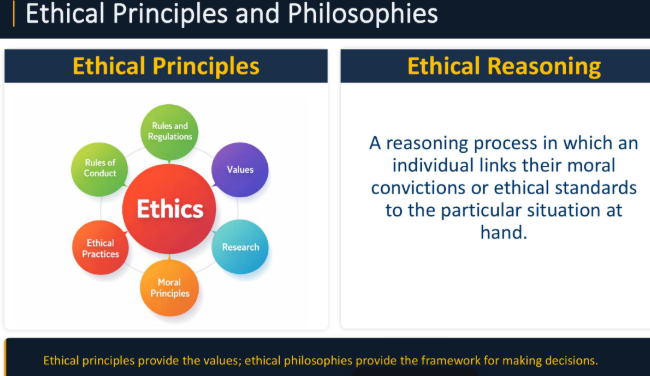
ethical principles and reasoning

Duty Based Ethics
ethical philosophy rooted in the idea that every person has certain duties to others:ethical fundamentalism, deontology, ethical relativism
Outcome Based Ethics
focuses on the impacts of a decisions on society or on key stakeholders
-utilitarianism, social ethics theories, other theories
Ethical Fundamentalism
individuals look to a central authority or set of rules to guide their decisions
Religious Ethical Principles
-rules about how to treat others
-can unify employees, increase motivation
-can also make problems when different people have different beliefs
How do religious ethical principles appear in business?
-refusal to adapt policies despite stakeholder harm
-justifications framed as duty, policy, or authority
-resistance to ethical nuance or compromise
Pharmaceutical Pricing Policies
-Strict adherence to shareholder return pricing models
-life saving drugs overpriced
-lack of compassion/flexibility
-ethical defense framed as fiduciary duty
Technology and free speech absolutism
platforms adopt minimal content
Strengths of ethical fundamentalism
-clear and predictable ethical standards
Weakness of Ethical Fundamentalism
-ignores human social consequences, can erode trust or escalate legal/ethical risks
Deontology
a moral theory that emphasizes the importance of moral rules or duties in guiding ethical decision making. Certain actions are inherently right or wrong regardless of consequence
Examples:
Respect for Rights: a doctor does not do a procedure without consent. Deontological because respects human rights is a duty not replaces by efficiency
-ignores human social consequences, can erode trust or escalate legal/ethical risks
-tell the truth and protect life, protect life outweighs
Kantian Ethical Principles
Immanuel Kant believed human beings are qualitatively different from other physical objects, and endowed with moral integrity and the capacity to reason and conduct their affairs rationally
-never lie, follow the universal moral law
Principle of rights
human beings have certain rights (to life, freedom, and the pursuit of happiness)
-key factor is whether a business is ethical or not, how this decision affects the rights of others.
Categorical imperative
in deciding whether an action is right or wrong, a person should evaluate the action in terms of what would happen if everybody in the same situation would act the same way.
Outcome Based Ethics
-focuses on the consequences over the nature of an action
Utilitarianism- ethically correct behavior related to the evaluation of consequences of an action on who will be affected by it
-cost vs benefits (greatest positive net benefit for the greatest number of people)
-the greatest good
Cost benefit analysis
applying the utilitarian theory requires the following steps
-determination of which individuals would be affected by said action
-cost benefit analysis: decision making requires weighing the costs of a given action against benefits of the action.
-choosing among different actions that would produce maximum societal utility
Situation Ethics
- put yourself in the other persons shoes
-depends on specific context
Strengths of situational ethics
-promotes fairness and compassion
-adapts to complex realities
-reduces harm in certain cases
-builds trust and goodwill
Social Egalitarianism
society should provide all persons with equal amounts of goods/services
Distributive justice
- Establishes whether people in society would advance to be talented/rich relative to other members of society
Libertarians
stress market outcomes as the basis for distributing awards
Intuitionism
holds that a rational person possesses inherent powers to assess the correctness of actions
Good person
individuals who wish to act morally should seek out and emulate those who always seem to know the right choice in most situations
Television test
imagine every ethical decision is being broadcast on nationwide television
Corporate Social Responsibility
Corporations can and should act ethically and be accountable to society for their actions
-not imposed by law but involves commitment to self regulation
-most successful when a company undertakes activities that are significant related to business operations
Social Aspects
-require promoting goals society deems worthwhile
Stakeholders effected: employees, customers
, creditors, supplies, the community
The social contract
because society allows creation of corporations and gives them special rights, they owe a responsibility to society
Less government regulation
more proactive approach, they create more trust and respect that reduces government regulation
Long run profits
Arguments against..
-profitability, only social obligation should be to return as much money to shareholders
-unfairness, diverts funds
Accountability
Expertise
Articles of Confederation
created a confederal form of government where the states had authority to govern themselves and the national government has limited powers
-because of this the constitution was ratified in 1789 and became the new basis for government
preamble: we the people…
Article 1-legislative
Article 2-executive
Article 3-judicial branch
Article 5-how to amend the constitution
Article 4-balance powers of state/federal gov
Federalism
System of government in which the states form a union and the sovereign power is divided between a central government and the member states
federal powers
constitution set forth specific powers that can be used by national (federal)
-all other powers reserved for the states
State Powers
-Soverignty- quality having independent authority over a geographic area
-police powers: powers possessed by the states as part of their inherent sovereignty
(Health, safety, morals, etc)
-Constitution includes provisions for relationships among states
Privileges and immunities clause
When you travel or live in another state you have the same fundamental rights and privileges as the citizens of that state
Full faith and credit act
constitution requires each state to respect the official acts, records, and judicial decisions
(Public Acts, Records, Judicial proceedings, unity/trust/order)
Obergfell v. Hodges
-state refused to recognize same gender marriages
-court ruled same gender marriage as a fundamental right
-states must license/recognize same gender marriage nationwide, DOMA & Respect for marriage act
Separation of Powers
3 branches to prevent government abuse of power, no branch exercises authority of another branch
-Legislative makes the laws
-Executive enforces the laws
-Judicial interprets the laws
Checks and balances
system of equal powers to prevent any one branch from becoming too powerful
Legislative makes laws -> Executive enforces->Judicial interprets
Preemption
When the federal law applies it takes precedence over conflicting state or local laws
-state/local law: when conflict with the federal law are preempted and have no effect
Federal law
the supremacy clause- The supreme law of the land
express
congress states federal law overrides state/local on subject matter
implied
federal law doesn’t expressly state ^, but court interprets it does
-No: federal and state laws can coexist
-no preemption exists when congress allows federal and state governments to regulate the same areas
The controlled substances act
-criminalizes weed possession, manufacture and distribution
-creates comprehensive federal drug regulation
-does not expressly preempt state weed laws
-doesn’t require states to criminalize
-potential supreme court case, but declined to hear
Congress
passes enabling laws and delegates authority
Agencies
create details rules and apply/enforce them
Rule making
creates regulations with force of law
Investigation
collects facts and checks compliance
Enforcement
Acts against a suspected violation
Adjudication Gears and decides an agency dispute
Notice-Response-Hearing-Review
Administrative Law
branch of public law that is created by administrative agencies in the form or rules regulations orders and decisions to carry out the regulatory powers and duties to those agencies
Exactness
congress cannot effectively pass statutes that are sufficiently detailed to regulate an entire subject matter. While laws provide a general outline for regulation, the agency rules and regulations make the statutory law more exact
Expertise
Administrative agencies employ officials experts in their given in their area of regulation
Public Protection
Agencies exist to regulate an area of conduct in a manner that protects public interest.