Urinary Tract Infections
 Call Kai
 Learn
Learn Practice Test
 Spaced Repetition
 Match
Match Flashcards
 Knowt Play
1/24

There's no tags or description
Looks like no tags are added yet.
Name | Mastery | Learn | Test | Matching | Spaced | Call with Kai | Chat |
|---|
No analytics yet
Send a link to your students to track their progress
25 Terms
Objectives
1. Differentiate between asymptomatic bacteriuria, uncomplicated cystitis and pyelonephritis.
2. Apply the results of laboratory tests and clinical signs and symptoms to aid in the diagnosis of urinary tract infections.
3. Design empiric and definitive pharmacotherapy plans (drug, dose, route, frequency and duration) for the management of complicated and uncomplicated urinary tract infections.
4. Describe adverse effects and monitoring parameters for drug regimens used to treat urinary tract infections.
Define asymptomatic bacteriuria
Lack of urinary symptoms
Presence of at least 1 species of bacteria in the urine (≥10^5 CFUs/mL)
With or without pyuria (white blood cells in urine) (20 WBC/mm³
When Routine Screening is NOT Recommended in Asymptomatic Bacteriuria → what patients?
Non-pregnant women
Patients with diabetes
Older adults in the community
Long-term care facility patients
Spinal cord injury patients
Indwelling catheter patients
When Routine Screening IS Recommended
Pregnant women
Patients undergoing urologic procedures
Kidney transplant patients
Define acute uncomplicated cystitis
Infection confined to the bladder in afebrile men and women
Absence of flank pain, fever or tenderness
Pyuria (>10 WBC/mm³)
Culture positive for uropathogens >1,000 CFU/mL (not required for diagnosis)
Signs, symptoms and lab values of UTI
Dysuria, increased frequency/urgency
25 WBC/mm³
Blood, nitrite and leukocyte esterase on urinalysis
No fever, chills, or flank pain
Describe the results of a UA based on:
Bacteria
WBC
Leukocyte esterase
Nitrite

What are empiric therapy selection factors to look out for?
Patient factor: allergies, age, renal function
Medication factor: efficacy, safety, tolerability
Local resistance patterns of E.coli (empiric therapy; urine culture and susceptibility tests not usually performed)
Trimethoprim/Sulfamethoxazole (Bactrim)
Dose
Duration
First line?
When to not use?
One double-strength tablet (160 mg/800 mg) PO BID
3 days
First line due to high cure rate and short therapy course
Do not use when
Sulfa allergy
High rates of resistance in community (20%)
Patient had recent treatment of Bactrim within last 3 months
Nitrofurantoin (Macrobid)
Dose
Duration
First line?
When to not use?
100 mg PO BID (of the monohydrate/macrocrystal formulation)
5 days
First-line due to high cure rate and low baseline resistance, especially when resistance to trimethoprim/ sulfamethoxazole is high
Do not use in patients with:
CrCl < 40 mL/min
Pyelonephritis
Fosfomycin
Dose
Duration
First line?
Disadvantages
3 grams orally (powder packet)
One dose
First-line due to high cure rate and single dose therapy, especially if resistance to TMP/SMX in community is high
Disadvantages:
Expensive.
Ideally should not be used for pyelonephritis (limited systemic absorption)
Oral Beta-lactam Antibiotics
Agents
Duration
First line?
When should avoid?
Different agents include:
Amoxicillin/clavulanic acid
Cefpodoxime
Cefixime
Duration depends on agent → 3-7 days
Not first-line for treatment of uncomplicated cystitis → more collateral damage
In general you should avoid unless other agents cannot be used
Fluoroquinolones (Ciprofloxacin and Levofloxacin)
Dose
Duration
Cure rate?
ADRs
Dose
Ciprofloxacin: 250 mg PO twice daily or 500 mg PO once daily
Levofloxacin: 250 mg PO daily
3 days
High cure rate but also high rates of resistance
ADRs
C. difficile infection
Prolonged QT interval
Tendon rupture (esp. in older adults)
Peripheral neuropathy.
Renally dosed
Avoid use unless other agents are not appropriate (ADRs)
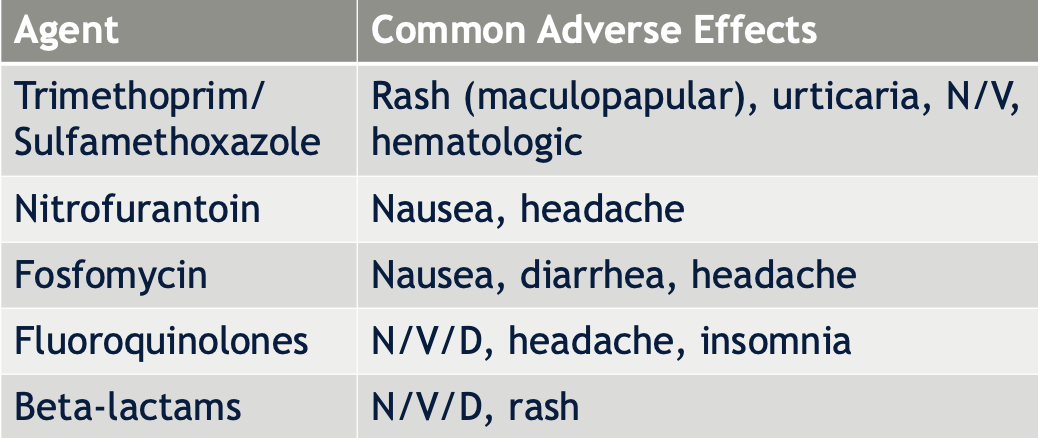
Describe the safety monitoring for
Bactrim
Macrobid
Fosfomycin
Fluoroquinolones
B-lactams
How do we tell the difference between uncomplicated cystitis and pyelonephritis?
Any nausea/vomiting, fever, chills, flank pain, or signs of hydronephrosis on imaging?
No → Cystitis: Treat with empiric antibiotics
Yes → Pyelonephritis: Obtain urine culture, start empiric antibiotics and target based on culture results
Describe the Four-Step Approach to Choosing Empiric Antibiotics for Complicated UTI
Severity of illness (sepsis or no sepsis)
Risk factors for resistance
Patient-specific considerations
The antibiogram (if patient is septic)
Pyelonephritis Treatment Principles
Urine culture and susceptibility testing should be performed
When local resistance patterns are not known, an initial intravenous dose of a long-acting, broad-spectrum parenteral antimicrobial is recommended
Empiric therapy should be de-escalated based on the results of the urine culture
Define sepsis
Life-threatening organ dysfunction (inhospital mortality >10%)
Caused by dysregulated host response to infection
Identified by SOFA score increase of 2 or more points
IV treatment of patients with Pyelonephritis and Sepsis → Preferred choices
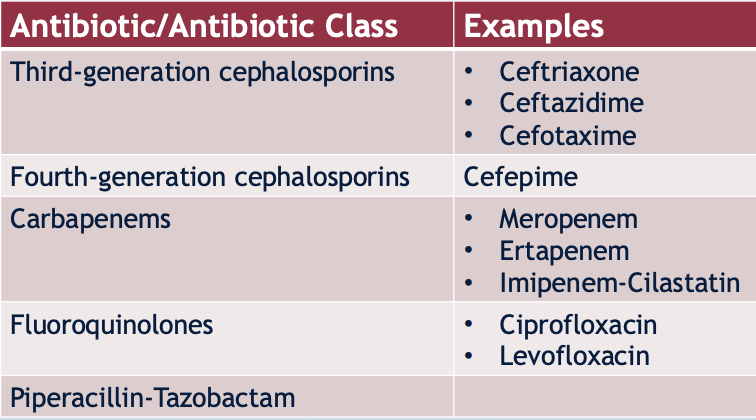
IV treatment of patients with Pyelonephritis and Sepsis → Alternative choices
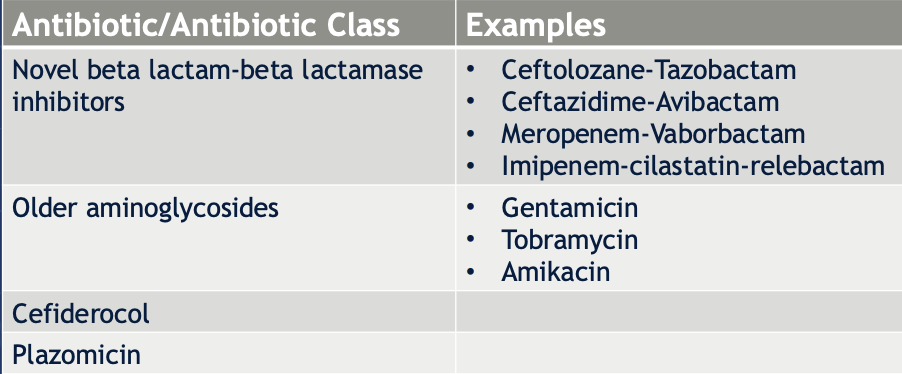
Describe the dosing for:
Cefepime
Ceftriaxone
Meropenem
Piperacillin- tazobactam
Cefepime → 1-2g every 8-12 hours
Ceftriaxone → 1-2g daily
Meropenem → 1g every 8 hours
Piperacillin- tazobactam → 4.5g every 8 hours
Treatment of Patients with Pyelonephritis without Sepsis
If using IV route:
Same as previous tables for sepsis
Except Carbapenems move to “alternative” therapy table
If using oral route
Fluoroquinolones
Trimethoprim-Sulfamethoxazole
Amoxicillin-Clavulanate
Oral cephalosporins
Duration of Treatment for Pyelonephritis
Fluroquinolones: 5 to 7 days
Non-fluoroquinolones: 7 days
Reasons to Switch from IV to PO Antibiotics
Reduce need for IV access (cost + convenience)
Lower risk of complications from IV administration
Decrease volume of fluid and amount of sodium given to patient
What are the next steps if patient is clinically improving?
Assess for oral options
Switch to oral agent
Treat for 7 days total